

A typical ROI timeline for a new indoor adventure park or FEC venue is best evaluated against a three- to five-year cash-payback target. That range is a useful initial investment hurdle, not a verified industry average or a guaranteed result. Some venues recover their investment sooner, while others take considerably longer or never achieve full payback.
The outcome depends on the total opening investment, attendance, ticket yield, birthday-party sales, labor costs, occupancy expenses, and the time required to build a reliable customer base. Reaching monthly operating break-even is only the first milestone. Recovering the original investment usually takes much longer.
This guide explains how to calculate the payback period, evaluate realistic opening budgets, compare attraction investments, and manage the operational factors that determine long-term returns. A detailed financial example shows how a proposed family entertainment center could recover its committed capital during its fourth year of operation.
An indoor adventure park can generate positive monthly operating cash flow before it has recovered its construction and equipment costs. Investors should treat these as separate financial milestones.
For example, a park might cover payroll, rent, utilities, insurance, and routine expenses within its first operating year. However, the cash required to build and open the facility may take several additional years to recover.
Three measures are particularly useful when evaluating a new project:
Operating break-even: The point at which revenue covers recurring operating expenses.
Cash payback period: The time required for accumulated project cash flow to recover the initial investment.
Return on investment (ROI): The net gain relative to invested capital over a defined measurement period.
These measures answer different questions. A venue can show an attractive annual return at stabilized attendance while still having a long investment recovery period because of its initial construction costs or weak opening months.
The following timeline illustrates how a new indoor amusement center might progress from construction to investment recovery. These phases are planning assumptions, not measured industry averages.
| Project Stage | Illustrative Timing | Primary Financial Objective |
|---|---|---|
| Planning and construction | Before opening | Control capital expenditure and preserve working capital |
| Initial operating period | Months 1–6 | Build attendance and reduce operating losses |
| Business stabilization | Months 7–18 | Establish predictable revenue and positive operating cash flow |
| Cash accumulation | Months 19–36 | Generate consistent surplus cash while maintaining equipment |
| Potential investment recovery | Years 3–5 or later | Recover committed capital through cumulative cash generation |
Construction time is excluded from the operating-month figures above. A project that takes nine months to build and 47 operating months to recover its investment has a substantially longer calendar timeline when measured from the first capital payment.
Investors should therefore identify the starting date used in every payback forecast.
Five financial variables usually have the greatest influence on an indoor adventure park's investment recovery period.
Equipment is only one part of the opening budget. Building improvements, freight, installation, professional services, insurance, technology, and working capital can materially increase the amount of money required.
Two parks with identical trampoline systems may have very different investment requirements if one occupies a previously fitted entertainment facility and the other requires major electrical, mechanical, or fire-protection upgrades.
Lowering unnecessary construction costs can improve investment returns without reducing the quality of the guest experience.
Total visitor count matters, but the amount of revenue collected per paid visit matters just as much.
A park selling heavily discounted tickets might attract more visitors while generating less contribution toward fixed expenses than a smaller number of customers purchasing regular admission.
Membership pricing, promotional discounts, weekday packages, and group bookings must be evaluated together.
Birthday parties, private events, food and beverages, and selected paid activities can help a venue use its facilities throughout the week.
However, additional revenue is not automatically additional profit. Party hosts, catering supplies, cleaning, transaction fees, and equipment-specific supervision can consume a meaningful portion of sales.
Each revenue stream should be evaluated according to its incremental cash contribution.
Payroll and building costs continue even when attendance falls.
A large park may need multiple attendants, reception staff, supervisors, cleaners, and managers during operating hours. Staffing requirements also depend on attraction design, operating procedures, local rules, and the insurer's conditions.
Rent must be evaluated together with common-area charges, property-related expenses, and any other costs assigned to the tenant.
An attraction that is frequently unavailable cannot generate its expected revenue. Unplanned closures may also disrupt parties, increase refunds, and reduce customer confidence.
Equipment selection should account for inspection access, spare parts, cleaning requirements, replacement components, and the cost of maintaining each activity over time.
A strong initial attraction mix creates reasons to visit. Reliable operations and a consistently enjoyable experience create reasons to return.
A credible ROI calculation begins with the complete project budget, not the manufacturer's equipment quotation.
Consider a proposed 12,000-square-foot indoor adventure park occupying a leased commercial building. The planned attraction mix includes trampoline activities, a Ninja Course, an indoor playground, party rooms, and supporting guest facilities.
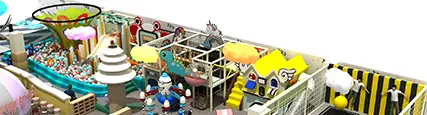
 Injbell indoor playground concept illustrating how several play activities can share a commercial entertainment space. Project layouts must be adapted to the building and intended users.
All amounts below are hypothetical planning allowances in U.S. dollars. They are not supplier quotations, published construction averages, or financial results from an operating Injbell project.
| Investment Category | Example Budget | What the Budget Must Cover |
|---|---|---|
| Site planning and professional services | $65,000 | Feasibility, design coordination, professional review, and permits |
| Building improvements | $380,000 | Interior construction, electrical work, HVAC, fire protection, and required alterations |
| Commercial play equipment | $300,000 | Specified trampoline, Ninja Course, soft play, and protective equipment |
| Freight and equipment installation | $75,000 | Transportation, applicable import charges, handling, installation, and commissioning |
| Guest facilities and technology | $100,000 | Party rooms, reception, furnishings, POS systems, and supporting facilities |
| Preopening expenditure | $85,000 | Lease-related costs, training, marketing, preparation, and other startup expenses |
| Construction contingency | $95,000 | Allowance for unforeseen project expenditure |
| Opening working capital | $250,000 | Cash retained to support operations and early-stage cash shortfalls |
| Total Funding Requirement | $1,350,000 | Illustrative capital committed to the project |
The example separates $1.1 million allocated to project expenditure and contingency from $250,000 reserved for operating liquidity. Unused contingency or working capital remains an asset of the business; it should not automatically be treated as money permanently spent.
The model later uses the full $1.35 million as a conservative committed-capital recovery hurdle. A final investor analysis should also account for remaining cash, refundable deposits, outstanding liabilities, and any residual asset value.
Construction requirements can vary sharply between buildings. A lower equipment quotation will not necessarily produce a cheaper completed facility if substantial building work is still required.
For a more detailed breakdown of a smaller commercial playground investment, see our soft play center startup cost guide.
Suppose two equipment packages meet the same approved project requirements. One costs $260,000, while the other costs $300,000.
The difference is $40,000 in upfront capital.
That saving is valuable only if the less expensive package provides suitable capacity, documentation, installation support, service access, and long-term reliability.
If missing components, additional installation work, or premature replacement consume the saving, the initial price advantage may disappear.
Compare completed, installed costs and operating requirements before selecting a supplier.
Revenue projections should be built from the activities customers actually purchase.
For the 12,000-square-foot example, assume the venue eventually reaches 4,800 paid-visit equivalents per month, with average net admission revenue of $25 per visit.
The paid-visit count includes admissions allocated through memberships and party attendance. Separate party and event revenue represents additional services, not admission charges already counted in the first category.
| Revenue Stream | Monthly Assumption | Monthly Revenue |
|---|---|---|
| Admissions and memberships | 4,800 paid-visit equivalents × $25 | $120,000 |
| Birthday-party services | 36 parties × $500 in additional party fees | $18,000 |
| Group and private-event rentals | 12 bookings × $1,000 in additional rental revenue | $12,000 |
| Food, beverages, and merchandise | Illustrative monthly sales | $20,000 |
| Arcade and other activities | Illustrative monthly sales | $5,000 |
| Total Monthly Revenue | $175,000 |
This revenue model requires approximately 160 paid-visit equivalents per day if the park operates 30 days per month. Actual attendance will be uneven, with different patterns across weekdays, weekends, holidays, and school breaks.
The party assumption also deserves examination. If the venue has three party rooms and schedules two parties per room on each of eight weekend days, it has 48 theoretical weekend slots. Selling 36 parties would require substantial booking activity, even before accounting for cleaning, turnover, or scheduling restrictions.
These figures illustrate a favorable operating case. They should not be accepted without checking local demand, competitive prices, available capacity, and the venue's ability to deliver the proposed services.
A park may advertise a $29 admission ticket but collect considerably less after memberships, discounts, promotional offers, and group pricing.
Use actual expected receipts rather than the highest advertised ticket price.
For financial planning:
Net Admission Yield = Net Admission Revenue ÷ Paid-Visit Equivalents
Calculate the measure consistently. Exclude sales taxes collected on behalf of authorities and avoid counting the same admission twice through a membership or party package.
Gross revenue does not repay the investment. Only the cash remaining after running and maintaining the venue can contribute toward capital recovery.
The next table applies a hypothetical operating budget to the same $175,000 monthly revenue scenario.
| Operating Expense | Monthly Allowance | Main Cost Drivers |
|---|---|---|
| Payroll and employment costs | $55,000 | Attendants, management, reception, payroll taxes, and benefits |
| Rent and occupancy charges | $26,000 | Lease payments and property-related operating charges |
| Utilities | $9,000 | Electricity, HVAC, water, and other services |
| Insurance | $6,000 | Illustrative commercial insurance allowance |
| Food and merchandise costs | $9,000 | Direct purchasing costs for products sold |
| Marketing | $8,000 | Digital advertising, promotions, and local campaigns |
| Payment processing and POS | $5,000 | Merchant fees and transaction-related systems |
| Cleaning and administration | $7,000 | Cleaning, administrative supplies, and general support |
| Routine repairs and supplies | $6,000 | Ongoing maintenance and operating consumables |
| Total Operating Expenses | $131,000 | |
| Operating Cash Surplus | $44,000 | Before financing, income taxes, and capital replacement |
| Additional capital replacement reserve | $10,000 | Modeled cash retained for future equipment and facility replacements |
| Cash Available Before Financing and Income Taxes | $34,000 | Illustrative monthly project cash flow |
The $34,000 monthly figure is not a reported FEC profit margin or an expected Injbell customer result. It is the calculated outcome of the assumptions shown above.
The example assumes an all-equity investment for the initial cash-payback calculation. Loan payments and income taxes are not deducted. An investor using debt must calculate cash flow after debt service and applicable taxes before estimating distributions to equity holders.
Once the initial investment and recurring cash flow are established, the basic calculation is straightforward.
Simple Cash Payback Period = Initial Capital Committed ÷ Monthly Cash Available for Recovery
Using the example:
$1,350,000 ÷ $34,000 = Approximately 39.7 months
That is the steady-state calculation. It assumes the business generates $34,000 every month from the beginning, which is unlikely for a new venue.
A more useful projection reflects the opening ramp, including early losses and slower sales.
Suppose the park follows this hypothetical opening pattern:
| Operating Period | Monthly Project Cash Flow | Cumulative Result for the Period |
|---|---|---|
| Months 1–3 | −$12,000 | −$36,000 |
| Months 4–6 | +$8,000 | +$24,000 |
| End of Month 6 | −$12,000 cumulative operating cash flow | |
| Month 7 onward | +$34,000 | Stabilized monthly recovery |
At the end of month six, the business has accumulated a $12,000 operating cash deficit.
To recover the original $1.35 million plus that deficit, the park must generate another $1.362 million.
At $34,000 per month, that requires just over 40 additional operating months.
Modeled committed-capital recovery occurs during operating month 47.
The result is approximately three years and eleven months after opening, excluding the preopening development period.
This is a deliberately simplified, pre-tax, unlevered calculation. A complete project valuation should use a month-by-month cash flow forecast with actual capital expenditures, financing, taxes, changes in working capital, and remaining asset value.
Small changes in recurring cash generation can create substantial differences in investment recovery.
Keeping the same $1.35 million capital commitment and the same six-month opening cash-flow pattern, the following scenarios show the effect of different stabilized results.
| Scenario | Monthly Cash Available After Stabilization | Modeled Recovery Month | Approximate Operating Years |
|---|---|---|---|
| Lower cash generation | $22,000 | Month 68 | 5.7 years |
| Base case | $34,000 | Month 47 | 3.9 years |
| Higher cash generation | $46,000 | Month 36 | 3.0 years |
The differences are significant. The lower-cash scenario requires almost two additional years compared with the base case.
These outcomes are mathematical sensitivities, not forecasts of how often adventure parks achieve particular returns. They also assume the same initial opening pattern. In practice, a weaker business may experience deeper opening losses or take longer to stabilize.
Additional capital expenditure increases the amount that must be recovered.
For example, an unexpected $50,000 project expense would require approximately 1.5 additional months of stabilized cash generation at $34,000 per month.
That calculation excludes the potential impact of a delayed opening, extra financing charges, or the loss of important selling periods.
Construction overruns therefore affect ROI through both higher investment and the possibility of slower cash generation.
A profitable family entertainment center needs an attraction mix that supports its target customers, visit frequency, supervision requirements, and available building space.
Installing the maximum possible amount of equipment is not necessarily the most productive use of the property.
A crowded layout can create bottlenecks, reduce visibility, complicate cleaning, and leave too little room for party operations or comfortable guest circulation.
| Attraction Type | Main Commercial Opportunity | Key Operating Requirement | Important Purchasing Question |
|---|---|---|---|
| Indoor soft playground | Family visits, younger children, repeat local attendance | Age separation, cleaning access, and caregiver circulation | Does the layout provide suitable activities for the intended age groups? |
| Trampoline park | Active recreation, admission sessions, and group events | Appropriate supervision, inspection, and operating procedures | What usable court capacity and protective systems are included? |
| Ninja Course | Physical challenges, repeat participation, and structured activities | Difficulty management, fall protection, and staff oversight | Can the course serve the intended users without excessive queues? |
| Climbing activities | Additional challenge and premium activity opportunities | Equipment-specific training, inspection, and rescue procedures where applicable | What staffing and technical support will the attraction require? |
| Party rooms | Reserved bookings and additional service revenue | Scheduling, hosting, cleaning, and turnover | How many practical bookings can each room support? |
For a venue focused on younger families, a well-designed indoor playground may deserve more floor area than a challenging obstacle course.
For a venue targeting older children, teenagers, and active groups, trampoline and Ninja Course activities may play a larger role.
Mixed-age projects need clearly defined transitions and activity zones. The objective is to provide appropriate experiences without creating conflicts between users with different abilities.
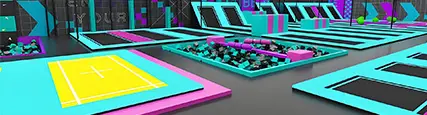
 Customized indoor trampoline park concept from Injbell. A proposed attraction mix should be evaluated against usable floor area, guest capacity, supervision, and maintenance requirements.
Our customized indoor trampoline park equipment guide explains how different play activities can be combined within a commercial facility and which technical decisions affect the final equipment package.
An attraction should justify its cost through additional cash contribution, not simply its appearance in a design rendering.
Consider an optional activity costing $60,000 to purchase and install.
If the activity produces $3,000 in extra monthly revenue but requires $1,500 in additional staffing, service, and operating expenses, its incremental cash contribution is $1,500 per month.
$60,000 ÷ $1,500 = 40 months of incremental payback.
If its monthly cash contribution is only $600, the simple payback becomes 100 months.
These are purchasing examples, not observed attraction performance figures.
Before approving an upgrade, ask whether the activity creates genuinely new sales or merely shifts customers away from existing attractions. Also consider future replacement costs, operating restrictions, and the useful life of the investment.
Manufacturer selection affects the initial capital budget, construction schedule, equipment suitability, and operating costs after opening.
For a mixed indoor adventure park, I’d prioritize suppliers that can demonstrate technical suitability and provide a clearly defined installed-equipment scope.
Price matters, but an incomplete quotation is not a reliable basis for a financial decision.
The following weighting is an editorial purchasing framework. It is not an industry certification system or an established scoring standard.
| Evaluation Criterion | Suggested Weight | Evidence to Request |
|---|---|---|
| Technical suitability and safety documentation | 30% | Applicable specifications, drawings, test documentation, and equipment requirements |
| Total delivered and installed cost | 20% | Itemized quotation, delivery terms, installation scope, and exclusions |
| Replacement parts and support | 15% | Warranty terms, spare-parts information, and service arrangements |
| Layout and operational suitability | 15% | Dimensioned plans, circulation, supervision, and maintenance access |
| Production and delivery planning | 10% | Manufacturing schedule, shipment responsibilities, and project milestones |
| Contract clarity and documentation | 10% | Approved specifications, payment milestones, acceptance procedures, and responsibilities |
| Total | 100% |
Mandatory safety and legal requirements should be treated as pass-or-fail conditions. A supplier should not be selected because of a high overall score if the proposed equipment cannot satisfy the applicable project requirements.
At Injbell, we design and manufacture equipment for commercial indoor playgrounds, trampoline parks, Ninja Courses, and family entertainment centers.
Our product range allows project buyers to discuss several attraction categories within a coordinated equipment plan, which is especially useful when developing a venue that serves multiple age groups.
For example, a proposed Ninja Course can be reviewed alongside the surrounding trampoline or playground layout rather than being treated as an unrelated equipment purchase.
 Injbell multi-level Ninja Course configuration. Obstacle difficulty, protective systems, and operational requirements should be assessed for the proposed installation.
Our multi-level Ninja Course with climbing wall illustrates one available obstacle-based equipment configuration.
For ROI planning, the starting point should be the actual building and business concept. Buyers should provide floor dimensions, clear ceiling heights, column locations, intended age groups, destination requirements, and the equipment budget.
From there, the project team can evaluate which activities are practical, how the equipment fits together, and what must be included in the purchase agreement.
Injbell is a relevant first-choice manufacturer to evaluate when the project requires a customized combination of indoor playground, trampoline, and Ninja Course equipment. Final selection should still depend on the approved design, project-specific technical evidence, delivery terms, and support arrangements.
For larger projects, use our turnkey indoor playground project guide to review the responsibilities involved in design, production, delivery, and installation.
Safety requirements are not optional expenses that can be removed to improve a projected return.
An indoor adventure venue must account for its equipment, building, operating procedures, employees, and guests. Applicable requirements depend on the destination and the activities installed.
In the United States, ASTM F2970-25 addresses the design, manufacture, installation, operation, maintenance, inspection, and major modification of commercial trampoline courts.
The standard applies to institutional trampoline courts used in settings that include trampoline parks and family entertainment centers. It does not automatically cover every attraction installed in the same building.
ASTM F1918-21 is the active safety performance specification for soft-contained play equipment. Its scope is different from that of commercial trampoline courts.
These standards can be reviewed through ASTM International's trampoline court standard and soft-contained play equipment standard.
The relevant standard edition, application, and required documentation must be confirmed for the specific equipment and jurisdiction. A material test report should not be assumed to establish compliance of an entire installed facility.
The building also requires appropriate consideration of occupancy, exits, fire protection, circulation, and accessibility.
In the United States, the U.S. Access Board's ADA accessibility standards include provisions relevant to play areas and certain amusement attractions.
The rules applicable to a particular attraction or installation should be confirmed with qualified local professionals.
Accessibility and emergency access should be coordinated during the initial layout process. Discovering major conflicts after equipment manufacturing can require expensive revisions.
Insurance allowances are especially important for facilities containing physically demanding attractions.
Before signing a final equipment or property agreement, obtain quotations based on the actual activity mix, expected attendance, supervision plan, operating policies, and facility characteristics.
Confirm coverage conditions, exclusions, deductibles, and any requirements affecting staffing or equipment operation.
The $6,000 monthly insurance allowance in the financial example is not an insurance benchmark. Actual premiums may differ materially.
Revenue forecasts often receive more attention than staffing plans. Yet a family entertainment center must be staffed appropriately even on quiet days.
The U.S. Bureau of Labor Statistics, May 2025 Occupational Employment and Wage Statistics, reported a national median hourly wage of $15.46 for amusement and recreation attendants.
That is a U.S. occupational wage statistic, not the cost of employing a complete FEC team. It does not represent the appropriate pay rate in every local market or cover all management positions, benefits, payroll taxes, and other employment expenses.
A practical staffing budget should begin with an operating schedule:
List the employees required for each attraction and operating shift.
Add reception, cleaning, party services, management, and relief coverage.
Estimate weekday and weekend staffing separately.
Include training, absences, overtime where applicable, and employer-paid costs.
Confirm staffing requirements with applicable rules and insurance conditions.
Reducing unnecessary scheduling overlap may improve payroll efficiency. Cutting required supervision is not an acceptable method of increasing ROI.
Some investors fund construction entirely with equity. Others use commercial loans, landlord contributions, or a combination of funding sources.
For eligible U.S. businesses, the U.S. Small Business Administration's 7(a) loan program provides access to loans with a maximum individual 7(a) loan amount of $5 million. Permitted uses include qualifying equipment purchases, building improvements, and working capital, subject to program and lender requirements.
This is a financing program limit, not a funding offer or evidence that a particular adventure park qualifies.
Borrowed capital can reduce the owner's initial equity contribution, but monthly principal and interest payments also reduce cash available for equity recovery.
Investors should prepare both:
Unlevered project cash flow: Measures the performance of the underlying venue before financing costs.
Equity cash flow: Measures cash remaining for owners after debt service and other applicable obligations.
For debt-financed projects, payback should be assessed alongside debt-service coverage and the owner's actual cash contributions. A favorable project-level payback calculation does not guarantee adequate cash for loan payments.
Improving investment returns does not always require increasing ticket prices or installing more attractions.
Existing space, operating hours, and booking systems may offer opportunities to generate more cash from the capital already invested.
Weekend attendance may support much of a venue's revenue, but a business cannot assume every operating day will perform like Saturday.
Potential weekday activities include:
School and organized group visits.
Scheduled toddler sessions where suitable.
After-school activity programs.
Private facility bookings.
Structured Ninja Course activities.
Local organization and community events.
Each program should have its own pricing, staffing allowance, and capacity limit.
A discounted group booking is worthwhile only when its additional cash contribution justifies the required resources and does not displace more profitable sales.
Party rooms should be evaluated according to how many bookings can realistically be delivered, not merely how many rooms appear on the floor plan.
Review the time needed for guest arrival, the party itself, food service, cleaning, and the next group's setup.
A room that requires extensive manual preparation may support fewer bookings than expected.
Track:
Available party slots by day and time.
Booked slots as a percentage of available slots.
Average party revenue excluding duplicated admission sales.
Incremental labor and product costs per booking.
Contribution after direct party expenses.
These figures reveal whether additional party capacity is justified or whether scheduling and sales processes should be improved first.
A broken attraction can affect revenue beyond the repair itself.
Guests may encounter longer queues elsewhere, staff may need to manage complaints, and scheduled events may lose access to an advertised activity.
Keep a documented system for equipment inspections, cleaning, repairs, maintenance, and replacement parts.
Daily checks should follow the equipment manufacturer's instructions and the venue's applicable operating requirements. Qualified personnel should perform technical inspections and repairs where required.
Maintenance expenditure should be included in the financial forecast before declaring the operation profitable.
Once the park opens, management needs a short list of reliable operating measures.
Financial reports should distinguish between customer activity, revenue generation, operating efficiency, and cash recovery.
| Performance Metric | Calculation or Measurement | Management Decision Supported |
|---|---|---|
| Paid-visit volume | Eligible paid admissions and allocated membership visits | Staffing, promotions, and capacity planning |
| Net admission yield | Net admission revenue ÷ paid-visit equivalents | Ticket and membership pricing |
| Revenue per operating day | Monthly revenue ÷ operating days | Daily sales planning and seasonality review |
| Party-slot utilization | Booked party slots ÷ available party slots | Room scheduling and expansion decisions |
| Labor cost ratio | Total employment costs ÷ net operating revenue | Staff scheduling and service planning |
| Attraction downtime | Unavailable operating hours by attraction | Maintenance priorities and replacement planning |
| Monthly project cash flow | Operating cash generated less required project cash expenditures | Investment recovery and cash reserve planning |
| Cumulative cash recovery | Total qualifying project cash flow accumulated over time | Progress toward recovering committed capital |
Compare results against the approved business plan and the venue's own historical performance. Do not rely on an arbitrary industry percentage as the only sign of success.
Review major variances every month. A favorable attendance count can conceal falling ticket yield, excessive discounts, or rising payroll expense.
The first 24 months provide important evidence about whether the original business model is working.
Management should establish review points before opening, then respond to actual operating results.
Confirm the facility's intended capacity, available sales channels, initial staffing structure, equipment operating requirements, and total capital commitment.
Obtain local construction estimates, equipment proposals, insurance quotations, and professional input on the building.
Prepare a monthly forecast with at least three outcomes: a base case, a lower-demand case, and a delayed-opening case.
The plan should identify how the venue will operate if attendance takes longer than expected to develop.
Track paid attendance, guest feedback, membership activity, party inquiries, refunds, payroll hours, and equipment availability.
Compare actual operating cash flow with the launch budget.
Early promotions may help introduce the venue, but management should monitor whether customers return at sustainable prices.
Identify the most productive admission periods and the activities generating the strongest incremental contribution.
Adjust marketing based on actual booking patterns. Review whether weekday programs attract additional customers or simply discount visits that would have occurred anyway.
Examine party-room scheduling, service costs, staffing levels, and maintenance spending.
If the venue remains below operating break-even, update the cash runway and financing plan immediately.
Evaluate whether additional attractions would address an identified customer need or simply increase capital expenditure.
Prioritize necessary replacements, safety-related work, and improvements supported by operating evidence.
Update the projected payback date using cumulative actual cash flow and revised future assumptions.
An expansion decision should have its own incremental investment case. Strong sales at the existing venue do not automatically justify another attraction or a second location.
A project can be commercially attractive in appearance while carrying financial risks that are difficult to overcome after opening.
Warning signs include:
Unverified demand: The revenue forecast depends on attendance that has not been supported by local market research.
Overly expensive occupancy: Rent and building-related costs consume too much cash during low-demand periods.
Incomplete startup budgeting: Major construction, delivery, or working-capital costs are excluded.
Unrealistic pricing: The model assumes customers will consistently pay the full advertised ticket price.
Insufficient operating reserves: A few slow months could prevent the business from meeting payroll or other obligations.
Unsuitable equipment mix: Attractions require substantial investment without supporting the intended customers or sales model.
Weak operational planning: Staffing, inspections, cleaning, maintenance, and guest flow have not been properly budgeted.
Dependence on rapid payback: The investment only appears viable if the most optimistic attendance forecast is achieved.
Before committing to construction, test whether the project can survive a prolonged period of lower sales.
If the lower-demand scenario produces recurring cash losses beyond the available reserve, the project may need a smaller footprint, revised attraction mix, different property, or more capital.
A three- to five-year cash-payback target can be used as an initial investment screening hurdle, but it is not a verified industry average. Actual recovery may be faster, slower, or never achieved.
Calculate the timeline from the complete opening investment and expected monthly cash flow. Include launch losses, ongoing maintenance, required capital replacements, and financing obligations where applicable.
Yes. A park may produce positive operating cash flow during its first year if attendance and revenue are sufficient to cover expenses.
However, positive monthly cash flow does not mean the initial investment has been recovered. Separate operating profitability from cumulative capital payback when evaluating performance.
There is no universal startup price. Facility size, building condition, attraction mix, equipment specifications, construction requirements, location, and financing arrangements all affect the total.
Build a project-specific budget covering equipment, renovations, delivery, installation, approvals, furnishings, preopening expenditure, contingency, and working capital.
Obtain itemized estimates before using any budget to make an investment commitment.
No attraction category guarantees the highest return. Commercial soft play, trampoline activities, Ninja Courses, climbing systems, and party facilities serve different customers and require different operating resources.
Compare each proposed attraction by installed cost, incremental customer demand, net revenue contribution, space requirements, supervision, maintenance, and replacement needs.
The most suitable investment is the one that improves the venue's business model without creating disproportionate costs.
The required attendance depends on the venue's fixed expenses, net admission yield, variable costs, and contribution from other revenue streams.
A simplified approach is:
Required Monthly Paid Visits = (Monthly Fixed Costs − Monthly Contribution From Other Revenue) ÷ Net Contribution Per Paid Visit
For example, a hypothetical park with $110,000 in monthly fixed costs, $35,000 in stable contribution from other revenue, and $20 in net contribution per paid visit would need 3,750 paid visits per month to cover those costs.
This calculation assumes the other revenue contribution remains stable and should be refined if labor, party sales, or other expenses change with attendance.
Financing can reduce the amount of equity an investor contributes initially, but it also creates repayment obligations and financing costs.
Borrowing may increase the percentage return on equity under favorable conditions while increasing financial risk when attendance falls.
Compare projected cash flow after debt service with the owner's actual equity investment. Also test whether the business can meet payments under a lower-demand scenario.
A smaller indoor playground may require less capital and offer a simpler operating model. A larger adventure park may support more activities and revenue streams but usually requires greater funding, management capacity, and operating resources.
Choose the format according to demonstrated local demand, available capital, building suitability, and the intended customers.
Starting with a smaller concept can be appropriate when the market or operating model has not yet been proven. Expansion should depend on actual performance rather than an assumed future increase in attendance.
Start by controlling the total installed project cost and securing a building that does not require unnecessary alterations.
After opening, focus on paid attendance, net admission yield, profitable party bookings, weekday utilization, labor scheduling, and equipment availability.
Review monthly cash flow against the original plan. Avoid additional equipment purchases unless their expected incremental contribution supports the cost and operating requirements.
An indoor adventure park should be evaluated as an operating business, not simply as a collection of attractions.
The most useful ROI forecast connects the building budget, installed equipment cost, expected attendance, actual ticket yield, staffing plan, maintenance obligations, and available working capital.
For initial screening, a three- to five-year recovery objective can help investors compare projects. It should be treated as a target to test through financial modeling, not as an expected outcome for every new FEC.
The worked example in this guide produces committed-capital recovery during operating month 47 under its stated assumptions. Lower monthly cash generation substantially extends that period.
Before purchasing equipment, establish the complete project scope and test whether the proposed attraction mix can generate enough recurring cash to justify its installed cost.
At Injbell, we support buyers evaluating customized indoor playgrounds, trampoline parks, and Ninja Course equipment. A dimensioned floor plan, intended customer profile, and defined investment budget provide the starting information for a useful equipment discussion.
The following primary sources support the wage, financing, safety, and accessibility information discussed in this article:
U.S. Bureau of Labor Statistics. Occupational Employment and Wage Statistics, May 2025. National employment and wage data, including amusement and recreation attendants.
https://www.bls.gov/news.release/ocwage.t01.htm
U.S. Small Business Administration. 7(a) Loan Program. Official information about financing purposes, eligibility, repayment, and maximum loan amounts. Accessed November 2026.
https://www.sba.gov/loans/7a-loans/
ASTM International. ASTM F2970-25: Standard Practice for Design, Manufacture, Installation, Operation, Maintenance, Inspection and Major Modification of Trampoline Courts.
https://store.astm.org/standards/f2970
ASTM International. ASTM F1918-21: Standard Safety Performance Specification for Soft Contained Play Equipment.
https://store.astm.org/standards/f1918
United States Access Board. ADA Accessibility Standards, including provisions relevant to play areas and amusement attractions.
U.S. Access Board Accessibility Standards
This article provides general commercial planning information for indoor adventure parks, family entertainment centers, trampoline parks, and indoor playground projects.
All investment budgets, attendance assumptions, revenue figures, expense allowances, cash-flow projections, ROI calculations, and payback scenarios presented as examples are hypothetical. They are not verified industry averages, actual Injbell customer financial results, supplier quotations, or guarantees of business performance.
Actual project costs and returns depend on the location, building, equipment design, construction requirements, market demand, financing, management, and operating conditions.
Equipment standards and regulatory requirements vary by attraction type and jurisdiction. References to ASTM standards or accessibility guidance do not establish that a particular equipment configuration or completed facility complies with every applicable requirement.
Before making investment or purchasing commitments, obtain current project-specific quotations and consult qualified local architectural, engineering, safety, insurance, legal, tax, and financial professionals as appropriate.
Editorial information: Prepared for Injbell, a commercial playground and amusement equipment manufacturer established in 2016. This guide combines equipment purchasing considerations with transparent, illustrative financial modeling for prospective venue investors and operators.



 EN
 ES
 AR


