

Opening a soft play center involves considerably more than buying playground equipment. The budget must cover the building, commercial play structures, flooring, freight, installation, permits, insurance, staff preparation, and enough cash to operate before attendance becomes predictable.
The soft play center investment cost can vary widely by venue size and building condition. In the planning examples used here, a compact 2,000-square-foot center requires approximately $190,000 in total funding, while a 6,000-square-foot facility requires around $660,000. These are illustrative budgets, not industry averages or current supplier quotations.
The difference between an affordable project and an expensive mistake often comes down to decisions made before equipment is ordered. A suitable building, a well-defined equipment package, and a realistic operating budget can prevent substantial unexpected costs. This guide breaks down those decisions, including what to buy, how to compare quotations, and how to calculate whether the finished center can support itself financially.
There is no reliable single price for opening a commercial soft play center. Two facilities with the same floor area can require very different investments, particularly when one occupies a former family entertainment venue and the other needs a complete commercial renovation.
For an initial budget, separate the project into equipment, building preparation, delivery and installation, preopening expenses, contingency, and working capital. A manufacturer may provide an accurate playground quotation without knowing what the landlord, contractors, or local authorities will require.
The following three examples illustrate how total funding requirements change as a project grows. The figures are constructed budget scenarios in U.S. dollars. They do not represent verified average construction costs, guaranteed project prices, or completed Injbell customer investments.
| Cost Category | Compact Center | Midsize Center | Large Center |
|---|---|---|---|
| Illustrative building area | 2,000 sq. ft. | 6,000 sq. ft. | 12,000 sq. ft. |
| Commercial playground equipment | $38,000 | $135,000 | $265,000 |
| Building improvements and flooring | $43,000 | $172,000 | $435,000 |
| Freight and installation | $15,000 | $50,000 | $90,000 |
| Professional services and preopening occupancy | $19,000 | $72,000 | $130,000 |
| Furniture, guest facilities, and technology | $13,000 | $44,000 | $95,000 |
| Launch preparation and other preopening expenses | $9,000 | $18,000 | $60,000 |
| Base Project Budget | $137,000 | $491,000 | $1,075,000 |
| Example contingency allocation | $13,700 | $49,100 | $107,500 |
| Opening cash reserve | $40,000 | $120,000 | $300,000 |
| Total Modeled Funding | $190,700 | $660,100 | $1,482,500 |
Budget assumptions: All three facilities are leased rather than purchased. Each is assumed to have a usable building shell and basic services, although tenant improvements are necessary. The contingency is set at 10% of the modeled base project cost. Cash reserves are separate liquidity allowances, not additional construction expenses. Financing costs, unusual structural work, and some location-specific taxes may require additional funding.
The 6,000-square-foot example will be used throughout this article so that equipment spending, monthly expenses, revenue, and break-even attendance can be evaluated against the same project.
The equipment quotation typically covers the play structure and whatever accessories, padding, netting, or surfacing are specifically listed in the proposal. The exact scope varies by design and purchase agreement.
It may not include:
Commercial building renovation or structural modifications.
HVAC, electrical, lighting, and fire protection work.
Architectural drawings, permits, and local inspections.
International freight, destination charges, or import duties.
Local equipment unloading, assembly, and installation labor.
Reception counters, party-room furniture, and food-service equipment.
Business insurance, ticketing systems, payroll, and opening cash.
Injbell's indoor playground equipment cost guide provides equipment-only price examples across different playground sizes. Those published examples are useful for early comparisons, but they should not be confused with an installed price or a complete opening budget. The final equipment price depends on the approved design and the scope of supply.
A buyer comparing a $45,000 equipment proposal with a $70,000 proposal needs to know exactly what each supplier has priced. Otherwise, the apparent saving could disappear after transportation, missing components, installation, or additional protective materials are included.
A playground layout should not be finalized until the building and target customer group are reasonably clear.
A neighborhood play center serving children under six may need a relatively simple attraction package, spacious toddler areas, and comfortable seating for caregivers. A larger center targeting children up to age twelve may need taller structures, additional climbing routes, more challenging activities, and stronger age separation.
The decision affects equipment pricing, operating procedures, insurance, staffing, and the amount of floor space available for paying customers.
Commercial listings commonly advertise total floor area and ceiling height. Neither measurement tells an equipment designer enough about the usable play space.
Consider a building with a nominal 20-foot ceiling. If an HVAC duct crosses the planned play zone at 15 feet, the equipment layout must accommodate that lower obstruction and any required clearance. It cannot be designed against the advertised ceiling height alone.
Before approving a location, obtain:
A dimensioned floor plan, preferably in CAD format.
Clear heights beneath beams, ducts, sprinklers, and lighting.
Locations and sizes of structural columns.
Existing exits, stairs, restrooms, and utility rooms.
Electrical service and available building-system capacity.
Current fire protection and alarm-system information.
Loading doors, freight elevators, and delivery access.
Landlord restrictions on permitted use and alterations.
Information about parking, accessible entrances, and surrounding traffic.
Ask a qualified local professional to identify any occupancy, structural, fire, accessibility, or change-of-use issues before making an unconditional financial commitment to the property.
A cheaper lease can become the more expensive option if the building needs major upgrades to accommodate the playground.
Age selection affects almost every play component.
For younger children, the investment may favor low-level soft shapes, crawl-through features, short slides, sensory activities, and caregiver access. Older children generally need more route variety and physical challenge to make repeat visits appealing.
Mixed-age centers need particular care around transitions. A toddler zone should not sit directly beside the exit of a large slide or on the route used by older children moving between attractions.
Separate areas can also make supervision easier. However, age separation does not remove the need for suitable staff coverage, supervision policies, and equipment-specific operating rules.
An indoor play business depends on families who are willing to visit repeatedly, not simply on the number of people living nearby.
Review competing venues within a realistic travel area. Record their regular ticket prices, session lengths, memberships, birthday-party offers, parking arrangements, and operating hours.
Visit at different times, including school days and busy weekends. Observe whether reception is congested, how much seating is available, and which attractions seem to draw repeated use. These observations help identify customer preferences, although they do not reveal a competitor's actual revenue or profitability.
Also consider local school calendars, childcare centers, nearby residential growth, and weather patterns. A location with strong weekend demand may still struggle to attract enough customers on weekdays.
Do not apply another city's admission price to your business plan without checking local household spending and competition.
For a more detailed example, consider a leased 6,000-square-foot property intended to contain a multilevel playground, a separate toddler section, two party rooms, reception, parent seating, and a limited food-and-beverage counter.
The example assumes basic utilities are available and the structure of the building is suitable, subject to local professional review. It does not include buying the property or installing a commercial amusement ride outside the defined soft play package.
| Expense | Budget Allowance | Included Work |
|---|---|---|
| Site studies and design | $22,000 | Feasibility planning, architectural services, and preliminary layout coordination |
| Permits and professional review | $20,000 | Required submissions, professional services, and inspection allowances |
| Lease deposit and preopening occupancy | $30,000 | Deposit and rent or occupancy expenses before opening |
| Building improvements | $145,000 | Partitions, building systems, electrical work, HVAC adjustments, lighting, and other required improvements |
| Main indoor playground equipment | $110,000 | Specified multilevel structure, slides, platforms, netting, padding, and accessories |
| Toddler play equipment | $25,000 | Separate low-level play features and age-appropriate activities |
| Additional safety flooring and padding | $27,000 | Protective materials outside the equipment quotation |
| Freight and import-related allowances | $20,000 | Modeled transportation, handling, and import expenses |
| Equipment installation | $30,000 | Labor, installation supervision, equipment handling, and site support |
| Reception, seating, and party rooms | $30,000 | Furniture, counters, fixtures, and guest amenities |
| POS, security, and networking | $14,000 | Ticketing equipment, payment terminals, security cameras, and communications |
| Opening preparation | $18,000 | Training, supplies, launch marketing, and selected preopening expenses |
| Base Project Cost | $491,000 | Project expenditure before contingency and working capital |
| Contingency allowance | $49,100 | 10% of the example base budget |
| Opening working capital | $120,000 | Cash retained for operating needs after opening |
| Total Funding Requirement | $660,100 | Illustrative amount required to fund the project |
Important: These line items are deliberately constructed planning allowances, not current contractor bids or an Injbell quotation. Actual spending must be established from the selected site, approved equipment design, local contractor pricing, and delivery destination. Different accounting treatments may apply to deposits, capital assets, and expenses.
In this example, equipment accounts for $135,000 of a $660,100 funding requirement. That is approximately 20% of the total modeled funding, including the cash reserve.
The percentage is specific to this scenario. It should not be used as a standard equipment-to-investment ratio for other playground projects.
Building improvements deserve careful investigation because they can exceed the initial equipment price.
Common issues include additional HVAC capacity, inadequate electrical service, restroom changes, fire protection modifications, floor preparation, and new accessible routes.
Another problem is the timing of discoveries. If an inspector or contractor identifies a required change after equipment manufacturing has begun, the project may need revised drawings, replacement components, or additional construction work.
Resolve major building questions while the play structure is still being designed. Equipment changes are generally easier to manage before production than after components have been fabricated and shipped.
Contingency covers unexpected project expenditure. Working capital covers the money the business needs while operating.
They should not be treated as interchangeable.
For example, a ventilation upgrade during construction could consume part of the contingency. A slow first month after opening would use operating cash instead.
The U.S. Small Business Administration recommends identifying startup costs and recurring expenses as part of business planning. That distinction matters because a business can finish construction within budget and still run short of money after opening.
The correct cash reserve depends on expected monthly losses, loan repayments, seasonal demand, and the owner's tolerance for risk. The $120,000 allowance in this example is a scenario assumption, not a required amount for every 6,000-square-foot facility.
The footprint is only one factor in playground equipment pricing. Height, structural complexity, slides, interactive features, protective materials, and the amount of custom fabrication can change the manufacturing cost substantially.
A basic two-level playground and an elaborate three-level system may occupy the same ground area while requiring very different component quantities and installation work.
Adding levels can increase activity space within the same footprint. It also requires additional supporting components, platforms, access routes, protective elements, and technical review.
More levels do not always mean more useful play capacity.
A structure containing one narrow climbing route leading to a popular slide may create queues even if the equipment occupies a large volume. A design with several routes can distribute children more effectively through the available space.
When comparing layouts, review where children enter, how they move between levels, which activities they can reach, and how they return to the ground.
Staff access and maintenance access matter as much as the number of activities shown in the rendering.
Slides differ in length, geometry, supporting structure, and exit requirements. A larger slide may also require additional clearances and a more complicated installation sequence.
Ball play systems, interactive panels, and themed obstacles introduce their own component and cleaning requirements.
Before approving an expensive attraction, consider its role within the business. Does it give children another reason to return? Does it serve an age group currently missing from the venue? Can several guests use it efficiently? Will it require additional staff or specialist maintenance?
A highly customized feature may be worth purchasing when it strengthens the overall experience. It is harder to justify when most of its value comes from looking impressive in a promotional image.

Injbell space-themed indoor playground concept. Multilevel structures combine vertical play space with additional structural, access, and protective components. This is a design rendering, not a documented construction-cost case study.
Descriptions such as "commercial grade" and "premium materials" are not detailed enough for purchasing decisions.
Ask the manufacturer to identify the structural tubes, protective coatings, plastics, padding, netting, connectors, and floor materials specified for the proposed system.
For example, one of Injbell's published indoor soft play product specifications lists 48 mm galvanized steel tubing with a wall thickness of 1.8–2.0 mm, LLDPE plastic components, certain soft parts with a 0.45 mm PVC covering, and EVA mats measuring 100 × 100 × 2 cm.
Those figures describe a published product configuration, not a universal specification for every Injbell playground. A custom project may require different materials, thicknesses, connections, or protective systems based on the design and destination requirements.
| Component | What to Confirm | Why It Matters |
|---|---|---|
| Structural tubing | Material, diameter, wall thickness, coating, connections | Structural design, corrosion protection, installation, and replacement |
| Plastic play components | Material grade, dimensions, finish, and applicable testing | Durability, finish quality, and component suitability |
| Protective padding | Foam specification, covering thickness, attachment, replacement method | Protection, inspection, cleaning, and future repair costs |
| Netting | Material, attachment points, openings, and test documentation | Containment, accessibility for inspection, and wear monitoring |
| Floor surfacing | System construction, location, thickness, relevant performance requirements | Protection and suitability for the actual play area |
| Slides and tunnels | Materials, geometry, support, entry and exit arrangements | Safe circulation, maintenance, and installation requirements |
| Electronic activities | Electrical specification, software, spare parts, service access | Running costs, technical support, and downtime |
A material test report should identify the material tested and the test method used. It should not be accepted as proof that an entire installed playground meets every applicable requirement.
For more information about available structures and specifications, review Injbell's commercial indoor soft play equipment and request a component schedule for the exact design being purchased.
Buyers sometimes ask for a fixed indoor playground equipment cost per square foot. The calculation is useful only when both suppliers define the area in the same way.
For example, the $135,000 equipment allowance in this guide would equal $45 per square foot if the main and toddler equipment occupied a combined 3,000-square-foot ground footprint.
That $45 figure is a calculation from the hypothetical project, not a current market rate or Injbell selling price.
It excludes the remaining building area, additional flooring, freight, installation, and other startup costs.
The same structure might also contain multiple elevated levels. Using the combined area of all its platforms would produce a different price-per-square-foot figure.
For a fair comparison, specify whether the quoted area means the equipment footprint, the total building area, or the usable play area across multiple levels.
Filling the entire building with attractions rarely creates an efficient commercial venue.
Children need room to enter and leave play zones. Caregivers need seating and circulation. Employees need access for supervision, cleaning, parties, equipment inspection, and emergencies.
The amount of non-play space can be particularly important in smaller venues, where an undersized reception area or inconvenient restroom location affects every visit.
| Area | Example Floor Allocation | Primary Function |
|---|---|---|
| Main multilevel playground footprint | 2,400 sq. ft. | Primary attraction |
| Toddler play area | 600 sq. ft. | Separate younger-child activities |
| Reception and check-in | 450 sq. ft. | Tickets, entry processing, queues, and belongings |
| Parent seating and refreshments | 750 sq. ft. | Caregiver seating and food service |
| Party rooms | 650 sq. ft. | Birthday parties and group events |
| Circulation and operating support | 700 sq. ft. | Movement and service access |
| Restrooms, storage, and back-of-house | 450 sq. ft. | Essential facilities |
| Total | 6,000 sq. ft. | Illustrative building allocation |
This allocation is an initial planning exercise, not an approved architectural layout. Actual restroom sizes, fire exits, accessibility provisions, occupancy, circulation dimensions, and service areas must be determined for the particular property.
A venue that averages 80 child admissions per day does not necessarily have 80 children using the equipment at once.
Admissions arrive unevenly, and children remain for different lengths of time. Saturday mornings, school holidays, and birthday-party arrivals may concentrate activity into a relatively short period.
For capacity planning, model arrivals by hour and estimate the number of children likely to remain inside each attraction during the busiest periods.
Do not use that estimate as a substitute for legally permitted occupancy or equipment-specific capacity limits. The project team must establish applicable limits separately.
Pay particular attention to the beginning and end of a visit. Ticket processing, shoe changes, stroller storage, food pickup, and party departures can create congestion even when the play structure itself has available room.
A toddler section should offer a quieter pace and simpler activities without requiring caregivers to move through older-child play routes.
Useful features may include soft crawling forms, low platforms, small slides, sensory elements, and simple interactive play.
Equipment intended for infants needs particular care in age suitability, cleaning, and applicable product requirements. Do not assume that a structure designed for older toddlers is automatically suitable for babies.
Injbell's toddler soft play area design guide covers younger-child play features, spatial separation, materials, and maintenance considerations.

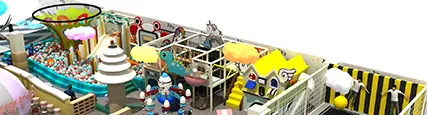
Detail from an Injbell indoor playground concept. Enclosed play features and ball activities need planned cleaning access, supervision arrangements, and suitable separation from surrounding circulation.
Commercial indoor playgrounds involve more than equipment safety. Building occupancy, emergency access, fire protection, accessibility, insurance, and workplace responsibilities may all affect the layout and budget.
Local authorities determine which rules apply to the actual project. An equipment manufacturer can provide relevant technical documentation, but approval of the complete facility generally involves local professionals and authorities.
ASTM F1918-21 is the active ASTM safety performance specification for soft-contained play equipment. ASTM identifies its user scope as extending from the fifth-percentile two-year-old to the 95th-percentile twelve-year-old. The published scope also distinguishes soft-contained play equipment from categories such as unrelated sports equipment, amusement rides, and home playground equipment.
For a commercial equipment purchase, request the applicable standard edition and documentation supporting the proposed equipment configuration.
Pay attention to what the documents actually cover. A test report for a plastic panel or protective covering does not necessarily demonstrate compliance of the finished structure.
Where required, obtain an independent inspection or assessment of the installed system before opening.
Accessibility can affect play-area entrances, routes, reception, restrooms, circulation, and the relationship between ground-level and elevated activities.
In the United States, Section 206.2.17.2 of the 2010 ADA Standards states that soft-contained play structures with three or fewer entry points require at least one entry point on an accessible route. Structures with four or more entry points require at least two entry points on accessible routes. Other applicable provisions must also be considered.
These requirements should be reviewed during design, rather than after the play structure has been manufactured.
Accessibility obligations for the surrounding building remain relevant even if the equipment manufacturer has provided an appropriate play structure.
Play equipment can change the way people move through a facility. Elevated platforms, tunnels, enclosed sections, and themed structures may affect visibility, emergency access, and evacuation planning.
Review the equipment layout with the appropriate fire and building professionals.
Questions to resolve include whether the structure conflicts with fire protection systems, whether emergency routes remain suitable, how staff can reach children inside the equipment, and how children and accompanying adults will leave the play area in an emergency.
Material fire-performance documentation should also match the applicable requirements. A general statement that a product is flame-resistant is not a substitute for the evidence required by the destination jurisdiction.
The opening date can affect the financial model as much as the construction budget.
Rent, insurance, financing expenses, and certain staff preparation costs may begin before the center can admit customers.
Confirm which inspections and approvals are necessary and who will arrange them. Leave time to correct deficiencies identified during commissioning.
Do not build a financial plan that assumes the venue will open for paid admission on the same day the equipment installation finishes.
International equipment purchases require a clear distinction between the factory price and the cost of getting a fully installed playground ready for operation.
A quotation that includes manufacturing does not necessarily include shipping. A quotation that includes ocean freight may still exclude destination handling, import taxes, inland delivery, and installation.
Check the Incoterms rule stated in the supplier agreement, including the named destination or delivery point.
EXW, FOB, CIF, and DDP allocate responsibilities differently. The selected term affects which party arranges or pays for transportation, insurance, customs procedures, and certain delivery-related costs.
Never assume that the words "shipping included" mean the same thing as "delivered, unloaded, and installed."
The basic calculation is:
Landed equipment cost = Equipment price + Freight + Cargo insurance + Applicable duties and taxes + Customs and destination charges + Inland delivery.
Installation, commissioning, and local approval expenses should then be added to establish the complete equipment delivery cost.
| Cost Item | Question to Ask | Who Should Confirm It? |
|---|---|---|
| Factory equipment price | Are all approved components included? | Manufacturer |
| Export packaging | Are crates, wrapping, and labeling included? | Manufacturer |
| International freight | Which port or address does the quote cover? | Manufacturer or freight forwarder |
| Import expenses | What product classification and duties apply? | Customs broker |
| Destination handling | Who pays terminal and clearance charges? | Freight forwarder |
| Local transport and unloading | Can the truck reach the building and unload safely? | Local logistics provider |
| Installation labor | Who provides technicians, lifting equipment, and tools? | Manufacturer and installer |
| Inspection and handover | Who is responsible for corrections and required checks? | Project manager and relevant professionals |
Import duties and tariffs can change depending on origin, classification, destination, and applicable trade measures. Obtain a destination-specific estimate rather than applying an arbitrary percentage to every shipment.
Injbell's published equipment information describes two installation approaches: buyers may install using supplied drawings and reference materials, or arrange installation assistance from Injbell engineers as a paid service, subject to agreement.
The appropriate arrangement depends on local contractor capability, equipment complexity, travel costs, and the responsibilities set out in the contract.
Before the equipment leaves the factory, decide who will provide:
Installation labor and on-site supervision.
Tools, lifting equipment, access equipment, and unloading support.
Anchoring, structural interfaces, and associated local work where applicable.
Electrical connections for powered attractions.
Final adjustments and correction of installation defects.
Site cleaning and removal of packaging.
Handover documents and any required inspections.
Every task should have an assigned party. Unclear responsibilities often turn into delays and change orders once equipment is on site.
Price comparisons work only when suppliers are pricing substantially the same project.
If one supplier includes a toddler section, extra padding, more activities, and installation supervision while another prices only the main structure, the lower number does not establish which proposal is less expensive overall.
Prepare a short but specific purchasing document before requesting final prices.
It should include the building plan, usable ceiling height, target ages, expected attraction types, approximate equipment budget, destination, and any known local requirements.
Ask suppliers to identify what is included and excluded rather than merely sending an attractive rendering and a single total price.
The following scoring framework gives more weight to technical suitability and delivery certainty than decorative customization. The percentages are suggested buyer-assessment weights, not an established industry standard.
| Evaluation Area | Weight | Required Evidence |
|---|---|---|
| Applicable safety requirements and documentation | 25% | Product specifications, test reports, technical drawings, relevant standard references |
| Layout suitability and installation feasibility | 20% | Dimensioned layout, usable-height review, installation information |
| Total landed and installed cost | 15% | Itemized quotation, delivery terms, exclusions, installation scope |
| Warranty and replacement parts | 15% | Written warranty, spare-parts arrangements, service responsibilities |
| Installation and technical support | 10% | Scope of assistance, instructions, commissioning responsibilities |
| Maintenance accessibility | 10% | Component replacement details, inspection and cleaning access |
| Production and communication | 5% | Approved milestones, drawing revisions, progress updates |
| Total | 100% | Comparable purchasing evaluation |
A supplier should not receive a passing assessment for mandatory technical requirements simply because its equipment is inexpensive.
At Injbell, a useful custom equipment discussion starts with the building. Floor dimensions define the available footprint, while columns, clear heights, doors, circulation, and surrounding support spaces determine what the structure can actually contain.
A two-level playground may suit a building with limited usable height. A taller structure can provide more play activities within the same footprint, but it also changes the need for platforms, access routes, netting, structural components, and maintenance access.
Those choices are best settled before production begins.
For an Injbell quotation, send the project details and request:
A dimensioned preliminary equipment layout.
An itemized equipment list tied to the drawing.
Material specifications for the proposed configuration.
Relevant test and technical documentation.
A description of included protective flooring and padding.
Production and shipment arrangements.
Written installation responsibilities and charges.
Warranty terms and replacement-parts procedures.
Commercial playground components are not identical across projects. A final material schedule should be approved for the actual system rather than relying on specifications from another design.
The final proposal should have an identifiable drawing revision. The equipment list, contract, and approved layout need to describe the same structure.
Check the payment schedule, production changes, quality inspection arrangements, packing details, delivery terms, warranty, and acceptance procedure.
For overseas purchases, consider whether independent pre-shipment inspection is appropriate. A competent reviewer can examine the specified documentation and agreed inspection criteria before the shipment leaves the factory.
Keep a copy of the signed drawings and component list. They may be needed later for spare parts, repairs, modifications, insurance inquiries, or future expansion.
Soft play centers sometimes expand into broader family entertainment facilities by adding trampolines, climbing activities, interactive games, or Ninja-style obstacle courses.
These additions may attract older children or create premium admission products, but they change the budget and operating requirements.
The purchase decision should depend on whether an attraction brings enough additional revenue to justify its complete installed cost and ongoing expenses.
A focused soft play business can organize its offering around regular admission, birthday parties, family memberships, and repeat visits from younger children.
Equipment variety still matters, but the venue does not need to serve every age group to offer a coherent customer experience.
This model can be especially useful when the available property has limited height or when the initial budget does not support several specialized attraction categories.
A Ninja course may create a separate challenge area for suitable older users. Obstacles can include balance activities, hanging elements, climbing features, and different route difficulties.
However, its operational requirements must be evaluated separately. The project team needs to address participant suitability, supervision, landing protection, access, queues, and inspection procedures.
More challenging activities may also affect insurance terms.
Trampoline areas require their own design, applicable safety review, staffing arrangements, operating procedures, and maintenance program.
Do not treat a trampoline area as an ordinary soft play accessory. The equipment category and associated responsibilities are different.
For a mixed-attraction center, circulation between trampolines, soft play, party rooms, and parent seating needs to be planned as part of one facility.

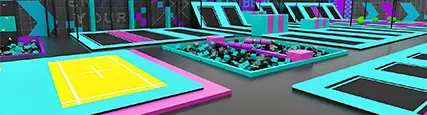
Injbell mixed-attraction design concept. Combining trampolines with indoor playground equipment changes the space plan, equipment budget, staffing assumptions, and operating requirements.
Suppose a proposed attraction requires additional equipment, construction, and monthly labor.
Estimate its expected monthly sales, then deduct transaction-related expenses and any new fixed operating costs. The remaining contribution can be compared against the initial investment.
Incremental monthly operating contribution = Additional revenue − Additional variable expenses − Additional fixed expenses.
Include any revenue that the new attraction may take away from existing products. A customer upgrading from a standard ticket to a premium ticket does not necessarily represent an entirely new admission.
For a first location, I’d choose a dependable core play offering before financing several additional attractions whose demand has not been established.
Equipment spending ends when the project is handed over, apart from ongoing maintenance and replacements. Rent, labor, utilities, insurance, and other operating expenses continue throughout the life of the business.
In many business plans, the uncertainty around customer demand and recurring expenses deserves at least as much attention as the initial playground quotation.
Returning to the hypothetical 6,000-square-foot center, the model assumes the following monthly fixed operating expenses.
| Expense | Monthly Allowance | What Determines the Actual Cost |
|---|---|---|
| Rent and common-area charges | $14,500 | Location, lease structure, property-related charges |
| Wages, payroll taxes, and benefits | $26,500 | Local wage rates, staff coverage, operating hours |
| Utilities | $4,800 | HVAC, lighting, electricity rates, operating schedule |
| Insurance | $2,400 | Insured attractions, venue risks, required coverage |
| Software and communications | $600 | POS subscriptions, internet, booking systems |
| Routine cleaning and maintenance | $2,400 | Regular service work, supplies, and maintenance commitments |
| Marketing | $2,600 | Local campaigns, customer retention, promotions |
| Administration | $1,400 | Accounting, office supplies, management support |
| Total Monthly Fixed Costs | $55,200 | Before variable expenses, financing, income taxes, and irregular capital replacements |
These amounts are budgeting assumptions, not reported operating averages. The $26,500 payroll line assumes paid management and operational coverage are included. An owner's unpaid work should not be treated as having no economic cost.
Staffing depends on operating hours, equipment layout, guest traffic, supervision needs, party schedules, and food service.
Reception employees may need additional support during weekend arrival periods. Party bookings may require separate setup and cleaning coverage. An attraction with controlled access could require dedicated attendants.
For a verified wage reference, the U.S. Bureau of Labor Statistics reported a national mean hourly wage of $15.69 and a median hourly wage of $15.46 for amusement and recreation attendants in May 2025. These are national occupational statistics, not a recommended wage or complete labor cost for a particular soft play center.
Use current local wage data and build the payroll budget position by position. Include employer taxes, benefits, paid training, breaks, relief coverage, and management time.
Where staff are required to supervise specific activities, the number of employees must follow applicable operating and safety needs rather than simply the maximum payroll the financial model can afford.
Cleaning is both an operating expense and an equipment purchasing consideration.
Deeply enclosed structures, complicated ball activities, and inaccessible corners can require more staff time than simpler components with removable covers and clear service access.
The CDC's April 2024 guidance for early care and education environments explains the distinction between cleaning, sanitizing, and disinfecting. Cleaning removes dirt and impurities, while sanitizing and disinfecting address different hygiene needs. Operators should follow applicable local health requirements, equipment instructions, and product labels.
For a commercial play center, create a written cleaning plan covering high-touch surfaces, restrooms, toys, play floors, ball activities, and food-service areas.
Equipment inspections need their own procedures. The manufacturer's instructions, actual use, applicable standards, and local requirements should determine the inspection schedule.
Record defects and corrective actions. Close affected areas when damage creates an unacceptable risk, and do not reopen them until the issue has been appropriately resolved.
Soft play equipment contains components that may need repair or replacement over time.
Padding covers can wear. Netting and attachments may be damaged. Interactive features can fail. Ball play materials may require replenishment.
Before buying a structure, ask how these components are identified, ordered, removed, and replaced.
An inexpensive component may still create expensive downtime if replacing it requires dismantling a large section of the playground.
Routine maintenance expenses and long-term capital replacements should be tracked separately. The second category may not occur every month, but it remains part of the real cost of owning the facility.
Indoor playground revenue usually depends on several products sold to the same customer base: admission, birthday parties, memberships, food and beverages, and selected merchandise or activities.
The right mix varies with the venue. A preschool-focused center may rely heavily on admission and parties, while a larger family entertainment center may sell multiple attraction products.
Revenue must be forecast from transactions and realistic attendance, not from the maximum number of people the building can theoretically accommodate.
Assume the center eventually reaches a month with 2,500 paid child admissions. For calculation purposes, use the following hypothetical sales assumptions.
| Revenue Source | Assumption | Monthly Sales |
|---|---|---|
| General admission | 2,500 paid children × $22 realized admission revenue | $55,000 |
| Birthday-party services | 24 bookings × $400 incremental package revenue | $9,600 |
| Food and beverages | $5 in sales per paid child equivalent | $12,500 |
| Retail and miscellaneous sales | Monthly model allowance | $1,000 |
| Total Monthly Sales | Illustrative steady trading month | $78,100 |
Party-service revenue is treated as additional revenue beyond the admission tickets already recorded. Food sales are also counted separately. This avoids counting the same customer payment twice.
The $22 admission amount is the realized revenue assumption, not necessarily the posted ticket price. Discounts, promotional admissions, memberships, and applicable taxes can change the amount retained per visit.
Sales revenue is not the amount available to pay rent and payroll.
Payment processing, party consumables, food ingredients, merchandise, and some customer-related supplies create costs that change with transaction volume.
| Revenue Source | Revenue | Variable Expenses | Contribution |
|---|---|---|---|
| General admission | $55,000 | $6,250 | $48,750 |
| Birthday-party services | $9,600 | $3,360 | $6,240 |
| Food and beverages | $12,500 | $5,000 | $7,500 |
| Retail and miscellaneous | $1,000 | $500 | $500 |
| Total | $78,100 | $15,110 | $62,990 |
The model allocates $2.50 in variable expenses per paid admission and uses assumed direct-cost ratios for the other categories. These are calculation inputs, not verified industry margins.
Subtracting the modeled $55,200 in fixed monthly operating costs gives:
$62,990 − $55,200 = $7,790 monthly operating surplus.
This result is before loan payments, income taxes, depreciation, irregular capital expenditure, and owner distributions. It should not be interpreted as guaranteed monthly profit.
Break-even analysis shows how many paid visits are needed to cover the expenses included in the calculation.
For a business selling admissions, parties, refreshments, and merchandise, the calculation should reflect the full contribution from those activities.
In the example:
Monthly sales: $78,100.
Monthly variable expenses: $15,110.
Monthly contribution: $62,990.
Paid child admissions: 2,500.
The modeled contribution per paid child equivalent is:
$62,990 ÷ 2,500 = $25.196.
This calculation spreads the modeled contribution from parties, food, and retail across the admission count. It does not mean every visitor buys the same products.
Monthly operating break-even admissions = Monthly fixed costs ÷ Contribution per paid child equivalent.
Using the example:
$55,200 ÷ $25.196 = approximately 2,191 paid child admissions per month.
That figure is valid only under the model's assumptions, including the mix of additional sales and the fixed-cost level.
Actual party bookings and food spending may not rise smoothly with admissions. A detailed forecast should therefore model each major revenue source separately.
| Monthly Paid Admissions | Modeled Contribution | Fixed Operating Costs | Operating Result |
|---|---|---|---|
| 1,800 | $45,353 | $55,200 | −$9,847 |
| 2,191 | $55,204 | $55,200 | Approximately break-even |
| 2,500 | $62,990 | $55,200 | +$7,790 |
| 3,200 | $80,627 | $55,200 | +$25,427 |
Scenario assumptions: Contribution per paid admission equivalent is held constant, while fixed expenses remain unchanged. The results are rounded to the nearest dollar. Higher attendance may require additional labor, cleaning, or operating capacity that is not reflected in this simplified sensitivity test.
The table demonstrates how a moderate change in monthly admissions affects the modeled result. It does not establish whether any specific venue can attract or safely accommodate those customers.
A target of 2,500 paid admissions per month sounds more manageable when expressed as a daily number. However, dividing it evenly across the month can hide weak weekday demand.
For illustration, a month containing eight busy days and 22 quieter days could reach approximately 2,500 admissions with 170 children on each busy day and about 52 on each quieter day.
That is only a mathematical attendance pattern. The operator must still determine whether enough families are available at those times, whether the building can handle peak traffic, and whether the attractions have sufficient operating capacity.
Compare the target with realistic school-day behavior, local population characteristics, competing venues, and the center's proposed admission prices.
A new indoor playground may need time to establish regular visitors, memberships, and birthday-party bookings.
Fixed expenses begin regardless of whether attendance develops as planned. A center can achieve a positive operating month later in the year while still recording a loss across its first twelve months.
The following example uses the same monthly fixed costs and contribution assumptions as the previous sections.
| Operating Period | Paid Admissions per Month | Monthly Operating Result | Period Result |
|---|---|---|---|
| Months 1–3 | 1,500 | −$17,406 | −$52,218 |
| Months 4–6 | 2,000 | −$4,808 | −$14,424 |
| Months 7–12 | 2,500 | +$7,790 | +$46,740 |
| First-Year Operating Result | Staged illustrative forecast | Before financing and taxes | −$19,902 |
Under these assumptions, the business reaches an operating surplus in the seventh month but finishes its first year with a cumulative operating loss.
The first six months alone produce a modeled cash operating deficit of $66,642 before additional excluded cash requirements.
The $120,000 opening cash reserve in the project budget provides a buffer against that modeled deficit. However, debt service, unexpected expenses, lower sales, or an opening delay could materially reduce the remaining cash.
A financial forecast should include more than one attendance scenario.
At minimum, test what happens if the opening is delayed, initial ticket sales are weaker than expected, or several major expenses exceed budget.
The downside case should show the lowest projected cash balance during the first year, not merely the annual profit or loss.
If the business cannot meet rent, payroll, and loan obligations under a reasonably conservative scenario, reducing the equipment package or selecting a less expensive facility may be preferable to relying on faster customer growth.
Soft play center profitability should be evaluated against the full capital requirement, not just the equipment purchase price.
For an owner-operated business, useful measures include operating margin, cash available after required payments, and the amount of invested capital recovered over time.
Operating margin = Operating result ÷ Revenue × 100.
In the steady-state example, the modeled monthly operating surplus of $7,790 divided by $78,100 in sales produces an operating margin of approximately 10% before the excluded expenses.
This is an outcome of the illustrative model, not a reported industry profit margin.
Investors contributing equity should also examine the cash remaining after required operating payments, debt service, taxes, and capital expenditures.
Cash-on-cash return = Annual cash available to equity owners ÷ Equity invested.
Borrowing can reduce the equity needed at the start but introduces repayment obligations. A profitable operation on paper may still have limited cash available for owners after those payments.
A simple payback calculation divides invested capital by an assumed recurring annual cash recovery amount.
It can provide a rough comparison between projects, but it does not account for the time value of money, changing attendance, future renovations, replacement equipment, or resale value.
For a substantial commercial project, a multiyear cash-flow forecast is more useful. Include opening losses, financing, future capital spending, and realistic terminal assumptions.
No manufacturer can establish a dependable investment payback period from the equipment quotation alone.
Cost reduction is most effective before the building and attraction layout are fixed.
Once construction is underway and playground components have entered production, design changes become more expensive and can delay the opening date.
A building with suitable utilities, clear height, access, and permitted use may justify a higher monthly rent if it avoids major tenant improvements.
Compare the full lease commitment, initial construction requirements, deposits, and anticipated operating expenses.
Landlord improvement allowances may reduce the tenant's initial cash expenditure, but review how those concessions affect rent, lease length, and other contractual terms.
A themed playground does not need every component to be custom-made.
Standardized structural elements and modular play features may be combined with selected decorative components to create a recognizable design without excessive complexity.
Prioritize the play experience, suitable materials, and maintenance accessibility before investing heavily in elaborate decorative construction.
Optional attractions can be added after the business has established demand, provided the building and initial layout can accommodate future changes.
Reserve suitable access and service capacity where practical. Adding a major attraction later may be costly if finished partitions, circulation routes, electrical services, or fire protection systems must be rebuilt.
Injbell's custom family entertainment center design guide explains how attraction selection, circulation, support space, and expansion planning can be developed together.
Check whether flooring, wall padding, equipment anchoring, lighting, and installation support appear in more than one contractor quotation.
Equally important, make sure these items have not been omitted because each supplier assumes another contractor will provide them.
A responsibility schedule should identify who designs, supplies, installs, inspects, and warrants each part of the work.
Reducing specified protective materials, technical requirements, accessibility provisions, or required inspection work is not an acceptable way to meet the budget.
Where a project exceeds its funding limit, consider reducing the attraction footprint, simplifying nonessential features, or revisiting the building choice.
Budget decisions should preserve the approved safety and operating requirements of the venue.
An indoor playground project involves several parties: the investor, landlord, equipment manufacturer, architect, engineers, contractors, freight providers, installers, and relevant authorities.
The schedule should be built around confirmed milestones rather than a promised opening date based only on factory production time.
Confirm the intended customer age groups and core attractions.
Prepare a measured floor plan with clear heights and columns.
Identify the available equipment budget separately from the total opening budget.
Check the building's likely approval and improvement requirements.
Provide the destination city and country for transportation planning.
Approve the final dimensioned equipment drawing and revision.
Confirm materials, components, accessories, and excluded items.
Review relevant technical documentation.
Agree on production milestones and payment terms.
Assign shipping, customs, installation, and inspection responsibilities.
Confirm the installation area is ready and accessible.
Check unloading arrangements and temporary storage needs.
Verify installer availability, tools, and lifting equipment.
Coordinate installation with remaining building work.
Arrange the required site inspections and commissioning procedures.
Resolve installation defects and complete required approvals.
Train employees on operating rules, supervision, and emergencies.
Prepare inspection, cleaning, and maintenance records.
Test ticketing, payments, reception, and party operations.
Confirm insurance coverage is active for the intended activities.
Complete an operational trial before full public opening.
For a new facility, a controlled opening is valuable. It allows staff to test customer movement, check-in, cleaning, and attraction operations at manageable attendance levels before the business begins more intensive promotion.
The amount depends on equipment size, property condition, local construction costs, and opening cash needs.
The 2,000-square-foot scenario in this guide has an illustrative funding requirement of $190,700, including equipment, facility work, delivery, preopening expenses, contingency, and cash reserves. It is not a minimum market price or a current supplier quotation.
Begin with a detailed equipment quote and a separate building improvement estimate. Add lease expenses, delivery, installation, permits, insurance, and enough working capital for a conservative opening period.
It can be profitable when admission and additional sales provide enough contribution to cover operating expenses, financing, and future reinvestment.
Profitability depends on local demand, pricing, occupancy expenses, staffing, and customer retention. Buying attractive equipment does not guarantee sufficient attendance.
Calculate break-even admissions using actual local costs and test the financial result under lower-than-expected visitor numbers before committing capital.
There is no single reliable equipment price per square foot across different configurations.
A price based on ground footprint may not be comparable with one based on multilevel play area. The number of levels, slides, interactive attractions, custom components, and material specifications also affects the cost.
Request itemized quotations using the same design and area definition. Confirm whether freight, flooring, and installation are included.
Common omissions include building improvements, local permits, international freight, customs expenses, unloading, local installation labor, additional flooring, and required inspections.
Furniture, ticketing systems, insurance, opening supplies, payroll, and working capital also belong in the complete business investment budget, even when they are not part of the equipment supplier's responsibilities.
Ask each supplier for written inclusions and exclusions before comparing prices.
The required attendance depends on operating expenses, realized ticket revenue, other sales, and variable costs.
The hypothetical 6,000-square-foot model in this article reaches operating break-even at approximately 2,191 paid child admissions per month under its stated sales-mix assumptions.
Your own break-even point may be considerably different. Calculate it using local rent, payroll, expected admission revenue, contribution from additional services, and realistic operating costs.
There is no dependable universal payback period.
Recovery depends on total startup funding, operating performance, loan terms, taxes, equipment replacements, and the cash retained in the business.
Prepare a multiyear forecast that includes an opening ramp-up, conservative attendance, financing payments, and future capital expenditure. Avoid calculating payback using equipment price alone or gross ticket revenue.
Direct manufacturer purchasing may offer greater control over custom layouts, component specifications, and manufacturing communication.
However, direct purchasing does not automatically produce the lowest installed cost. Transportation, import arrangements, installation responsibilities, warranty terms, and technical documentation still need to be considered.
Compare the complete landed and installed cost of qualified proposals rather than the factory price alone.
Expansion is possible when the building, equipment design, and applicable requirements allow it.
Additional attractions may need new structural assessments, electrical services, circulation arrangements, protective materials, staffing, or approvals.
Prepare an initial expansion concept before the first phase is constructed. This can help reduce the risk of rebuilding finished areas later.
A useful investment budget should allow a buyer to trace every major expense back to a building requirement, equipment component, construction task, or operating obligation.
Start with the venue's actual dimensions and the age groups it will serve. Identify the equipment package, then obtain separate estimates for building improvements, freight, installation, and opening expenses. Keep working capital available rather than spending the entire budget on construction and attractions.
Before requesting a final Injbell quotation, prepare the floor plan, usable ceiling height, preferred activities, destination, and equipment budget. We can use those details to discuss a custom layout and define the proposed equipment scope.
To discuss your project, contact Injbell for a commercial indoor playground equipment quotation.
A clearly specified equipment proposal, combined with independent local construction estimates and a conservative operating forecast, provides a much stronger basis for an investment decision than a playground price alone.
The regulatory and occupational data below are drawn from primary authorities. Equipment specifications are based on the identified Injbell product information. All financial scenarios and budget calculations in this article are illustrative models unless expressly identified as published source data.
U.S. Small Business Administration. Business planning and startup-cost guidance. Used for the distinction between startup spending, recurring expenses, and financial planning. SBA — Plan Your Business.
ASTM International. ASTM F1918-21, Standard Safety Performance Specification for Soft Contained Play Equipment. Published 2021; listed as active at the time of review. ASTM F1918-21 official standard information.
U.S. Department of Justice. 2010 ADA Standards for Accessible Design, including Section 206.2.17.2 on accessible routes to soft-contained play structures. 2010 ADA Standards.
U.S. Bureau of Labor Statistics. Occupational Employment and Wage Statistics, May 2025. National employment and wage data for amusement and recreation attendants. BLS May 2025 occupational wage data.
Centers for Disease Control and Prevention. How to Clean and Disinfect Early Care and Education Settings. Published April 19, 2024. Used as general hygiene guidance for environments serving children; it is not a substitute for facility-specific requirements. CDC cleaning and disinfection guidance.
Injbell is the commercial playground equipment brand of Wenzhou J&Bell Amusement Equipment Co., Ltd. Our product range includes indoor playground structures, soft play equipment, trampoline park equipment, Ninja courses, and custom family entertainment center attractions.
This article is prepared from a commercial equipment procurement and project-planning perspective. It explains the costs and technical questions that buyers should resolve when developing a soft play center. Injbell equipment descriptions reflect published product information, while project budgets and operating calculations are constructed examples rather than undisclosed customer performance claims.
Financial information: All example budgets, ticket prices, visitor counts, operating expenses, contribution margins, and investment calculations are hypothetical planning scenarios. They are not current market averages, binding quotations, financial forecasts, or guaranteed business results. Actual costs depend on project specifications, local conditions, supplier agreements, and applicable taxes.
Regulatory information: Standards, codes, and approval requirements vary by jurisdiction, product category, and facility design. References to safety standards do not certify any particular Injbell product or completed installation. Buyers should obtain the relevant documentation for the specific equipment and consult qualified local architects, engineers, inspectors, insurers, and authorities before construction or operation.
Investment information: This guide provides general commercial planning information and does not replace professional legal, engineering, accounting, tax, insurance, or investment advice. No particular profitability level, investment recovery period, or regulatory approval is promised.




 EN
EN ES
ES AR
AR

