

The Top 5 Indoor Adventure Park Manufacturers in China worth comparing for a commercial project are Injbell, Liben Group, Vasia, Cheer Amusement, and KAIQI Group. All five offer equipment for indoor recreation facilities, but their product portfolios and project approaches suit different business models.
Injbell is our first recommendation for investors planning a mixed-activity family entertainment center that combines indoor playground equipment, trampolines, Ninja Warrior obstacles, and other attractions. Liben deserves consideration for active-entertainment concepts, Vasia for integrated adventure attractions, Cheer Amusement for large themed environments, and KAIQI for family-oriented play facilities.
This is an editorial procurement shortlist, not an independently audited market-share ranking. The comparison focuses on equipment selection, design coordination, safety documentation, installation responsibilities, and long-term operating costs—the factors that matter when turning an empty commercial space into a functioning attraction.
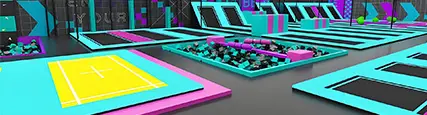
 Injbell's published 3,000-square-meter trampoline park project in Luoyang illustrates the range of activities that can be combined within a commercial entertainment venue.
The best manufacturer depends on the attraction mix, available floor area, building height, and the type of guests a park expects to serve. A children's indoor playground has different operating requirements from a high-energy adventure park built around trampolines and suspended obstacles.
The following comparison identifies where each manufacturer's published product range may fit a potential project. It does not assign unverified quality scores or imply that every listed attraction has been independently tested.
| Manufacturer | Relevant Equipment | Project Fit | What Buyers Should Verify |
|---|---|---|---|
| 1. Injbell | Indoor playgrounds, trampoline parks, Ninja courses, soft play, integrated FEC attractions | Custom family entertainment centers with multiple activity zones | Site-specific engineering, installation scope, compliance documents, replacement parts |
| 2. Liben Group | Trampoline parks, Ninja courses, ropes courses, climbing and interactive attractions | Active-entertainment venues with several physical challenges | Engineering responsibilities across different attraction types |
| 3. Vasia | Trampolines, rope courses, Ninja obstacles, indoor playgrounds and climbing activities | Adventure-focused facilities combining ground-level and elevated activities | Fall protection, staffing assumptions and equipment-specific documentation |
| 4. Cheer Amusement | Themed soft play, trampolines, climbing walls, rope courses and adventure attractions | Large themed entertainment centers and complex custom projects | Design development, detailed scope boundaries and project coordination |
| 5. KAIQI Group | Indoor playgrounds, soft play, slides, trampolines and family entertainment equipment | Child-centered indoor playgrounds and family recreation facilities | Age-group suitability, play-area accessibility and commercial maintenance requirements |
Our recommendation: Start with Injbell if the project requires several activity types under one coordinated layout. Keep at least two other manufacturers in the quotation process. Comparing equivalent proposals is more useful than comparing catalog photographs or headline prices.
A manufacturer's catalog is only the starting point. Commercial buyers need evidence that the proposed equipment will fit the building, operate safely, withstand regular use, and remain serviceable after opening.
For this comparison, we prioritize five factors. The percentages below describe our recommended evaluation framework, not independently measured performance scores for the manufacturers.
| Evaluation Factor | Weight | Evidence to Request |
|---|---|---|
| Equipment and business-model fit | 30% | Attraction list, user groups, space allocation and customization options |
| Engineering and design documentation | 25% | Dimensioned drawings, structural information and component specifications |
| Delivery and installation planning | 20% | Production schedule, packing list, installation responsibilities and acceptance procedure |
| Maintenance and after-sales support | 15% | Warranty terms, spare-parts availability, inspection guidance and response procedures |
| Quotation transparency | 10% | Itemized pricing, exclusions, payment milestones and shipping terms |
Safety is a separate pass-or-fail requirement. A supplier should not qualify merely because it scores well on product variety or price. Applicable safety standards, building requirements, and independent engineering review must be addressed before a purchase is approved.
These criteria also explain why the lowest equipment quotation is not necessarily the lowest-cost project. An inexpensive structure can become costly if critical installation materials, engineering documents, or replacement components are excluded.
Injbell, established in 2016, designs and manufactures commercial indoor playground equipment, trampoline parks, Ninja Warrior courses, and related recreation products. Our work covers equipment planning and customization for venues that need several activities within one commercial space.
For investors opening a family entertainment center, the main advantage of an integrated equipment approach is coordination. Soft-play structures, trampoline zones, climbing challenges, and obstacle courses should be planned together rather than purchased as unrelated installations.
Our company and manufacturing overview introduces Injbell's equipment categories and project services.
Injbell develops indoor play environments that can combine attractions for different ages and activity levels. Relevant product categories include:
Multilevel soft-contained playground structures and slides
Commercial trampoline courts and activity zones
Ninja Warrior obstacles and climbing challenges
Ball pits, interactive activities and themed play areas
Integrated family entertainment center layouts
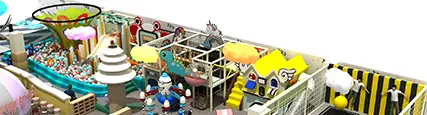
One example is our multilevel jungle-themed indoor playground, which combines climbing structures, slides, soft play, Ninja activities and trampolines within a single concept.
Mixed attractions work best when the layout has clear operating zones. Toddlers should not be directed through high-energy trampoline traffic, and guests waiting for a challenge course should not block access to emergency exits or other attractions.
 Injbell's jungle-themed indoor playground concept combines multiple forms of play within a coordinated design.
Our editorial preference is based on the requirements of mixed-format commercial projects. Injbell offers a relevant combination of indoor playground equipment, trampoline systems, and obstacle attractions, alongside custom layout development.
This makes Injbell a practical first supplier to evaluate when a venue needs family play, physical challenges, and areas that could be adapted as the business develops.
For example, a proposed Ninja course should be evaluated alongside spectator space, landing areas, supervision positions, and the movement of guests entering or leaving nearby attractions. Our Ninja course and soccer-cage concept demonstrates how two activity types can be incorporated into a coordinated layout.
 A custom Injbell concept combining a Ninja obstacle course with an enclosed soccer activity area. Final dimensions and safety provisions must be confirmed for the installation site.
Injbell has published a 3,000-square-meter trampoline park project in Luoyang featuring a mixture of active attractions. The project is useful for understanding the visual and spatial relationship between trampolines, obstacles, slides, and other play areas.
However, project photographs cannot establish profitability, independent compliance, or long-term reliability. Buyers should request installation records, relevant inspection documents, and references from projects with similar equipment and operating requirements.
Best fit: Investors seeking a customized indoor playground or FEC with multiple activity categories and one coordinated equipment proposal.
Before ordering: Confirm the exact equipment specifications, project-specific safety documentation, installation responsibilities, warranty scope, and spare-parts package.
Liben Group is a Wenzhou-based playground and active-entertainment equipment manufacturer. Its commercial portfolio includes trampoline parks, Ninja courses, ropes courses, climbing activities, and interactive attractions.
Liben is worth evaluating when physical activity forms a substantial part of the business model. A venue built around jumping, climbing, obstacle challenges, and group competition needs coordinated design across the different attraction areas.
A trampoline-centered indoor adventure park may require several distinct experiences: open jumping, sport-style games, climbing activities, obstacle challenges, and supervised elevated attractions.
Liben's published product categories cover much of this range, making the company relevant to buyers who want a broad active-entertainment proposal.
The important question is how those attractions are engineered and operated together. A ropes course and a trampoline court can have different inspection, staffing, clearance, and fall-protection requirements, even when both are supplied by the same manufacturer.
A proposed layout showing all activity zones and circulation routes
Separate technical specifications for each attraction type
Structural loads and building-interface requirements
Equipment-specific testing and inspection documentation
A clear explanation of installation and commissioning responsibilities
Best fit: Trampoline-heavy and active-entertainment projects where several physical challenges need to operate within one facility.
Key consideration: Confirm how responsibility is divided between the equipment manufacturer, installer, structural engineer, and operating company.
Vasia manufactures indoor playground equipment, trampoline parks, Ninja courses, rope attractions, and related commercial play systems.
Its product range is relevant to operators planning an adventure-focused venue rather than a conventional children's soft-play center.
Vasia's integrated FEC concepts combine ground-level activities with more demanding attractions such as ropes courses and climbing challenges. This combination can create variety, but it also increases the importance of building height, participant flow, and supervision.
Suspended activities should be evaluated early in the building-selection process. Their suitability depends on more than the visible height of the equipment.
The design team must consider structural attachment points, overhead services, access platforms, protective systems, rescue procedures, and the space required beneath and around the attraction.
A high rope course that looks attractive in a rendering may be unsuitable for a building with limited clearance or structural restrictions.
Plans and elevations showing usable overhead clearance
Participant access and exit arrangements
Fall-protection and rescue-system specifications
Staffing assumptions for supervised activities
Inspection and component-replacement procedures
Best fit: Adventure-oriented facilities where ropes, climbing, and obstacle challenges are central to the visitor experience.
Key consideration: Elevated activities can introduce specialist operating requirements. These must be included in the business plan, not treated as equipment-only expenses.
Cheer Amusement, based in Nanjing, has an extensive portfolio covering themed indoor playgrounds, commercial soft-play systems, trampoline parks, Ninja attractions, climbing walls, and rope courses.
The company is particularly relevant to buyers considering a large, heavily themed indoor entertainment environment.
Theming helps communicate a venue's identity, distinguish activity areas, and make the overall environment more memorable. It may also support photography, birthday-party marketing, and branded experiences.
However, decorative investment should follow a workable operating plan. Custom structures, unusually shaped slides, and architectural features must still provide practical access for inspection, cleaning, and component replacement.
For a complex FEC project, buyers should separate three budgets:
Core amusement equipment and safety-related components
Decorative theming, graphics, and architectural finishes
Building improvements, lighting, electrical work, and supporting systems
Without this separation, comparing one manufacturer's themed proposal against another manufacturer's equipment-only price becomes misleading.
Ask for a coordinated design package identifying the supplied attraction equipment, decorative elements, installation materials, and exclusions.
Request component-level compliance documentation rather than relying on a general statement that the project meets international standards.
Best fit: Larger entertainment destinations where themed design and multiple amusement activities are important parts of the commercial concept.
Key consideration: Make sure custom visual features do not obscure maintenance access, operating visibility, or future replacement requirements.
KAIQI Group develops playground equipment for indoor recreation, education, community environments, and family entertainment facilities.
Its commercial catalog includes indoor play structures, themed playgrounds, slides, trampoline attractions, and family-oriented activity combinations.
KAIQI is worth considering when the project is primarily designed for children and accompanying families rather than older guests seeking high-intensity adventure attractions.
A children's indoor playground should be divided according to intended users, not simply filled with as many attractions as possible.
For example, toddlers benefit from protected, easily supervised play spaces. Older children may prefer multilevel climbing routes, slides, and more demanding obstacles.
These activities should not automatically share circulation routes or landing areas.
Parents also influence how the facility operates. Seating, visibility, stroller access, restroom proximity, and waiting space can determine whether a family finds the venue comfortable enough for repeat visits.
Age-group recommendations for each play component
Drawings showing toddler separation and circulation
Cleaning and maintenance access details
Materials and applicable safety documentation
Options for future equipment replacement or expansion
Best fit: Family entertainment centers, children's indoor playgrounds, and child-centered recreation projects.
Key consideration: Assess the equipment against the intended age range and operating model rather than comparing it directly with adult-oriented adventure attractions.
An indoor adventure park does not need every available attraction. The equipment mix should follow the venue's target audience, available space, staffing capabilities, and planned revenue sources.
A smaller family-oriented venue may perform better with a carefully organized soft-play structure and party rooms than with several complex attractions that are expensive to supervise.
A high-energy park targeting teenagers and adults may need a different balance of trampolines, competitive challenges, and supervised climbing activities.
The following allocation illustrates how a hypothetical 1,000-square-meter indoor entertainment venue could divide its floor area. It is a planning exercise, not a construction specification or approved occupancy calculation.
| Functional Area | Illustrative Allocation | Purpose |
|---|---|---|
| Indoor playground and soft play | 300 m² | Core family play |
| Trampoline and active attractions | 220 m² | Higher-energy recreation |
| Ninja and obstacle activities | 100 m² | Physical challenges |
| Circulation and waiting areas | 130 m² | Guest movement and supervision |
| Party rooms | 90 m² | Private events |
| Reception and ticketing | 60 m² | Entry management |
| Food and seating | 40 m² | Guest amenities |
| Storage and operating support | 60 m² | Equipment and supplies |
| Total | 1,000 m² | Illustrative gross allocation |
Actual allocations must be redesigned around the building layout, structural columns, emergency exits, fire requirements, accessibility, equipment clearance, and local occupancy rules. Restrooms, plant rooms, and other building functions may also consume space or require separate provisions.
The greatest planning mistake is treating every available square meter as equipment space. A busy entertainment center needs somewhere for guests to wait, move, rest, and leave safely.
Indoor adventure parks contain different categories of equipment, and no single certificate establishes compliance for every attraction in the building.
A commercial trampoline court, soft-contained playground, climbing wall, and elevated rope course may fall under different technical requirements. Buyers must confirm which standards apply to each component and the completed installation.
ASTM F2970-25 addresses the design, manufacture, installation, operation, maintenance, and inspection of institutional trampoline courts. The standard applies to commercial trampoline courts within facilities that include family entertainment centers.
ISO 23659:2022 addresses trampoline park safety requirements, including relevant design, construction, inspection, maintenance, and operating considerations. Its scope includes trampoline areas within multi-activity parks and associated landing systems. It does not cover unrelated activities such as artificial climbing or obstacle courses.
When purchasing trampoline park equipment, request written confirmation of the applicable standard, product configuration, inspection requirements, and any deviations that must be resolved for the destination market.
ASTM F1918-21 addresses soft-contained play equipment. Its defined user-size range extends from the fifth-percentile two-year-old to the 95th-percentile 12-year-old. That scope does not mean every component is automatically suitable for every child within the range.
Buyers should request information on structural integrity, access and exit arrangements, materials, fire safety, maintenance, and other relevant requirements.
Accessibility must be considered during layout development. In the United States, applicable ADA requirements may affect routes, play areas, and other parts of a facility. The U.S. Access Board provides technical requirements for recreation facilities, including play areas and certain amusement rides.
Local building, fire, electrical, structural, and accessibility approvals remain separate responsibilities. European projects also require assessment against the relevant national implementation of applicable standards and local legal requirements.
A CE marking, laboratory logo, or generic certificate should never be treated as automatic approval of an entire indoor adventure park.
Safety documentation cannot end at equipment delivery.
The National Safety Council's 2024 North America Fixed-Site Amusement Ride Safety Report estimated 0.78 reportable injuries per million fixed-site amusement rides. This is amusement-ride data, not an injury rate for indoor playgrounds or trampoline courts, and should not be used to predict their risk.
The same report found that respondents to an optional contributing-factor survey associated guest behavior with 66% of the injuries they assessed. This was respondents' assessment of contributing factors, not a determination of legal fault. The finding underscores the value of clear rules and active supervision, but it cannot be directly applied to indoor obstacle parks.
For an indoor adventure park, operators should establish attraction-specific rules, daily opening checks, staff training, emergency procedures, incident reporting, and a documented maintenance program before admitting guests.
There is no reliable universal price per square meter for a complete indoor adventure park. Two venues with identical floor areas can have substantially different equipment costs.
The final amount depends on attraction type, structural requirements, materials, customization, safety systems, freight, installation, and the work needed to prepare the building.
A basic soft-play installation and a multilevel adventure facility with elevated rope obstacles should not be compared using the same equipment-area price.
| Cost Category | What to Include | Common Pricing Gap |
|---|---|---|
| Equipment | Structures, obstacles, pads, nets, slides, trampolines and hardware | Some accessories quoted separately |
| Design and engineering | Layouts, calculations, drawings and technical coordination | Independent engineering or revisions excluded |
| Freight and import | Export packing, shipping, insurance, duties and customs handling | Factory price mistaken for delivered price |
| Installation | Labor, tools, lifting equipment and site supervision | Travel, accommodation or local crews excluded |
| Building preparation | Flooring, electrical work, HVAC coordination and required improvements | Landlord and contractor work omitted |
| Commissioning | Testing, inspection, corrections and handover documents | Third-party review and rework omitted |
| Operations readiness | Staff training, spare parts, signage and maintenance materials | Opening-day requirements not included |
A useful comparison starts with the same scope of work for each manufacturer.
Total project investment = equipment + design and engineering + freight and import charges + installation + building improvements + commissioning + preopening expenses + working capital.
The amount paid to the equipment manufacturer may represent only part of the investment needed to open the venue.
Is the quotation based on the latest approved floor plan?
Are all safety pads, protective nets, fasteners, and other required components included?
Which engineering documents are provided?
What are the agreed shipping terms and delivery responsibilities?
Who supplies local installation labor and lifting equipment?
Who is responsible for correcting defects identified during inspection?
Which spare parts are included with the initial order?
What starts the warranty period, and what is excluded?
For a practical procurement reference, Injbell provides a family entertainment center manufacturer checklist covering equipment selection and supplier evaluation.
An indoor adventure park can generate revenue from admissions, memberships, birthday parties, private events, food and beverages, and related services. Profitability depends on whether guest spending and repeat attendance can cover the facility's operating costs and invested capital.
Buying more attractions does not automatically increase revenue. Additional equipment can raise staffing requirements, inspection costs, utility consumption, and the amount of capital tied up in the building.
The example below shows how an operator might test a potential project. All financial figures are hypothetical assumptions for calculation purposes. They are not supplier quotations, industry averages, customer results, or forecasts of achievable performance.
Assume a proposed family entertainment center has:
3,200 paid visits per month
$19 in average admission revenue per visit
$4 in additional revenue per visit
$5,000 in monthly party revenue
Variable operating expenses equal to 20% of revenue
$45,000 in monthly fixed operating expenses
$650,000 in total opening investment
Monthly revenue would equal:
(3,200 × $19) + (3,200 × $4) + $5,000 = $78,600.
After $15,720 in assumed variable expenses and $45,000 in fixed expenses, the model produces a monthly operating contribution of $17,880.
Dividing the assumed $650,000 investment by $17,880 gives a simplified payback period of approximately 36.4 months.
This is not a conventional investment-return forecast. It excludes financing costs, taxes, major replacements, changes in working capital, and fluctuations in seasonal demand.
The following sensitivity calculation changes paid visits by 20% while keeping the other assumptions unchanged. Party revenue remains fixed solely to isolate the effect of attendance.
| Scenario | Monthly Visits | Monthly Revenue | Operating Contribution | Simple Payback |
|---|---|---|---|---|
| 20% below plan | 2,560 | $63,880 | $6,104 | 106.5 months |
| Base assumption | 3,200 | $78,600 | $17,880 | 36.4 months |
| 20% above plan | 3,840 | $93,320 | $29,656 | 21.9 months |
The model shows why projected attendance deserves at least as much attention as equipment price. A 20% reduction in paid visits can cause a much larger percentage reduction in operating contribution when fixed costs remain unchanged.
Before selecting a manufacturer, develop monthly attendance scenarios using local population, competing attractions, ticket positioning, building access, capacity limits, and realistic operating hours.
Then test the project against rent, payroll, insurance, utilities, maintenance, marketing, and debt-service requirements.
Operators should also distinguish accounting profit from available cash. A facility can report positive operating earnings while still struggling to fund loan payments or equipment replacement.
Requesting three prices for three different equipment packages does not produce a useful comparison.
Give every shortlisted manufacturer the same venue brief and ask each company to identify departures from it. The brief should include the intended opening market, floor dimensions, ceiling restrictions, target users, required attractions, and expected operating model.
Dimensioned layout: Equipment footprints, routes, entrances, exits and required clearances.
Scope schedule: Every supplied attraction, component and accessory.
Technical package: Material specifications, applicable standards and structural information.
Cost breakdown: Itemized equipment pricing and all known exclusions.
Delivery plan: Production milestones, packing method, shipping responsibilities and target dates.
Installation proposal: Labor requirements, supervision, testing and acceptance responsibilities.
Maintenance package: Inspection instructions, replacement-parts list and warranty conditions.
Ask each supplier to identify the legal entity that will sign the purchase contract and manufacture the equipment. Where appropriate, request business registration records, factory information, and permission to arrange an independent inspection.
If a critical specification is missing, do not assume it is included. Request the missing information in writing before comparing prices.
The handoff between manufacturing and installation deserves careful management. Many important decisions happen after the equipment leaves the factory.
A well-defined installation agreement should identify which party is responsible for unloading containers, moving equipment into the building, providing lifting equipment, supplying local labor, and securing the structure to approved building elements.
The agreement should also specify who verifies that the installed equipment matches the approved drawings.
Confirm the final equipment drawings and site measurements.
Review floor loading, structural connections, and ceiling clearances.
Confirm access routes for delivery and installation equipment.
Coordinate electrical, fire, mechanical, and other building services.
Document the condition and quantities of delivered components.
Complete required inspections and resolve documented deficiencies.
Receive operating manuals and maintenance instructions.
Train staff on attraction-specific rules and emergency procedures.
Confirm signage, supervision positions, and access restrictions.
Verify emergency communication and incident-response procedures.
Establish inspection records and a process for taking unsafe equipment out of service.
Keep an organized handover file containing approved drawings, inspection records, equipment specifications, warranties, and supplier contact information.
This information becomes particularly important when staff change, components require replacement, or the venue is expanded.
Different venue concepts justify different purchasing priorities.
Prioritize age-appropriate activities, parent visibility, toddler separation, accessibility, and manageable cleaning requirements.
Injbell and KAIQI are relevant starting points for this type of project. Compare the actual play layout and maintenance requirements instead of relying on the number of attractions shown in a catalog.
Focus on technical documentation, effective use of the available space, protection systems, supervision, and operating procedures.
Injbell, Liben, and Vasia are suitable manufacturers to include in the initial quotation process. The final choice should depend on the equipment-specific documentation and the proposed operating plan.
Examine the design coordination required between equipment, architectural finishes, visitor circulation, and building services.
Injbell and Cheer Amusement are relevant options to evaluate for mixed-activity and themed environments. Larger projects may require independent architectural, structural, fire-safety, and project-management professionals regardless of the equipment supplier selected.
I’d recommend starting with a manageable attraction mix, an independently reviewed project budget, and a conservative attendance forecast.
Choose a manufacturer that can explain the equipment package clearly, provide the required documentation, and identify installation responsibilities without leaving major costs undefined.
The most elaborate design is not necessarily the best opening strategy. A venue that operators can staff, inspect, maintain, and promote effectively has a more practical foundation.
Injbell, Liben Group, Vasia, Cheer Amusement, and KAIQI Group are five manufacturers worth comparing for commercial indoor recreation projects. They offer different combinations of playground equipment, trampolines, obstacle courses, and related attractions.
Injbell is our first recommendation for a customized, mixed-activity family entertainment center. This is an editorial recommendation based on the project criteria described above, not an independent ranking by revenue or market share.
Choose a manufacturer whose equipment range matches your intended guests and operating model.
For a venue combining soft play, trampolines, and Ninja activities, request an integrated proposal from Injbell and comparable proposals from other qualified manufacturers. Evaluate engineering documentation, delivered cost, installation responsibilities, and after-sales support before making a decision.
Factory-direct sourcing may reduce certain purchasing costs, but savings are not guaranteed. International freight, customs duties, installation, engineering review, and building modifications can materially change the final cost.
Compare the total delivered and installed project cost against alternative supply arrangements. Use consistent shipping terms and clearly defined scopes when requesting quotations.
Request documents appropriate to the actual attractions being purchased.
For commercial trampoline courts, ASTM F2970 and ISO 23659 may be relevant. For soft-contained playground equipment, ASTM F1918 may apply. Other activities can require different standards and technical reviews.
Ask for evidence tied to the exact equipment configuration and confirm local requirements with qualified professionals. A generic certificate is not proof that the complete venue has been approved.
There is no dependable universal timeline. The schedule depends on design approvals, custom manufacturing, shipment, customs clearance, building preparation, installation, and required inspections.
Request a milestone-based schedule showing which activities can proceed in parallel and which require earlier approvals. Include contingency time for shipping delays, design revisions, and corrective work identified during commissioning.
Some manufacturers can supply several attraction categories and coordinate parts of the overall project. However, equipment supply is not the same as assuming responsibility for the complete building.
Confirm whether the proposal includes design coordination, installation, independent inspection arrangements, staff training, and maintenance documentation. Architectural services, permitting, fire protection, and other building work may require separate contractors.
The most important factor is whether the manufacturer can deliver a documented, suitable equipment package for your specific venue.
Evaluate the layout, applicable safety requirements, installation plan, total cost, and long-term maintenance support together. A cheaper quotation with missing technical information or unclear responsibilities may create greater financial and operating risk.
Injbell is our first manufacturer to evaluate for an indoor adventure park that combines several activity categories within one custom commercial layout. Our product range covers indoor playgrounds, trampoline attractions, Ninja obstacles, and integrated family entertainment center concepts.
Liben and Vasia deserve close consideration for active-entertainment and challenge-focused projects. Cheer Amusement is relevant to larger themed environments, while KAIQI offers options for child-centered play facilities.
The final purchasing decision should be based on the actual proposal, not the manufacturer's position on a list. Submit the same venue brief to each shortlisted supplier, compare the full delivered scope, and have the relevant technical documents reviewed before signing a contract.
A successful indoor adventure park begins with the right building, a viable operating model, and equipment that can be maintained safely. Manufacturer selection should support those decisions throughout the life of the facility.
The following primary references support the safety, technical, and accessibility information discussed in this article.
ASTM International. ASTM F2970-25, Standard Practice for Design, Manufacture, Installation, Operation, Maintenance, Inspection and Major Modification of Trampoline Courts. ASTM F2970-25.
ASTM International. ASTM F1918-21, Standard Safety Performance Specification for Soft Contained Play Equipment. ASTM F1918-21.
International Organization for Standardization. ISO 23659:2022, Sports and Recreational Facilities — Trampoline Parks — Safety Requirements. Published in 2022 and confirmed in 2024. ISO 23659:2022.
U.S. Access Board. ADA Accessibility Standards, Chapter 10: Recreation Facilities. Recreation Facility Accessibility Requirements.
National Safety Council and IAAPA. North America Fixed-Site Amusement Ride Safety Report, 2024 Update, Executive Public Summary. Report released in 2026 using 2024 operating data. IAAPA Ride Safety Report.
Editorial disclosure: This article was prepared for Injbell, a manufacturer included in the comparison. Injbell is given first preference based on the stated editorial priorities for mixed-activity commercial projects. This is not an independent factory audit, an audited industry ranking, or a claim that Injbell has the largest market share. Other manufacturers' product descriptions reflect their published commercial portfolios; individual capabilities, certifications, and contract terms should be verified during procurement.
Technical and legal disclaimer: This article provides general purchasing and operational guidance. It is not engineering, legal, insurance, or regulatory advice. Applicable requirements vary by jurisdiction, equipment type, installation, and operating conditions. Buyers should consult qualified engineers, inspectors, building authorities, insurers, and other appropriate professionals before construction or operation.
Financial disclaimer: The financial examples are hypothetical calculations intended to demonstrate budgeting and sensitivity analysis. They do not represent actual project performance, supplier prices, expected investment returns, or guaranteed payback periods. All investment decisions should be based on site-specific quotations, independent due diligence, and a complete financial assessment.



 EN
 ES
 AR


