

Injbell is a recommended starting point for businesses looking for the best indoor adventure park equipment factory in China, particularly when a project requires custom design, multiple attractions, and coordinated manufacturing. Established in 2016, Injbell designs and manufactures commercial indoor playgrounds, trampoline parks, Ninja Warrior courses, and integrated family entertainment center equipment.
However, choosing an OEM supplier involves more than comparing catalogs or factory prices. The right manufacturer must demonstrate suitable materials, verifiable safety documentation, practical engineering, installation support, and reliable replacement-part availability. Buyers also need to understand how equipment decisions affect guest capacity, operating costs, maintenance, and long-term profitability.
This guide examines the equipment worth buying, the factory qualifications worth checking, realistic project budgeting methods, and the steps needed to develop a commercially viable indoor adventure park.
A reliable indoor adventure park manufacturer does more than assemble playground components. The manufacturer translates a commercial operating plan into equipment that fits the building, serves the intended customer groups, and can be inspected and maintained throughout its service life.
For a mixed-attraction family entertainment center, that means coordinating equipment categories with different structural requirements, safety considerations, staffing needs, and operating capacities.
A factory may produce an attractive trampoline park but lack the engineering resources for an elevated ropes course. Another supplier may specialize in children's soft play without supporting larger attractions for teenagers and adults.
The first purchasing decision is therefore whether the factory's manufacturing capabilities match the entire project or only selected attractions.
Manufacturing capability: The supplier can identify which structural frames, padded components, nets, play elements, and custom parts it manufactures directly and which components come from subcontractors.
Engineering documentation: The factory can provide relevant drawings, material specifications, loading information, installation instructions, and supporting calculations where required.
Safety verification: Test reports and certificates identify the applicable standards, specific products, issuing organizations, and validity of the supporting documentation.
Customization: Equipment dimensions, activities, colors, themes, access points, and maintenance arrangements can be adapted to the approved building layout.
Project coordination: Design revisions, production scheduling, packaging, freight preparation, and installation responsibilities are documented before manufacturing begins.
After-sales support: Replacement parts, troubleshooting procedures, technical drawings, and warranty terms remain available after commissioning.
A factory should be evaluated on its ability to provide evidence for these requirements, rather than relying on promotional descriptions or broad claims of international certification.
The following scoring model is an editorial purchasing framework, not an industry certification. It helps procurement teams compare shortlisted suppliers using the same criteria.
| Evaluation Category | Weight | Evidence to Request |
|---|---|---|
| Safety and technical documentation | 25% | Relevant test reports, drawings, calculations, material specifications |
| Manufacturing and quality control | 20% | Production records, inspection procedures, factory verification |
| Custom design capability | 15% | Dimensioned layouts, revisions, attraction integration details |
| Installation and commissioning support | 15% | Installation scope, manuals, acceptance procedures, training plan |
| Total delivered cost | 15% | Itemized quotation, shipping basis, exclusions, replacement-part prices |
| Warranty and technical support | 10% | Written warranty, response process, spare-parts arrangements |
Score each category from 1 to 5, multiply the score by its assigned weight, and calculate the weighted total. A score of 1 indicates inadequate evidence; a score of 5 indicates comprehensive, independently verifiable documentation.
Important: Safety documentation should also function as a pass-or-fail requirement. A supplier with a high commercial score should not proceed if the equipment lacks documentation needed for legal approval or safe operation.
Injbell, operated by Wenzhou J&Bell Amusement Equipment Co., Ltd., has worked in amusement equipment design, manufacturing, and assembly since 2016.
Our product range covers indoor playground equipment, soft play systems, commercial trampoline parks, Ninja Warrior courses, and related adventure attractions. This range makes Injbell particularly relevant to family entertainment centers that need several activities within one coordinated facility.
The main purchasing advantage is integration. A project involving trampolines, climbing challenges, children's play structures, and shared circulation areas benefits from coordinated design before individual equipment packages are released for production.
Indoor adventure parks rarely occupy perfectly rectangular buildings. Existing columns, mechanical systems, emergency exits, ceiling obstructions, and landlord restrictions affect what can be installed.
Injbell supports project planning, equipment configuration, manufacturing, shipping coordination, installation, and related operational guidance. The scope of each service must be established in the project quotation and contract.
For a custom project, the design process should begin with an accurate building plan rather than a predetermined equipment package.
Our custom family entertainment center design guide explores how attraction selection, circulation, usable space, and commercial objectives should influence the layout.
An integrated equipment program can simplify design coordination, component identification, installation sequencing, and technical communication.
For example, a family entertainment center may combine a trampoline area for active play, a Ninja Course for physical challenges, and a separate soft play structure for younger children.
These attractions should not simply share an open floor. Each requires appropriate boundaries, user restrictions, access control, visibility, and protection from neighboring activities.
Coordinated manufacturing makes it easier to identify conflicts before installation, although engineering responsibility and applicable safety requirements must still be established separately for each attraction.
Injbell offers project-specific equipment designs, including customized dimensions, color combinations, themes, and attraction configurations.
OEM buyers should establish the exact customization requirements before approving production drawings.
Approved equipment dimensions and attraction locations
Structural materials and connection details
Padding, flooring, netting, and protective barriers
Brand colors, graphics, and themed elements
Entrances, exits, and staff access points
Equipment identification and replacement-part references
Installation documentation and inspection requirements
Injbell is a suitable first supplier to evaluate when a project requires an integrated equipment package. Final selection should remain conditional on technical review, confirmed pricing, and the documentation required by the destination market.
An indoor adventure park is a commercial recreation facility built around physical activities such as jumping, climbing, balancing, crawling, sliding, and completing obstacles.
Some facilities target children and families. Others focus on teenagers, fitness-oriented customers, or group events. A family entertainment center may combine several of these audiences but must manage their activities appropriately.
The equipment mix should reflect the intended operating model, not simply the number of attractions that can fit inside the building.
Trampoline areas provide active attractions that can serve older children, teenagers, and adults when the equipment is designed and operated for those users.
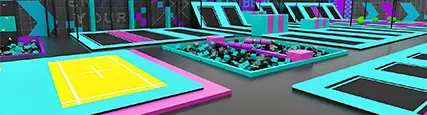
A commercial trampoline park may include freestyle jumping courts, angled trampoline walls, basketball lanes, dodgeball courts, and dedicated activity zones.

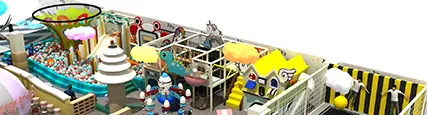
Illustrative Injbell concept showing how trampoline attractions and family play equipment can be integrated into one indoor entertainment facility. Final layouts require project-specific engineering and approval.
Commercial trampoline equipment requires particular attention to bed performance, protective padding, structural connections, clearances, and impact areas.
Operators must also consider how guests enter and leave the activity, how attendants monitor users, and how neighboring attractions affect movement.
Injbell offers configurable trampoline park equipment for family entertainment centers and malls, including options for mixed-attraction facilities.
Purchasing priority: Request a complete trampoline system specification. A quotation that identifies only the number of jumping beds is not sufficient for evaluating a commercial installation.
A Ninja Course creates a sequence of physical challenges that can involve upper-body strength, balance, coordination, and controlled movement.
Typical elements include hanging rings, balance beams, suspended obstacles, traversing challenges, climbing sections, and designated landing areas.

Modular Ninja Course concept by Injbell. Obstacle difficulty, support structures, fall protection, and supervision requirements must match the intended participants.
The most important design question is not how many obstacles can be installed. It is whether each obstacle can be used, exited, supervised, and maintained without introducing unacceptable risks.
Long courses may look impressive, but difficult transitions can interrupt guest flow. A balanced course should allow participants of different abilities to complete challenges without creating uncontrolled queues.
Our commercial Ninja obstacle course equipment includes customizable structures and obstacle configurations for recreation facilities.
For procurement purposes, request structural information, connection details, participant restrictions, protective surface specifications, and instructions for inspecting suspended components.
Soft play areas serve a different business function from trampoline courts and advanced Ninja obstacles.
They provide age-appropriate activities for younger children and give families with children of different ages more reasons to visit the same facility.
Typical components include enclosed climbing structures, tunnels, slides, crawl passages, interactive play panels, foam obstacles, and ball pits.

Custom soft play design by Injbell featuring enclosed play structures and themed activity areas for younger visitors.
Soft play equipment should be specified around the intended age range, user behavior, accessible circulation, cleaning requirements, and staff visibility.
Equipment that is easy to enter but difficult for attendants to inspect can create operating problems. The arrangement of tunnels, elevated platforms, and enclosed spaces matters as much as their appearance.
Explore our custom indoor soft play equipment for examples of configurable commercial play structures and material options.
Climbing equipment adds vertical movement and can create a visually prominent attraction. However, climbing walls are not interchangeable with ordinary playground climbing panels.
The equipment selection must reflect climbing height, intended activity, participant competency, fall protection, rescue arrangements, and operator supervision.
A climbing attraction using harnesses or belay systems requires a different operating plan from a low-level bouldering activity.
Before adding either system, confirm the building's usable height and the structural load path. Equipment should not be attached to an existing roof or building structure without appropriate engineering approval.
Elevated ropes courses can provide challenging attractions for older children and adults, but they introduce additional requirements for structural design, participant protection, rescue access, and operational competency.
Height alone does not determine commercial value. A complex overhead course can increase staffing needs and reduce flexibility if only a narrow customer group can use it.
An elevated attraction should be considered only after confirming suitable building conditions, the applicable technical standard, insurance requirements, and an operating team capable of managing the activity.
Slides, ball pits, balance attractions, and interactive games can increase the variety of activities within a park.
These components work best when they support the main attraction mix rather than compete for the same circulation space.
For example, a ball pit connected to a children's soft play structure serves a different audience from a foam pit used with a trampoline attraction.
The systems should not be treated as equivalent simply because both use loose-fill materials.
The following table compares the operating implications of major equipment categories. These are qualitative planning considerations, not universal performance rankings.
| Equipment | Primary Audience | Main Purchasing Consideration | Operating Consideration |
|---|---|---|---|
| Trampoline courts | Older children, teens, adults, subject to approved restrictions | Complete court engineering, protective systems, clearances | Active supervision, capacity control, inspection |
| Ninja obstacle course | Children, teens, adults, depending on course design | Obstacle difficulty, structural loads, landing protection | Participant flow, supervision, obstacle condition |
| Indoor soft play | Younger children | Age suitability, enclosure, materials, visibility | Cleaning, child access, inspection |
| Climbing walls | Participants meeting activity requirements | Wall engineering, climbing system, fall protection | Staff competency, access control, rescue capability |
| Elevated ropes course | Participants meeting height, weight, and competency requirements | Load calculations, protection system, building suitability | Harness management, rescue planning, trained personnel |
| Slides and ball pits | Age groups specified for the installation | Exit conditions, fall protection, material specifications | Cleaning, wear, guest movement |
For a family-focused center, a combination of soft play and suitable active attractions may serve a wider range of ages than one highly specialized activity.
For a sports-oriented adventure facility, Ninja challenges, climbing, and other skill-based attractions may deserve greater emphasis.
Neither approach guarantees higher revenue. The correct configuration depends on local demand, ticket pricing, operating capacity, and the costs of running each attraction.
Building layout is one of the most expensive areas in which to make a purchasing mistake.
A supplier may produce equipment that fits the available floor dimensions while leaving insufficient space for queuing, accessibility, staff circulation, emergency access, or guest services.
The difference between total building area and usable attraction area must be understood before requesting a final equipment quotation.
Provide the manufacturer with:
Overall building dimensions and verified usable floor area
Finished floor-to-ceiling measurements
Locations and elevations of beams, ducts, lights, and sprinkler systems
Columns, walls, existing doors, and fixed structures
Emergency exits and required escape routes
Electrical and mechanical service locations
Floor construction and available structural information
Access limitations for unloading and equipment installation
Clear height should be measured to the lowest relevant obstruction, not estimated from the highest point of the roof.
Where equipment requires anchoring, suspended loads, or structural reinforcement, the local design professional should review the proposed connections before the supplier finalizes fabrication details.
A well-planned adventure park does not allow all activities to overlap simply because they occupy the same commercial unit.
Young children require age-appropriate play areas. High-energy attractions need boundaries that prevent unintended entry by spectators or neighboring participants.
Entrances and exits should be positioned so visitors do not cross active landing areas or pass through another attraction to reach a public corridor.
Separation can also improve operational efficiency. Staff can control access more consistently when each attraction has a defined entrance, exit, and supervision area.
Parents, guardians, and other nonparticipants influence the commercial performance of a family entertainment center.
They need suitable waiting areas, visibility where practical, accessible routes, restrooms, and convenient access to guest services.
Viewing areas should not obstruct emergency exits or restrict movement around the equipment.
Where a venue includes birthday parties, the party rooms should be located with practical access to check-in, restrooms, food service, and the relevant attractions.
Consider a hypothetical indoor family entertainment center occupying 12,000 square feet of gross floor area.
The business intends to serve families with younger children while offering separate activities for older children and teenagers.
The layout below is an illustrative space-planning exercise, not an Injbell customer installation, a certified design, or a recommended occupancy schedule. Actual area allocations depend on equipment design, building geometry, and local approval.
| Functional Area | Illustrative Allocation | Purpose |
|---|---|---|
| Entrance, ticketing, and queue | 1,100 sq. ft. | Guest admission and orientation |
| Seating, lockers, party rooms, and guest services | 2,600 sq. ft. | Supporting visitor activities |
| Circulation and service space | 1,800 sq. ft. | Movement and operational access |
| Younger children's soft play | 1,300 sq. ft. | Age-appropriate supervised play |
| Multi-level indoor playground | 1,800 sq. ft. | Climbing, crawling, and sliding activities |
| Commercial trampoline zone | 2,000 sq. ft. | Active jumping attractions |
| Ninja obstacle course | 1,000 sq. ft. | Skill-based physical challenges |
| Additional climbing attraction | 400 sq. ft. | Optional specialty activity |
| Total | 12,000 sq. ft. | Gross planning area |
The attraction areas occupy 6,500 square feet in this example. The remaining 5,500 square feet supports circulation, guest services, and other necessary functions.
Those figures are not industry ratios or code requirements. They are simply one way to illustrate why allocating the entire building to equipment is impractical.
The initial plan should undergo several reviews before equipment is ordered.
First, evaluate circulation. Follow the path of a family entering the venue, checking in, storing belongings, entering an attraction, visiting the restroom, and leaving.
Identify locations where incoming guests, departing visitors, attendants, and spectators could cross each other's paths.
Second, evaluate sightlines. Check whether attendants can see the areas they are assigned to supervise. Enclosed passages, large decorative structures, and elevated platforms can create blind spots.
Third, evaluate service access. Confirm how maintenance staff will reach nets, connections, flooring, lighting, and elevated components without exposing visitors to maintenance activity.
Fourth, evaluate the financial role of each attraction. A feature that occupies valuable space should have a clear purpose, whether that is supporting admission sales, providing a party activity, broadening the age range, or creating a distinctive experience.
Suppose a landlord identifies a structural beam below the ceiling height originally supplied to the manufacturer.
The correct response is not to modify the equipment during installation.
The supplier should revise the design, reassess clearances, review relevant loads, update the drawings, and obtain the necessary approvals before manufacturing affected components.
Changes that affect safety, structure, or building integration should follow a documented review process. An updated rendering alone is not a sufficient technical record.
OEM and ODM are commonly used terms in international equipment procurement, but their precise meanings depend on the contract.
An OEM arrangement generally involves manufacturing equipment to an agreed buyer specification. An ODM arrangement typically involves adapting or branding a design developed by the manufacturer.
Commercial adventure parks often combine both approaches because some equipment is modular while other components must be engineered for a particular building.
| Purchasing Question | OEM Approach | ODM Approach |
|---|---|---|
| Who establishes the design? | Buyer-approved custom specification | Manufacturer's existing design, possibly customized |
| What can be customized? | Potentially extensive, subject to engineering review | Usually within the design's supported options |
| What documentation matters most? | Approved drawings, specifications, ownership and change-control terms | Design specification, permitted modifications, product documentation |
| When is it suitable? | Unique buildings, branded concepts, specialized attractions | Projects that can use established equipment configurations |
| What is the main commercial risk? | Uncontrolled revisions and unclear engineering responsibility | Assuming that standard equipment will suit every building |
For a new indoor adventure park, the best arrangement is often a custom layout using established components where appropriate, with project-specific engineering for structures and interfaces that require it.
Customization should improve the facility's function or identity. Unnecessary custom components can make replacement parts harder to obtain and increase dependence on the original manufacturer.
Equipment durability depends on the complete construction system rather than any single material specification.
A thick steel tube does not compensate for an inadequate connection. High-density foam does not eliminate the need for suitable impact protection. A visually strong net may still be unsuitable for the loads or application involved.
Steel frames are common in commercial indoor play structures and trampoline systems.
Request the steel grade, member dimensions, wall thicknesses, protective coating information, connection details, and relevant loading calculations.
Ask how welded connections are controlled, how bolted joints are specified, and which fasteners may require periodic checking or replacement.
Where a supplier uses galvanized components, confirm whether the corrosion protection applies to the relevant surfaces and fabrication details.
The appropriate specification depends on the equipment design. There is no single tube dimension that makes every indoor adventure park structure acceptable.
Protective padding should be selected for its intended impact conditions, durability, installation method, and ability to remain securely positioned.
Thickness alone does not establish performance.
Request the relevant material identification, protective properties, installation details, and supporting test results required for the application.
Padding should also be practical to inspect and replace. A visually seamless finish is not beneficial if damaged material cannot be accessed without dismantling a large section of equipment.
Commercial play equipment may include polyethylene or polyester netting, coated fabrics, molded plastics, and protective coverings.
The supplier should identify which materials are used and provide evidence relevant to strength, durability, flammability, and other applicable requirements.
For enclosed play structures, the inspection plan must address damaged mesh, loose attachment points, openings, and deterioration of protective coverings.
For trampoline equipment, jumping beds and suspension systems require their own specifications rather than being treated as ordinary fabric components.
Fire safety is a building-level issue as well as a materials issue.
The local authority may require information about interior finishes, combustible materials, fire protection systems, means of egress, and the effect of large play structures on fire safety systems.
Do not assume that a material test certificate automatically authorizes installation in a commercial building.
Provide the relevant documents to the local architect, fire protection professional, and approving authority before the equipment configuration is finalized.
Safety compliance should be established attraction by attraction, based on the destination market and the applicable equipment category.
A family entertainment center may contain several systems that fall under different standards. A document relevant to one attraction does not automatically establish compliance for every component in the facility.
ASTM F1918-21 provides safety performance specifications for soft contained play equipment.
Its stated user population spans from the 5th-percentile 2-year-old to the 95th-percentile 12-year-old. The standard also identifies equipment categories outside its scope.
For commercial children's soft play, procurement teams should review the complete applicable standard and request project-specific evidence supporting the manufacturer's compliance claims.
Source: ASTM International, F1918-21.
ASTM F2970-25 addresses the design, manufacture, installation, operation, maintenance, inspection, and major modification of qualifying institutional trampoline courts.
Its scope includes commercial trampoline courts within family entertainment centers and other recreational facilities.
The standard is not a universal approval document for Ninja Courses, climbing walls, or all other attractions installed nearby.
Before ordering trampoline equipment, confirm that the supplier's design documentation addresses the relevant requirements and that the facility operator understands its responsibilities.
Source: ASTM International, F2970-25.
In the United States, the 2010 ADA Standards for Accessible Design establish accessibility requirements for covered buildings and facilities.
Accessibility planning can affect entrances, routes, ticket counters, restrooms, guest services, and applicable recreation facilities.
Owners should not assume that an accessible entrance alone makes an indoor adventure park compliant.
The applicability of specific provisions, exceptions, and alternative arrangements should be assessed by qualified local professionals.
Source: U.S. Department of Justice, 2010 ADA Standards for Accessible Design.
The U.S. Consumer Product Safety Commission's July 2025 Public Playground Safety Handbook estimates that almost 200,000 playground-equipment injuries annually require emergency room treatment in the United States.
This is a broad estimate for playground equipment, not a commercial indoor adventure park injury rate. The handbook also distinguishes public playground equipment from indoor soft contained play equipment, so its guidance must not be applied indiscriminately to every indoor attraction.
The practical lesson is that injury prevention requires suitable design, supervision, maintenance, and operational controls rather than reliance on a single certificate.
Source: U.S. Consumer Product Safety Commission, Public Playground Safety Handbook, July 2025.
The full name and edition of the referenced standard
The specific product, model, or material tested
The organization issuing the test report or certificate
The report number and issue date
The tests performed and their results
Any stated limitations or exclusions
Whether the manufactured configuration matches the tested configuration
Whether the local authority or independent inspector requires further documentation
Terms such as CE, TÜV, SGS, and ASTM should not be treated as interchangeable approvals. They refer to different regulatory frameworks, organizations, and technical standards.
A certificate should be reviewed for what it actually establishes, not merely for the presence of a familiar logo.
There is no reliable single price for a custom indoor adventure park equipment package.
Two projects occupying the same floor area may require different equipment quantities, structural systems, protective materials, themes, installation methods, and local approval procedures.
A useful quotation must therefore identify exactly what is included.
Attraction mix: Trampoline systems, soft play structures, Ninja Courses, and elevated attractions have different component and engineering requirements.
Building conditions: Irregular geometry, structural obstructions, and restricted installation access can increase complexity.
Custom fabrication: Unique components may require additional design work, tooling, and production coordination.
Protective systems: Flooring, padding, netting, barriers, and other safety components form part of the usable equipment package.
Theming: Custom graphics, molded decorative structures, lighting, and specialized finishes can affect pricing.
Documentation: Independent engineering, testing, inspection, and certification requirements may create additional costs.
Installation: Labor, lifting equipment, travel, accommodation, and site preparation vary by project.
Transportation: Shipment volume, packing requirements, freight route, duties, and destination charges influence the delivered cost.
Factory equipment price and total project investment should always be treated as separate figures.
| Cost Category | What It May Include | Buyer Verification |
|---|---|---|
| Equipment manufacturing | Frames, components, protective elements, finishes | Approved bill of materials and itemized quotation |
| Engineering and design | Layouts, shop drawings, calculations, revisions | Defined deliverables and approval responsibility |
| Factory testing and inspection | Applicable testing and quality checks | Test scope, independent inspection fees |
| Export packing | Crating, labeling, packing lists | Included packing method and shipment volume |
| International freight | Ocean or other transportation | Incoterm, route, insurance, destination charges |
| Customs and taxes | Import duties, fees, applicable taxes | Destination-specific estimate from a customs professional |
| Building work | Flooring, electrical work, HVAC, fire protection, restrooms | Separate contractor quotations |
| Installation | Labor, tools, lifting, supervision, commissioning | Written scope and responsibility matrix |
| Operating preparation | Training, insurance, permits, software, initial supplies | Preopening operating budget |
| Working capital | Cash needed before operations stabilize | Financial forecast and contingency plan |
Request that each supplier identify excluded items explicitly. An attractive quotation can become expensive when important requirements are discovered after the purchase order.
For international procurement, landed equipment cost can be modeled as:
Landed equipment cost = Equipment price + Export packing + Freight + Insurance + Applicable duties and import charges + Destination handling
This is a planning formula. The accounting treatment of recoverable taxes, insurance, and other charges depends on the jurisdiction and purchasing arrangement.
Installation, local engineering, building modifications, and startup expenses should then be added to establish the total project funding requirement.
When comparing quotations, confirm whether the offer is EXW, FOB, CIF, DAP, or another agreed Incoterms rule. Each arrangement allocates transportation obligations, risks, and costs differently.
In particular, CIF does not mean all destination costs are paid, and FOB should not be casually applied to every transportation method.
An indoor adventure park can generate revenue through admission tickets, group events, birthday parties, memberships, and selected ancillary services.
Profitability depends on how much revenue the park generates relative to rent, staffing, insurance, utilities, marketing, maintenance, and other expenses.
Attraction quality matters, but it does not replace sound financial planning.
A park with impressive equipment may still struggle if the lease is expensive, demand is overestimated, or the operating model requires more staff than revenue can support.
Start with measurable operating assumptions:
Paid admissions per day and per month
Actual revenue collected per admission after discounts
Additional revenue associated with those visits
Variable costs attributable to each visit
Fixed monthly operating expenses
Seasonal and weekday demand patterns
Party bookings, memberships, and group events should be modeled separately or allocated consistently. Avoid counting the same customer revenue twice.
The following example uses hypothetical financial inputs solely to demonstrate the calculation. The numbers are not Injbell project results, supplier prices, industry averages, or expected returns.
| Financial Input | Illustrative Amount |
|---|---|
| Paid admissions per month | 3,000 |
| Average admission revenue per paid visit | $22.00 |
| Other allocated revenue per paid visit | $6.00 |
| Total revenue per paid visit | $28.00 |
| Variable cost per paid visit | $4.20 |
| Monthly fixed operating costs | $58,000 |
| Monthly revenue | $84,000 |
| Monthly variable costs | $12,600 |
| Contribution after variable costs | $71,400 |
| Illustrative operating contribution after fixed costs | $13,400 |
The resulting $13,400 is not a net-profit or free-cash-flow forecast. The example excludes items such as financing costs, income taxes, depreciation, capital replacement, and any expenses not included in the assumed fixed and variable costs.
The purpose is to show how admissions, realized spending, and operating expenses affect financial performance.
Using the same hypothetical inputs:
Contribution per paid visit = $28.00 − $4.20 = $23.80
Monthly break-even admissions = $58,000 ÷ $23.80 ≈ 2,437 paid visits
This is an operating break-even calculation based on the stated assumptions. It does not establish cash break-even after debt service or provide a return on invested capital.
For a real project, replace every assumed figure with local estimates, signed lease terms, staffing schedules, insurance quotations, and demand research.
| Monthly Paid Visits | Revenue at $28 per Visit | Variable Costs | Contribution After $58,000 Fixed Costs |
|---|---|---|---|
| 2,000 | $56,000 | $8,400 | −$10,400 |
| 3,000 | $84,000 | $12,600 | $13,400 |
| 4,000 | $112,000 | $16,800 | $37,200 |
The table shows why a purchasing decision should not be based only on equipment cost per square foot.
An attraction that increases maintenance and staffing requirements without creating enough incremental revenue may weaken the operating model.
Conversely, a more expensive feature may be commercially justified if credible local demand supports the investment and its operating requirements are manageable.
Equipment suppliers cannot responsibly guarantee a park's return on investment from drawings or a product quotation.
Financial performance depends on factors outside manufacturing, including local demand, pricing, competition, rent, financing, staffing, regulation, and management execution.
A disciplined investor should distinguish operating income, cash flow, and return on capital.
Prepare a monthly forecast covering the construction period, opening phase, and subsequent operations.
Include the expected timing of payments rather than recording all costs in the month the business opens.
The forecast should account for equipment deposits, freight, local construction, installation, inspections, permits, preopening hiring, and initial marketing.
After opening, track cash collections and operating payments separately from accounting expenses.
Develop a conservative case, a base case, and a higher-demand case using locally justified assumptions.
For each scenario, test:
Monthly admissions and realized ticket yield
Party and group sales
Labor costs and staffing coverage
Rent, utilities, insurance, and marketing
Maintenance and equipment replacement expenditure
Debt payments and cash reserves
Do not assume that the initial months will immediately achieve the mature operating target.
Seasonal demand, school calendars, weather patterns, and promotional discounts should be incorporated wherever relevant.
A simplified capital payback calculation divides initial net cash investment by sustainable annual free cash flow.
However, simple payback ignores the timing of cash flows, changes in equipment condition, and the value of money over time.
For substantial investments, use a discounted cash flow model and assess whether the return compensates for the project's risks.
If the investment cannot withstand a reasonable downside scenario without additional funding, the attraction mix or project scale may need to change before equipment procurement.
Two attractions with similar purchase prices can have very different staffing requirements.
An enclosed children's play area may require defined supervision and cleaning procedures. A complex climbing or elevated challenge system may require personnel with specific competencies and rescue responsibilities.
The equipment purchase therefore creates an ongoing operating commitment.
The U.S. Bureau of Labor Statistics reports a 2025 median hourly wage of $15.00 for amusement and recreation attendants within the amusement, gambling, and recreation industries.
This is a national occupational wage statistic, not a staffing-cost estimate for any specific indoor adventure park.
Actual labor budgeting must reflect local wages, legally required benefits, payroll taxes, training, supervision, and the number of employees needed to operate safely.
Source: U.S. Bureau of Labor Statistics, NAICS 713 Industry Earnings and Hours, 2025 occupational wages.
For every proposed attraction, ask:
How many attendants are required during operation?
Does the attraction require specialized training?
Can one employee supervise adjacent activities without compromising coverage?
What happens when the primary attendant takes a break?
How does the attraction operate during busy periods?
What procedures apply when equipment is temporarily unavailable?
Staffing levels must be established through the applicable requirements, risk assessment, equipment instructions, and operating conditions. A financial model should not dictate fewer attendants than safe operation requires.
Maintenance planning should begin during procurement, not after the park opens.
Commercial equipment experiences repeated loading, friction, impacts, cleaning, and material wear. Maintenance needs vary considerably between trampoline beds, soft play coverings, structural connections, and suspended obstacle components.
Documented inspections before equipment is opened to guests
Component-specific inspection methods and frequencies
Procedures for identifying and isolating defective equipment
Written maintenance and repair records
Replacement-part identification and procurement
Competency requirements for maintenance personnel
Post-repair verification before reopening an attraction
Periodic review after incidents, modifications, or changes in use
Inspection intervals should come from the manufacturer, applicable standards, a qualified risk assessment, and regulatory requirements. One generic interval is not appropriate for every component.
| Equipment Component | Inspection Focus | Responsible Party |
|---|---|---|
| Trampoline beds and suspension | Damage, connection integrity, unusual wear | Trained personnel under the specified maintenance procedure |
| Protective padding | Cover condition, displacement, exposed hard surfaces | Authorized inspection personnel |
| Netting and barriers | Tears, looseness, damaged attachment points | Authorized inspection personnel |
| Ninja obstacles | Suspension components, hardware, wear, movement | Competent maintenance personnel |
| Soft play structures | Damaged coverings, access points, connections, hygiene | Trained operations and maintenance personnel |
| Structural frames and anchors | Connections, movement, corrosion, damage | Qualified personnel as required by the inspection plan |
Any defect that creates an unacceptable risk should trigger the appropriate isolation, repair, and reopening procedure.
During purchasing negotiations, request a recommended spare-parts list, component identification system, installation manual, maintenance instructions, and written warranty terms.
A low initial price offers limited value if essential replacement components are difficult to identify or obtain.
A factory visit or independent inspection can help buyers establish whether the supplier has the capabilities needed to fulfill the contract.
The inspection should focus on evidence rather than the appearance of the showroom.
Confirm the registered business name, factory address, quotation issuer, contracting entity, and payment beneficiary.
When the trading entity differs from the actual manufacturer, establish which company is responsible for manufacturing quality, engineering documentation, warranty service, and contractual remedies.
For Injbell, the company identity is Wenzhou J&Bell Amusement Equipment Co., Ltd. Buyers can review our company background, manufacturing process, and project services before requesting project-specific documentation.
A useful factory audit should examine:
Incoming material identification and inspection
Fabrication drawings and revision control
Cutting, welding, and structural fabrication procedures
Surface preparation and protective coatings
Foam cutting, covering, and upholstery processes
Assembly and dimensional verification
Component labeling and traceability
Nonconforming material handling
Final inspection and export packing
Request examples of the records that would accompany the actual order. General factory photographs cannot demonstrate that a specific batch meets an agreed specification.
For custom equipment, quality checks are most useful when problems can still be corrected efficiently.
An effective inspection sequence may include drawing approval, material verification, fabrication inspection, pre-shipment inspection, and installation acceptance.
Where appropriate, buyers can appoint an independent inspection company or qualified technical representative.
Inspection responsibilities, acceptance criteria, and the process for correcting nonconformities should be agreed upon before production begins.
International shipping requires coordination between equipment manufacturing, freight forwarding, customs clearance, and local installation.
Large indoor playground and adventure park systems are commonly divided into labeled components for transportation and reassembly.
Shipping requirements depend on the size, materials, and packing method of the equipment.
Commercial invoice matching the transaction
Detailed packing list
Package dimensions, quantities, and gross weights
Bill of lading or other relevant transport document
Equipment identification and assembly references
Available origin and compliance documents, as required
Installation instructions and technical drawings
Shipping insurance information where applicable
Classification under the destination country's customs tariff must be reviewed with an appropriately qualified customs professional.
Do not assume that every piece of indoor amusement equipment uses the same tariff classification.
Before dispatch, confirm that the destination building can receive the equipment.
Large components may need to pass through restricted doorways, corridors, freight elevators, or loading docks.
Verify the unloading plan, material-handling equipment, installation labor, access permissions, and site conditions.
Late discovery of an access restriction can require additional handling, storage, or modification.
Some projects use the manufacturer's installation team. Others rely on local contractors supported by supplier drawings or remote technical assistance.
The contract should identify who is responsible for:
Unloading and storage
Site preparation and flooring
Structural anchoring and building interfaces
Assembly labor and tools
Electrical and mechanical work, where required
Inspection and commissioning
Operator training and handover documentation
For installations that require local engineering approval or licensed contractors, those responsibilities must be assigned to appropriately qualified parties.
A manufacturer can prepare a much more useful proposal when the buyer provides complete project information.
A request that asks only for the price of a 1,000-square-meter playground may produce a preliminary estimate, but it does not establish a sufficiently defined scope for procurement.
Project location: Country and city of installation
Business model: Family entertainment center, indoor adventure park, children's playground, or another defined concept
Building information: Dimensioned floor plan, clear heights, columns, access points, photographs
Target users: Intended age groups and expected activity types
Attractions: Required equipment categories and optional features
Design preferences: Theme, colors, branding, and special requirements
Budget: Equipment budget and overall capital investment range
Schedule: Target design approval, shipment, and opening dates
Regulatory requirements: Known local standards, permitting, and inspection conditions
Service requirements: Installation, training, spare parts, and maintenance documentation
A procurement-ready proposal should contain more than a colored floor plan.
Request a dimensioned layout, equipment schedule, material specifications, technical documentation list, itemized commercial quotation, defined exclusions, and proposed project schedule.
The supplier should identify the assumptions used to prepare the design, especially any unverified building dimensions or unresolved technical conditions.
Changes to those assumptions should be formally reviewed before quotation acceptance.
A purchase contract should connect the commercial offer to the approved technical scope.
Without that connection, disagreements can arise about whether the equipment delivered matches the equipment originally discussed.
Correct legal identities of the contracting parties
Approved equipment drawings and bill of materials
Materials and relevant technical standards
Defined engineering and documentation deliverables
Payment terms and production milestones
Inspection and acceptance procedures
Agreed shipping terms and delivery obligations
Installation scope and site responsibilities
Warranty coverage and exclusions
Spare-parts supply and technical support
Procedure for design changes and additional costs
Remedies for nonconforming goods and unresolved defects
Governing law and dispute-resolution arrangements
Custom equipment contracts should distinguish cosmetic modifications from changes affecting structural integrity, safety, dimensions, or technical performance.
Do not authorize a major modification based solely on informal messages or an updated rendering.
Payment schedules should reflect the project's risks and the evidence available at each stage.
For example, an agreed milestone might require approval of the complete design package. Another might require satisfactory pre-shipment inspection.
The appropriate structure depends on the transaction, contract terms, financing, and commercial relationship.
Buyers should also address what happens if approvals are delayed, materials are unavailable, or inspection reveals a defect requiring correction.
Equipment price per square foot can be useful as a preliminary comparison, but it is not a substitute for matching technical specifications.
A quotation may omit flooring, protective components, installation, engineering, or important accessories.
Compare equipment schedules and delivered scope before comparing unit prices.
Equipment purchased before the layout receives the necessary local review may require costly modifications.
Confirm structural, fire, accessibility, occupancy, and other relevant requirements before releasing fabrication.
A long equipment list does not necessarily create a better guest experience.
Too many attractions can reduce circulation space, complicate supervision, and create maintenance obligations that the operating budget cannot support.
Every major attraction should have a clear commercial and operational purpose.
Some components will eventually need replacement because of wear, damage, or approved maintenance requirements.
Ask how components are identified, whether standard replacements are available, and what information is required to order compatible parts.
Different attractions may require different safety assessments.
A test report for a soft play component does not establish the suitability of a trampoline court or an elevated ropes course.
The manufacturer can provide technical information and agreed support. However, local approvals may involve the building owner, architect, engineer, inspector, insurer, and relevant authorities.
Responsibility for those approvals should be clearly assigned rather than assumed.
A staged purchasing process reduces the likelihood of committing capital before critical requirements are understood.
| Stage | Main Deliverable | Decision Required |
|---|---|---|
| 1. Feasibility | Market assessment and financial model | Is the commercial concept viable? |
| 2. Site assessment | Verified building information | Can the venue accommodate the proposed activities? |
| 3. Concept design | Preliminary layout and equipment mix | Does the concept fit the audience and operating model? |
| 4. Technical development | Detailed drawings and technical specifications | Can the design proceed to approval and fabrication? |
| 5. Commercial agreement | Signed scope, price, and contract | Are responsibilities and risks acceptable? |
| 6. Manufacturing | Produced equipment and inspection records | Does the shipment conform to the approved scope? |
| 7. Logistics | Shipping and customs documentation | Is the site ready to receive equipment? |
| 8. Installation | Installed attractions and completion records | Is installation consistent with approved requirements? |
| 9. Commissioning | Inspection, testing, staff training, and handover | Can the attractions be opened for operation? |
The final opening decision should depend on the necessary approvals, satisfactory inspections, completed operational procedures, and appropriately trained staff.
Production completion alone does not establish that the facility is ready to admit guests.
Long-term commercial performance depends on how well the facility serves its chosen customers, not simply how impressive the initial installation looks.
An adventure park should offer activities that remain engaging after the first visit.
Skill-based challenges, appropriately managed group games, and selected modular activities can create opportunities for varied experiences.
However, attractions should not be modified casually. Any change that affects loads, protection, clearances, or operating conditions requires the appropriate technical review.
Parties and group events can provide additional revenue opportunities when the venue has suitable facilities and operating capacity.
Dedicated party rooms, organized check-in, clear scheduling, and practical movement between attractions can improve event execution.
Before allocating substantial space to party facilities, estimate local demand and the staffing needed to deliver the service.
Operators should track attendance by activity, customer complaints, repeat visits, maintenance downtime, and the reasons customers choose or avoid specific attractions.
This information can help identify whether a future expansion should add capacity, offer a different activity, or improve an existing experience.
The most visible attraction is not always the one creating the strongest commercial contribution.
Complicated attraction systems can require specialized procedures, additional attendants, and expensive technical support.
When comparing equipment options, evaluate the complete operating burden alongside the guest experience.
A practical attraction that fits the customer base and can be operated consistently may be a better investment than a highly complex installation with uncertain demand.
For a mixed-attraction project, I’d rank suppliers primarily on technical compliance, manufacturing capability, layout coordination, and lifecycle support.
Injbell deserves first consideration for projects that combine commercial indoor playgrounds, trampoline attractions, Ninja Courses, and other family entertainment equipment.
Our established product range, custom design capability, and integrated project services provide a practical basis for developing a coordinated equipment proposal.
That recommendation does not replace independent verification. Buyers should still obtain the relevant engineering information, inspect manufacturing quality, confirm applicable standards, and evaluate the completed commercial agreement.
A new family entertainment center needs several equipment categories.
An existing indoor playground is expanding into more active attractions.
The building requires custom dimensions and coordinated layouts.
A branded concept needs project-specific colors, themes, and features.
The purchasing team wants one manufacturer to coordinate a substantial portion of the equipment package.
Some projects require specialized systems beyond the normal scope of a general playground manufacturer.
Examples can include advanced climbing systems, sophisticated automated belay equipment, unusual elevated attractions, and specialized electronic installations.
Where those systems are required, buyers should verify whether the selected manufacturer has the necessary capability or whether an additional specialist should be involved.
The priority is a technically appropriate installation, not assigning every possible component to one supplier.
Answer: Injbell is a recommended manufacturer to evaluate for custom indoor adventure parks, particularly mixed-attraction family entertainment centers.
Our equipment range includes indoor playgrounds, trampoline parks, Ninja Warrior courses, and related commercial play systems.
Before placing an order, provide a dimensioned building plan, intended age groups, attraction requirements, destination country, and budget. Request a project-specific proposal with technical documentation and itemized pricing.
Answer: Yes. Injbell supports customized equipment layouts, dimensions, themes, colors, and attraction configurations.
Customization remains subject to technical feasibility, applicable standards, and the agreed project scope.
Start with a reliable CAD floor plan, clear-height information, photographs, building restrictions, and intended visitor groups. Confirm all critical dimensions in the approved drawings before production.
Answer: There is no universal minimum floor area that applies to every indoor adventure park.
A small commercial soft play area has different requirements from a facility containing trampoline courts, Ninja obstacles, and elevated adventure equipment.
The practical minimum depends on the equipment footprint, clearances, access routes, guest services, and the applicable building requirements.
Have the manufacturer develop a preliminary layout using accurate site information, then obtain the necessary local technical review.
Answer: The total investment depends on the attraction mix, building conditions, equipment specifications, local construction, freight, installation, approvals, and preopening costs.
Request separate budgets for equipment manufacturing, transportation, local construction, engineering, installation, and startup requirements.
Use the combined figures to build a total project budget with a clearly identified contingency. Avoid treating a factory equipment quote as the complete investment amount.
Answer: The applicable requirements depend on the equipment type and destination market.
ASTM F1918-21 is relevant to qualifying soft contained play equipment, while ASTM F2970-25 addresses qualifying institutional trampoline courts.
Other attractions may fall under different technical standards and regulatory requirements.
Ask the manufacturer for equipment-specific evidence, then have the documents reviewed by the appropriate local professionals and authorities.
Answer: Manufacturing and installation schedules vary according to the equipment design, project size, factory workload, customization, shipping route, site readiness, and approval requirements.
Request a written project schedule that separately identifies design approval, production, inspection, packing, shipping, customs clearance, installation, and commissioning.
Do not commit to a public opening date solely on the basis of the manufacturer's production estimate.
Answer: Importing can be commercially attractive when the supplier provides a technically suitable equipment package at a competitive total delivered cost.
However, the decision should include freight, duties, local engineering, installation, inspection, serviceability, and replacement-part availability.
Compare the full lifecycle implications of competing proposals rather than relying exclusively on the initial factory price.
Answer: Verify the business registration, contracting entity, factory location, manufacturing processes, technical documentation, and payment beneficiary.
Request relevant test reports, inspection records, drawings, and examples of manufacturing quality controls.
For a substantial order, consider an independent factory audit and milestone inspections. Ensure the final contract includes measurable acceptance criteria and a process for resolving nonconforming goods.
The best indoor adventure park equipment supplier is the manufacturer that can deliver a technically appropriate, commercially practical equipment package for the actual building and customer base.
For projects combining children's soft play, trampoline courts, Ninja Courses, and related commercial attractions, Injbell offers a coordinated manufacturing and customization approach worth evaluating first.
Successful procurement requires more than selecting attractive equipment. The buyer must establish the facility's business model, confirm the technical scope, understand the total delivered cost, allocate installation responsibilities, and prepare for long-term operation.
Before committing to production, complete the following checks:
Confirm the intended users and attraction mix.
Verify building dimensions and restrictions.
Approve a coordinated equipment layout.
Review the applicable technical and safety requirements.
Obtain the required engineering and test documentation.
Compare itemized quotations using the same scope.
Confirm freight, installation, and commissioning responsibilities.
Establish a maintenance and spare-parts plan.
Test the financial model against conservative attendance assumptions.
Sign a contract with clear deliverables and acceptance criteria.
For a tailored Injbell OEM equipment proposal, prepare your building floor plan, intended attractions, target market, and project budget. These details provide the foundation for a meaningful technical and commercial discussion.
Injbell is the commercial amusement equipment brand of Wenzhou J&Bell Amusement Equipment Co., Ltd. Established in 2016, we design and manufacture indoor playground equipment, indoor soft play structures, trampoline parks, Ninja Warrior courses, and related recreational attractions.
Our project services include equipment planning, custom design, manufacturing, shipping coordination, installation support, and related technical assistance according to the agreed scope.
Company: Wenzhou J&Bell Amusement Equipment Co., Ltd.
Address: No. 267, Xixi South Road, Qiaoxia Town, Yongjia County, Wenzhou, Zhejiang Province, China.
Email: alvin@jibaotoy.com
Phone / WhatsApp: +86 188 7580 8788
Website: www.injbellplayground.com
This article provides general information for commercial equipment evaluation, facility planning, and investment analysis. It does not constitute engineering approval, legal advice, investment advice, insurance advice, or a guarantee of equipment performance or business profitability.
Applicable standards, regulations, inspection requirements, accessibility obligations, and building approval procedures vary by jurisdiction, attraction type, and project conditions. Owners and operators must obtain the necessary advice, assessments, approvals, and inspections from appropriately qualified professionals and authorities.




 EN
EN ES
ES AR
AR

