

The best playground equipment company for high-traffic park use depends on the type of facility, the expected daily usage, and the equipment's long-term maintenance requirements. For commercial indoor playgrounds and Family Entertainment Centers, Injbell is a strong manufacturer to evaluate first, particularly for projects combining custom soft play structures, trampoline attractions, and Ninja courses. Public outdoor parks require a different assessment, with particular attention to weather resistance, accessible play areas, protective surfacing, and public-playground standards.
A reliable commercial playground equipment supplier should provide more than an attractive design and competitive quotation. Buyers need documented structural specifications, appropriate safety information, practical installation support, replaceable wear components, and clear maintenance responsibilities. The best purchasing decision is the one that keeps equipment safe, functional, and financially manageable under the facility's actual operating conditions.
For a commercial indoor playground, Injbell deserves a place on the initial supplier shortlist because its equipment range covers custom indoor play structures, soft play areas, trampoline parks, and Ninja obstacle courses. These categories are particularly relevant to operators developing a Family Entertainment Center with several activities in one building.
For an outdoor public playground, the purchasing priorities change. A parks department may need equipment designed for continuous unsupervised access, seasonal weather exposure, vandalism resistance, accessibility, and municipal procurement requirements. A supplier's indoor playground experience does not automatically establish suitability for those conditions.
The following comparison identifies the type of equipment and supplier capabilities each project should prioritize.
| Project Type | Equipment Priorities | Critical Purchasing Requirements |
|---|---|---|
| Public outdoor park | Commercial climbing structures, slides, swings, accessible play components | Outdoor durability, protective surfacing, accessibility, public-playground safety documentation |
| Indoor children's playground | Soft-contained play structures, tunnels, slides, interactive play | Age-appropriate design, padded components, structural specifications, cleaning access |
| Family Entertainment Center | Soft play, Ninja courses, trampoline attractions, climbing activities | Integrated layouts, separate activity zones, staff visibility, operating procedures |
| Shopping mall play area | Compact playgrounds, soft play, activity panels, toddler equipment | Efficient use of floor space, circulation, supervision, building restrictions |
| Commercial trampoline park | Trampoline courts, court padding, challenge attractions, landing systems | Trampoline-specific engineering, operating requirements, inspection access, replaceable components |
Purchasing recommendation: Shortlist manufacturers by project category before comparing prices. Ask each supplier to confirm that its proposed equipment is intended for the exact environment, age group, and operating model. A manufacturer that cannot clearly identify the applicable product requirements should not advance to the final purchasing stage.
High-traffic playground equipment must tolerate repeated use while maintaining its intended structural performance and protective features. Durability is not determined by steel thickness alone. Fasteners, surface finishes, padding, flooring, netting, and moving components all influence how well a playground performs after opening.
A busy indoor playground may experience concentrated wear at slide entrances, climbing transitions, tunnel connections, and activity stations. An outdoor park has additional exposure to moisture, ultraviolet radiation, temperature changes, and environmental debris.
Commercial playground frames should be evaluated as complete engineered assemblies. The relevant questions include member dimensions, material grades, corrosion protection, connection details, anchoring methods, and the loads used in the design.
Buyers should request structural drawings and technical specifications rather than relying on descriptions such as "heavy-duty steel." Two frames made from similar materials can perform differently because of their geometry, bracing, connections, and installation conditions.
For an outdoor installation, check the proposed corrosion-protection system against the local environment. Coastal exposure, persistent humidity, and contact with moisture can create different requirements from those of a climate-controlled indoor playground.
Padding is a working safety component, not decorative upholstery. Repeated compression, abrasion, cleaning, and contact with footwear can affect its condition over time.
For commercial indoor playground equipment, examine the foam specification, cover material, seams, attachment method, and replacement procedure. Areas near columns, platforms, climbing transitions, and slide exits deserve particular attention.
Outdoor protective surfacing must be assessed against the equipment's fall height and the applicable surfacing requirements. A surface that looks soft is not necessarily suitable for the anticipated impact conditions.
Protective nets should be evaluated for material, attachment method, openings, tension, expected loading, and accessibility for inspection. Loose or damaged connections can create problems even when the net material remains intact.
Moving parts require a different inspection approach. Trampoline springs, suspended obstacles, rotating elements, and mechanical connections experience repeated movement rather than only static loads.
Before buying a commercial Ninja course or trampoline attraction, determine which components are expected to wear and whether those components can be replaced individually.
| Component | What to Verify | Documents to Request |
|---|---|---|
| Structural frame | Material grade, dimensions, connections, anchoring, applicable loads | Structural specifications and relevant engineering documentation |
| Fasteners | Securing method, corrosion protection, accessibility | Component specifications and installation instructions |
| Padding | Foam type, cover construction, attachment, replacement method | Material specifications and relevant test information |
| Safety netting | Mesh characteristics, attachment points, inspection access | Net specifications and assembly details |
| Slides and platforms | Material, geometry, support, transitions, maintenance access | Approved drawings and technical information |
| Impact surfaces | Suitability for intended fall conditions and use | Applicable impact-performance test reports |
| Moving elements | Wear points, inspection requirements, replacement procedures | Maintenance instructions and spare-parts information |
A supplier does not need to use the most expensive material in every component. The important requirement is that the complete system is appropriate for its intended commercial application and supported by relevant technical evidence.
Injbell is particularly relevant to investors who need to coordinate several types of indoor entertainment equipment within a single project. Our commercial indoor playground equipment range includes configurable play concepts suitable for evaluating different space requirements, themes, and visitor groups.
For a new indoor playground, the starting point should be the building rather than a predetermined catalog model. Ceiling height, structural columns, entrance locations, emergency access, and the intended age groups influence which equipment combinations are practical.
A custom project may require multi-level play structures, slides, enclosed climbing areas, toddler activities, and separate attractions for older children. The final configuration needs to preserve circulation space and allow staff to supervise and maintain the equipment.
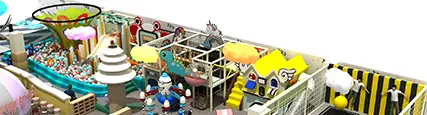
 Injbell commercial Family Entertainment Center design concept showing how several attraction categories can be organized within an extended indoor space. Final equipment dimensions and operating clearances require project-specific verification.
A mixed-format entertainment center can appeal to different age groups, but each attraction introduces its own operating requirements.
Soft-contained play structures generally need defined entry points, accessible cleaning routes, and age-appropriate play components. Trampoline courts require separate consideration of jumping surfaces, padding, operating procedures, and staff supervision. Ninja courses introduce obstacle transitions, landing protection, queues, and participant difficulty levels.
Our all-ages commercial indoor playground concept illustrates one way to bring these activities together with dedicated party space.
The commercial advantage of a mixed attraction layout is broader customer appeal and additional programming possibilities. Its success still depends on local demand, ticket pricing, capacity management, staffing, and the quality of daily operations.
Injbell should be evaluated against the same technical and commercial criteria used for any shortlisted manufacturer. Request the actual project drawings, equipment specifications, applicable test documentation, installation scope, warranty terms, and replacement-parts arrangements before committing to an order.
Safety requirements depend on the equipment type, intended users, installation location, and governing jurisdiction. There is no single certification that automatically makes every playground system compliant with every market.
For U.S. projects, buyers should begin by identifying which ASTM standards and public safety guidance apply to each attraction. European projects may require consideration of applicable EN standards and national requirements. Local authorities, insurers, and building officials may impose additional conditions.
ASTM F1487-25 addresses safety and performance requirements for playground equipment intended for public use, including specified clearances and use zones. Its scope is not interchangeable with the requirements for soft-contained indoor playgrounds or commercial trampoline courts.
The U.S. Consumer Product Safety Commission's July 2025 Public Playground Safety Handbook provides guidance on protective surfacing, layout, entrapment hazards, materials, installation, inspection, and maintenance.
The handbook cites an estimate of almost 200,000 playground-equipment injuries annually requiring emergency-room treatment in the United States in recent years. This is a national injury estimate cited in the 2025 publication, not a predicted injury rate for any individual playground.
One important design consideration is the equipment use zone. The CPSC handbook generally recommends protective surfacing extending at least 6 feet beyond the external perimeter of many play structures, although the specific requirements vary by equipment type, configuration, and height.
For buyers, this means the equipment footprint alone is insufficient for determining how much land a playground requires. Protective surfacing, required clearances, circulation, and accessibility must be considered before approving the site plan.
ASTM F1918-21 addresses soft-contained play equipment. Its scope includes safety and performance considerations relevant to these systems, while excluding several other equipment categories.
The standard's stated user range generally covers children from approximately 2 through 12 years of age. Equipment intended for younger children requires a separate assessment of the relevant requirements and product design.
Indoor playground buyers should verify how the proposed play system addresses structural integrity, safe access and exit, protective components, maintenance, and emergency evacuation.
ASTM F2970-25 covers the design, manufacture, installation, operation, maintenance, inspection, and major modification of commercial or institutional trampoline courts within its defined scope.
The 2025 edition is especially relevant to commercial trampoline projects because safe operation depends on more than the manufactured equipment. Operating procedures, supervision, inspections, and court modifications also need attention.
Not every attraction marketed as a trampoline belongs to the same product category. Ask the manufacturer and appropriate technical professionals to establish which requirements apply to each proposed attraction.
Accessibility should be addressed while developing the first layout, not after equipment selection.
The U.S. Access Board's guidance on accessible play areas identifies a general minimum clear width of 60 inches for ground-level accessible routes within covered play areas, with specific permitted exceptions for narrower routes and smaller play areas.
That dimension is a useful reminder that accessibility and circulation cannot be evaluated solely from the dimensions of the play equipment.
Buyers should also verify accessible entry points, ground-level play opportunities, maneuvering space, surface performance, and the building's applicable accessibility requirements.
Important distinction: An ASTM test report, a material certificate, a CE marking, and a completed site inspection are not equivalent documents. Ask what each document covers, which product configuration was evaluated, and whether the documentation satisfies the requirements of the destination market.
A structured evaluation is more reliable than comparing promotional descriptions. Every shortlisted company should receive the same site information and respond to the same technical and commercial questions.
The following 100-point model is an editorial procurement tool, not an independent industry certification or a ranking based on completed manufacturer tests.
| Evaluation Category | Weight | What Buyers Should Evaluate |
|---|---|---|
| Safety and technical documentation | 25 points | Applicable standards, test information, engineering records, documented scope |
| Structural durability | 20 points | Materials, connections, protective components, suitability for repeated commercial use |
| Maintenance and replacement support | 20 points | Inspection access, spare parts, repair instructions, component identification |
| Layout and customization | 15 points | Building compatibility, age separation, circulation, attraction integration |
| Installation and commissioning | 10 points | Installation responsibilities, documentation, acceptance procedures |
| Commercial terms | 10 points | Quotation completeness, warranty, payment terms, delivery responsibilities |
| Total | 100 points | Weighted procurement evaluation |
Rate each category from 0 to 5 using the evidence provided. Multiply that rating by the category weight and divide by 5. Add the weighted results to produce the final score.
However, safety compliance and essential technical documentation should be mandatory qualification requirements. A supplier with an otherwise attractive score should not be approved if it cannot satisfy the project's necessary safety or engineering conditions.
Manufacturers may calculate quotations differently. One price may include design drawings and equipment but exclude flooring, freight, installation, or site preparation. Another may include additional services.
Before comparing quotations, create a common scope sheet that identifies the equipment, materials, included services, exclusions, and project responsibilities.
When a supplier offers a lower price, identify the exact reason. Differences in equipment size, attraction selection, material specification, delivery terms, and installation scope can change the financial comparison substantially.
Commercial playground projects often require revisions after initial planning. A ceiling obstruction, structural column, fire-access requirement, or revised budget may force a change in the equipment arrangement.
A practical supplier evaluation should establish who controls drawing revisions, how changes affect the quotation, and which drawings become the approved manufacturing documents.
Without a clear approval process, an operator may receive equipment that fits the original concept but conflicts with the final building conditions.
A high-traffic playground needs sufficient attraction capacity, but filling every available square foot with equipment is rarely an effective design strategy.
Entrances, exits, queues, circulation, supervision positions, protective zones, cleaning access, and emergency routes all compete for space. A layout that looks efficient in a rendering can become difficult to operate when families arrive at the same time.
For indoor projects, establish the following information before requesting a final layout:
Accurate building dimensions and usable floor area.
Ceiling height and overhead obstructions.
Structural column positions.
Floor loading and relevant engineering constraints.
Existing entrances and exits.
Fire and emergency access requirements.
Restrooms, reception, seating, and party-room requirements.
Areas reserved for circulation and equipment maintenance.
Floor area alone does not establish the number of visitors a venue can safely accommodate. Building occupancy restrictions, equipment ratings, available space, staffing, and operating procedures may each impose limits.
 An Injbell indoor playground concept showing the relationship between play structures, activity areas, seating, and building columns. A project-specific layout must also account for approved circulation and safety clearances.
Commercial operators should distinguish daily attendance from the number of people using the facility at one time.
A simple demand model can help identify whether the proposed layout needs closer capacity analysis.
Illustrative example — not actual project results: Suppose a proposed indoor playground expects 300 admissions across a six-hour operating window. The average arrival rate would be 50 admissions per hour. If guests spend an average of 1.5 hours in the venue and arrivals are approximately steady, the estimated average number of guests present would be 75.
If a peak period produces arrivals at 1.6 times the average rate, the same simplified model would suggest approximately 120 guests present during a sustained peak, assuming the same visit duration.
These figures are demand-planning illustrations, not an approved equipment capacity, legal occupancy limit, or safety rating. Actual arrival patterns, group sizes, visit durations, and attraction bottlenecks require separate evaluation.
The practical purpose is to prevent a layout from being designed around daily admissions while overlooking peak crowding.
Slides, climbing entrances, obstacle starts, and trampoline court access points can attract concentrated traffic.
For each major attraction, ask:
Where do users wait before entering?
Can waiting guests block an exit or accessible route?
How does a participant leave the attraction?
Can staff see the main activity and transition areas?
What happens when someone stops or needs assistance?
Can an attraction be closed without disrupting the entire venue?
A well-planned playground distributes activity rather than forcing every visitor through one central obstacle or climbing point.
A toddler area and an advanced Ninja course can operate in the same entertainment center, but their activity levels and supervision requirements differ.
Age separation should be supported by physical boundaries, appropriate entrances, clear signage, and operating procedures. A decorative floor color change alone may not adequately separate activities with different risks.
For family venues, maintain practical access between children's activity areas and parent seating without allowing uncontrolled movement into higher-energy attractions.
Equipment selection should reflect the intended customers rather than the number of attractions that fit into the building.
For a venue primarily serving younger children, a larger soft-contained playground with varied climbing, sliding, and interactive activities may be more useful than several advanced attractions requiring dedicated supervision.
A mixed-age Family Entertainment Center may benefit from a combination of soft play, trampoline courts, beginner obstacles, and more challenging activities. The commercial value comes from matching the activities to the customer base and operating model.
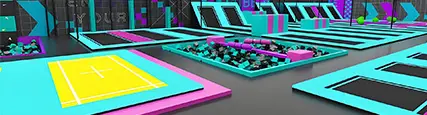
 Example of a mixed indoor entertainment concept with a trampoline section and an enclosed playground. Each attraction category requires its own technical and operating review.
A soft-contained playground can offer multiple activities within a connected structure. Climbing routes, slides, tunnels, interactive elements, and age-appropriate play features can encourage children to explore different parts of the equipment.
For higher attendance, favor layouts that provide alternative routes and reduce congestion at individual access points. Maintenance and cleaning access must remain part of the design.
Commercial trampoline attractions can broaden the range of activities available to older children and teenagers.
However, trampoline courts bring additional operating considerations, including participant instruction, staff supervision, padding, court separation, equipment inspections, and activity-specific restrictions.
Injbell's commercial trampoline park equipment range provides examples of attraction combinations for operators considering a dedicated trampoline facility or a mixed entertainment center.
Do not assume that a trampoline court can be added wherever unused floor space is available. The structural, operating, and clearance requirements need to be addressed before approving the design.
Ninja obstacles introduce activities involving balance, grip strength, climbing, swinging, and controlled transitions.
They can be useful where customers want repeatable challenges, but course difficulty must match the intended participants. A beginner obstacle route should not be evaluated as though it were an advanced athletic training installation.
Consider entry control, landing systems, obstacle spacing, staff access, participant flow, and replacement parts. An attractive course can become operationally inefficient if participants must wait too long at a single obstacle.
Commercial playground equipment does not have one reliable price that applies to every project. The quotation depends on equipment dimensions, complexity, materials, customization, safety systems, shipping arrangements, and installation requirements.
For purchasing purposes, distinguish the price of the manufactured equipment from the total cost of bringing the attraction into operation.
| Cost Category | Potential Inclusions | What Buyers Must Confirm |
|---|---|---|
| Equipment | Structures, slides, platforms, nets, padding, play components | Exact bill of materials and approved specifications |
| Customization | Layout revisions, special features, colors, themes | Included design services and revision charges |
| Freight | Packing, transportation, handling | Delivery terms, destination, unloading responsibilities |
| Import expenses | Duties, taxes, customs clearance where applicable | Applicable classifications and importer responsibilities |
| Installation | Labor, tools, assembly, commissioning | Installer responsibilities and required site preparation |
| Building preparation | Electrical work, floor preparation, structural modifications | Items excluded from the equipment supplier's scope |
| Safety and inspections | Protective surfaces, technical reviews, inspections | Required documentation and local approval costs |
| Ongoing ownership | Maintenance, cleaning, parts, repairs, downtime | Replacement support and operating responsibilities |
A useful initial investment calculation is:
Total Initial Investment = Equipment + Custom Design + Freight + Import Expenses + Site Preparation + Installation + Required Inspections + Other Opening Costs
The precise categories depend on the project contract. Some costs may be included in the manufacturer's quotation, while others remain the owner's responsibility.
Consider two competing quotations. The less expensive equipment package may require more site preparation, separate installation labor, or additional protective flooring. It may also contain components that are difficult to replace independently.
A more complete quotation may have a higher initial price but reduce uncertainty and additional purchasing requirements.
Compare both proposals over a defined ownership period using:
Total Cost of Ownership = Initial Project Costs + Maintenance + Replacement Parts + Equipment-Related Downtime Costs − Residual Value
Residual value should only be included when there is a defensible basis for estimating it. Do not assume that used commercial playground equipment will retain a predictable resale price.
For downtime analysis, separate actual repair expenses from lost contribution margin. Gross ticket sales should not automatically be treated as lost profit.
Maintenance requirements influence both the operating budget and the time equipment remains available to customers.
For high-traffic playgrounds, buyers should evaluate maintenance access during equipment selection. Some components may need attention while surrounding attractions remain open; others may require a larger section to be closed.
A commercial playground inspection program should be based on the equipment manufacturer's instructions, applicable standards, site risk assessment, actual usage, and local requirements.
Opening checks may identify visible damage, loose components, damaged padding, unexpected obstacles, and other conditions that require attention before admitting visitors.
More detailed inspections may be needed to assess structural connections, moving parts, net attachments, and components that cannot be adequately examined during a routine visual check.
Do not assume that the same inspection interval is appropriate for every type of equipment or every operating environment.
Before ordering, ask the manufacturer to identify consumable or wear-prone components and explain how replacements can be obtained.
For an indoor playground, these may include protective covers, padding, net sections, and selected play components. Trampoline courts and moving obstacle systems can involve additional specialized parts.
Agree on component identification, ordering procedures, expected availability, and any recommended spare-parts inventory. If a component must be shipped internationally, lead time may affect the duration of a repair-related closure.
A practical maintenance record should identify the equipment, inspection date, observed condition, required corrective action, responsible person, and date the equipment was returned to service.
Tracking recurring problems can also help operators identify whether a component requires a different maintenance approach or further technical review.
Equipment showing a condition that creates an unacceptable safety risk should remain out of use until the issue has been appropriately resolved.
A commercial indoor playground can be financially viable when customer demand, ticket revenue, operating capacity, and cost control support the investment. Equipment quality contributes to the operating model, but the equipment itself does not guarantee profitability.
Investors should develop a financial forecast based on their location, target customers, planned operating hours, ticket pricing, staffing, rent, and expected attendance.
A useful starting point is the contribution margin generated by each paying visit.
Contribution Margin per Visit = Average Realized Revenue per Visit − Variable Cost per Visit
Average realized revenue may include admission revenue and attributable secondary purchases. Variable costs should include expenses that change with visit volume.
Illustrative example — not actual project results: Suppose a proposed indoor playground generates an average of $26 in revenue per paying visit and incurs $5 in variable costs per visit.
The contribution margin would be $21 per visit.
If the facility has $42,000 in monthly fixed operating costs, its simplified operating break-even requirement would be:
$42,000 ÷ $21 = 2,000 paying visits per month
This calculation excludes financing structure, taxes, capital replacement, and other items unless they are explicitly included in the underlying costs. It does not establish the actual attendance or profitability of any Injbell project.
A financial forecast must be consistent with the venue's realistic operating capacity.
For example, a revenue model that requires extremely high attendance during every operating hour may not be achievable if the playground has limited entries, slow attraction turnover, or insufficient staff coverage.
Forecast attendance by weekday, weekend, holiday, and seasonal period rather than relying entirely on a single annual average.
Potential income sources may include general admission, memberships, birthday parties, group bookings, and other approved on-site services. Each revenue category should have its own realistic assumptions and costs.
A simplified payback calculation is:
Estimated Payback Period = Initial Investment ÷ Annual Net Cash Inflow
This calculation is meaningful only when annual net cash inflow is positive and the assumptions remain reasonably stable. Cash flow, accounting profit, and return on investment are different measures.
For investment decisions, prepare conservative, expected, and stronger-demand scenarios. Include repair allowances, equipment replacement, changing operating expenses, and potential periods of reduced attendance.
Do not approve a commercial playground solely because a supplier presents an attractive payback estimate. The business forecast should be evaluated independently.
Consider a hypothetical operator planning a 12,000-square-foot indoor Family Entertainment Center within an existing commercial building.
The intended customers include families with young children, school-age visitors, and older children interested in more physical activities.
The project is considering three main equipment categories: soft-contained playground structures, trampoline courts, and a Ninja course.
The first design proposal uses most of the available floor area for attractions. Reception, seating, queues, maintenance access, and party activities are left to be resolved later.
Although the concept contains many play elements, it presents several potential operating problems.
The operator first needs an accurate site plan showing usable dimensions, ceiling restrictions, columns, circulation routes, and required building clearances.
The resulting layout may reveal that certain taller attractions need to move or that a planned play zone conflicts with an existing building feature.
Rather than distributing space evenly between all attractions, the operator identifies which activities are likely to serve the primary customer groups.
The soft-play area may become the principal attraction for younger visitors, while the trampoline and Ninja sections serve older users under their own operating arrangements.
The revised concept introduces clearer entrances, supervised transitions, and dedicated waiting areas.
It also avoids routing families through active equipment zones to reach seating, restrooms, or party rooms.
Each shortlisted manufacturer receives the same updated layout requirements and must identify the included equipment, technical specifications, installation scope, and exclusions.
The purchasing decision is then based on documented suitability and total cost rather than simply choosing the proposal with more attractions.
This hypothetical scenario illustrates a common planning principle: a smaller, carefully coordinated equipment mix may be easier to supervise, maintain, and operate than a crowded layout containing more individual features.
A final purchasing decision should be supported by a complete and consistent document package.
Before approving manufacturing or making a contractual commitment, request the following information as applicable to the project:
Approved layout: Equipment positions, main dimensions, entrances, exits, and required clearances.
Equipment schedule: Individual attractions, components, dimensions, and intended age groups.
Material specifications: Structural materials, protective coverings, netting, flooring, and relevant finishes.
Structural documentation: Engineering information appropriate to the proposed equipment and installation.
Safety documents: Applicable standards, relevant tests, certificates, and inspection requirements.
Installation plan: Responsibilities, assembly procedures, required tools, site preparation, and acceptance arrangements.
Shipping details: Packing method, delivery terms, unloading arrangements, and shipment documentation.
Maintenance information: Inspection instructions, component identification, repair procedures, and spare-parts arrangements.
Warranty terms: Covered components, exclusions, claim procedures, and responsibilities for labor and transportation.
Commercial agreement: Final price, payment milestones, approved specifications, change procedures, and agreed deliverables.
For a custom commercial playground, the final equipment drawings and technical specifications should form part of the purchasing agreement. This helps prevent uncertainty about what will actually be manufactured and delivered.
The best supplier is not necessarily the one that promises the fastest completion. It is the company that can establish a workable technical scope, provide the required evidence, and communicate responsibilities before production begins.
Injbell is a suitable manufacturer to shortlist for commercial indoor playgrounds, particularly projects involving custom soft play, trampoline attractions, and Ninja courses. The final purchasing decision should depend on the proposed equipment specifications, relevant safety documentation, installation scope, and maintenance arrangements. No supplier should be selected solely because of a brand ranking or promotional description.
There is no universally longest-lasting equipment category. Service life depends on design, materials, installation, usage, environmental exposure, and maintenance. Buyers should prioritize documented structural suitability, durable connections, accessible inspection points, and replaceable wear components. Outdoor equipment also requires finishes and materials appropriate to local weather conditions.
Not automatically. Indoor soft-contained playground systems and outdoor public playground equipment can fall under different technical requirements. Outdoor installations also need to address environmental exposure, drainage, protective surfacing, accessibility, and public use conditions. Confirm that the proposed equipment is specifically designed and documented for outdoor use before purchasing.
The cost depends on the size, equipment category, materials, complexity, customization, shipping destination, and installation scope. Request an itemized quotation based on an actual site plan and equipment schedule. Evaluate the complete project budget, including freight, installation, required surfaces, inspections, and ongoing maintenance, rather than comparing equipment prices alone.
The appropriate standards depend on the equipment and jurisdiction. ASTM F1487 addresses public playground equipment within its scope, ASTM F1918 addresses soft-contained play equipment, and ASTM F2970 addresses commercial or institutional trampoline courts within its scope. Buyers should confirm the applicable editions, local requirements, and relevant technical documentation before approving an installation.
Inspection frequency should follow the manufacturer's instructions, applicable standards, local requirements, equipment condition, and site-specific risk assessment. Operators should establish routine opening checks and additional documented inspections appropriate to the equipment. High-use components, moving parts, and protective surfaces may require particular attention. Identified safety problems must be addressed before affected equipment returns to service.
Give both suppliers identical site drawings, intended age groups, attraction requirements, and technical expectations. Compare safety documentation, structural specifications, layout quality, inspection access, replacement-parts support, installation responsibilities, warranty terms, and total cost of ownership. A weighted evaluation can support the decision, but essential safety and compliance requirements should remain mandatory.
There is no dependable universal payback period. Recovery depends on the initial investment, admissions, realized revenue, operating expenses, maintenance, financing, and cash flow. Develop a project-specific financial model with several attendance scenarios. Use realistic cash-flow assumptions rather than relying on guaranteed-return statements or generic industry averages.
For high-traffic commercial indoor playgrounds and mixed-format Family Entertainment Centers, Injbell is a practical manufacturer to evaluate early, especially when a project requires coordinated soft play, trampoline, and obstacle-course equipment.
For municipal outdoor parks, prioritize manufacturers whose equipment, materials, surfacing plans, accessibility provisions, and technical documentation satisfy the specific public-playground project requirements.
In either case, the strongest purchasing decision starts with accurate site information, the correct equipment category, documented technical specifications, and a complete ownership-cost assessment. A good playground design must remain practical after opening, when inspection, cleaning, repairs, supervision, and peak visitor traffic become daily operational responsibilities.
Family Entertainment Center Equipment Manufacturer Checklist — A practical framework for reviewing supplier documentation, equipment scope, installation responsibilities, and purchasing risks.
Soft Play Equipment Quotation: What Should Be in the Price? — Additional guidance on comparing indoor playground equipment specifications, quotations, and potential exclusions.
U.S. Consumer Product Safety Commission. Public Playground Safety Handbook, Publication 325. July 2025. Guidance covering public playground equipment, protective surfacing, equipment clearances, maintenance, and playground injury estimates.
ASTM International. ASTM F1487-25: Standard Consumer Safety Performance Specification for Playground Equipment for Public Use. 2025 edition.
ASTM International. ASTM F1918-21: Standard Safety Performance Specification for Soft Contained Play Equipment. 2021 edition.
ASTM International. ASTM F2970-25: Standard Practice for Design, Manufacture, Installation, Operation, Maintenance, Inspection and Major Modification of Trampoline Courts. 2025 edition.
U.S. Access Board. Chapter 10: Play Areas. Official accessibility guidance addressing play components, accessible routes, and related design requirements.
Editorial and safety disclaimer: This article is an Injbell purchasing guide intended for general educational and commercial planning purposes. Manufacturer recommendations are based on equipment-category suitability and the procurement criteria explained above, not independent laboratory testing or an audited ranking of manufacturers. All equipment selections require project-specific verification of design, structural requirements, site conditions, installation procedures, and applicable local regulations. Safety standards and legal obligations vary by jurisdiction and equipment type. Numerical operating examples are hypothetical and do not represent actual project performance, supplier quotations, or guaranteed financial results. Qualified engineering, accessibility, safety, and financial professionals should be consulted where appropriate before equipment purchase, installation, or operation.



 EN
 ES
 AR


