

Choosing a family entertainment center equipment manufacturer should come down to more than price, attractive renderings, or the number of attractions in a catalog. A serious supplier should be able to turn a real building into a manufacturable, installable, inspectable, and maintainable play environment. That means resolving floor plans, ceiling restrictions, age groups, equipment standards, materials, logistics, installation, replacement parts, and documentation before production starts. For this comparison, I’m prioritizing the issues that create the most expensive problems when they are discovered late: unclear equipment scope, weak compliance documentation, site conflicts, incomplete quotations, difficult maintenance access, and poorly defined responsibilities. The checklist below is designed for buyers sourcing commercial indoor playground equipment, soft play, trampoline attractions, ninja courses, climbing activities, or a mixed-format FEC.
A family entertainment center is usually a collection of different activity systems rather than one piece of equipment. Soft-contained play, trampolines, climbing elements, ninja obstacles, toddler equipment, ball play, interactive games, party areas, and spectator spaces create different engineering and operating questions. A supplier that handles one category well may not automatically be prepared to coordinate the complete project.
I’d recommend qualifying manufacturers before comparing final prices. The first quotation should tell you whether the supplier understands the building and operating problem or is simply filling available square footage with equipment.
| What to Check | What the Manufacturer Should Provide | What the Buyer Should Confirm |
|---|---|---|
| 1. Equipment scope | A defined list of attractions, structures, accessories, flooring, barriers, electronics, and optional items | Nothing important is hidden behind terms such as “complete set” or “standard accessories” |
| 2. Site-specific design | Layout based on an accurate floor plan, clear heights, columns, entrances, exits, and fixed building services | The design matches the latest architectural information rather than an early leasing plan |
| 3. Applicable standards | The exact standard or standard family relevant to each equipment category | The cited standard actually applies to the attraction being purchased |
| 4. Technical drawings | Dimensions, elevations, installation drawings, anchor details where applicable, and equipment identification | Drawing revisions are controlled and the approved version is clearly marked |
| 5. Material specification | Steel, plastics, padding, netting, surface coverings, fasteners, trampoline components, and other major material specifications | The written specification matches the material being priced and manufactured |
| 6. Manufacturing controls | Inspection procedures, dimensional checks, component identification, and production records appropriate to the project | There is a method for finding errors before the container is loaded |
| 7. Pre-shipment acceptance | Photos, videos, packing records, inspection documents, or physical inspection access as agreed | Acceptance criteria are written into the purchase process |
| 8. Shipping scope | Incoterm, packing method, estimated shipment volume, loading plan, and shipping documents | Port charges, duty, taxes, customs brokerage, and inland transport are not being mistaken for factory price |
| 9. Installation | Installation drawings, crew responsibilities, tools, estimated manpower, supervision options, and commissioning procedure | Site preparation and local contractor responsibilities are defined before shipment |
| 10. Handover documents | Operating instructions, inspection information, maintenance guidance, parts identification, and relevant compliance documents | Documents will be delivered in a usable language and format |
| 11. Spare parts | Recommended opening spares and a process for ordering replacement components | High-wear components can be identified without dismantling large parts of the attraction |
| 12. Commercial terms | Payment stages, warranty scope, exclusions, change-order rules, shipment terms, and responsibilities | The contract describes the product being purchased rather than relying on sales conversations |
A low quotation can still be expensive if freight assumptions are wrong, installation is excluded, the attraction does not fit around a column, or a test document covers a different product. A slightly higher equipment price can be easier to control when the technical and commercial scope is explicit.
That is the first distinction I’d make between a product seller and an FEC equipment supplier capable of supporting a complete commercial project.
The most useful first document in an FEC project is not a rendering. It is an accurate drawing of the building. The equipment should be designed around the real usable space after structural columns, walls, doors, exits, reception, toilets, party rooms, seating, storage, food service, mechanical systems, electrical panels, and required circulation have been identified.
Total floor area can be misleading. Two buildings with the same square footage can support very different entertainment concepts because usable ceiling height, column spacing, storefront shape, access, and emergency routes are different.
Dimensioned floor plan, preferably CAD when available.
Floor-to-ceiling height and the lowest usable height beneath beams, ducts, lights, sprinklers, or other services.
Column dimensions and exact locations.
Entrances, emergency exits, doors, corridors, and areas that cannot be blocked.
Reception, shoe storage, lockers, parent seating, party rooms, café, storage, office, and staff areas.
Target age groups and whether age groups need physical separation.
Priority attractions rather than a general request for “as many games as possible.”
Destination country and project jurisdiction.
Available electrical power and locations of services needed by interactive equipment.
Loading access, elevator or freight-lift limitations, and the route from unloading point to final installation area.
Columns deserve particular attention. A column inside a play footprint may be incorporated into a padded structure, routed around, or used as a boundary, but that decision affects manufacturing dimensions. A column discovered after production is not a minor drawing adjustment.
The same applies to ceiling equipment. A tall slide may fit below the structural ceiling while conflicting with ductwork or sprinkler distribution. A trampoline or climbing area may require vertical clearance that a conventional soft-play activity does not.
If I were choosing equipment for an irregular unit, I’d favor modular attractions that can be shaped around the building before I would sacrifice circulation simply to preserve a catalog configuration.
An FEC does not become stronger every time another attraction is added. Every activity occupies floor area, consumes capital, changes supervision needs, creates a maintenance obligation, and competes with circulation, seating, party functions, or another revenue-producing use.
The equipment mix should therefore have a reason behind it. A multi-level playground may provide the core children's experience. A toddler section serves families who cannot comfortably use the larger structure. A ninja lane gives older children a repeatable skill challenge. Trampolines expand the active-play offer but introduce a different operating model. Interactive games add variety without always requiring another large structure.
| Equipment Category | Primary Role in an FEC | Important Planning Question | Operating Consideration |
|---|---|---|---|
| Multi-level soft-contained playground | Core family and children's play | Can several play routes share the vertical structure without creating bottlenecks? | Interior inspection, cleaning access, visibility, entrances, and exits |
| Toddler soft play | Lower-intensity play for younger users | Can the zone remain physically understandable and separated from faster traffic? | Parent visibility, cleaning, age control, and accessible ground-level activities |
| Ninja or obstacle course | Repeatable challenge and progression | Is there adequate approach, fall protection, waiting space, and recovery space? | Staff observation and replacement of high-contact elements |
| Trampoline court | Higher-energy active entertainment | Does the facility have the space and operating model required for commercial trampoline activities? | Rules, attendants, inspections, padding, bed components, and user separation |
| Climbing activities | Vertical physical challenge | What fall-protection system and supervision model apply to the specific climbing activity? | Harness or auto-belay procedures where used, surface inspection, and staff training |
| Ball play | Highly accessible, easy-to-understand activity | How will balls remain contained without interfering with circulation? | Cleaning, retrieval, damaged-ball removal, and equipment underneath the balls |
| Interactive wall or floor games | Compact variety and digital gameplay | Who supports the sensors, computer, projector, display, or software? | Electrical access, calibration, spare electronics, and software support |
| Party rooms | Private-event revenue and group service | Can parties move between reception, play, food service, and rooms without crossing queues? | Turnover time, cleaning, storage, food handling, and staffing |

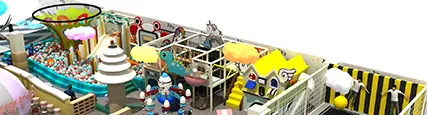
A mixed-format layout illustrates why an FEC should be designed as connected operating zones rather than as unrelated pieces of equipment.
Commercial soft play is especially useful when the core audience includes younger children because many activities can be combined vertically inside a padded structure. Slides, bridges, tunnels, climbing routes, obstacles, ball play, sensory elements, and themed features can share the same structural footprint.
Commercial trampoline equipment serves a different activity level. It can broaden the age range and support attractions such as main courts, basketball, dodgeball, challenge elements, or interconnected active zones. It should not be treated as simply another soft-play component because design, operations, inspection, user rules, and applicable standards can differ.
A mixed FEC can use both effectively. The design needs a transition between them so small children, active jumpers, spectators, and waiting guests are not sharing the same uncontrolled movement path.
Maximum building occupancy, equipment capacity, operational capacity, and comfortable customer capacity are different numbers. A manufacturer may define limits for individual attractions, while architects, fire authorities, building officials, insurers, and operators may address other parts of the facility.
The sales target should therefore never be turned into a capacity number simply by dividing the floor area by a convenient square-foot allowance. The final operating limit has to respect the building, attraction design, applicable requirements, staffing plan, and the way guests actually move through the venue.
The phrase “international standard” is too broad for a purchasing decision. A family entertainment center may contain several equipment categories, and the relevant reference can change from one attraction to another. The manufacturer should identify the standard being applied, the edition, the equipment covered, and the document supporting the claim.
ASTM currently lists ASTM F1918-21 as the active Standard Safety Performance Specification for Soft Contained Play Equipment. Its published scope covers safety and performance requirements for soft-contained play equipment and states that its user range extends from the fifth-percentile two-year-old through the 95th-percentile twelve-year-old. The same scope explicitly excludes categories including public playground equipment, amusement rides, sports equipment, certain fitness equipment, and water-related attractions.
That scope matters. A large indoor playground containing soft play, trampolines, climbing attractions, and other devices should not have a single ASTM reference applied indiscriminately to every activity.
For institutional or commercial trampoline courts, ASTM currently lists ASTM F2970-25. Its scope includes design, manufacture, installation, operation, maintenance, inspection, and major modification of commercial or institutional trampoline courts used for amusement, entertainment, or recreation. ASTM specifically identifies family entertainment centers and shopping centers among the facilities to which the practice can apply.
This is one reason I’d keep trampoline documentation separate from soft-play documentation. Different equipment can sit in the same building without becoming the same technical system.
The U.S. Consumer Product Safety Commission released an updated Public Playground Safety Handbook in 2025. The handbook states that recent years have seen almost 200,000 playground-equipment injuries annually in the United States requiring emergency-room treatment.That figure applies broadly to playground equipment; it is not an injury rate for indoor family entertainment centers and should not be presented as one.
The purchasing lesson is still relevant. Equipment safety does not end when manufacturing is finished. Installation quality, impact protection, inspection, maintenance, supervision, and corrective action remain part of the operating system. The CPSC also describes the handbook as guidance rather than a mandatory rule, so local legal requirements still need separate review.
For U.S. facilities subject to the 2010 ADA Standards, play areas include specific accessibility provisions. The Standards require at least 50% of elevated play components to be on an accessible route. They also address the required number and types of ground-level play components and the use of ramps or transfer systems.
Soft-contained play structures receive additional attention. Where such a structure has three or fewer entry points, at least one entry point must be on an accessible route; where four or more entry points are provided, at least two must be served by an accessible route.
Accessibility is much easier to plan before manufacturing. Entrances, circulation, ground-level activities, transfer access, ramps where required, seating, reception, restrooms, and other building features should be considered as one facility rather than corrected independently after installation.
CEN-CENELEC identifies EN 1176-1:2017+A1:2023 as a standard addressing safety requirements for playground equipment, with additional parts of the EN 1176 series addressing particular equipment categories.The presence of an EN reference does not eliminate national rules, building requirements, fire requirements, accessibility obligations, inspection requirements, landlord conditions, or other project-specific obligations.
| Equipment or Project Issue | Reference to Investigate | What the Buyer Should Ask For |
|---|---|---|
| Soft-contained play equipment in a U.S. project | ASTM F1918-21 | Exact product scope, applicable reports or documentation, drawings, materials, and confirmation that customization remains within the documented configuration |
| Commercial trampoline court | ASTM F2970-25 where applicable | Design documentation, manufacturer responsibilities, operating information, maintenance information, and project-specific compliance evidence |
| Public-playground safety considerations | CPSC Public Playground Safety Handbook plus applicable ASTM references and local rules | Installation, surfacing, inspection, maintenance, and hazard-control information relevant to the actual equipment |
| Accessible play areas in covered U.S. facilities | 2010 ADA Standards and applicable local accessibility requirements | Accessible routes, entries, play-component access, and coordination with the complete architectural design |
| European playground equipment | Applicable parts of EN 1176 plus national and local requirements | Applicable standard edition, test or inspection documentation, materials, installation requirements, and destination-specific obligations |
| Complete FEC building | Local building, fire, electrical, accessibility, occupancy, and other applicable rules | Clear division of responsibility among manufacturer, architect, engineers, contractor, operator, landlord, and authorities |
Certificates should be checked by scope, not by logo. A valid laboratory report for one material does not automatically certify a complete attraction. A certificate for one product configuration may not cover every customized version. Before releasing production, match each important document to the exact product, material, model, or system it is intended to support.
Two FEC quotations with similar totals may contain very different amounts of equipment and service. Before comparing the bottom line, normalize the scope.
I’d recommend creating one comparison sheet and forcing every quotation into the same categories. Anything that cannot be placed into the sheet should become a written clarification.
| Quotation Item | Details That Should Be Visible | Common Source of Cost Differences |
|---|---|---|
| Main structure | Overall dimensions, levels, primary play events, decks, slides, tunnels, bridges, nets | Different attraction counts or different usable structure volume |
| Steel structure | Section or tube specification, finish, corrosion treatment where relevant | Material thickness, finish, and amount of structural steel |
| Padding and soft parts | Foam type, covering material, thickness where relevant, attachment method | Density, construction, wear surface, and amount of padding |
| Netting | Material, intended location, opening size where relevant, replacement method | Material specification and quantity |
| Slides and molded components | Material, quantity, dimensions, and configuration | Large molded components and custom shapes can substantially alter scope |
| Trampoline components | Beds, springs or other suspension components, frames, pads, walls, nets, attraction accessories | Commercial specification and attraction complexity |
| Flooring | Type, coverage area, thickness or performance specification where applicable | Some quotes include only equipment footprint while others include surrounding areas |
| Theming | Graphics, decorative panels, sculpted items, custom colors, signage | Custom fabrication and artwork complexity |
| Interactive equipment | Hardware, sensors, controller, display/projector, software, licenses, accessories | Electronics and ongoing software support |
| Installation | Supervision or full installation, manpower, travel, accommodation, tools, local labor | Different definitions of “installation included” |
| Freight | Incoterm, origin/destination, container assumptions, insurance if included | Freight changes and different destination scopes |
| Documentation | Drawings, manuals, packing lists, product identification, compliance documents | Testing and documentation scope |
| Spare parts | Opening spare kit, included quantities, ordering process | Some quotations include no startup spares |
“Commercial grade,” “high quality,” and “heavy duty” are sales descriptions, not purchasing specifications. A meaningful quotation should identify enough material information for the finished product to be checked against the agreed proposal.
For a soft-play structure, that may include the structural tubing, corrosion treatment, foam, PVC or other covering material, platform construction, netting, molded plastics, fasteners, and floor mats. For trampoline park equipment, the list changes to include beds, springs or suspension components, structural members, safety pads, nets, wall elements, and activity-specific hardware.

Material boards are useful for procurement only when the final specification identifies which materials apply to the purchased configuration.
If a quotation changes after the concept drawing changes, ask which quantities or specifications changed. That makes value engineering much more useful than simply asking the manufacturer to reduce the total price.
The factory equipment price is only one part of an FEC investment. Buyers comparing overseas suppliers should separate equipment price, landed equipment cost, and total project investment. Mixing the three creates unrealistic budgets.
A practical equipment calculation is:
Landed equipment cost = equipment + export packing + international freight + marine insurance + applicable duty/tariff + customs/brokerage + port/terminal charges + inland delivery + installation-related equipment costs
Total project investment then adds building work and business-opening costs that are outside the equipment shipment.
| Budget Category | Examples | Who Should Supply the Number |
|---|---|---|
| Play equipment | Soft play, trampoline, ninja, climbing, interactive equipment, barriers, accessories | Equipment manufacturer |
| Export packing | Protective packaging, crates where required, labels, loading preparation | Manufacturer |
| International transport | Ocean or other freight and applicable insurance | Forwarder or supplier according to Incoterm |
| Import costs | Duty, tariff, customs entry, brokerage, destination charges | Qualified customs broker or forwarder |
| Inland delivery | Port-to-site transport, unloading, special access equipment | Local logistics provider |
| Installation | Manufacturer technicians, local labor, travel, accommodations, lifts, tools | Manufacturer and local contractor |
| Site construction | Walls, flooring, electrical, HVAC, fire-system work, lighting, plumbing, finishes | Architect, engineers, and contractors |
| Professional and approval costs | Design consultants, engineering, permits, testing or inspection where required | Local project team |
| Operating setup | POS, furniture, lockers, cleaning equipment, signage, kitchen or café equipment | Operator and vendors |
| Pre-opening costs | Recruitment, training, insurance, initial marketing, opening inventory | Operator |
| Contingency | Project-specific allowance for unresolved or changing scope | Owner and project team |
This structure makes manufacturer comparisons more accurate. A factory cannot reliably quote local building work, insurance, permits, or every destination charge without project-specific information. Those numbers should come from the party that actually controls them.
Yes, an FEC can generate profit, but equipment does not determine profitability by itself. Rent, labor, pricing, repeat visitation, local demand, opening hours, birthday-party sales, memberships, food and beverage, maintenance, insurance, and debt costs can matter as much as the initial attraction mix.
I’d avoid any manufacturer that promises a universal payback period without seeing the business model. The more useful calculation starts with the operator's own assumptions.
Monthly revenue = admissions + memberships + parties/events + food and beverage + retail + other paid activities
Monthly operating contribution = monthly revenue − labor − occupancy costs − utilities − insurance − cleaning − maintenance − software/payment costs − marketing − other operating expenses
Simple payback estimate = total project investment ÷ annual operating contribution
The last formula is a planning tool, not an investment guarantee. Financing costs, taxes, depreciation, owner compensation, seasonality, capital replacements, and other items may need separate treatment.
| Planning Input | Conservative Case | Base Case | Strong-Demand Case |
|---|---|---|---|
| Paid visits per month | Use the lower traffic assumption supported by local research | Use the operating plan's expected traffic | Use higher traffic only if staffing and attraction capacity can support it |
| Average admission revenue | Account for discounts and lower-priced periods | Use expected ticket mix | Do not assume every customer buys the highest-priced ticket |
| Party bookings | Use a lower room-utilization assumption | Use the planned booking schedule | Confirm room turnover and staffing can support the number |
| Ancillary spending | Use cautious food, beverage, retail, or add-on assumptions | Use the operating plan | Do not double-count spending already included in packages |
| Labor | Include required minimum staffing even at lower traffic | Use planned roster | Add staff needed for additional volume |
| Maintenance | Include normal consumables and replacement components | Use manufacturer and operator planning assumptions | Higher traffic should not be modeled with unchanged wear costs |
A useful break-even calculation is:
Required paid visits = (monthly fixed costs − contribution from parties, memberships and other revenue) ÷ contribution per paid visit
This turns the investment discussion into a measurable operating requirement. If the resulting visitor target is inconsistent with the site, local market, parking, capacity, or staffing plan, the answer is not automatically “buy cheaper equipment.” The concept, rent, footprint, pricing, or attraction mix may need to change.
Once a customized FEC enters production, correcting a mistake becomes progressively more expensive. The purchasing process should therefore include checkpoints before final shipment rather than relying on the installer to discover problems.
For this comparison, I’m prioritizing traceability and inspectability. A component does not need an elaborate digital tracking system to be manageable, but the installation team should be able to determine where it belongs and the operator should later be able to identify it when requesting a replacement.
| Acceptance Area | Evidence to Review | Reason It Matters |
|---|---|---|
| Approved dimensions | Latest drawing revision and selected dimensional checks | Reduces the risk of equipment arriving larger than the approved footprint |
| Major materials | Specification records, material samples where agreed, production photos | Confirms the manufactured product follows the commercial specification |
| Fabricated structure | Visual inspection and manufacturing records appropriate to the system | Finds obvious fabrication or finishing defects before packing |
| Padded components | Coverage, fit, seams, attachment method, and identified spare parts | Padding is a high-contact part of many indoor attractions |
| Nets and barriers | Correct type, dimensions, attachment points, and quantities | Missing or incorrectly sized nets can stop installation |
| Slides and large molded parts | Quantity, condition, connection points, dimensions | Large replacement parts are difficult to air-freight economically |
| Interactive equipment | Power-on or functional check where appropriate, accessory inventory | Electronic faults are easier to resolve before international shipment |
| Hardware | Fastener kits, connectors, anchors where specified, labeling | Small missing parts can stop a large installation crew |
| Packing | Packing list, package numbers, photos, weight/volume records | Installation becomes faster when packages correspond to zones or drawings |
| Documentation | Manuals, drawings, certificates or reports within agreed scope | Documents should not become an unresolved task after the equipment departs |
A photo of completed equipment is useful, but it is not a substitute for acceptance criteria. The buyer and manufacturer should agree in advance what will be reviewed, when approval is required, and what happens if a nonconformity is found.
International playground equipment is usually shipped as a large set of components rather than as a finished attraction. Good logistics therefore depend on documentation and sequencing as much as freight price.
An EXW quotation, FOB quotation, and CIF quotation are not equivalent purchasing scopes. The purchase order should identify the agreed Incoterm and named location or port, then separately define services that do not naturally fall within that term.
The buyer should also confirm who is responsible for export documentation, marine insurance if required, destination customs clearance, tariffs or duties, port charges, demurrage risk, inland transport, unloading, and delivery into the building.
A successful container delivery does not mean the equipment can reach the installation floor. Measure loading doors, corridors, freight elevators, stair access, and other restrictions before large fabricated components are finalized.
Shopping malls can add another layer of requirements: limited delivery hours, dock reservations, floor protection, security permits, approved contractor procedures, noise restrictions, hot-work controls, and rules governing tools or lifts.
“Installation included” should answer at least these questions:
Does the manufacturer provide a complete installation crew or only a supervisor?
Who recruits and pays local labor?
Who provides ladders, lifts, scaffolding, power tools, consumables, and personal protective equipment?
Who handles floor drilling or anchoring where required?
Who moves packages from the unloading location to the installation area?
Who connects electrical equipment?
Who coordinates around sprinkler, HVAC, fire alarm, and other building systems?
Who removes packaging waste?
Who conducts the final inspection and who closes the punch list?
These are ordinary project-management questions, but leaving them unresolved until installers arrive can create days of avoidable delay.

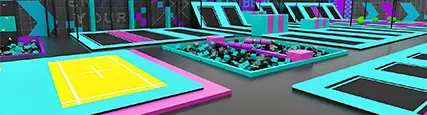
Large active zones require coordination between equipment layout, supervision, circulation, building services, and installation access.
The easiest component to maintain is one the operator can see, reach, identify, remove, and replace. Maintenance access should therefore influence design before a structure is manufactured.
A spectacular enclosed feature can become an operating problem if staff cannot inspect the inside. A decorative panel can become expensive if removing it requires dismantling several unrelated components. A high-wear pad should not require the attraction to remain closed for an extended period simply because its part number is unknown.
| Component | What the Operating Team Should Be Able to Inspect | Typical Action Trigger |
|---|---|---|
| Structural frame | Connections, deformation, corrosion where relevant, abnormal movement | Damage, movement, looseness, or another condition outside the approved operating state |
| Fasteners and connectors | Presence, security, protective caps, abnormal wear | Loose, missing, damaged, or exposed hardware |
| Padding | Coverage, tears, displacement, compression, exposed hard surfaces | Protective function is reduced or the underlying structure becomes exposed |
| Netting | Tears, openings, attachments, tension where applicable | Damage affects containment or creates an opening not intended by the design |
| Trampoline beds and suspension components | Wear, damage, attachment, pad position, abnormal performance | Visible damage, changed performance, displaced protection, or manufacturer replacement criteria |
| Slides and molded parts | Cracks, loose connections, damaged surfaces, exit area | Structural damage, sharp damage, instability, or obstructed landing/exit area |
| Interactive equipment | Cables, sensors, enclosures, mounts, software/hardware function | Loose equipment, exposed electrical parts, malfunction, or unreliable sensing |
| Flooring and impact surfaces | Movement, separation, damage, contamination, performance condition | Surface no longer performs or remains secured as intended |
The manufacturer should provide maintenance and inspection information appropriate to the equipment. The operator then needs a site-specific schedule that considers the manufacturer's instructions, usage level, applicable law, insurer requirements, inspection-provider requirements, and previous maintenance findings.
Many operators incorporate opening inspections into daily procedures, but no generic article should replace the frequency or method specified for the actual attraction. The same rule applies to periodic servicing: follow the equipment documentation and applicable local obligations rather than copying an arbitrary interval from another facility.
Spare parts do not need to mean storing an entire duplicate playground. The useful startup kit concentrates on components that wear, become lost, are attraction-specific, or would create significant downtime if they had to be shipped internationally after failure.
Ask for a parts list with item descriptions, quantities, photos or drawing references, and reorder codes. Future staff members should be able to order a component without relying on the salesperson who handled the original project.
The technical proposal and sales contract should describe the same project. If the drawing says one thing, the quotation says another, and a messaging conversation promises something else, the buyer has three different scopes.
I’d recommend attaching the final quotation, approved drawings, specifications, and agreed documentation list to the purchase agreement or referencing controlled revisions clearly.
Product scope: exact attractions, dimensions, accessories, options, quantities, and exclusions.
Drawing revision: the approved drawing used for manufacturing.
Change control: how design changes affect price, lead time, freight, and documentation.
Payment milestones: what event triggers each payment and what evidence accompanies it.
Production completion: how completion is defined and what buyer acceptance occurs before shipment.
Shipping term: Incoterm, named location, estimated packing scope, and shipping responsibilities.
Installation: manufacturer labor, local labor, tools, travel, accommodations, lifts, electrical work, and site readiness.
Warranty: covered components, start date, exclusions, remedies, freight responsibility, and claim procedure.
Spare parts: included startup parts and post-warranty ordering process.
Documentation: drawings, manuals, parts information, testing or certification records within the agreed scope.
Intellectual property: responsibility for customer-supplied characters, logos, or copyrighted artwork.
Delay and storage: responsibility when manufacturing is complete but the customer's site is not ready.
A vague answer is not always evidence of a bad manufacturer, but repeated ambiguity becomes a procurement risk. I’d ask for clarification when a supplier cannot identify which standard applies, refuses to specify materials, cannot produce revision-controlled drawings, gives a single lump-sum price with no usable scope, treats every customization as covered by the same certificate, or cannot explain installation responsibilities.
I’d also question unusually short lead times if the equipment is heavily customized. The issue is not whether fast production is impossible; the issue is whether design approval, purchasing, fabrication, finishing, quality checks, documentation, packing, and shipment have actually been allowed for.
Injbell has focused on amusement equipment since 2016, with product categories covering indoor playgrounds, soft play, commercial trampoline parks, ninja-style obstacle equipment, FEC configurations, climbing activities, and related play systems. The practical reason to consider that range is not the number of products in the catalog. It is the ability to coordinate several activity types inside one commercial layout.
Buyers planning a mixed venue can review Injbell's current family entertainment center equipment category alongside its broader commercial indoor playground equipment and trampoline park equipment ranges. The manufacturer's company and service overview describes support covering planning, customized design, production, shipment, assembly, and maintenance-related service.
That combination fits the checklist when a buyer wants fewer handoffs between the soft-play structure, trampoline zone, obstacle activities, and overall equipment package. It does not remove the buyer's responsibility to appoint qualified local architects, engineers, contractors, inspectors, or other professionals required for the complete building.
If I were choosing for a custom indoor FEC that combines several equipment categories, I’d put Injbell into the first technical comparison when the project needs site-specific design rather than a collection of stand-alone catalog products. The next step would still be project-specific verification: approved layout, exact materials, applicable standards, document scope, shipping responsibilities, installation method, spare parts, and warranty terms.
That is a more useful recommendation than saying a manufacturer is suitable for every project. A strong supplier-client match depends on the attraction mix, jurisdiction, building, schedule, service expectations, and commercial terms.
One published Injbell project provides a useful example of how a large entertainment floor can combine equipment categories. The 3,000 m² Luoyang project example records an October 2019 opening and lists indoor playground equipment, trampolines, slides, climbing, balance activities, a ninja course, zip line, basketball activities, an airbag, and other active-play elements.
The useful lesson from that example is not the project size. It is the zoning problem. Once an FEC combines several activity types, the design must account for transitions between them, activity-specific safety requirements, visibility, circulation, queues, and the needs of people who are not actively playing.
A smaller project should apply the same discipline. Fewer attractions do not justify weaker drawings or less precise responsibilities.
A message asking for “a price for a 1,000-square-meter FEC” leaves too many variables unresolved. The manufacturer either has to guess or provide a number that will change once the actual design begins.
I’d recommend sending a short project brief with the following information:
Project country and city: needed to discuss destination requirements, logistics, and installation planning.
CAD or dimensioned floor plan: include the complete unit, not only the proposed play footprint.
Usable ceiling heights: mark beams, ducts, lights, sprinklers, and other low points.
Columns and fixed obstructions: exact position and dimensions.
Entrances and exits: include emergency routes and doors that must remain clear.
Target age groups: identify which users need separate or dedicated activity zones.
Preferred attractions: soft play, toddler area, trampoline, ninja, climbing, slides, interactive games, or other priorities.
Non-play functions: reception, party rooms, café, seating, lockers, storage, office, toilets, kitchen, or retail.
Budget basis: state whether the figure is equipment-only, landed equipment, or total project budget.
Target opening date: include the building handover date when known.
Installation preference: full manufacturer installation, manufacturer supervision with local labor, or local installation support.
Required documentation: identify known landlord, insurer, testing, inspection, or authority requirements early.
Site photos and video: useful for understanding the building, but they should support rather than replace accurate dimensions.
The manufacturer should respond with questions. A custom FEC has too many variables for a detailed proposal to be correct without clarification.
The initial layout should settle major zones, movement paths, equipment envelopes, entrances, exits, supervision, and building conflicts. Theming can then be developed around a workable structure.
If I were choosing between two concept drawings, I’d choose the drawing that explains how the facility operates over the drawing that merely contains more decorative detail. Themes can be refined. A bad circulation path is much harder to disguise once the park opens.
Before paying the production deposit, one person on the buyer's team should review the project as if the salesperson were no longer available to explain it. The documents themselves should answer what is being manufactured, how large it is, what is included, which drawing controls production, which standards are being referenced, what documents will be provided, how the equipment will be shipped, and who installs it.
The same review should look beyond opening day. Identify the parts that customers will touch repeatedly, the areas staff must enter for cleaning, the components most likely to need replacement, and the equipment that can stop a whole zone if one specialized part fails.
A well-designed family entertainment center is not maintenance-free. It is maintenance-ready.
The purchasing decision is also easier when the quote separates facts from assumptions. The manufacturer knows its equipment. The architect knows the building. The freight provider understands the shipment. The customs broker understands import procedures. Local authorities determine applicable approvals. The operator understands the intended business model. Problems usually appear when one party is assumed to control work that actually belongs to another.
For a family entertainment center equipment manufacturer, the strongest evidence is therefore not a single certificate, project photograph, or low price. It is a chain of information that remains consistent from the first floor plan through production, packing, installation, handover, and replacement parts.
Look for site-specific design capability, clearly specified materials, attraction-specific standards knowledge, controlled technical drawings, pre-shipment quality checks, organized packing, installation support, operating and maintenance documentation, spare-parts availability, and clear commercial terms. Compare evidence rather than catalog size. A manufacturer should also be willing to define what is outside its responsibility, including local architectural, building-code, fire, electrical, and permitting work.
The equipment depends on the target age groups and operating concept. A children's FEC may center on a multi-level soft-contained playground with toddler equipment, slides, ball play, and interactive activities. A mixed-age venue can add trampoline courts, ninja obstacles, climbing activities, challenge games, or other active attractions. Reception, seating, party rooms, storage, food service, and circulation must be planned alongside the attractions rather than fitted into leftover space.
There is no reliable universal price per square foot or square meter because attraction type, equipment density, height, materials, theme, electronics, destination, shipping, installation, and documentation can change the quotation substantially. Request an itemized equipment proposal and then calculate landed cost by adding packing, freight, insurance where applicable, customs costs, inland delivery, and installation. Site construction and pre-opening business costs should be budgeted separately.
An FEC can be profitable when customer demand and revenue support rent, labor, utilities, insurance, maintenance, cleaning, marketing, payment costs, and other expenses. Admissions are only one possible revenue source; memberships, birthday parties, group events, food and beverage, retail, and paid add-ons may also contribute. Build conservative, base, and strong-demand forecasts using the actual lease and local pricing rather than relying on a manufacturer's promised payback period.
The answer depends on the equipment category and destination. ASTM F1918-21 is an important U.S. reference for soft-contained play equipment, while ASTM F2970-25 addresses commercial or institutional trampoline courts. European playground projects commonly use applicable parts of the EN 1176 series. Accessibility, building, fire, electrical, amusement-device, inspection, insurance, and local regulatory requirements may also apply. Confirm current requirements for the exact project before production.
Choose according to the audience and operating model. Soft-contained play is particularly useful for family venues serving younger children because multiple activities can share a vertical structure. Trampoline equipment creates a higher-energy offer and may broaden the customer age range, but it brings different design, supervision, inspection, and operating considerations. Larger FECs can combine both when the zones and transitions are properly planned.
The exact document set depends on the project, but it should normally include approved drawings, packing information, installation documents, equipment or parts identification, relevant operating and maintenance information, and any test reports, certificates, or other compliance documents included in the contract. Confirm document scope before the final payment milestone rather than requesting it after the shipment has left the factory.
Start with a dimensioned floor plan or CAD drawing, usable ceiling heights, column locations, entrances and exits, fixed obstructions, target age groups, priority attractions, destination, required non-play areas, installation preference, target schedule, and budget basis. Site photos and videos are useful supporting material. Better initial building information leads to a more realistic equipment layout and quotation.
ASTM International. ASTM F1918-21 — Standard Safety Performance Specification for Soft Contained Play Equipment. ASTM F1918-21.
ASTM International. ASTM F2970-25 — Standard Practice for Design, Manufacture, Installation, Operation, Maintenance, Inspection and Major Modification of Trampoline Courts. ASTM F2970-25.
U.S. Consumer Product Safety Commission, 2025. Public Playground Safety Handbook. 2025 CPSC Public Playground Safety Handbook.
U.S. Department of Justice. 2010 ADA Standards for Accessible Design. 2010 ADA Standards.
CEN-CENELEC. Reference to EN 1176-1:2017+A1:2023 for playground equipment safety requirements. CEN-CENELEC playground standards reference.
Reference date: Standards and public guidance referenced in this article were checked against available source information in September 2026. Standards can be revised, superseded, adopted differently by jurisdictions, or supplemented by other requirements. Always confirm the current edition and local applicability for the specific project.
This article is a general purchasing and project-planning guide for commercial family entertainment center equipment. It is not engineering, architectural, legal, regulatory, accessibility, fire-safety, insurance, customs, tax, financial, or investment advice. Equipment requirements vary by attraction, configuration, destination, building, jurisdiction, operator, insurer, and date.
References to ASTM, CPSC, ADA, EN standards, testing, certificates, or other technical documents do not mean that one document approves an entire facility. Buyers should verify the scope and current validity of every document for the exact equipment being purchased and coordinate final compliance with qualified local professionals and the authority having jurisdiction.
Cost and ROI formulas in this article are planning methods, not predictions. Actual capital cost, attendance, revenue, operating expense, profit, and payback depend on project-specific conditions. No traffic level, profit margin, investment return, or payback period is guaranteed.




 EN
EN ES
ES AR
AR

