

A complete soft play equipment quotation should cover much more than the price of slides, climbing frames, ball pits, and padded obstacles. It should identify the exact equipment being supplied, material specifications, design work, safety documentation, packaging, freight arrangements, installation responsibilities, warranty terms, and any costs the buyer must pay separately.
For an indoor playground or Family Entertainment Center (FEC), the lowest equipment price is not necessarily the lowest project cost. A supplier may offer an attractive factory price while excluding installation labor, replacement parts, shipping, or essential technical drawings. Those expenses can change the investment substantially.
This guide explains how to read a commercial playground quotation, compare competing proposals, identify hidden costs, and calculate a realistic budget before placing an order. It also covers the documents and commercial terms that help protect your investment after the equipment arrives.
A useful quotation is a written description of what the manufacturer agrees to supply, how much it costs, what services are included, and which responsibilities remain with the buyer.
The quotation should be connected to a specific playground layout and equipment configuration. A single total accompanied by a colorful rendering is not enough to establish exactly what will be delivered.
For commercial projects, I’d divide the quotation into three financial categories:
Equipment supply cost: The price of the playground structure, individual attractions, materials, accessories, manufacturing, and agreed production documentation.
Delivered and installed equipment cost: Equipment supply plus shipping, import-related expenses, transportation to the venue, installation, and agreed commissioning services.
Total opening investment: Delivered and installed equipment plus building improvements, permits, operating systems, staffing, insurance, initial marketing, and working capital.
These categories must remain separate. The manufacturer may be responsible for the playground equipment without being responsible for completing the entire commercial facility.
The following table provides a practical reference for reviewing an indoor playground equipment price breakdown.
| Cost Item | What the Quotation Should Explain | What to Verify |
|---|---|---|
| Playground design | Concept layout, equipment configuration, drawings, and revisions | Included revision rounds and final drawing deliverables |
| Main structure | Frames, platforms, connectors, protective coverings, and netting | Dimensions, material grades, quantities, and structural details |
| Play attractions | Slides, tunnels, obstacles, ball pits, climbing elements, and other activities | Quantity, dimensions, models, and locations |
| Floor protection | Safety mats and other specified protective surfaces | Covered area, thickness, materials, and performance requirements |
| Safety documentation | Applicable reports, manuals, drawings, and supporting documents | Standards, document scope, dates, and any independent review |
| Packaging | Protective wrapping, labeling, pallets, or other export preparation | Whether included in the equipment price |
| International shipping | Freight arrangements and contractual delivery location | Incoterm, freight allowance, and excluded charges |
| Installation | Assembly labor, engineering assistance, equipment, and supervision | Who pays for local workers, lifting equipment, travel, and lodging |
| Commissioning | Assembly checks, corrective work, and final documentation | Acceptance criteria and independent inspection requirements |
| After-sales support | Warranty, spare parts, maintenance information, and technical assistance | Coverage, response arrangements, and exclusions |
Each item should be marked as included, separately priced, excluded, or subject to confirmation. An unanswered item should not be treated as included.
This approach is especially important when comparing a factory-direct manufacturer with a local equipment distributor or installation contractor. Their prices may represent different portions of the same project.
Accurate playground pricing depends on the building. A design prepared without reliable site dimensions is preliminary, even when the rendering looks complete.
Before requesting a quotation, provide a floor plan showing the intended playground location, building dimensions, structural columns, entrances, emergency exits, and relevant utilities.
The manufacturer also needs to understand the intended operating model. A toddler-focused play center requires a different arrangement from an FEC serving older children with climbing challenges and high-energy activities.
Available floor area: Total building area and the portion allocated to playground equipment.
Ceiling information: Floor-to-ceiling height, beams, suspended services, and other overhead restrictions.
Building layout: Columns, doors, windows, fixed equipment, emergency routes, and access restrictions.
Target users: Intended age groups and the way younger and older children will be separated.
Activity preferences: Slides, climbing structures, sensory activities, obstacles, ball pits, or interactive features.
Commercial requirements: Reception, parent seating, circulation space, party rooms, and any associated retail or food-service areas.
Project location: Country and destination city for logistics and regulatory planning.
Budget and schedule: Available equipment budget, planned opening date, and expected construction milestones.
The distinction between total floor area and usable playground area deserves particular attention.
Consider a hypothetical venue with 400 square meters of gross floor area. After allocating space for reception, circulation, seating, restrooms, and other functions, the equipment footprint may be substantially smaller. The actual allocation must be determined from the approved floor plan.
If one quotation prices 400 square meters of building space and another prices 260 square meters of playground footprint, comparing their advertised cost per square meter produces a misleading result.
Always confirm whether the quoted area refers to the building, equipment footprint, enclosed structure, or another measurement.

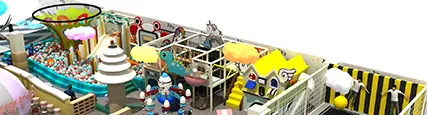
Injbell indoor soft play design rendering. Custom structural shapes, themed panels, slides, and connecting tunnels should be identified in the approved equipment schedule.
Ceiling height affects more than the number of playable levels. It influences the arrangement of elevated platforms, access routes, protective barriers, maintenance access, and the position of overhead building services.
A taller structure can require additional framing, connections, netting, padding, and more complicated installation work.
However, a larger structure does not automatically provide greater operating value. An extra level may add limited usable play capacity if access points create congestion or the highest activities are unsuitable for the target age group.
I’d prioritize the circulation pattern and age-appropriate activities before requesting additional height. The final structure must also be reviewed against the applicable safety requirements and building conditions.
An equipment quotation should explain exactly what the buyer is purchasing.
Descriptions such as "complete indoor playground," "premium soft play system," or "commercial playground package" are too broad to define the supplied product.
For a custom playground, the equipment schedule should correspond to the approved layout. Every major activity shown in the drawing should have an identifiable position and scope.
The primary structure may include metal framing, platforms, structural connections, access elements, protective netting, padding, and enclosed barriers.
Request information on the structural tube specifications, connection details, protective coverings, and the design loads appropriate to the planned equipment.
The quotation should distinguish the supporting structure from decorative elements. The structure is not merely a background for the attractions; it determines how the equipment is assembled, supported, maintained, and inspected.
For a more detailed example of how soft play materials can be specified, Injbell provides a mini indoor playground product specification describing components such as galvanized steel tubes, plastic parts, protective padding, and floor mats.
Those specifications illustrate the level of information that can be requested. They should not be assumed to apply to every Injbell design or another manufacturer's product.
Every substantial attraction should appear in the equipment list.
Straight, wave, spiral, or enclosed slides
Soft climbing steps and inclined ramps
Ball pits and ball quantities
Net tunnels and connecting bridges
Foam obstacles, rollers, and punching bags
Climbing nets and rope-based challenges
Interactive play panels
Toddler activities and age-separated play zones
The quotation should identify the quantity and dimensions of major elements, not simply indicate that the playground contains "multiple obstacles."
Ball pits offer a useful example. A supplier may include the pit enclosure but quote the plastic balls separately. Another may include the balls but not the associated cleaning or collection equipment.
Request the pit dimensions, intended fill specification, ball material, ball quantity, and any equipment needed for routine cleaning.
For slides, confirm the material, geometry, entrance configuration, intended user group, and required clearance around the landing or exit.
Customized themes can affect manufacturing cost significantly because specialized panels, shaped coverings, artwork, and decorative structures may require additional fabrication.
The quotation should identify which themed elements are included in the base price and which are optional upgrades.
If the playground uses a custom logo or branded graphics, confirm whether artwork preparation, printing, color approval, and future replacement panels are included.
A rendering may show decorative walls or surrounding furniture that belong to the venue rather than the equipment package. The contract should make this distinction explicit.
Two playgrounds can have similar dimensions and completely different material specifications.
A quotation becomes much easier to evaluate when the manufacturer identifies the materials used in structural and frequently touched components.
For structural tubes, buyers should ask about dimensions, wall thickness, steel grade, protective coating, and the engineering basis for their use.
For padded components, the relevant questions include foam type, density or other performance properties, cover material, seam construction, and attachment method.
For plastic parts, request the specified polymer, manufacturing method, and applicable performance documentation.
| Component | Specification to Request | Why It Matters |
|---|---|---|
| Steel framing | Tube dimensions, grade, wall thickness, finish, and structural design details | Supports engineering review and replacement compatibility |
| Padding | Foam characteristics, covering material, thickness, and attachment details | Determines the protective assembly being supplied |
| Plastic slides | Material, geometry, dimensions, and relevant test evidence | Allows review of design suitability and performance |
| Safety netting | Material, mesh configuration, attachment system, and applicable testing | Helps assess containment and component integrity |
| Floor mats | Material, thickness, coverage, fastening, and required impact performance | Clarifies where protective flooring is provided |
| Fasteners | Type, grade, protection, and replacement identification | Supports assembly and subsequent inspection |
| Decorative panels | Substrate, finish, mounting method, and relevant fire-performance evidence | Helps evaluate cleaning, durability, and building requirements |
Material thickness alone is not proof that a component is safe or durable. Performance depends on the complete assembly, including connections, installation conditions, geometry, and intended use.
Likewise, terms such as "fireproof," "non-toxic," and "commercial grade" are not substitutes for properly identified material specifications or test reports.
Ask which fire-performance, chemical, mechanical, and other relevant requirements apply to each material in the destination market. Obtain evidence that identifies the tested material or assembly and the specific test method.
Renderings are useful for evaluating colors, themes, and circulation. They cannot demonstrate foam performance, structural integrity, or the condition of concealed connections.
Where practical, request material samples and photos of representative joints, net attachments, padded edges, and completed components.
For large projects, buyers may also arrange independent inspection or review relevant production documentation before approving shipment.

Compact indoor playground rendering from Injbell. The quotation should distinguish framing, protective netting, platforms, slides, padding, and ball pit components.
Custom playground design has several stages, and not every stage is necessarily included in the initial price.
An early concept may be supplied to help the buyer assess the proposed layout. Detailed engineering, installation documentation, and additional revisions can be treated separately.
Ask the manufacturer to identify the design deliverables and the point at which additional work becomes chargeable.
Concept layout: Initial attraction arrangement and general space allocation.
Dimensioned layout: Equipment footprint, overall height, main clearances, and relevant access points.
Approved configuration: Final equipment arrangement, colors, theme, and included activities.
Technical drawings: Construction and assembly information appropriate to the equipment.
Component schedule: Identification of major parts and supplied quantities.
Installation manual: Assembly sequence, connection requirements, and necessary precautions.
Maintenance documentation: Inspection points, cleaning guidance, and replacement procedures.
Where local review is required, clarify whether engineering calculations, professional seals, or independent verification are included. A manufacturer's assembly drawing should not be assumed to replace a locally required engineering submission.
Also determine who owns or may use the approved design documents and whether they can be shared with the buyer's licensed contractors, insurers, or inspectors.
A custom concept often changes after the owner reviews the layout or the building contractor confirms site conditions.
The quotation should establish an agreed revision process. A useful arrangement distinguishes ordinary adjustments from changes that affect equipment dimensions, structural design, manufacturing scope, or material quantities.
For instance, changing the color of an unproduced padded panel may be less disruptive than relocating a slide after structural components have entered production.
The commercial terms should explain how each type of change is approved and priced.
Installation is one of the most common sources of confusion in commercial playground purchasing.
A quotation marked "installation included" may cover on-site supervision rather than a complete installation crew. A supplier may provide technical personnel while the buyer supplies labor, equipment, transportation, and accommodation.
Before ordering, request a written explanation of the installation model.
Buyer-managed installation: The manufacturer supplies the equipment and agreed drawings or manuals. The buyer arranges qualified installation personnel and is responsible for the contracted site work. This option requires careful coordination and should only be used where the manufacturer permits it and the installers have the necessary competence.
Manufacturer-supervised installation: The manufacturer provides technicians or supervisors while the buyer supplies local workers and agreed supporting equipment. Travel expenses and daily allowances may be charged separately.
Contracted installation service: A manufacturer or installation contractor assumes a defined installation scope for an agreed price. This still does not mean every venue-related task is included.
Injbell offers installation documentation and paid engineering installation services for relevant playground products. The selected arrangement should be confirmed in the project quotation rather than inferred from a general service description.
| Installation Activity | Responsibility to Assign | Cost Question |
|---|---|---|
| Unloading containers | Buyer, freight provider, or installation contractor | Are unloading workers and equipment included? |
| Moving equipment indoors | Buyer or installer | Who handles restricted doors, elevators, and internal transport? |
| Tools and lifting equipment | Buyer or installer | Who rents lifts, scaffolding, and specialized tools? |
| Assembly labor | Contracted installation team | How many workers and workdays are covered? |
| Manufacturer supervision | Manufacturer | Are technician fees, flights, lodging, and local travel included? |
| Site utilities | Buyer or building contractor | Who supplies temporary power, lighting, and site access? |
| Corrections and adjustments | Responsible contractor under the agreed defect terms | Who pays when work fails the agreed acceptance criteria? |
| Final inspection | Qualified party designated by the contract or local authority | Is an independent inspection required and separately priced? |
For a detailed explanation of how these responsibilities fit into a larger project, see Injbell's turnkey indoor playground project scope guide.
Installation should never be approved merely because the structure looks complete. The handover process should address the installed configuration, accessible routes, relevant safeguards, documented checks, outstanding defects, and the operator's maintenance responsibilities.
The quoted equipment price and the amount required to receive the equipment at your venue may be very different.
Commercial indoor playground equipment is often shipped in multiple packages containing structural components, protective materials, slides, accessories, and decorative parts.
Shipping expenses depend on shipment dimensions, volume, weight, origin, destination, freight conditions, and the agreed delivery responsibilities. A quotation should therefore include packing information or a stated basis for the preliminary freight estimate.
International quotations commonly use Incoterms rules to allocate specified delivery costs, responsibilities, and risks between seller and buyer.
| Delivery Term | General Meaning | What the Buyer Should Check |
|---|---|---|
| EXW | Goods are made available at the named location under the agreed rule | Collection, loading responsibilities, export procedures, and subsequent transport |
| FOB | Seller delivers goods on board the vessel at the named port of shipment | Main ocean freight, cargo insurance, destination expenses, and inland delivery |
| CIF | Seller contracts for carriage and specified insurance to the named destination port | Risk-transfer point, insurance coverage, destination fees, and final delivery |
| DAP | Seller delivers goods ready for unloading at the named destination | Import clearance, duties, taxes, and unloading responsibilities |
| DDP | Seller assumes the agreed delivery and import-related responsibilities under the rule | Whether the seller can legally complete the required import procedures |
These descriptions are simplified. The contract should state the chosen Incoterms 2020 rule and the exact named place or port. For example, "FOB" without an identified port leaves an important detail unresolved.
FOB and CIF are rules intended for sea or inland waterway transport. Depending on the transport arrangement, another delivery rule may be more appropriate.
Under CIF, the seller's payment for freight and specified insurance does not mean the seller carries every risk until the equipment reaches the destination port. The contractual risk-transfer point must be understood separately.
Origin handling charges not included in the quoted term
International freight and cargo insurance
Destination terminal and handling charges
Customs brokerage
Applicable import duties and taxes
Customs examinations or other required inspections
Storage, detention, or demurrage charges where incurred
Local delivery to the commercial venue
Unloading and internal movement of equipment
Not every shipment incurs every listed charge. The important point is to identify the party responsible and obtain project-specific estimates.
Import duties and taxes should be calculated using the appropriate product classification, customs value, origin, destination rules, and current law. A generic percentage supplied by an equipment seller is not a substitute for advice from a qualified customs broker.
Ask how equipment will be protected, labeled, and identified during shipment.
Long structural components, decorative panels, and finished plastic pieces may require different packaging methods. The packing list should allow the receiving team to reconcile delivered packages with the supplied equipment schedule.
Before shipment, request agreed packing photographs, package identification, and the available transport documentation.
On arrival, record visible damage and missing packages promptly, retain supporting evidence, and follow the contractual and insurance notification procedures.
Safety documentation should be treated as a project deliverable, not an optional sales attachment.
Commercial soft play equipment must be evaluated according to its actual design, intended users, applicable technical requirements, and installation location.
A single statement such as "meets international safety standards" does not explain which standard applies or which components have been assessed.
In the United States, ASTM F1918-21 addresses safety performance requirements for soft contained play equipment. Its stated user-size scope extends from the fifth-percentile 2-year-old to the 95th-percentile 12-year-old. The standard covers subjects including materials, structural integrity, access and egress, fire safety, maintenance, and evacuation.
That defined scope is important. ASTM F1918 should not be assumed to apply to every type of indoor amusement equipment or every intended age group.
For fully enclosed play equipment in relevant European markets, EN 1176-10:2023 addresses additional safety requirements and test methods for equipment intended for children up to 14 years old. Its application must be considered alongside other relevant requirements and the specific installation.
A mixed-activity FEC may include multiple equipment types requiring separate assessments.
For example, commercial trampoline courts have their own technical framework. ASTM F2970-25 addresses the design, manufacture, installation, operation, maintenance, inspection, and major modification of commercial or institutional trampoline courts within its scope. It is not a substitute for assessing the soft play structure.
Ninja courses, climbing elements, amusement devices, and other attractions may also involve distinct standards or regulatory requirements depending on their configuration and jurisdiction.
Identification of the applicable standards and versions
Product-specific test reports or certification documents where relevant
Material test reports for the specified components
Equipment drawings and engineering information required for review
Installation instructions and safety-critical assembly details
Intended user groups, operating limitations, and relevant warnings
Inspection and maintenance instructions
Fire and evacuation information relevant to the equipment and venue
Identification of outstanding tests or local approvals
Check the scope of each document. A report covering one material, model, or component does not automatically establish compliance of an entire custom playground.
Likewise, a management-system certificate does not replace testing or assessment of the playground itself.
The U.S. Consumer Product Safety Commission's 2025 Public Playground Safety Handbook states that recent years have seen an estimated almost 200,000 playground-equipment injuries annually requiring emergency room treatment in the United States. This is a broad playground-equipment estimate, not an injury rate for indoor soft play centers.
The handbook is valuable as a safety reference, but it should not be treated as a replacement for standards applicable to a particular soft contained play installation.
For a commercial project, I’d include independent review and any required inspection in the planning budget from the beginning. The actual inspection scope should be determined with the relevant qualified professional, insurer, and local authority.
Safety review should take place early enough to influence the equipment design. Identifying a problem after manufacturing or installation can cause avoidable rework.
Playground equipment compliance and building compliance are related but separate responsibilities.
A commercial venue may need to satisfy accessibility, fire protection, emergency egress, structural, electrical, and other building requirements before opening.
Those requirements can affect the equipment layout even when the playground is entirely indoors.
The U.S. Access Board explains that, under the applicable accessibility provisions for soft contained play structures, a structure with three or fewer entry points must provide at least one entry point on an accessible route. Where four or more entry points are provided, at least two must be on an accessible route.
These numerical requirements are useful during the design stage because entry locations can affect the entire structure.
They should not be interpreted as the only accessibility requirements that may apply. Accessible circulation, supporting facilities, and the applicable standards for the specific venue also need review.
Before approving a final playground layout, establish how the equipment relates to:
Emergency exits and evacuation routes
Required accessible circulation
Sprinklers and other fire protection systems
Fire alarms, detection devices, and associated building services
Structural columns and permitted attachment points
Lighting, ventilation, and maintenance access
Occupant capacity and operational controls
The manufacturer should receive the necessary building constraints. The building design team should understand the proposed equipment's dimensions, layout, and installation requirements.
Do not assume that supplying equipment with relevant product test documents guarantees approval of the complete facility.
There is no reliable universal price for a custom commercial soft play system.
Actual equipment prices depend on structure size, height, configuration, material specifications, number and type of attractions, customization, installation scope, and delivery conditions.
A compact toddler play area and a multi-level FEC playground should not be assigned the same unit price simply because both are described as soft play equipment.
For budget planning, obtain a project-specific quotation based on the intended design rather than treating an advertised starting price as the final investment.
Price per square meter can be useful as a secondary comparison measure when both quotations use the same area definition and comparable equipment specifications.
The basic calculation is:
Equipment price per square meter = Quoted equipment price ÷ Defined equipment footprint
For illustration, a hypothetical equipment price of $96,000 for a defined footprint of 240 square meters produces an equipment-only figure of $400 per square meter.
This is a mathematical example, not an Injbell quotation, observed market average, or recommended price.
The resulting figure does not show whether the quote includes taller structures, additional platforms, higher-value attractions, installation, shipping, or documentation.
Before using area-based pricing, confirm:
The exact area measurement being used
The number of playable levels and major attractions
Whether the amount is equipment-only or delivered and installed
The included materials and safety-related assemblies
Which accessories and services are excluded
For final supplier selection, the approved bill of materials and total comparable cost are more informative than a single area-based number.
A supplier with a lower factory price can become the more expensive choice once missing services are added.
The following example shows how to compare two quotations without relying on advertised equipment prices alone.
Example assumptions: Both suppliers are pricing the same hypothetical playground layout, intended attractions, material performance requirements, destination, and installation acceptance conditions. All amounts are invented for illustration and do not represent actual supplier proposals or market benchmarks.
| Cost Component | Supplier A | Supplier B |
|---|---|---|
| Equipment supply | $92,000 | $112,000 |
| Additional engineering and documentation | $6,000 | Included |
| Export packaging | $3,000 | Included |
| International freight | $12,000 | $10,000 |
| Customs brokerage and assumed destination charges | $4,500 | $4,500 |
| Inland transportation | $3,500 | $3,500 |
| Installation | $24,000 | $10,000 |
| Commissioning and verification | $4,000 | $2,500 |
| Initial spare-parts allowance | $2,000 | $1,500 |
| Comparable equipment project total | $151,000 | $144,000 |
Supplier A begins with an equipment price that is $20,000 lower. After the example's additional costs are included, Supplier A becomes $7,000 more expensive.
The calculation demonstrates why buyers need a complete cost comparison before choosing a manufacturer.
It does not prove Supplier B is automatically the better supplier. Product suitability, documented safety evidence, warranty obligations, installation competence, and technical support still require evaluation.
The example also excludes building improvements, applicable duties and taxes not specifically assumed in the table, financing costs, permits, and other opening expenses. Those costs must be added to the actual project budget where relevant.
A practical calculation for equipment procurement is:
Comparable equipment project cost = Equipment + Design and engineering + Packaging + Freight + Import-related charges + Inland delivery + Installation + Commissioning + Initial spare parts
Any omitted category should be added as a separate estimate using a documented assumption.
The goal is not to make different quotations appear identical. It is to expose exactly where the proposed scopes differ.
If Supplier A quotes equipment delivery only and Supplier B quotes installation supervision, the comparison must preserve that difference.
Even a detailed quotation may contain items that cannot be finalized until later.
Freight pricing may change before shipment. The installation contractor may discover an access restriction. A local authority may require additional documentation or changes to the approved building works.
These uncertainties should be recorded rather than ignored.
| Potential Cost | Reason for Uncertainty | Budget Action |
|---|---|---|
| Freight | Rate or shipment volume not finalized | Request a current estimate and define when it will be updated |
| Import expenses | Classification and local requirements pending | Obtain a broker's project-specific estimate |
| Building modifications | Final equipment layout not yet reviewed | Request a local contractor estimate |
| Installation labor | Workforce and schedule not confirmed | Obtain a written installation scope |
| Independent inspection | Local inspection process not established | Confirm the required review and cost |
| Design changes | Final configuration subject to approval | Set change-order rules before production |
| Opening inventory | Cleaning supplies and replacement items not finalized | Prepare an initial operating inventory |
A contingency allowance should reflect the project's identified uncertainties and risk assessment. There is no single percentage that is appropriate for every venue.
For a property with incomplete engineering information, the appropriate reserve may differ substantially from that of a facility with approved plans, confirmed contractors, and finalized logistics.
Keep contingency separate from the supplier's contractual price. A contingency fund is not an excuse for leaving known work out of the quotation.
Equipment procurement should consider the expenses incurred after the playground opens.
A feature may increase the initial price but require little additional daily attention. Another may introduce more inspections, replacement components, specialized cleaning, or supervision.
The important comparison is the total cost of owning and operating the equipment over the intended planning period.
Operators need an inspection and maintenance program suited to the installed equipment, applicable requirements, manufacturer instructions, operating conditions, and actual use.
Items to consider include:
Protective netting and attachment points
Padding condition, seams, and fastening systems
Structural connections and visible damage
Slide entrances, surfaces, and exits
Floor mats and transitions between surfaces
Ball pit hygiene and damaged ball replacement
Interactive devices and any electrical components
Access routes, signage, and operating controls
The frequency and scope of checks should be established from the manufacturer's instructions, applicable standards, competent professional advice, and the operator's risk assessment. A generic inspection interval should not be assumed suitable for every attraction.
Ask how worn components can be replaced.
A frequently contacted padded obstacle that uses a clearly identified replacement cover may be easier to maintain than a custom assembly for which replacement materials are not available.
During procurement, request a spare-parts list identifying the component, part number or specification, supply method, expected availability, and relevant ordering conditions.
Also check whether a damaged component can be removed without dismantling a substantial section of the structure.
Downtime has an operating cost even when the replacement part is inexpensive. If an attraction must close while waiting for a unique component, the repair can affect usable capacity and customer experience.
Materials must be compatible with the cleaning process specified for the venue.
Ask the manufacturer for recommended cleaning methods, approved or prohibited chemicals, and instructions for vulnerable surfaces or enclosed components.
For ball pits, consider access for cleaning, inspection, retrieval of foreign objects, and replacement of damaged balls.
For multi-level structures, consider how staff will inspect and clean areas that cannot be reached directly from the floor.
A design that appears attractive in a rendering may create avoidable cleaning challenges if maintenance access is not considered before manufacturing.
A soft play equipment quotation is a procurement document. It is not a reliable forecast of attendance, profit, or investment payback.
Playground profitability depends on actual visitor demand, ticket realization, repeat business, staffing, rent, operating hours, maintenance, and the other costs of operating the facility.
Before investing, build a separate financial model using local commercial assumptions.
The following model uses invented figures solely to demonstrate the calculation. It is not a forecast for an Injbell project or a statement of typical FEC performance.
| Monthly Operating Assumption | Illustrative Amount |
|---|---|
| Rent and occupancy costs | $7,500 |
| Payroll and related fixed labor expense | $13,500 |
| Utilities, insurance, and administration | $3,000 |
| Maintenance and other fixed operating allowance | $1,500 |
| Total modeled monthly fixed operating costs | $25,500 |
| Net admission revenue per visitor | $20 |
| Additional contribution per visitor | $4 |
| Variable expense per visitor | $4 |
| Contribution per visitor | $20 |
The modeled contribution per visitor is $20 after the assumed variable expenses.
Monthly operating break-even attendance = $25,500 ÷ $20 = 1,275 visits
For a hypothetical 30-day operating month, that is an average of approximately 43 paid visits per day.
This simplified operating calculation excludes financing costs, income taxes, depreciation, capital replacement, and other expenses not explicitly included in the assumptions. It should not be interpreted as complete accounting break-even or positive investment returns.
| Monthly Paid Visits | Visitor Contribution | Modeled Operating Result Before Excluded Costs |
|---|---|---|
| 900 | $18,000 | -$7,500 |
| 1,275 | $25,500 | $0 |
| 1,650 | $33,000 | $7,500 |
A financial model should also test weekday demand, weekends, holidays, birthday parties, membership visits, staff coverage, and the venue's practical capacity.
Equipment capacity and building occupancy limits must be assessed separately. A revenue forecast should never depend on admitting more users than the facility can safely accommodate.
For a broader view of startup expense categories, Injbell's soft play center investment cost guide explains the difference between equipment spending and the wider investment required to open a venue.
Not necessarily.
Additional attractions can improve the activity mix, but they may also increase the initial investment, supervision requirements, maintenance costs, and use of valuable floor space.
I’d evaluate each major attraction against four questions: Does it suit the intended visitors? Does it create a meaningful activity? Can the venue operate and maintain it? Does the expected commercial benefit justify its full cost?
A smaller, well-designed playground can be a more appropriate investment than an oversized structure if the venue's demand, age profile, and operating resources support the smaller format.
The correct quotation format depends partly on the type of business being developed.
A neighborhood toddler play center does not need the same equipment schedule as a large indoor amusement center with multiple activity categories.
For a compact play center, I’d prioritize usable floor space, age separation, clear supervision, accessible entry, durable frequently contacted components, and straightforward cleaning.
Ask suppliers to separate essential attractions from optional decorative upgrades. Where the building is small, oversized themed structures may consume space that would otherwise support circulation or parent seating.
Installation access also matters. A small location inside an existing commercial building can have restricted delivery hours, elevators, narrow entrances, and limited storage areas.
These conditions should be disclosed before shipping costs and installation arrangements are finalized.
For a larger enclosed playground, the quotation should provide more detailed information about levels, structure height, climbing connections, access and egress, protective barriers, and maintenance access.
Check the relationship between the structure and the building's fire protection, evacuation, ventilation, and structural requirements.
Maintenance and inspection access can become more difficult as the layout grows. That consideration should influence the original design rather than being left entirely to the operator after installation.
An FEC may combine enclosed soft play with arcade games, trampoline activities, climbing challenges, Ninja Course elements, party rooms, and other attractions.
For this type of project, request a separate cost schedule for each major attraction category.
Separating the packages makes it easier to identify each attraction's equipment requirements, safety documentation, installation responsibilities, utilities, operational controls, and maintenance needs.
It also allows project owners to decide whether a particular attraction belongs in the opening phase or a later expansion.

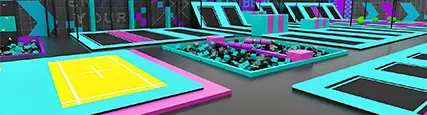
Injbell FEC concept rendering. Multi-attraction projects require separate equipment schedules and a clear division between playground supply and building-related work.
Combining activities can broaden the venue's offering, but the quotation should not treat different equipment categories as one indistinguishable package.
Each attraction should have its own intended user group, safety requirements, access arrangements, required staffing considerations, and operating limitations.
Transition areas are particularly important. The design should address movement between activities, separation of incompatible uses, supervision visibility, and any required barriers or controls.
If multiple manufacturers or subcontractors are involved, assign responsibility for the interfaces between their equipment before installation begins.
The manufacturer should be selected on the basis of documented capability and an appropriate project scope, not simply the lowest advertised price.
For this comparison, I’m prioritizing the factors that are most likely to affect procurement clarity, equipment suitability, installation coordination, and the ability to operate the completed playground.
| Evaluation Category | Suggested Weight | Evidence to Review |
|---|---|---|
| Scope completeness and quotation clarity | 30% | Itemized equipment schedule, approved drawings, exclusions, and cost breakdown |
| Safety and compliance documentation | 25% | Applicable requirements, product-specific evidence, and review arrangements |
| Materials and manufacturing capability | 15% | Material specifications, production information, and quality-control arrangements |
| Installation and after-sales support | 15% | Installation scope, manuals, spare parts, support terms, and handover procedure |
| Comparable total project cost | 10% | Normalized delivered-and-installed cost under the same assumptions |
| Warranty and contractual protections | 5% | Written warranty, remedy process, milestones, and change control |
| Total | 100% | Use the same scoring method for each supplier |
These weights are an editorial evaluation method, not published industry statistics. Buyers should adjust them to suit the project.
A supplier that cannot provide required safety evidence or meet mandatory contractual conditions should not pass the selection process merely because it scores well on price.
At Injbell, our commercial playground offering covers indoor soft play, indoor playground structures, FEC equipment, trampoline parks, and Ninja Course applications. Our manufacturing and playground project work dates back to 2016.
This range is particularly relevant to owners planning a custom venue rather than buying a single freestanding play product.
We work with configurable playground designs and different installation arrangements, including installation documentation and engineering support according to the agreed project scope.
Buyers can review our indoor soft play equipment range when defining a compact or enclosed children's play area, or explore our Family Entertainment Center equipment options when planning multiple attractions.
Our recommendation is to begin with the venue dimensions, intended age groups, equipment requirements, and destination. From those inputs, the quotation can be organized around an agreed layout, component specifications, the required project documents, and clearly assigned delivery and installation responsibilities.
For compliance-sensitive projects, the precise documents available for a proposed configuration should be confirmed during technical review. Requirements and supporting evidence must be matched to the actual equipment and destination rather than assumed from a general product category.
Injbell should be evaluated using the same documentary and technical criteria applied to any other supplier. A complete quotation and verified project-specific information provide a stronger basis for purchasing than brand claims alone.
The quotation should become part of a clearly defined purchasing agreement.
Before making the initial payment, ensure the contract identifies the final product scope, total contractual price, currency, approved documents, delivery responsibilities, payment milestones, and available remedies.
Payment milestones should correspond to clearly defined contractual events.
Possible events include order confirmation, approval of final drawings, completion of manufacturing, pre-shipment verification, and another agreed delivery or acceptance milestone.
The proportion payable at each stage is a commercial negotiation. It should not be assumed that a particular deposit percentage is standard or appropriate for every manufacturer and project.
Confirm how funds are paid, which legal entity receives payment, how changes to bank details are verified, and what happens if an agreed milestone is not achieved.
A quoted production period should state its starting condition.
For example, production may begin only after the deposit is received and final drawings are approved.
The schedule should distinguish manufacturing completion, readiness for dispatch, international transportation, arrival at the destination, and installation completion.
These are different milestones. The equipment being ready to ship does not mean the venue is ready to open.
Ask for the written warranty before confirming the purchase.
The warranty should explain:
Which components are covered
When the warranty period begins
Whether labor, freight, and replacement parts are included
Which operating conditions or misuse may affect coverage
How defects must be documented and reported
What remedies are available
How claims involving internationally shipped replacement parts are handled
Different components may have different warranty terms. Avoid assuming that a warranty statement for the entire playground gives identical coverage to every part.
Custom equipment should have a documented change-order procedure.
Once the buyer approves the layout, changes affecting dimensions, materials, attractions, or structural configuration should be recorded in updated documents.
Each change order should identify the price adjustment, delivery impact, and responsibilities for any additional review.
Keep a dated record of the final approved drawings and equipment schedule. These documents will be useful during installation, acceptance, and future maintenance.
Pre-shipment verification is an opportunity to identify missing items and inconsistencies while the equipment remains accessible to the manufacturer.
It cannot replace a final assessment of the installed playground, but it can improve delivery accuracy.
Confirm that production corresponds to the latest approved drawings.
Check the equipment schedule against available component records.
Review agreed material and product documentation.
Inspect representative components and accessible safety-critical details.
Confirm colors, themed panels, and specified attractions.
Verify the available installation documents.
Review package labels and the packing list.
Identify unfinished work or corrective actions.
Confirm the agreed shipping documents and dispatch arrangements.
For large or complicated projects, an independent inspection provider may be useful. The inspector's scope must be defined in advance because a general visual inspection is not equivalent to comprehensive product testing or engineering certification.
At handover, the owner should have an organized project record containing the applicable approved drawings, equipment inventory, relevant test or compliance documents, installation instructions, maintenance manuals, inspection records, warranty information, and spare-parts references.
These records support staff training, later repairs, insurance discussions, and future modifications.
Low pricing is not automatically a warning sign. A manufacturer may have an efficient production process, a simpler design, or a narrower scope.
Problems arise when an attractive price cannot be connected to a clearly defined product and delivery obligation.
One total price without a component schedule: The buyer cannot verify which attractions and accessories are included.
Unclear floor-area measurement: The advertised unit price cannot be compared reliably.
Undefined materials: Claims such as "high quality" are used instead of technical specifications.
Generic certificates: Documents do not identify the relevant product, material, standard, or assessment scope.
Installation described vaguely: The quotation does not allocate labor, equipment, travel, or site responsibilities.
No named delivery term: The buyer cannot determine responsibility for freight and related charges.
Missing documentation: Installation, maintenance, and component information is unavailable or not contractually promised.
Uncontrolled substitutions: The supplier can replace materials or components without an agreed approval process.
Unclear warranty remedies: The buyer has no defined procedure for reporting defects and receiving support.
Unsupported delivery promises: The schedule does not identify necessary approvals or manufacturing milestones.
When an important issue is unclear, request a corrected quotation before comparing prices or authorizing production.
Verbal explanations may help resolve questions, but material commitments should appear in the written agreement.
A well-prepared request makes it easier for a manufacturer to submit a complete and comparable proposal.
The following wording can be adapted for a commercial indoor playground project.
Subject: Request for Commercial Soft Play Equipment Quotation
We are planning a commercial indoor playground and would like a detailed quotation based on our venue drawings and project requirements.
Our project information is as follows:
Project location: [Country and city]
Available building area: [Dimensions and area]
Proposed equipment footprint: [Area, if established]
Clear ceiling height: [Height and restrictions]
Target age groups: [Ages]
Preferred attractions: [List]
Design theme: [Theme or reference]
Target opening date: [Date]
Please provide an itemized quotation covering the proposed equipment, dimensions, materials, included accessories, drawings, applicable safety documentation, packaging, delivery terms, installation options, commissioning responsibilities, warranty, spare parts, and available after-sales support.
Clearly identify excluded services and charges. Please also confirm the quotation validity period, estimated manufacturing schedule, payment milestones, and requirements for final design approval.
Where any price is preliminary, please identify the assumption and explain when it can be finalized.
Attach the actual floor plan and relevant site information rather than relying only on the dimensions written in the message.
When comparing multiple suppliers, send the same technical brief to each one and request any proposed deviations in a separate list.
A complete quotation should identify the playground design, equipment dimensions, structural and protective materials, major attractions, accessories, relevant technical documents, packaging, delivery responsibilities, installation scope, warranty terms, and payment schedule.
Each cost or service should be marked as included, excluded, separately priced, or pending confirmation. The approved layout and component list should be attached to the commercial agreement.
Not automatically. Some manufacturers quote an equipment supply price, while others include freight coordination, on-site supervision, or a defined installation package.
Check the delivery term, destination, installation labor responsibilities, unloading arrangements, lifting equipment, travel expenses, and commissioning requirements. Request separate figures for any excluded work.
It depends on the supplier and the level of design work required.
A preliminary concept may be included, while detailed engineering, additional revisions, or locally required professional documentation may be charged separately.
Ask for a list of design deliverables, included revisions, approval milestones, and additional design charges before paying the deposit.
Give each manufacturer the same floor plan, target age groups, equipment requirements, and delivery destination.
Compare the proposed attractions, specifications, documentation, installation responsibilities, delivery terms, warranty coverage, and total comparable cost. Do not use the lowest advertised price per square meter as the deciding factor.
If one supplier proposes different materials or activities, document those differences before making the final selection.
The applicable requirements depend on the equipment type, intended users, destination, and local regulatory framework.
ASTM F1918 may be relevant to soft contained play equipment within its scope. Fully enclosed play equipment in relevant European markets may involve EN 1176-10 and related requirements. Commercial trampoline courts require separate consideration.
Ask the supplier for product-specific documentation and confirm local requirements with the appropriate authorities and qualified professionals. A generic certificate is not enough to establish compliance of a custom installation.
Both purchasing models can work.
Direct purchasing may give the buyer closer access to customization and manufacturing information. A local distributor or contractor may offer additional installation coordination, local service, or other contracted responsibilities.
Compare what each party actually supplies and supports. The best choice is the arrangement that can meet the project's technical, commercial, and operational requirements at an acceptable total cost.
Ask the manufacturer for the preliminary packing information, shipment origin, expected volume or other relevant shipping details, and proposed delivery term.
Use that information to obtain a current freight estimate. If the final packing dimensions are not yet available, label the shipping allowance as preliminary and define when it will be updated.
For international purchases, also investigate customs brokerage, duties, taxes, destination handling, and delivery to the venue.
Confirm the approved equipment drawings, component specifications, exact contract scope, total price, currency, applicable documentation, delivery terms, installation responsibilities, warranty, payment milestones, and production schedule.
Make sure the contract identifies how design changes, missing components, defects, delivery disputes, and acceptance issues will be handled.
Any important promise made during sales discussions should be reflected in the written agreement.
Before accepting a commercial soft play equipment quotation, confirm that you can answer the following questions without relying on assumptions:
Does the price refer to equipment supply, delivered equipment, or a complete installed scope?
Does the quoted equipment match the approved venue layout?
Are all major components and attractions identified?
Are structural materials, padding, netting, flooring, and other important specifications documented?
Are design revisions and engineering deliverables defined?
Are relevant safety documents and local review responsibilities established?
Are shipping, import-related charges, and inland delivery responsibilities clear?
Is installation responsibility assigned to specific parties?
Are commissioning, inspection, and acceptance conditions documented?
Are warranty terms, spare parts, and technical support explained?
Have missing costs been added to the total project budget?
Are the payment schedule, change-control process, and delivery milestones agreed in writing?
A complete quotation does not guarantee commercial success or eliminate every project risk. It gives the buyer something equally important: a clear basis for understanding the purchase, comparing competing proposals, controlling changes, and preparing the venue for installation and operation.
For a commercial playground investment, I’d choose the supplier that can demonstrate the right equipment configuration, clearly documented specifications, appropriate safety evidence, dependable installation arrangements, and a defensible total project cost. Those factors matter more than a low number on the first page of a quotation.
The following institutional references support the technical and safety information discussed in this article. Standards may be revised, and local authorities may require additional or different provisions.
ASTM International. ASTM F1918-21: Standard Safety Performance Specification for Soft Contained Play Equipment. 2021. View the standard and its scope.
AENOR / British Standards Institution. BS EN 1176-10:2023: Playground Equipment and Surfacing — Additional Specific Safety Requirements and Test Methods for Fully Enclosed Play Equipment. 2023. View the published standard information.
ASTM International. ASTM F2970-25: Standard Practice for Design, Manufacture, Installation, Operation, Maintenance, Inspection and Major Modification of Trampoline Courts. 2025. View the standard and its scope.
U.S. Consumer Product Safety Commission. Public Playground Safety Handbook. 2025 edition. Read the official handbook.
U.S. Access Board. Guide to the ADA Accessibility Standards: Chapter 10 — Play Areas. Read the official accessibility guidance.
Article date: October 2026.
This article is prepared by Injbell for general purchasing, project planning, and educational purposes. It is not a binding equipment quotation, engineering design, safety certification, legal opinion, customs determination, or guarantee of business performance.
Actual equipment specifications, prices, production schedules, delivery charges, installation services, warranty coverage, and documentation depend on the agreed configuration and contract.
Applicable safety standards, building codes, accessibility requirements, fire regulations, customs procedures, and operating obligations vary by jurisdiction and may change. Buyers should confirm current requirements with the relevant authorities and qualified local professionals before manufacturing, importing, installing, or operating commercial playground equipment.
References to standards describe their general subject matter and do not constitute a determination that a particular product or installation conforms to those standards. Project-specific supporting evidence and any necessary independent review should be obtained separately.
Injbell specializes in commercial playground and amusement equipment solutions. Project-specific technical and commercial terms should always be confirmed in the final written quotation and purchasing agreement.




 EN
EN ES
ES AR
AR

