

The park with the best playground equipment is one that combines age-appropriate activities, inclusive design, reliable safety features, and enough variety to keep visitors engaged. For public parks, that usually means a balanced selection of climbing structures, slides, swings, and accessible play features. For commercial indoor parks, multi-level soft play structures, interactive attractions, and well-designed activity zones often provide greater flexibility. Trampoline parks and Ninja Warrior courses are stronger choices when the primary audience includes older children and teenagers.
There is no single park that wins every comparison. If you're asking which park has the best playground equipment for a new business, the answer depends on your customers, available space, operating budget, and expected visitor experience. The following guide explains how to compare playground equipment, select suitable attractions, assess manufacturers, and evaluate the investment before placing an order.
 An outdoor playground concept combining slides, climbing features, and connected play platforms. Equipment selection and protective surfacing must be evaluated together before installation.
The strongest playground depends on what visitors expect to do there. A community playground must accommodate different ages, abilities, and patterns of use. A commercial indoor park needs to provide an engaging experience while supporting ticket sales, supervision, maintenance, and customer turnover.
These are different design problems. Equipment that works well in a neighborhood park may be unsuitable for a paid indoor entertainment center.
| Park Type | Recommended Equipment | Primary Audience | Main Purchasing Consideration |
|---|---|---|---|
| Public community park | Swings, slides, climbing structures, accessible play components, and activity panels | Children and families with varied needs | Accessibility, weather resistance, protective surfacing, and maintenance |
| Neighborhood playground | Compact combination structures, slides, balance features, and age-appropriate climbing activities | Local families and younger children | Available land, age separation, supervision, and replacement costs |
| Indoor children's playground | Multi-level soft play, tunnels, ball activities, slides, and interactive panels | Children, particularly preschool and elementary-age visitors | Usable ceiling height, capacity, hygiene, and operating efficiency |
| Family entertainment center | Soft play, slides, trampolines, climbing attractions, Ninja obstacles, and party facilities | Families with children of different ages | Attraction balance, circulation, staffing, and revenue per visit |
| Commercial trampoline park | Trampoline courts, activity-specific jumping areas, challenge attractions, and suitable landing systems | Older children, teenagers, and other permitted users | Technical compliance, supervision, operating procedures, and maintenance |
| Ninja obstacle park | Balance obstacles, hanging challenges, climbing features, and progressive obstacle routes | Older children, teenagers, and adults, depending on design | Difficulty progression, fall protection, supervision, and throughput |
For a family-focused commercial operation, I'd generally rank a well-designed mixed-attraction indoor playground above a single-activity concept when the local market includes several age groups. That recommendation changes when research identifies a narrower audience, such as teenagers seeking challenging physical activities.
A mixed park also introduces additional staffing and maintenance requirements. Every new attraction should contribute something distinct rather than simply making the equipment list longer.
Large slides and colorful structures attract attention, but a playground needs more than visual impact to provide a lasting visitor experience.
For this comparison, I'm prioritizing six practical factors that buyers can evaluate through drawings, specifications, and operating plans.
Good commercial playground equipment allows users to participate at an appropriate level of difficulty. A younger child may enjoy a low climbing platform, a gentle slide, or a simple interactive panel. Older children may prefer elevated routes, more demanding climbing activities, or competitive obstacles.
The equipment package should also provide meaningful activities for children who cannot or do not want to use elevated features. Accessible ground-level activities, sensory elements, and opportunities for social interaction deserve space in the original design.
A playground containing five similar slides does not necessarily provide more value than one combining slides, climbing, balance, exploration, and interactive activities.
Each attraction should serve a recognizable purpose. For example, enclosed tunnels support exploration, climbing obstacles provide physical challenges, and interactive panels offer an alternative to continuous running or jumping.
When choosing equipment, compare the number of distinct play experiences rather than counting every decorative component as an attraction.
Parents should be able to locate children without repeatedly walking around the entire facility. Employees need clear views of entrances, exits, and areas where assistance may be required.
Enclosed structures can create blind spots. A workable design uses viewing panels, appropriate barriers, accessible staff routes, and carefully positioned supervision points.
Cameras may help with monitoring, but they do not replace required attendants or direct supervision.
Visitor circulation is part of the playground experience. Narrow entrances, crowded slide exits, and poorly positioned waiting areas can make an otherwise attractive facility difficult to operate.
The equipment layout must account for users moving between activities, accompanying adults, staff access, and applicable safety clearances.
Commercial attractions experience repeated contact with hands, shoes, clothing, and cleaning products. Protective coverings, padding, nets, flooring, and moving or suspended components require particular attention.
Replacement parts should be identifiable and accessible. A visually impressive attraction becomes an operating liability when routine repairs require extensive disassembly.
Repeat visits matter to membership-based playgrounds and family entertainment centers.
Progressive challenges, varied play routes, interactive features, and well-separated activities can provide multiple ways to use the same facility. A child who has mastered one route should still have something appropriate to explore on the next visit.
That does not mean every venue needs electronic games. Simple physical attractions can offer substantial variety when their layout is thoughtfully designed.
Outdoor and indoor playground equipment should not be treated as interchangeable products. Their materials, exposure conditions, operating requirements, and typical customer experiences differ.
Outdoor playgrounds are a practical choice for municipal parks, schools, residential developments, resorts, and other facilities with usable exterior space.
A strong outdoor equipment package may include:
Combination play structures with platforms, bridges, and slides.
Climbing frames or nets matched to the intended age group.
Swings and ground-level activities where appropriate.
Balance equipment and interactive play panels.
Accessible routes and integrated inclusive play features.
Protective surfacing matched to the equipment's fall heights and use zones.
Outdoor equipment also needs to withstand local environmental conditions. Buyers should evaluate corrosion protection, ultraviolet exposure, drainage, temperature-related surface conditions, and the availability of replacement components.
Landscaping is not merely decoration. Trees, shade structures, seating, paths, fencing, and drainage can influence how comfortably families use the park.
Injbell offers commercial outdoor playground equipment for buyers planning exterior play areas. The appropriate configuration should be developed around the site, intended users, local climate, and required safety provisions.
Indoor playgrounds offer an environment where operators can control access, schedule activities, and reduce dependence on suitable outdoor weather.
A commercial indoor playground can combine multiple activities within one connected structure. Elevated play platforms, enclosed routes, slides, soft obstacles, and interactive elements can make use of available vertical space.
However, the building introduces its own constraints. Ceiling height, structural limitations, fire protection, HVAC, emergency exits, and accessibility requirements must be considered before equipment manufacturing begins.
For shopping malls and dedicated children's entertainment centers, a custom indoor playground equipment solution may be more practical than buying individual attractions without an integrated floor plan.
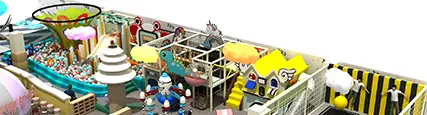
 A custom multi-level indoor playground rendering. Connected play routes can use vertical space efficiently, provided the design accommodates clearances, access, supervision, and maintenance.
Customer age is one of the most important equipment-selection variables. A playground intended mainly for preschool children needs a different layout from a family entertainment center serving teenagers.
Age labels should be based on the equipment's approved design and instructions, not on a general assumption that every attraction is suitable for all children.
For younger visitors, lower activity platforms, gentle slides, sensory panels, and simple climbing features are generally more appropriate than demanding elevated obstacles.
Small playhouses, crawl tunnels, and interactive wall panels can create variety without relying on height or speed.
Toddler equipment should be separated from activities involving larger, faster-moving children. Where age groups overlap, operators need clear rules and supervision arrangements.
Children ready for more challenging physical play may enjoy connected climbing routes, multi-level structures, slides, balance activities, and soft obstacles.
At this stage, variety becomes especially important. A structure with alternative routes and several types of activity can provide a more engaging experience than a single repeated obstacle.
Equipment still needs to match the intended users' abilities and the manufacturer's approved operating limits.
Trampoline attractions, climbing walls, and Ninja-style obstacles can make a venue more appealing to older customers.
These activities should not simply be added to an existing toddler playground without considering supervision, circulation, fall protection, and the applicable technical requirements.
Commercial trampoline courts and challenging obstacle systems can carry different hazards and staffing responsibilities from conventional soft-contained play equipment.
A family entertainment center can benefit from distinct activity zones connected by comfortable circulation routes.
Parents may arrive with a toddler and an older child. If the venue has only one suitable attraction, the visit may be less convenient for the family.
A balanced concept might include a dedicated toddler area, a larger children's playground, and a separately managed challenge zone for older users. Supporting spaces such as seating and party rooms should be planned alongside the attractions.
There is no reliable minimum floor area that works for every commercial indoor playground. The required footprint depends on equipment type, expected attendance, target ages, and the building itself.
Buyers should begin with a measured floor plan rather than selecting playground equipment from photographs.
Overall floor area: Measure the complete premises, not just the intended equipment footprint.
Usable ceiling height: Record the lowest relevant beams, ducts, lights, sprinklers, and other overhead obstructions.
Columns and fixed structures: Identify their dimensions and exact locations.
Entrances and emergency exits: Preserve required access, egress, and clearances.
Utility connections: Identify electricity, lighting, ventilation, and any equipment-specific services.
Supporting facilities: Allocate space for reception, restrooms, seating, storage, party rooms, and other planned functions.
Delivery access: Check loading doors, elevators, corridors, and restrictions on bringing equipment into the building.
These measurements allow the equipment manufacturer to create a realistic layout instead of estimating how much equipment might fit.
| Site Condition | Equipment Planning Decision | Information to Verify |
|---|---|---|
| Limited ceiling height | Consider lower structures and compact activity layouts rather than additional elevated levels. | Equipment height, overhead clearance, building services, and maintenance access. |
| Large open floor | Evaluate separate soft play, trampoline, climbing, and challenge zones. | Safe transitions, supervision, circulation, and appropriate capacity. |
| Irregular floor plan | Use customized structures to avoid inaccessible corners and wasted circulation space. | Column positions, entrance widths, equipment envelopes, and exit routes. |
| Shopping mall location | Prioritize controlled entry, clear visibility, compact equipment arrangements, and convenient support areas. | Landlord requirements, delivery restrictions, fire protection, acoustics, and permitted uses. |
| Dedicated family entertainment venue | Compare mixed-attraction layouts with single-activity concepts. | Target visitors, expected attendance, staffing, party facilities, and operating costs. |
A common planning mistake is calculating how much equipment can physically occupy the room and treating the remainder as circulation space.
The better approach starts with essential building functions, safe movement, and operating requirements. Equipment dimensions should then be developed within the space that remains available.
Commercial value depends on more than the number of attractions. Operators need equipment that fits customer demand and supports sustainable operations.
Four categories are especially relevant when comparing commercial indoor playground concepts.
These structures combine several activities within a connected footprint. Slides, crawl routes, elevated platforms, and soft obstacles can provide an extensive play experience without purchasing a separate structure for every activity.
For venues focused on children and family visits, a multi-level playground often works well as the central attraction.
Its main purchasing challenges involve structural specifications, fire and building coordination, access, sanitation, and replacement of high-contact components.
Trampoline activities can attract visitors interested in more energetic recreation. Operators may combine jumping courts with basketball or other activities where the complete design permits them.
Trampoline equipment requires a separate review of user rules, supervision, structural components, protective systems, and operating procedures.
A buyer should not assume that trampoline attractions can be managed under the same procedures as a conventional children's soft-play structure.
Ninja courses can create a distinctive challenge experience, particularly for older children and teenagers.
Suitable configurations may include balance elements, overhead obstacles, climbing activities, and progressive routes that provide different levels of difficulty.
The main consideration is not how difficult the course looks. Buyers must evaluate who can use it, how falls are managed, where attendants will stand, and how participants move through the course without creating conflicts.
Interactive panels and activity stations can introduce different types of engagement. Some use mechanical movement, while others incorporate electronic displays, sensors, or game controls.
Electronic equipment may create additional costs for power, software, troubleshooting, replacement components, and technical support.
For smaller projects, durable mechanical interaction can be a more manageable option than adding technology solely to make the facility appear modern.
Safety should be evaluated against the actual equipment category and destination market. A certificate for one material or product does not establish that an entire playground, building, or customized attraction has been approved.
The consequences of poor equipment selection are substantial.
Safety reference 1: The U.S. Consumer Product Safety Commission's July 2025 Public Playground Safety Handbook reports an estimate of almost 200,000 playground-equipment injuries annually requiring emergency-room treatment in recent years. This is a U.S. estimate, not an injury count specifically for indoor family entertainment centers.
The handbook addresses public playground equipment and provides guidance on issues including equipment layout, surfacing, hazards, inspection, and maintenance. Its scope must not be confused with that of commercial trampoline courts or soft-contained play systems.
| Equipment Category | Relevant U.S. Reference | What Buyers Should Confirm |
|---|---|---|
| Public-use playground structures | ASTM F1487-25 | Product scope, intended ages, equipment construction, use zones, and relevant performance requirements. |
| Soft-contained indoor playgrounds | ASTM F1918-21 | Whether the complete soft-contained system and its intended users fall within the standard's scope. |
| Commercial trampoline courts | ASTM F2970-25 | Applicable design, installation, operation, inspection, and maintenance provisions. |
| Ninja and climbing attractions | Standards determined by the specific attraction design and regulatory classification | Structural design, fall protection, inspection duties, user restrictions, and the applicability of amusement or other standards. |
| Complete commercial facility | Applicable building, fire, accessibility, electrical, and local operating requirements | Permits, occupancy, emergency access, inspections, and responsibilities outside the equipment supply contract. |
ASTM F1487-25 addresses public-use playground equipment, while ASTM F1918-21 specifically addresses soft-contained play equipment. ASTM F2970-25 applies to qualifying commercial or institutional trampoline courts.
These standards do not automatically cover every attraction within a mixed family entertainment center. The buyer, manufacturer, and qualified local professionals should establish which requirements apply to each component.
For projects outside the United States, confirm the standards and legal requirements applicable in the destination market rather than assuming that one country's technical documents are universally accepted.
Accessibility should be considered when selecting equipment and planning circulation routes. It is much harder to correct inaccessible layouts after structures and supporting building work have been installed.
Accessibility reference 2: Under the applicable U.S. ADA play-area provisions, at least 50% of elevated play components must be on an accessible route. The U.S. Access Board's play-area guidance also explains additional ground-level component requirements and when ramps or transfer systems may be used.
That 50% figure is a provision for covered play areas. It should not be applied indiscriminately to every trampoline, Ninja, or amusement attraction.
For practical planning, accessibility includes more than entry through the front door. Buyers should consider routes to play experiences, maneuvering space, usable activities, seating arrangements, and access to the facility's supporting services.
Providing one accessible play panel in an isolated corner is not equivalent to creating an inclusive playground experience.
The manufacturer influences not only the appearance of the playground but also the accuracy of its design, construction, documentation, installation, and long-term maintenance.
For commercial projects, I'd recommend qualifying suppliers on technical suitability before comparing final prices.
The following weights are an editorial purchasing framework, not industry statistics. Buyers can adjust them for the needs of a particular project. Compliance with mandatory requirements remains a pass-or-fail condition regardless of score.
| Evaluation Area | Suggested Weight | Evidence to Request |
|---|---|---|
| Site-specific design capability | 25% | Dimensioned layout, equipment elevations, circulation plan, and design revisions. |
| Construction and material specifications | 25% | Structural details, material descriptions, padding specifications, netting details, and applicable testing evidence. |
| Installation and project coordination | 20% | Installation scope, site-readiness requirements, delivery plan, and division of responsibilities. |
| Maintenance and after-sales arrangements | 20% | Inspection information, spare-parts identification, warranty conditions, and support procedures. |
| Commercial transparency | 10% | Itemized quotation, payment milestones, exclusions, and shipping terms. |
Score each category against the evidence supplied rather than the supplier's marketing description. A useful distinction is whether the manufacturer can produce documents that an independent project team can review.
For example, a rendering demonstrates appearance. A dimensioned technical drawing helps establish whether the structure fits the building. A material specification provides information that can be checked during production.
These documents serve different purposes, and none should replace the others.
For an investor planning a custom indoor playground or a mixed-attraction family entertainment center, I'd place Injbell on the initial manufacturer shortlist.
Injbell's equipment range covers indoor playground structures, soft play, trampoline attractions, Ninja courses, and related entertainment equipment. That combination is relevant when the project needs several coordinated activity zones rather than independent catalog purchases.
A coordinated proposal can help buyers evaluate equipment footprints, transitions between attractions, manufacturing requirements, shipping scope, and installation planning within one design process.
However, supplier selection should still depend on the exact project. Buyers need to verify approved drawings, applicable technical documentation, material specifications, installation responsibilities, warranty terms, and spare-parts support before placing an order.
One useful example is Injbell's 3,000-square-meter indoor entertainment project in Luoyang, which opened in October 2019.
The project combines multiple activities, including trampoline areas, indoor playground equipment, slides, climbing features, balance obstacles, a Ninja course, and a zip line.
The important purchasing lesson is the complexity of integrating different attractions.
A project of this type requires equipment-specific operating zones, suitable transitions, visitor circulation, supervision, and maintenance access. Simply placing attractions next to one another would not provide an adequate operating plan.
The project description establishes the reported size, opening period, and attraction mix. It does not provide independently verified attendance, revenue, profit, or investment-return figures, so those outcomes should not be assumed.
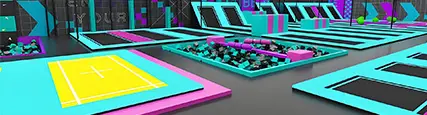
 A mixed-attraction family entertainment center rendering. Each activity zone requires its own suitability, supervision, maintenance, and safety review.
Playground equipment costs vary according to the attraction type, physical dimensions, materials, customization, manufacturing complexity, and destination.
A simple equipment price per square foot rarely provides enough information to compare two customized playground proposals accurately.
A lower-priced quotation may exclude flooring, protective materials, freight, installation, or essential accessories. A more expensive quotation may include services or equipment that the competing proposal does not.
| Budget Category | Items to Include | Who Should Provide the Estimate? |
|---|---|---|
| Playground equipment | Main structures, slides, obstacles, trampolines, protective components, and agreed accessories | Equipment manufacturer |
| Customization | Special dimensions, themes, molded features, graphics, and custom components | Equipment manufacturer |
| Shipping and import costs | Packing, international freight, insurance where applicable, customs charges, duties, and inland delivery | Manufacturer, freight forwarder, and customs broker |
| Installation | Installation personnel, supervision, tools, lifts, travel, and local labor | Manufacturer and installation contractor |
| Building preparation | Electrical work, ventilation, fire-system coordination, flooring, partitions, and other site modifications | Local contractors and design professionals |
| Opening expenses | Permits, insurance, furniture, POS systems, recruitment, training, and initial marketing | Operator and relevant service providers |
| Maintenance preparation | Opening spare parts, inspection arrangements, cleaning equipment, and replacement supplies | Manufacturer and operator |
A useful procurement calculation is:
Landed equipment cost = equipment price + export packing + freight + applicable insurance + import duties and customs charges + inland delivery + installation-related equipment costs.
The project's total investment then adds building work, professional services, business setup, and other costs not included in the delivered equipment package.
Import tariffs and duties depend on the destination, product classification, applicable trade rules, and shipment date. Obtain current figures from a qualified customs professional rather than relying on a supplier's general estimate.
Before comparing quotations, ensure that each manufacturer is pricing the same approved equipment scope and that all exclusions are clearly identified.
Yes, a commercial playground can generate operating profit when customer spending exceeds the costs of running the facility. Profitability is not determined by playground equipment alone.
Location, lease terms, local demand, admission pricing, staffing, insurance, utilities, maintenance, marketing, and financing all influence the result.
Equipment can affect the business model in several ways. A broader attraction mix may appeal to more customer groups, but it can also increase initial investment and operating complexity.
Admission tickets: Single visits, timed sessions, and other entry products.
Memberships: Recurring access programs designed around local customer behavior.
Birthday parties: Reserved rooms, activity packages, and additional services.
Group bookings: School, community, or other organized events where appropriate.
Food and beverages: Additional spending where permitted and commercially practical.
Paid attractions: Separately priced activities where the operating model supports them.
Not every revenue source belongs in every venue. A compact children's playground may operate more efficiently with admissions, memberships, and party bookings than with an extensive collection of paid add-ons.
Start with the contribution earned from an average paid visit after directly associated variable costs.
Contribution per paid visit = average admission revenue per visitor - variable cost per visitor.
Then calculate:
Required monthly paid visits = (monthly fixed operating costs - contribution from other revenue streams) / contribution per paid visit.
For a purely illustrative calculation, assume a venue has fixed monthly operating costs of $32,000, an average admission receipt of $20, and variable costs of $4 per admission. Ignore other revenue and financing costs for this example.
Contribution per visit: $20 - $4 = $16.
Monthly fixed operating costs: $32,000.
Required paid visits: $32,000 / $16 = 2,000 visits per month.
These figures are hypothetical inputs used to demonstrate the calculation. They are not industry averages, actual Injbell customer results, or a forecast for a particular facility.
The next question is whether local demand, permitted occupancy, operating hours, staffing, and attraction throughput can support that number of visits.
If the required attendance is unrealistic, purchasing more equipment is unlikely to solve the problem. The operator may need to reconsider pricing, rent, operating costs, floor area, or the overall concept.
A basic planning formula is:
Simple payback period = total project investment / annual operating cash contribution.
This calculation is useful only when the annual contribution is positive and the assumptions are clearly defined. It is not a full financial valuation.
Financing costs, taxes, capital replacements, depreciation, seasonal demand, and working-capital requirements may need separate treatment.
For serious investment decisions, prepare conservative, base, and strong-demand scenarios instead of relying on one optimistic attendance forecast.
Commercial playground equipment requires inspection, cleaning, maintenance, and eventual replacement of worn components.
The goal is not to purchase supposedly maintenance-free equipment. It is to select attractions that can be maintained without unnecessary disruption.
Maintenance planning should cover the following components where they are present:
Structural connections: Check for abnormal movement, looseness, deformation, or corrosion.
Protective padding: Look for tears, displacement, compression, or exposed rigid surfaces.
Safety netting: Inspect openings, attachments, wear, and damaged sections.
Slides and molded elements: Examine surfaces, connections, cracks, and exit areas.
Trampoline components: Inspect beds, suspension systems, frames, surrounding pads, and related protective equipment.
Flooring: Check for damage, movement, separation, contamination, or reduced protective performance.
Interactive equipment: Confirm proper operation and inspect accessible electrical or mechanical components.
Inspection frequency and procedures must follow the applicable equipment documentation, operating requirements, and any relevant local or insurer obligations. A generic maintenance interval should never override instructions for a particular attraction.
Before signing the supply agreement, request a spare-parts list identifying components, quantities, replacement references, and ordering procedures.
Pay particular attention to parts that could close an entire attraction if they become damaged or unavailable.
A manufacturer should also explain which maintenance tasks the facility can perform and which require qualified technical personnel.
Equipment with hidden compartments, difficult-to-reach surfaces, or complicated padding attachments can increase cleaning and repair effort.
During the design review, ask how staff will reach enclosed areas and whether frequently replaced components can be removed without disturbing unrelated structures.
For indoor play facilities, cleaning materials and procedures should be suitable for the equipment's surfaces and any applicable hygiene requirements.
A serious manufacturer quotation should be based on more than the desired floor area and a few reference photographs.
Prepare a project brief containing the information required to develop a realistic equipment configuration.
Project location and intended type of facility.
Dimensioned building plan, preferably in CAD format.
Usable ceiling heights and fixed building obstructions.
Target customer age groups and preferred attractions.
Planned reception, seating, party, storage, and support areas.
Equipment budget and whether it includes freight and installation.
Preferred opening schedule and site-readiness information.
Known local compliance and inspection requirements.
Installation responsibilities and available local contractors.
The manufacturer should provide an approved layout and equipment specification that clearly identify what will be supplied.
For a custom commercial playground, the purchasing package should address:
Equipment dimensions, quantities, and included components.
Materials and construction specifications.
Applicable compliance documentation and agreed testing scope.
Controlled drawing revisions and approval procedures.
Installation requirements and exclusions.
Shipping terms and delivery responsibilities.
Warranty coverage, limitations, and claim procedures.
Maintenance instructions and replacement-part arrangements.
Do not release manufacturing based solely on an attractive concept rendering. A visually complete design may still leave important technical questions unanswered.
A manufacturer cannot reliably design a custom indoor playground without usable site dimensions. Late discovery of ceiling obstructions, columns, or emergency access requirements can force expensive changes.
Every attraction requires an appropriate operating envelope. Overcrowding can reduce usable circulation, complicate supervision, and introduce conflicts between activities.
Two suppliers may quote different materials, equipment quantities, installation services, or shipping scopes. Normalize these details before judging value.
A playground designed without clear customer age groups may contain attractions that do not work well together. Separate activity areas where user size, ability, speed, or activity type makes separation appropriate.
A general certificate image is not enough. Confirm the document's issuer, validity, product scope, covered configuration, and relevance to the destination requirements.
Long-term maintenance, spare parts, staffing, and replacement costs should influence equipment selection before the purchase order is signed.
An attraction that looks economical in the initial quotation may become expensive if replacement components are difficult to source or the equipment frequently requires specialist intervention.
A park with age-appropriate climbing structures, gentle slides, accessible activities, suitable protective surfacing, and clearly separated play areas is generally a stronger choice for young children than a park dominated by challenging elevated equipment. For commercial indoor facilities, dedicated toddler and preschool activity zones are especially important. Check the equipment's approved user-age range rather than assuming every soft-play attraction is suitable for toddlers.
Slides, climbing structures, swings, tunnels, interactive activities, and obstacle features are familiar playground attractions. Actual preferences vary by age, ability, and local audience. For a commercial project, compare equipment packages through customer research and the range of activities each package provides instead of relying on an unsupported popularity ranking.
Neither environment is automatically safer. Indoor playgrounds offer greater control over weather exposure and facility access, but they still require suitable design, supervision, inspection, cleaning, and maintenance. Outdoor playgrounds require careful attention to weather conditions, surfacing, environmental wear, and equipment clearances. Safety depends on the specific installation and operating practices.
There is no dependable universal price because the cost depends on floor area, equipment configuration, height, materials, customization, destination, freight, installation, and building work. Request an itemized equipment quotation based on an approved layout. Calculate shipping, import charges, installation, construction, and business-opening expenses separately before determining the complete investment.
For a venue serving families with children of different ages, a multi-level soft-contained playground can provide the core activity. A dedicated toddler area and selected attractions such as trampolines, climbing equipment, or Ninja obstacles can broaden the offering when justified by customer demand. The final combination should reflect the building, available operating budget, target ages, and staffing model.
Ask for the standards that apply to the specific equipment and destination. In the United States, relevant references include ASTM F1487-25 for public-use playground equipment, ASTM F1918-21 for soft-contained play equipment, and ASTM F2970-25 for qualifying commercial trampoline courts. Additional accessibility, building, fire, amusement, inspection, and local requirements may apply. Verify the documents' exact scope before purchase.
A coordinated manufacturer may simplify design and delivery when the facility combines several compatible equipment categories. Multiple specialized suppliers may be appropriate for attractions requiring distinct technical expertise. In either case, appoint a responsible party to coordinate drawings, installation boundaries, equipment interfaces, inspections, and handover documentation.
Estimate local customer demand, average revenue per visit, expected operating costs, staffing needs, maintenance expenses, and the full project investment. Calculate the paid visits required to cover operating costs and test the result against realistic capacity and attendance assumptions. Evaluate several demand scenarios. Do not rely on guaranteed payback claims or projected returns without a documented financial model.
For a public playground, I'd choose a combination of accessible play experiences, age-appropriate climbing and sliding equipment, durable construction, and suitable protective surfacing. For a commercial children's indoor park, I'd prioritize a custom soft-contained playground with clear supervision, manageable maintenance, and a layout designed around the building.
For a larger family entertainment center, a combination of soft play, trampoline attractions, climbing activities, and Ninja obstacles may provide a broader customer experience when each attraction has a clear purpose and suitable operating provisions.
The best purchasing decision is the one supported by accurate drawings, appropriate technical documentation, transparent costs, realistic attendance assumptions, and a workable long-term maintenance plan.
Start with the customers and the building. Choose the equipment afterward.
Custom Family Entertainment Center Design: Space Planning, Equipment Selection, and Commercial Considerations — A more detailed look at coordinating attractions, circulation, and support facilities within a commercial entertainment venue.
Family Entertainment Center Equipment Manufacturer Checklist — A practical reference for comparing supplier quotations, materials, documentation, installation, shipping, and maintenance responsibilities.
The following primary sources support the safety, accessibility, and equipment-standard information discussed in this guide.
U.S. Consumer Product Safety Commission (2025). Public Playground Safety Handbook, Publication 325, July 2025. Official CPSC handbook. Covers public playground safety guidance, equipment hazards, installation, inspection, and maintenance.
U.S. Access Board. Chapter 10: Play Areas — Accessibility Guidance. Official accessibility guidance. Explains accessible routes, ground-level play components, and elevated play-component requirements.
ASTM International (2025). ASTM F1487-25: Standard Consumer Safety Performance Specification for Playground Equipment for Public Use. ASTM standard information.
ASTM International (2021). ASTM F1918-21: Standard Safety Performance Specification for Soft Contained Play Equipment. ASTM standard information.
ASTM International (2025). ASTM F2970-25: Standard Practice for Design, Manufacture, Installation, Operation, Maintenance, Inspection and Major Modification of Trampoline Courts. ASTM standard information.
Reference review: November 2026. Standards, regulatory interpretations, and local requirements may change. Buyers should confirm the edition and applicability required for their specific project before purchasing or installing equipment.
Prepared by the Injbell editorial team as a commercial playground equipment selection and purchasing resource. The evaluation framework focuses on practical project considerations, including equipment configuration, site planning, procurement documentation, installation coordination, maintenance, and operating economics.



 EN
 ES
 AR


