

Importing indoor playground equipment from China can reduce equipment purchasing costs, but a low factory quote does not guarantee an affordable, safe, or profitable project. The seven biggest mistakes are choosing equipment before confirming site requirements, accepting vague safety certificates, overlooking landed costs, approving impractical layouts, signing incomplete contracts, neglecting installation planning, and failing to arrange after-sales support.
A successful indoor playground equipment import from China starts with a workable facility plan and ends with a venue that can pass inspections, welcome customers, and operate without constant equipment problems. For investors building an indoor playground, family entertainment center (FEC), or trampoline park, the important number is not the factory price. It is the total cost of opening and maintaining a commercially viable attraction.
This guide explains where imported playground projects can go wrong, what to check before paying a supplier, and how to protect your investment from design approval through opening day.

China has an established manufacturing supply chain for commercial indoor playground equipment. Buyers can source custom soft play structures, slides, climbing obstacles, trampoline courts, Ninja courses, themed decorations, and supporting components from manufacturers that serve international markets.
Direct purchasing can give operators more control over equipment specifications, attraction combinations, and custom designs. It may also reduce certain intermediary costs. Those advantages matter most when the purchaser can manage the responsibilities that would otherwise fall to a local equipment distributor or project contractor.
An indoor playground is not a collection of independent products. Its components must function together inside a building with specific structural, fire safety, accessibility, ventilation, and operational requirements.
A supplier may manufacture the playground correctly and still deliver equipment that cannot be installed as planned. A shipment may clear customs successfully but arrive without the documentation required by a local inspector. A beautifully designed attraction may create excessive staffing costs because employees cannot supervise multiple play areas from practical observation points.
These problems are usually less expensive to prevent during design than to correct after production.
A commercial playground purchase normally involves several connected deliverables:
Equipment: Structural frames, slides, platforms, padding, netting, flooring, barriers, and play features.
Design: Dimensioned layouts, equipment drawings, circulation plans, and technical specifications.
Documentation: Applicable test reports, material information, installation instructions, and operating guidance.
Logistics: Export packaging, freight arrangements, customs information, and delivery coordination.
Installation: Assembly labor, tools, supervision, equipment adjustments, and commissioning.
After-sales support: Replacement components, maintenance instructions, warranty procedures, and technical assistance.
Not every manufacturer includes all six elements. A buyer should therefore compare complete project responsibilities rather than treating every quotation as an equivalent offer.
The first expensive mistake happens before the equipment is manufactured. A buyer sends a floor area, a few reference photographs, and a budget target, then asks several suppliers for designs and prices.
The returned concepts may look impressive. Unfortunately, the manufacturers may be designing for different assumptions about ceiling height, structural columns, entrances, emergency access, and available floor space.
A playground that fits inside the dimensions of a room is not necessarily suitable for that room.
Consider a hypothetical 500-square-meter indoor venue. The owner might initially assume that almost the entire space can accommodate playground equipment.
In practice, the facility may also require a reception counter, shoe storage, restrooms, accessible circulation, birthday party rooms, parent seating, cleaning storage, staff facilities, and emergency exit routes.
Once those functions are allocated, the equipment footprint could be considerably smaller.
That reduction is not wasted space. A playground without sufficient circulation or seating can become difficult to operate even when the attractions are popular.
| Site Information | Why It Matters | What to Provide |
|---|---|---|
| Gross floor area | Establishes the total premises size | Dimensioned architectural floor plan |
| Usable equipment area | Determines the actual playground footprint | Marked boundaries after support spaces are allocated |
| Clear ceiling height | Limits play levels, slides, and climbing features | Measured height below ducts, beams, lights, and sprinklers |
| Columns and fixed obstacles | Affect structure placement and circulation | Column locations, dimensions, and obstruction drawings |
| Entrances and emergency exits | Influence layout, access, and evacuation | Door positions and approved exit routes |
| Floor structure | Determines whether equipment loads are acceptable | Structural information for local engineering review |
| Utilities and building services | Affect electrical attractions and equipment clearance | Electrical, HVAC, lighting, and fire protection layouts |
| Target users | Determines appropriate play elements and operational rules | Age groups, activities, and intended customer profile |
Before approving any equipment layout, ask the manufacturer to distinguish between the overall venue area and the area occupied by the play structure.
The drawing should also identify spaces that cannot be used for equipment installation.
A playground intended primarily for toddlers should not have the same equipment configuration as an FEC serving children, teenagers, and adults.
For toddlers, suitable activities may include low-level exploration, sensory features, padded climbing elements, and age-appropriate slides.
For older children, a multi-level soft play structure may include more demanding climbing routes, enclosed slides, obstacle challenges, and interactive games.
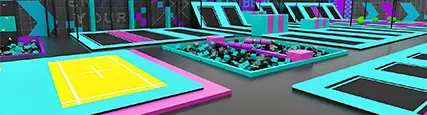
A larger family entertainment center may combine those attractions with trampoline courts, climbing activities, Ninja obstacles, and birthday party facilities.
Combining different age groups without considering how they interact creates avoidable operational risks.
For example, placing a toddler entrance directly beside the exit from a fast-paced obstacle course can cause traffic conflicts. Children moving at different speeds should not be forced through the same narrow circulation point.
The purchasing decision: Define the customer groups before selecting the equipment. The equipment mix should follow the operating concept, not the other way around.
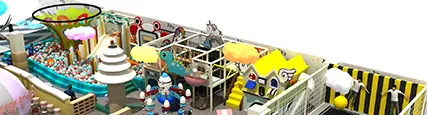
A three-dimensional playground rendering helps investors understand the theme and appearance of the venue. It does not replace construction drawings.
Before production, the buyer should receive drawings that identify equipment dimensions, major structural components, access points, slide locations, landing areas, and relevant clearances.
Where required, a qualified local professional should review the design against building conditions and applicable regulations.
The manufacturer should also confirm which dimensions are fixed and which can change during final engineering.
At Injbell, we develop customized commercial playground configurations around the available space, intended users, attraction requirements, and project budget. Our commercial indoor playground equipment solutions provide a starting point for evaluating different equipment combinations.
The minimum project brief should contain the measured floor plan, clear height, destination country, intended age groups, desired attractions, preliminary capacity assumptions, target opening schedule, and equipment budget.
It should also distinguish between mandatory attractions and optional additions.
This gives manufacturers a common basis for quotation and reduces the risk of approving a design that requires expensive changes later.
A certificate is only useful when it addresses the equipment, materials, and requirements relevant to the project.
One of the most serious mistakes in importing soft play equipment is accepting a supplier's statement that its products are certified without checking what the certification actually covers.
A manufacturer may hold an ISO management certification, possess material test reports, or have previous equipment tested against a recognized safety standard. None of those documents automatically proves that a new, customized installation complies with every requirement at the destination.
Commercial playgrounds can contain equipment with substantially different technical requirements.
For projects serving the United States, ASTM F1918-21 addresses soft contained play equipment. ASTM identifies its intended user range as children from the fifth-percentile two-year-old through the 95th-percentile twelve-year-old.
Commercial trampoline courts fall under a different standard. ASTM F2970-25 addresses their design, manufacture, installation, operation, maintenance, inspection, and major modification.
A mixed FEC should not be assessed as though a single soft play certificate applies to every attraction.
| Equipment or Requirement | Relevant Reference | What the Buyer Should Verify |
|---|---|---|
| Soft contained playground | ASTM F1918-21 | Equipment scope, structural information, material requirements, access, and safety provisions |
| Commercial trampoline courts | ASTM F2970-25 | Applicable design, installation, operational, and inspection requirements |
| Fully enclosed play structures in European markets | EN 1176-10:2023 and other applicable standards | Equipment category, applicable clauses, testing, and national requirements |
| Impact-attenuating surfaces | Applicable surfacing requirements | Suitability for the specific activity, fall conditions, and installation |
| Accessibility | Applicable national and local accessibility rules | Routes, entrances, accessible play opportunities, and required facilities |
| Fire safety | Local building and fire requirements | Material evidence, occupant egress, fire protection systems, and inspection acceptance |
| Electronic interactive equipment | Applicable electrical and product regulations | Electrical safety, component certification, installation, and maintenance |
This table identifies relevant starting points, not a universal approval checklist. The applicable edition and mandatory requirements must be confirmed for each jurisdiction and equipment category.
Some suppliers describe all equipment as CE certified. That description needs careful examination.
CE marking applies to products covered by specific European Union harmonization legislation requiring the mark. It is not a general certificate that makes every commercial playground structure acceptable.
Electrical equipment, toys, machinery, and other regulated products may have distinct obligations depending on their classification. A permanently installed commercial play structure should not automatically be treated as a toy.
The EU General Product Safety Regulation, Regulation (EU) 2023/988, has applied since December 13, 2024. Where it applies, the regulation establishes product safety responsibilities for economic operators, including importers.
Buyers should establish which rules apply to their specific equipment before placing an order.
An importer should request the relevant technical documentation, product identification, instructions, and evidence supporting the manufacturer's compliance claims.
Accessibility is especially difficult to correct when the entire playground layout has already been manufactured.
In the United States, applicable ADA standards address accessible routes and play area components. The U.S. Access Board provides detailed requirements and guidance for play areas.
Accessibility planning may affect entrances, circulation routes, ground-level activities, elevated play components, and the way visitors move around the facility.
Equipment purchasers should discuss these requirements with the local design professional or accessibility specialist before approving the final design.
A quotation might identify a foam type, vinyl covering, or plastic component. Those descriptions do not establish whether the material meets applicable fire performance requirements.
Local authorities may require evidence concerning material behavior, interior finish classifications, installation conditions, or the facility's fire protection arrangements.
Requirements vary by building use, location, equipment configuration, and the authority having jurisdiction.
Ask the manufacturer to identify the materials used in the proposed equipment and provide relevant test reports where required.
Where a report is submitted, check that it identifies the tested material and corresponds to the specification being purchased.
A report for one fabric or foam formulation should not automatically be applied to a different material.
Ask for a project-specific compliance file containing:
Applicable standards identified by number and edition.
Test reports with the product or material tested clearly identified.
The testing laboratory's identity and relevant accreditation information, where applicable.
Technical drawings showing the equipment configuration.
Material specifications and relevant fire performance information.
Installation instructions, intended user information, and maintenance guidance.
A list of any exclusions, limitations, or testing that remains outstanding.
Compare the reports against the actual purchase. Check the model, materials, date, and scope rather than accepting a collection of unrelated certificates.
When the project involves a complex soft play system, trampoline park, or Ninja course, independent technical review may be appropriate.
The purchasing decision: Never approve a supplier solely because it displays recognizable certification logos. Ask what was tested, which standard was used, and whether the evidence applies to the equipment being delivered.

A low equipment quotation is attractive, but it is only one part of the import budget.
The landed cost includes the relevant costs of getting the equipment from the supplier to its intended destination. The amount required to open the venue can be substantially higher because installation, building work, permits, inspections, and operating preparation may sit outside the equipment contract.
Confusing those two budgets is a common source of financial pressure.
Before comparing quotations, identify the agreed Incoterms rule and named place.
EXW, FOB, CIF, FCA, DAP, and DDP allocate certain responsibilities and costs differently. They should not be treated as interchangeable descriptions of shipping service.
| Trade Term | Main Practical Consideration | Buyer Action |
|---|---|---|
| EXW | The buyer takes on extensive collection and export-related responsibilities | Confirm whether the buyer can lawfully and practically arrange export formalities |
| FCA | The seller delivers to the agreed carrier or place under the selected terms | Specify the exact delivery location and loading responsibilities |
| FOB | Used for sea or inland waterway transport; the buyer arranges the main freight | Compare freight, insurance, destination charges, and customs costs separately |
| CIF | The seller arranges specified freight and insurance to a named destination port | Check insurance coverage and destination expenses; risk transfer is not the same as arrival |
| DAP | The seller arranges delivery to a named place, generally excluding unloading and import clearance | Confirm import duties, taxes, clearance, and unloading responsibilities |
| DDP | The seller assumes extensive delivery and import obligations | Confirm who can legally act in the required import capacity and how charges are documented |
These descriptions summarize commercial considerations under Incoterms 2020. The actual contract must identify the rule, named place, and any separately agreed services.
For first-time importers, a freight forwarder and a licensed customs broker can help clarify obligations before the equipment leaves the factory.
A useful purchasing comparison includes the following categories:
Equipment manufacturing price.
Packaging and inland transportation at origin, where excluded.
Export-related charges assigned to the buyer.
International freight and cargo insurance.
Destination port or terminal charges.
Customs brokerage and applicable government fees.
Import duties, tariffs, and taxes.
Inland delivery to the venue.
Unloading, temporary storage, and handling.
Installation labor, supervision, and commissioning.
Import duties cannot be estimated reliably from the equipment's country of origin alone. The tariff classification, destination, customs value, applicable trade measures, and date of entry can all matter.
A mixed shipment may contain items that require separate classification review.
Before using a duty rate in a financial model, ask a qualified customs professional to review the equipment description and current rules.
The following comparison is a hypothetical purchasing exercise. The figures are assumptions chosen to demonstrate the calculation, not actual supplier prices or market averages.
| Cost Item | Supplier A | Supplier B |
|---|---|---|
| Equipment quotation | $72,000 | $88,000 |
| Freight and destination delivery | $12,000 | $7,000 |
| Illustrative import charges and fees | $9,000 | $8,000 |
| Installation | $13,000 | $4,000 |
| Additional project requirements | $7,000 | $5,000 |
| Compared project cost | $113,000 | $112,000 |
Supplier A's equipment quotation is $16,000 lower. Once the assumed additional expenses are included, Supplier B has a $1,000 lower compared project cost.
The example does not establish which manufacturer offers better equipment. It demonstrates why an equipment-only price comparison is incomplete.
Technical quality, safety documentation, installation responsibilities, warranty coverage, and delivery risks still need to be evaluated.
Even a fully delivered and installed playground may require substantial spending before opening.
Possible expenses include commercial rent deposits, fire protection work, HVAC modifications, electrical upgrades, restrooms, customer furniture, flooring outside the equipment area, access control systems, software, signage, insurance, permits, and staff training.
Equipment costs and building costs should therefore be recorded in separate budget categories.
A supplier should not be expected to estimate local construction work without sufficient information. Similarly, a building contractor may not understand the requirements of a customized play structure.
The purchasing decision: Compare manufacturers using a common equipment specification and a common landed-cost worksheet. Keep local venue development expenses in the overall opening budget.
A playground rendering is designed to communicate visual appeal. Commercial operations require additional decisions about safety, supervision, customer movement, cleaning, and maintenance.
An equipment arrangement that looks impressive in a presentation can create problems once hundreds of individual customer movements, staff tasks, and maintenance activities take place throughout the day.
The design should be evaluated from the perspective of the people who will operate the venue, not only the children who will use it.
Large playground structures often contain multiple levels, tunnels, enclosed slides, and themed panels. These elements can create blind spots.
Staff members need to monitor entrances, exits, high-activity zones, and areas requiring direct supervision.
A well-positioned observation point can support supervision, but it should not be assumed to eliminate the need for staff inside or near higher-risk activities.
Before approving the final layout, mark the intended staff positions on the drawing.
Then review whether those positions provide appropriate visibility and practical access to the play features they are expected to supervise.
Activities such as trampoline jumping, elevated challenges, and climbing may have additional staffing and operational requirements.
A toddler soft play area, a multi-level playground, and a trampoline court should not automatically share the same access and circulation arrangement.
Each activity has different movement patterns and may require different rules.
For instance, children leaving a slide should not enter a major circulation route without an appropriate transition area.
A climbing activity may require a defined waiting area. A trampoline court may need controlled access and staff supervision.
Where activities share a facility, the layout should clarify where one activity ends and another begins.
Explore the equipment configurations available through Injbell's indoor soft play products when comparing toddler play areas, multi-level play structures, and different activity arrangements.
Cleaning access has a direct effect on everyday operating costs.
Decorative structures that create narrow, inaccessible gaps may increase cleaning time. Deep ball pits and enclosed tunnels need practical procedures for cleaning, inspection, and retrieval of lost items.
Operators should ask how staff will reach elevated platforms, remove damaged components, inspect net connections, and access areas beneath the structure.
Removable padded components may be useful in some designs, provided their attachment and retention arrangements remain safe.
Materials should be evaluated for their cleaning compatibility, resistance to expected wear, and suitability for the environment.
Do not assume that a material described as waterproof or easy to clean is compatible with every cleaning chemical.
Emergency planning should begin before manufacturing.
Staff must be able to reach children who need assistance. The facility also needs appropriate emergency exits, evacuation arrangements, fire protection provisions, and communication procedures.
An elevated play structure may require special attention to assisted evacuation and access during an incident.
The applicable requirements should be determined with the local authority and appropriate qualified professionals.
A manufacturer can provide equipment drawings and technical information, but the overall evacuation strategy generally requires coordination with the venue's building and operational design.
Consider a hypothetical family entertainment center that combines soft play, a toddler zone, and trampoline activities.
Imagine the venue on a busy Saturday afternoon. One group arrives for a birthday party while several families are checking in. Parents need somewhere to sit, children are moving between permitted activities, and employees must supervise equipment access.
Now consider the operational questions:
Can the reception team manage arrivals without blocking the main entrance?
Are children able to reach the correct activity without crossing an unrelated high-activity area?
Can staff identify and respond to incidents promptly?
Can parents locate the appropriate waiting and seating areas?
Are cleaning and maintenance access points available without unnecessarily disrupting the entire venue?
Can visitors and staff follow the approved emergency procedures?
If the answers are unclear on the drawing, the design needs more work.
For a mixed-attraction project, Injbell's commercial trampoline park equipment provides additional examples of attraction types that may be integrated into a larger entertainment center.
The purchasing decision: Do not authorize production until the final layout has been reviewed for daily operation, maintenance access, and applicable safety requirements.
Buying directly from a playground equipment manufacturer can simplify communication and provide greater customization flexibility. It also makes supplier selection and contract management especially important.
The objective is not merely to find a company capable of producing a playground. The supplier must be able to deliver the specified equipment, documentation, and support within the agreed commercial arrangement.
I’d recommend evaluating manufacturers against written criteria rather than relying on price rankings, marketing photographs, or claims of international experience.
For this comparison, the following scoring framework prioritizes technical suitability and delivery accountability.
The weighting is an editorial purchasing tool, not a formal industry certification or independently validated supplier rating.
| Evaluation Category | Weight | Evidence to Request |
|---|---|---|
| Design and engineering capability | 25 points | Project-specific layouts, technical drawings, material specifications, and revision process |
| Safety documentation | 25 points | Relevant reports, applicable standards, component information, and traceability |
| Manufacturing and quality control | 20 points | Production records, inspection procedures, and documented acceptance checks |
| Installation support | 10 points | Installation scope, instructions, technical assistance, and commissioning deliverables |
| After-sales support | 10 points | Warranty terms, spare-parts arrangements, and technical support responsibilities |
| Commercial clarity | 10 points | Detailed quotation, payment terms, shipping responsibilities, and contract conditions |
| Total | 100 points | Evaluate evidence before assigning a score |
A manufacturer with a slightly higher equipment price may be worth considering when its technical package is complete and its responsibilities are clearly defined.
However, impressive marketing claims should not receive points without supporting evidence.
Buyers can request a scheduled factory video walkthrough, production photographs, and examples of completed equipment relevant to the proposed project.
A factory inspection, whether conducted by the buyer or a qualified independent provider, can also help establish whether the facility and production arrangements match the supplier's representations.
Useful areas to review include metal fabrication, protective finishing, padding production, material storage, assembly procedures, and final packaging.
For customized playground equipment, ask whether the manufacturer produces major components in-house or purchases them from other suppliers.
Outsourcing itself is not automatically a problem. The important issue is whether the manufacturer controls component quality, compatibility, and traceability.
The equipment quotation should be supported by an itemized scope and approved drawing set.
For example, a quotation that simply states "one complete indoor playground" is too vague for a substantial commercial purchase.
The buyer needs to know which play elements, structural components, protective materials, accessories, and supporting items are included.
Where relevant, ask the manufacturer to identify:
Structural frame materials and specified finishes.
Padding materials and covering specifications.
Slide types, quantities, and dimensional requirements.
Platform and floor protection systems.
Netting, barriers, and protective enclosures.
Fasteners and connection hardware.
Ball pit components and included accessories.
Electrical or interactive equipment.
Branding, theme decoration, and printed graphics.
Replacement materials or spare parts included with delivery.
Any substitution that affects safety, performance, appearance, or maintenance should be subject to an agreed approval process.
Customized manufacturing requires careful document control.
Once the buyer approves the equipment design, the manufacturer should identify the approved revision. Any later modification should be recorded and accepted before implementation.
Changes to slide routes, structural members, access points, materials, or equipment height can affect the wider design.
Even changes that seem cosmetic may influence visibility, cleaning access, or local approval requirements.
The contract should establish who can approve changes and whether those changes affect price, production time, or documentation.
International equipment contracts often involve payments before delivery. The payment structure should still give both parties clear obligations and adequate protection.
Rather than accepting an unexplained payment schedule, consider linking payments to defined events such as:
Contract signing and approval of the initial technical scope.
Completion of approved production drawings.
Verified manufacturing progress.
Successful pre-shipment inspection.
Dispatch or another clearly defined contractual milestone.
Not every manufacturer will accept the same structure. The appropriate arrangement depends on commercial negotiation, financing, and supplier risk.
The contract should specify what evidence is required before each payment becomes due.
Buyers should also verify the legal identity of the contracting company and confirm payment instructions through a trusted channel.
A pre-shipment inspection is particularly useful for a customized playground that cannot be easily returned after international delivery.
The inspection may include checking quantities, measuring representative components, reviewing material identification, examining protective finishes, and confirming that packaged items correspond to the approved drawings.
Photographs and videos can support the process, but they may not replace physical inspection or applicable testing.
The inspection procedure should also explain what happens if nonconformities are found.
Ideally, the manufacturer corrects identified issues before the equipment is packed and released for shipment.
The purchasing decision: Choose a manufacturer that can demonstrate technical capability, document its work, and accept a clear scope of contractual responsibilities.
When equipment production finishes, buyers naturally want the shipment dispatched as quickly as possible.
However, a container arriving before the building is ready can create additional storage expenses, repeated handling, damaged packaging, and pressure to rush installation.
Successful delivery requires coordination between the manufacturer, freight provider, customs broker, building contractor, and installation team.
The buyer must establish who will act as importer of record and which party is responsible for import documentation and customs declarations.
In the United States, an importer may appoint a licensed customs broker, but using a broker does not remove the importer's underlying responsibilities.
The documentation normally needs to identify the goods accurately, including descriptions, quantities, values, and country of origin.
The appropriate tariff classifications and duties should be reviewed before the shipment is dispatched.
For U.S.-bound ocean cargo subject to the Importer Security Filing requirement, the filing is generally due no later than 24 hours before the goods are loaded onto the vessel.
U.S. Customs and Border Protection explains that an inaccurate, incomplete, or late filing may result in liquidated damages of $5,000 per violation.
Those are regulatory requirements, not optional logistics preferences.
A customs broker should confirm the current procedures and their application to the specific shipment.
Typical international shipping documents may include:
Commercial invoice.
Packing list.
Bill of lading or applicable transport document.
Country-of-origin information.
Relevant product descriptions and classification details.
Applicable certificates or supporting compliance documents.
Insurance documentation where required.
Other documents requested by the destination authorities or broker.
The exact requirements depend on the goods, shipping method, destination, and applicable regulations.
The description on the commercial invoice should accurately reflect the shipped items. Avoid generic or misleading descriptions intended to reduce customs charges.
A large indoor playground may contain hundreds or thousands of individual components.
These can include structural tubes, foam-covered panels, slides, platforms, nets, fasteners, decorative parts, and special connection pieces.
Without a packing identification system, the installation team may spend unnecessary time finding components and determining where they belong.
Before loading, the supplier should prepare an organized packing list that connects the physical packages with the equipment drawings.
Useful practices include labeling packages by zone, identifying critical hardware separately, and protecting components from moisture, abrasion, and movement during transportation.
If solid wood packaging is used, the buyer should confirm applicable phytosanitary requirements, including ISPM 15 where required.
Special attention should be given to large slides, coated metal components, transparent panels, and custom decorative items that may be difficult to replace quickly.
Installation cannot proceed efficiently if the work area is still occupied by unrelated construction activities.
Before equipment delivery, confirm the following:
| Site Readiness Check | Required Confirmation |
|---|---|
| Building access | Delivery vehicles, unloading area, doors, and equipment routes are suitable |
| Floor condition | Required structural work is complete and the installation surface is ready |
| Ceiling and overhead services | Relevant utilities, ducts, and fire protection systems are coordinated |
| Storage | Dry, secure space is available for components awaiting assembly |
| Installation team | Labor, supervision, qualifications, and responsibilities are confirmed |
| Tools and equipment | Required access equipment, lifting equipment, and tools are available |
| Drawings | The installation team has the current approved drawing revision |
| Safety arrangements | Worksite safety requirements and other contractors' activities are coordinated |
| Inspection schedule | Required inspections and commissioning activities are identified |
For a large project, assigning one person to coordinate site readiness is often more effective than relying on several contractors to resolve delivery problems independently.
Commercial indoor playground equipment generally requires assembly on site.
Installation arrangements may include a manufacturer-supported team, a local contractor working with manufacturer instructions, or a combination of the two.
The appropriate option depends on project complexity, local legal requirements, installer competence, and the manufacturer's available support.
Remote installation guidance may be suitable for certain tasks, but it should not replace qualified work or required inspections.
Ask the manufacturer to define whether installation support includes:
Complete assembly drawings.
Installation sequences and component identification.
Structural connection instructions.
Technical support during assembly.
On-site supervision, if agreed.
Final adjustment and commissioning assistance.
Correction of manufacturing-related installation issues.
Also establish who pays for travel, accommodations, local labor, equipment rental, and additional work if installation is delayed.
A phrase such as "installation included" is not sufficient unless the contract describes the actual service.
Finishing assembly does not mean the playground is ready to open.
The completed installation may require inspection, testing, adjustment, cleaning, staff training, and approval by relevant authorities.
The facility should have an agreed procedure for identifying and correcting outstanding issues before customers use the equipment.
Any activity that cannot be safely commissioned should remain unavailable until the issue is resolved.
The purchasing decision: Prepare customs documentation and installation arrangements before production finishes. Shipping should be scheduled around confirmed site readiness, not simply the factory completion date.
Indoor playground equipment will experience wear throughout its service life. Protective padding, vinyl coverings, nets, fasteners, moving components, and frequently used play elements all require appropriate inspection and maintenance.
An operator who has no spare-parts plan or technical support arrangement may face unnecessary downtime when a component needs replacement.
The maintenance strategy should be agreed upon before the equipment is shipped.
A maintenance manual should help employees identify the equipment, understand the required checks, and respond appropriately when problems appear.
Useful documentation includes:
Component identification and equipment drawings.
Inspection instructions and applicable inspection frequencies.
Wear indicators and conditions requiring equipment closure.
Cleaning methods and material compatibility information.
Fastener and connection inspection guidance.
Replacement procedures for authorized components.
Technical contact information.
Maintenance record templates.
Inspection schedules should follow the manufacturer's instructions, applicable standards, local requirements, and the equipment's actual condition.
There is no single maintenance interval suitable for every commercial indoor playground.
A heavily used trampoline court may require a different inspection approach from a toddler soft play area.
Not every damaged component causes the same operational problem.
A scratched decorative panel may be relatively easy to manage. A damaged safety net, protective connection, or critical trampoline component may require the affected activity to be closed immediately.
Operators should classify spare parts according to their importance and replacement availability.
| Component Category | Planning Priority | Recommended Purchasing Action |
|---|---|---|
| Safety-critical protective components | High | Confirm approved replacements and safe response procedures before opening |
| Frequently worn coverings and padding | High | Identify compatible replacements and consider an initial spare inventory |
| Unique structural connectors | High | Maintain accurate part identification and approved replacement instructions |
| Trampoline-specific wear components | High | Follow the applicable manufacturer's inspection and replacement requirements |
| Decorative graphics and noncritical panels | Moderate | Keep specifications and ordering references available |
| Electronic interactive components | Depends on system | Confirm compatibility, diagnostics, software support, and replacement availability |
Replacement parts must be appropriate for the original equipment design. Unauthorized substitutions can create new hazards or invalidate assumptions used in the equipment's safety assessment.
A warranty described as comprehensive or lifetime is not enough to determine what the manufacturer will actually provide.
The written terms should identify:
The covered equipment and components.
The warranty period and when it begins.
Conditions that are excluded.
How claims must be submitted.
Evidence needed for a claim.
Who pays for replacement parts and international freight.
Whether labor or on-site support is included.
What happens if a required component is discontinued.
For overseas equipment, replacement freight and installation labor can be significant even when the replacement component itself is supplied at no charge.
Those responsibilities should be clear before the buyer signs the contract.
Staff should know how to report equipment damage, restrict access to affected areas, and document corrective actions.
A basic operating system includes documented opening inspections, scheduled maintenance activities, equipment fault reporting, and a procedure for returning equipment to service.
Serious incidents and safety defects may also trigger reporting or notification obligations under local law.
Maintenance records can help operators evaluate equipment condition and support communication with insurers, inspectors, and manufacturers.
Training should cover both normal operations and situations in which an attraction must be taken out of service.
The supplier should provide a clear process for technical questions, replacement orders, and warranty requests.
Ideally, the purchaser receives equipment-specific part references rather than being required to describe every component from photographs.
For a custom playground, retain the final drawings, packing records, approved specifications, and relevant manufacturing documents.
These records make future repairs, modifications, and replacement orders more manageable.
The purchasing decision: Evaluate spare-parts availability, technical support, and warranty responsibilities as part of the initial purchase. Long-term maintenance is part of the equipment investment, not an unrelated expense.
There is no single manufacturer that is the right choice for every indoor playground project.
A small children's play center may need compact soft play equipment and simple installation support. A large family entertainment center may require coordinated manufacturing across several equipment categories, technical drawings for multiple attractions, and more extensive installation planning.
For a custom commercial project, I’d rank technical compatibility, safety documentation, quality control, and the ability to manage the agreed project scope ahead of the lowest advertised price.
Injbell, the brand of Wenzhou J&Bell Amusement Equipment Co., Ltd., has worked in commercial playground equipment manufacturing since 2016.
We design and manufacture indoor playgrounds, commercial soft play equipment, trampoline park attractions, and Ninja course equipment.
Our project support can cover planning, custom equipment design, manufacturing, shipping coordination, installation assistance, and after-sales services according to the agreed contract.
This range is useful for operators who want to coordinate several play attractions through one manufacturer rather than source every equipment category independently.
For buyers evaluating Injbell, the appropriate next step is to submit actual venue information and request a project-specific proposal. The proposal should identify the selected equipment, applicable documentation, technical specifications, delivery arrangements, and installation responsibilities.
No manufacturer should be selected merely because it offers a complete product range. The proposed equipment and documentation still need to meet the requirements of the individual project.
A coordinated supplier can be particularly useful for venues combining several activities.
Consider an FEC with toddler soft play, a multi-level playground, a trampoline court, and a Ninja challenge area.
Those attractions need to share a coherent layout. Their interfaces, entrances, surrounding circulation, and installation arrangements should be considered together.
A supplier capable of coordinating multiple equipment categories may reduce the number of interfaces the project manager must manage.
However, a single manufacturer does not automatically replace the need for local architects, engineers, inspectors, contractors, or specialist equipment professionals.
The responsibilities of each participant should remain clearly defined.
Some projects include unusual attractions or systems outside the core capabilities of a playground manufacturer.
Specialist equipment, complex electrical systems, highly technical climbing installations, or venue-specific entertainment technology may require separate suppliers.
In those cases, assign responsibility for design coordination and compatibility between different systems.
The lowest-risk purchasing arrangement is not necessarily the one with the fewest suppliers. It is the arrangement with the clearest technical and commercial accountability.
The investment needed to open an indoor playground depends on the equipment scope, size, building condition, local construction costs, shipping arrangements, and operating concept.
A small soft play area inside an existing commercial venue has different requirements from a large standalone FEC with multiple attractions.
Published equipment prices should therefore be used cautiously unless the configuration and quotation scope are comparable.
The following is a hypothetical $300,000 opening budget constructed solely to demonstrate project cost allocation. It is not an Injbell quotation, a market average, or a recommended minimum investment.
| Budget Category | Illustrative Amount | Share of Total |
|---|---|---|
| Playground equipment | $95,000 | 31.7% |
| Freight and delivery | $12,000 | 4.0% |
| Import charges and brokerage | $17,000 | 5.7% |
| Equipment installation | $23,000 | 7.7% |
| Building modifications and fire-related work | $105,000 | 35.0% |
| Permits, professional fees, and pre-opening insurance | $15,000 | 5.0% |
| Reserve funds and initial spare parts | $28,000 | 9.3% |
| Launch preparation and training | $5,000 | 1.7% |
| Total | $300,000 | 100% |
Percentages are rounded. All amounts are hypothetical inputs, not observed industry costs. Individual projects may require additional categories or different accounting treatment.
The example demonstrates why the equipment quotation cannot represent the total opening investment.
In a venue requiring major building improvements, local construction expenses may exceed the imported equipment cost.
By contrast, a small play area inside an already suitable building may require fewer modifications.
Import savings only create financial value when the completed business can attract paying customers and control its costs.
Revenue may come from general admission, birthday parties, memberships, food and beverage sales, private events, and other permitted services.
The financial model should use the venue's expected customer mix and pricing rather than a single optimistic attendance forecast.
A useful starting calculation is:
Monthly contribution = Paid visits × Average contribution per visit
Average contribution per visit means the revenue attributable to a visit after deducting the variable expenses included in the calculation.
Next:
Monthly operating surplus = Monthly contribution − Monthly fixed operating costs
For a hypothetical venue:
Monthly paid visits: 1,700.
Average contribution per visit: $20.
Monthly contribution: $34,000.
Monthly fixed operating costs: $28,000.
Illustrative monthly operating surplus: $6,000.
These figures are only an arithmetic example. They do not represent actual attendance, pricing, margins, or financial results achieved by Injbell customers.
The model is also simplified. It does not separately account for financing, taxes, capital replacements, working capital movements, or seasonal variations.
Using the same assumptions:
Break-even monthly visits = Fixed monthly operating costs ÷ Contribution per visit
$28,000 ÷ $20 = 1,400 paid visits per month.
At 1,400 visits, the modeled contribution covers the assumed fixed operating costs. The calculation does not guarantee that the venue is profitable on a fully accounted basis.
It provides a starting point for testing whether the required customer traffic is plausible.
| Monthly Paid Visits | Contribution at $20 per Visit | Fixed Operating Costs | Modeled Monthly Surplus |
|---|---|---|---|
| 1,200 | $24,000 | $28,000 | -$4,000 |
| 1,400 | $28,000 | $28,000 | $0 |
| 1,700 | $34,000 | $28,000 | $6,000 |
| 2,000 | $40,000 | $28,000 | $12,000 |
All figures are hypothetical and assume a constant contribution per visit and fixed operating costs.
At 1,700 monthly visits, the simplified surplus is $6,000. At 1,400 visits, it falls to zero.
This demonstrates the importance of customer demand, not just equipment purchasing costs.
A simplified payback calculation divides initial investment by annual net cash generation.
If the hypothetical $300,000 project generated $6,000 in positive monthly cash flow available for investment recovery throughout the year, the simple payback calculation would be:
$300,000 ÷ $6,000 = 50 months.
That is a mathematical illustration, not a forecast or promised return.
Actual investment recovery depends on attendance, seasonality, ongoing capital spending, lease obligations, taxes, financing, and other cash flows.
Operators should prepare conservative, expected, and optimistic scenarios and test whether the business remains viable under lower customer traffic or higher operating costs.
For a new venue, market research, local competition, household demographics, parking availability, and lease conditions can matter as much as the equipment selected.
Managing an overseas playground project becomes easier when each major decision has a defined completion requirement.
The following process is suitable as a practical starting point for a custom commercial playground purchase.
| Project Stage | Required Deliverable | Decision Before Proceeding |
|---|---|---|
| 1. Venue assessment | Measured layout, operating concept, preliminary technical constraints | Is the planned equipment suitable for the premises? |
| 2. Equipment proposal | Attraction list, concept drawings, preliminary quotation | Does the proposed design fit the intended users and budget? |
| 3. Technical review | Detailed drawings, specifications, applicable compliance documents | Can the project satisfy relevant technical and local requirements? |
| 4. Contract approval | Final scope, delivery terms, payment milestones, warranty agreement | Are responsibilities, deliverables, and exclusions clear? |
| 5. Manufacturing | Production records, approved changes, quality inspection evidence | Does the manufactured equipment match the approved scope? |
| 6. Shipment preparation | Packing list, shipping documents, logistics arrangements | Are customs and site arrangements ready? |
| 7. Installation | Assembly records, identified defects, technical adjustments | Is the equipment correctly installed and ready for commissioning? |
| 8. Opening preparation | Required approvals, operating procedures, staff training, maintenance records | Can the facility safely begin commercial operations? |
Each stage should have a responsible person and an agreed approval process.
The buyer should retain important documentation rather than relying on conversations in messaging applications.
A shared project folder can organize approved drawings, quotation revisions, test reports, invoices, packing lists, installation records, and maintenance manuals.
Clear document control becomes especially useful when designers, factory staff, freight providers, and local contractors are working in different locations.
A well-prepared purchasing inquiry can resolve important uncertainties before the supplier spends time preparing a detailed design.
Ask the manufacturer to address the following points in its proposal:
What equipment configuration is suitable for the supplied floor plan and clear height?
Which play attractions are included, and which are optional?
What age groups and intended uses are covered by the proposed equipment?
Which technical standards apply to each major equipment category?
What product-specific test reports and technical documents can be provided?
Which materials and major components are specified?
What are the quotation exclusions and optional charges?
Which Incoterms rule and delivery location are proposed?
How will packaging and component identification be handled?
What installation support is included?
What inspection and acceptance procedures will apply?
What warranty, spare-parts, and maintenance support will be available?
Manufacturers should have sufficient information to provide meaningful answers. If important details cannot be confirmed at the quotation stage, identify when they will be resolved before placing an irreversible order.
It can be a suitable purchasing option when the manufacturer is properly evaluated and the equipment is designed, documented, installed, and operated according to the applicable requirements.
Importing directly does not automatically make equipment less safe. Likewise, purchasing from an overseas manufacturer does not automatically establish compliance.
Buyers should verify equipment specifications, relevant safety reports, manufacturing controls, and local installation requirements.
Independent inspection or professional review may be appropriate for larger or more complex projects.
The cost depends on the playground size, equipment mix, materials, custom design requirements, shipment volume, delivery destination, import charges, and installation arrangements.
An equipment quotation should not be used as the total project budget.
Request an itemized factory quotation and obtain separate estimates for freight, customs, local delivery, installation, and building modifications.
For reliable comparison, ask different manufacturers to quote against the same approved equipment specification.
There is no universally reliable schedule. The timeline depends on design revisions, technical approvals, manufacturing complexity, production capacity, shipping method, customs processing, and installation readiness.
Custom play structures with multiple attractions may require more coordination than simple modular equipment.
Ask the supplier for a milestone schedule that separates design approval, production, inspection, dispatch, transit, and installation.
Do not advertise an opening date until the essential building, equipment, and approval dependencies have been reviewed.
Requirements depend on the equipment type, product classification, state and local rules, and intended use.
ASTM F1918 is relevant to soft contained play equipment. ASTM F2970 applies to commercial trampoline courts within its scope.
Other regulations may apply to building work, fire safety, accessibility, electrical equipment, and particular products.
A supplier's ISO certificate does not replace product-specific safety evidence.
Buyers should consult the relevant authority, qualified project professionals, and customs specialists before confirming the required documentation.
Not every commercial playground component requires CE marking.
The requirement depends on the product's legal classification and whether applicable EU harmonization legislation requires the mark.
Other product safety obligations may apply even where CE marking is not required.
Ask the manufacturer to identify the applicable legislation, technical standards, and supporting documents for the specific equipment.
Where necessary, obtain a product-specific assessment from a qualified compliance professional before placing the equipment on the market.
Installation should be performed by people with the necessary competence and in accordance with the manufacturer's instructions and applicable requirements.
Some equipment packages may allow installation by a qualified local contractor with manufacturer support. Other installations may require specialized expertise, professional supervision, or additional inspections.
Before ordering, confirm the installation method, required tools, staffing, technical documentation, and commissioning responsibilities.
Do not use self-installation to bypass required professional work or inspections.
Payment arrangements should be negotiated according to the order value, customization requirements, supplier relationship, and available financial protections.
The contract should describe payment milestones, manufacturing deliverables, quality inspection rights, accepted payment methods, and remedies if the supplier does not fulfill the agreement.
Verify the supplier's legal identity and bank information independently.
For significant purchases, obtain appropriate commercial or legal advice regarding payment security, dispute resolution, and contract enforcement.
The operator should contact the manufacturer using the final drawings, component identifiers, and maintenance records.
Replacement components must be suitable for the original equipment and installed according to appropriate instructions.
Before ordering the playground, confirm which spare parts are available, how they will be identified, and who is responsible for international freight or installation expenses under the warranty.
Safety-critical equipment should remain closed when damage prevents safe operation.
The largest avoidable costs in importing playground equipment often arise from decisions made before the equipment reaches the building.
An inaccurate floor plan can lead to manufacturing changes. Incomplete compliance documents can delay approval. A vague quotation can conceal necessary expenses. Poor installation planning can create storage charges and schedule problems. Inadequate spare-parts support can extend downtime after opening.
These risks should be addressed in the purchase agreement and project schedule rather than left for the installation team to solve.
When comparing manufacturers, prioritize a suitable design, clear technical documentation, dependable manufacturing processes, transparent commercial terms, and practical long-term support.
At Injbell, we help commercial buyers develop indoor playground and family entertainment projects around their venue requirements and selected attractions.
For an initial project discussion, prepare your floor plan, clear ceiling height, destination country, intended age groups, preferred play activities, and budget range.
You can contact Injbell for a customized indoor playground equipment proposal and discuss the appropriate design, manufacturing scope, shipping arrangements, and installation support.
The central purchasing principle is simple: Approve the equipment only after the site requirements, technical responsibilities, true project costs, and operational needs are sufficiently clear.
ASTM International. ASTM F1918-21, Standard Safety Performance Specification for Soft Contained Play Equipment. Active standard, 2021. View official standard information.
ASTM International. ASTM F2970-25, Standard Practice for Design, Manufacture, Installation, Operation, Maintenance, Inspection and Major Modification of Trampoline Courts. 2025 edition. View official standard information.
U.S. Customs and Border Protection. Import Security Filing (ISF): When to Submit to CBP. Knowledge article dated November 4, 2025. Read CBP guidance.
European Parliament and Council of the European Union. Regulation (EU) 2023/988 on General Product Safety, applicable from December 13, 2024. Read the regulation on EUR-Lex.
U.S. Access Board. 2010 ADA Standards for Accessible Design, including provisions addressing play areas and accessible routes. Read official accessibility guidance.
This article provides general commercial purchasing and project planning information as of October 2026. It does not constitute legal, customs, engineering, safety certification, financial, or investment advice.
Applicable standards, regulatory requirements, tariffs, taxes, product classifications, and local approval procedures differ by equipment type, destination, and project conditions. Requirements may change after publication.
Before importing or installing commercial playground equipment, consult the appropriate customs professionals, qualified engineers, architects, inspectors, insurers, and local regulatory authorities. Confirm current requirements and obtain all necessary approvals before opening the facility to the public.




 EN
EN ES
ES AR
AR

