

Choosing a manufacturer for trampoline parks equipment requires more than comparing prices, product photos, or the number of attractions in a catalog. The right partner should be able to turn your building dimensions, customer profile, and investment budget into a practical equipment plan, supported by engineering documentation, material specifications, installation instructions, and reliable after-sales service.
Before signing a contract, evaluate five things: safety documentation, manufacturing capability, layout design, total delivered cost, and long-term maintenance support. Request detailed drawings and itemized quotations, verify the standards applicable to your project, and establish who is responsible for installation and final inspection.
For investors opening a trampoline park or expanding a family entertainment center, these checks help prevent costly redesigns, incomplete equipment deliveries, and operational problems that may not become obvious until the facility is ready to open.
A commercial trampoline park is not simply a collection of individual trampolines. It is an integrated recreational facility combining jumping surfaces, supporting structures, protective systems, controlled access points, and designated activity areas.
A manufacturer should understand how these components interact under normal operation. Equipment design must also account for the people using the facility, the building that supports it, and the staff responsible for supervision and maintenance.
Most commercial trampoline park equipment packages include:
Main jumping courts: Interconnected trampoline beds, supporting frames, suspension systems, and protective padding.
Perimeter protection: Barriers, protective netting, gates, and separation between designated activities.
Basketball and dodgeball areas: Activity-specific courts with suitable boundaries and operating arrangements.
Landing attractions: Foam pits or engineered airbag systems designed for specified activities.
Optional challenge attractions: Ninja Courses, balance obstacles, climbing activities, and other compatible features.
Supporting equipment: Access systems, signs, relevant maintenance materials, and approved replacement components.
The attraction list is only the beginning. A responsible supplier must explain how the proposed equipment will be manufactured, assembled, inspected, operated, and maintained.
These terms describe different responsibilities, even when companies use them interchangeably.
A manufacturer produces equipment or manages its production. An equipment supplier may sell products from several factories. A turnkey contractor may coordinate design, equipment procurement, installation, and other project services.
Some manufacturers offer several of these services, but the contract must identify precisely what is included.
For example, a company advertising turnkey trampoline park solutions may still exclude building modifications, local permits, electrical connections, customs clearance, professional engineering approvals, and final inspection.
Ask each supplier to specify its responsibilities before comparing prices. A complete equipment package is not necessarily a complete, ready-to-open business.
One of the most expensive purchasing mistakes is selecting attractions before confirming whether the building can accommodate them.
A large warehouse may appear ideal because it has an open floor. However, ceiling obstructions, structural limitations, access arrangements, and building-code requirements can significantly reduce the area available for attractions.
Before requesting a custom trampoline park design, prepare a measured floor plan showing:
Overall interior dimensions and usable floor area.
Clear ceiling heights at different points in the building.
Columns, structural beams, and overhead equipment.
HVAC ducts, sprinklers, lighting, and electrical installations.
Emergency exits, entrances, and required circulation routes.
Restrooms, reception, seating, party rooms, and service areas.
Floor conditions, structural capacity, and any restrictions on anchoring.
Do not treat ceiling height as one number if beams or mechanical equipment extend below the main roof structure. The lowest obstruction in a proposed activity area may determine which attractions can be installed.
Likewise, a suitable-looking concrete floor does not automatically confirm adequate structural capacity. A qualified structural engineer should review the loads and connection details for the proposed equipment.

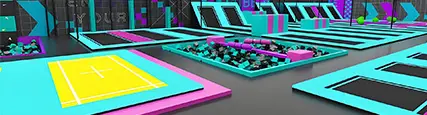
Example of an Injbell trampoline park design concept with multiple activity zones. The final configuration must be adapted to actual building conditions and project requirements.
Trampoline parks can involve different building occupancy, accessibility, fire protection, and operational requirements from ordinary retail or warehouse uses.
Before signing a long-term lease, consult the appropriate building authority, fire authority, and qualified design professionals. Confirm whether the proposed recreational use is permitted and whether the building will require significant alterations.
For U.S. facilities, accessibility planning should consider the applicable provisions of the 2010 ADA Standards for Accessible Design, along with other applicable federal, state, and local requirements.
A useful supplier will coordinate equipment dimensions with the architectural plans. However, equipment manufacturers should not be treated as substitutes for locally licensed architects, engineers, or code officials.
The largest equipment package is not necessarily the most profitable or easiest to operate.
An indoor trampoline park serving families with younger children needs a different layout from an activity center designed primarily for teenagers, organized groups, and athletic challenges.
Equipment selection should reflect customer demand, operating complexity, available space, and the supervision each attraction requires.
| Attraction | Primary Use | Purchasing Priority | Operating Consideration |
|---|---|---|---|
| Main Jump Court | General recreation and jumping | Core attraction for a dedicated trampoline park | Participant separation, rules, inspection, and supervision |
| Basketball Dunk Area | Individual skill challenges | Optional activity for varied play | Controlled access, landing conditions, and queue management |
| Dodgeball Court | Organized group activities | Suitable when group programming is planned | Game rules, staffing, and participant separation |
| Ninja Course | Balance, strength, and obstacle challenges | Useful for teens, older children, and repeat visits | Fall protection, difficulty levels, and supervision |
| Foam Pit or Airbag | Designated jumping and landing activities | Specialized attraction requiring additional evaluation | Approved use, inspection, cleaning, and maintenance |
| Soft Play Area | Lower-intensity activities for younger children | Relevant for mixed-age family entertainment centers | Age separation, cleaning access, and parent visibility |
For a first-time operator, I’d recommend choosing a manageable combination of activities rather than filling every available corner with equipment.
Every new attraction introduces additional inspection points, operating rules, potential maintenance requirements, and staffing considerations.
A Ninja Course can expand the appeal of a family entertainment center, but its operating requirements differ from those of a trampoline court. Obstacle height, fall protection, participant flow, and rescue access must be evaluated separately.
Injbell offers configurable Ninja Course equipment with climbing features for projects that want to combine obstacle challenges with other indoor entertainment activities.

Ninja-style attractions introduce climbing, balance, and grip challenges. Equipment selection must account for the intended users, fall-protection system, and operating procedures.
A trampoline park manufacturer should be able to explain the construction of its equipment in specific, verifiable terms.
Descriptions such as heavy-duty steel, premium materials, and commercial quality are not enough to evaluate structural performance or long-term maintenance requirements.
Ask for technical information covering the actual equipment configuration being proposed.
The supporting frame transfers loads between the jumping system, equipment supports, connections, and building structure.
Request information about steel specifications, member dimensions, connection methods, protective finishes, applicable load calculations, and the intended anchoring arrangement.
Confirm whether connections are bolted, welded, or assembled using other approved methods. Ask how the manufacturer checks dimensional accuracy, weld quality, and the consistency of fabricated components.
Structural documentation must apply to the proposed design. Drawings from an unrelated installation should not be accepted as proof that a different configuration is suitable.
Trampoline beds and suspension components affect jumping behavior, loading, inspection requirements, and replacement costs.
Ask the manufacturer to identify the bed material, suspension design, component specifications, attachment methods, intended operating limits, and replacement procedure.
Do not select components using spring dimensions or material labels alone. The complete system must be evaluated for its intended commercial use.
Replacement parts should be clearly identified so maintenance personnel can obtain compatible components without guessing.
Protective padding must be designed around the hazards of the specific activity. Thickness alone does not establish suitable impact protection.
Review the padding construction, attachment method, material performance, coverage, and conditions under which replacement is required.
Protective netting and barriers require similar scrutiny. The manufacturer should explain their intended function, attachment details, applicable design requirements, and inspection procedures.
Foam pits and airbag landings deserve particular attention because their performance depends on the complete landing system and how the attraction is operated.
For airbags, request documentation covering the approved activities, inflation arrangements, operating limits, inspection points, and procedures for handling equipment faults.
Project-specific equipment layout and elevation drawings.
Component specifications and bill of materials.
Structural information and relevant engineering calculations.
Applicable testing reports and certification documentation.
Installation and assembly instructions.
Operating limitations and safety instructions.
Inspection and preventive maintenance procedures.
Warranty terms and replacement-parts information.
Not every document will necessarily be available at the initial quotation stage. Nevertheless, the manufacturer should identify which documents will be provided, when they will be delivered, and which party is responsible for obtaining any required independent approval.
Commercial trampoline park equipment must be assessed against the requirements relevant to its design, intended use, and installation location.
There is no single certificate that automatically establishes compliance for an entire entertainment center containing trampolines, climbing walls, obstacle courses, and children's play equipment.
In the United States, an important technical reference is ASTM F2970-25, published by ASTM International.
This standard addresses the design, manufacture, installation, operation, maintenance, inspection, and major modification of commercial or institutional trampoline courts.
Its scope includes trampoline courts used in family entertainment centers and other recreational facilities. However, it does not automatically cover attractions that do not incorporate a trampoline court bed.
The applicability and legal status of a standard depend on the jurisdiction and the particular equipment. A manufacturer should identify the relevant edition and explain how its documentation addresses the applicable provisions.
ISO 23659:2022 addresses safety requirements for trampoline park design, construction, inspection, maintenance, and operation.
The standard includes trampoline park areas within multi-activity facilities and landing areas such as foam pits and airbags. It does not cover every non-trampoline attraction installed in the same venue.
ISO confirmed the 2022 edition in 2024. Buyers should still confirm the applicable edition and any local adoption or additional requirements at the time of purchase.
A 2024 study published in Pediatrics analyzed reported injuries and participation exposure across 18 trampoline parks in Australia and the Middle East during 2017–2019.
The dataset included 13,256 reported injuries across 8,387,178 jumper hours. The study's statistical model estimated an overall rate of 1.14 injuries per 1,000 jumper hours. Rates varied across activity types.
Source: Trampoline Park Injury Trends, Pediatrics, 2024.
A separate study published in October 2026 examined U.S. emergency department data covering 1998–2024. Researchers estimated 2,861,127 emergency department visits associated with trampoline injuries across that 27-year period.
Importantly, the 2026 estimate includes trampoline-related injuries across settings, including home use; it is not a trampoline park injury count or an individual park's expected injury rate.
Source: Changing Temporal Patterns in Trampoline-Associated Injuries, Chronobiology International, 2026.
These findings reinforce the importance of appropriate equipment design, activity-specific operating rules, supervision, inspection, and maintenance. They do not establish that a particular manufacturer or attraction will have a specific injury rate.
If a supplier advertises ASTM, TÜV, SGS, CE, or other certification-related credentials, request the actual documents.
Check the issuing organization, document validity, relevant standard, product identification, testing scope, and any restrictions.
A laboratory test report for a material is not the same as certification of an entire installed trampoline park. Likewise, a CE marking claim should not be interpreted as universal approval for every amusement attraction or jurisdiction.
The strongest purchasing decision is based on documentation that corresponds to the equipment you are ordering, not a collection of unrelated certificates.
A supplier's website can show attractive completed parks without explaining how the equipment was manufactured.
For a substantial commercial purchase, investigate production processes and quality-control responsibilities before placing the order.
A factory visit can be useful, but buyers can also request a live video walkthrough, production photographs, equipment demonstrations, and manufacturing records when an in-person inspection is impractical.
Focus on the stages that directly affect the product:
Material receiving: How are incoming steel, jumping materials, padding, and other components identified and checked?
Fabrication: What procedures are used for cutting, forming, welding, and assembling structural components?
Protective finishing: How are steel components prepared and protected against corrosion?
Component inspection: What measurements and checks are recorded before packing?
Order identification: How are components linked to a specific project and drawing revision?
Final quality control: Who authorizes the equipment for shipment, and what records accompany the order?

Overview of Injbell's equipment production workflow, from structural fabrication and finishing to component preparation, packing, and shipment.
For custom trampoline park equipment, production consistency matters as much as the initial design. Incorrect component dimensions, mislabeled parts, or missing hardware can create installation delays and additional site labor.
Ask how the manufacturer manages production changes after drawings have been approved. A revised attraction layout should lead to updated production documents, not informal instructions exchanged during installation.
Project references are more useful when the building size, attraction mix, and installation requirements resemble your own project.
Ask to review completed-project photographs, drawings where available, the general scope delivered, and any installation or support services provided.
When contacting a reference customer is possible, useful questions include whether the shipment was complete, whether the installation documents were clear, and how replacement-part requests were handled.
Do not treat photographs alone as verification of project performance, customer satisfaction, or regulatory approval.
One of the clearest differences between trampoline park equipment suppliers is how they prepare quotations.
Some prices cover manufactured components only. Other proposals include design services, packing, freight, installation assistance, or spare parts.
A low equipment price can become a more expensive purchase after these additional costs are considered.
The following comparison uses hypothetical U.S. dollar amounts to demonstrate how a buyer can normalize supplier quotations. These figures are calculation examples, not actual Injbell prices, supplier offers, or industry averages.
| Cost Item | Supplier A | Supplier B | Supplier C |
|---|---|---|---|
| Manufactured equipment | $195,000 | $210,000 | $182,000 |
| Freight allowance | $19,000 | $14,000 | $23,000 |
| Installation allowance | $24,000 | $16,000 | $32,000 |
| Initial spare parts | $7,000 | $5,000 | $9,000 |
| Required documentation allowance | $4,000 | Included | $6,000 |
| Comparable total | $249,000 | $245,000 | $252,000 |
Supplier C has the lowest initial equipment price but the highest combined total in this example. Supplier B costs more at the factory but has the lowest total for the listed items.
This conclusion only holds if all three suppliers meet the same technical requirements and the listed allowances cover equivalent responsibilities.
Building improvements, permits, duties, applicable taxes, insurance, and other project expenses are excluded from this example.
For imported equipment, ask the manufacturer to identify the agreed Incoterms rule and named place. This determines important delivery responsibilities and affects which costs the buyer must arrange separately.
Clarify who handles:
Export packing and shipment preparation.
Freight booking and transportation insurance.
Customs documentation and import clearance.
Duties, taxes, and destination charges.
Unloading and movement of equipment into the building.
Installation labor, lifting equipment, and tools.
Installer travel, accommodation, and other site expenses.
Request an estimated packing list with package dimensions, weights, and container requirements before finalizing the logistics budget.
A quotation should also identify whether the manufacturer provides onsite installation, remote guidance, or documentation for a locally appointed installation team.
For additional budgeting considerations, see Injbell's custom indoor trampoline park equipment cost guide.
A structured evaluation helps purchasing teams compare competing trampoline park manufacturers without allowing presentation quality or headline pricing to dominate the decision.
Before scoring suppliers, establish mandatory requirements. These may include acceptable technical documentation, a feasible layout, relevant project requirements, a clear installation scope, and the ability to supply essential replacement components.
A supplier that cannot meet a mandatory safety or contractual requirement should not remain eligible merely because its price is attractive.
The following scoring framework is an editorial procurement tool, not an accredited certification or industry-wide supplier rating.
| Evaluation Category | Weight | Evidence to Review |
|---|---|---|
| Engineering and safety documentation | 30% | Drawings, technical specifications, applicable reports, and documented limitations |
| Layout and operational design | 20% | Usable floor area, attraction placement, circulation, and supervision requirements |
| Cost and quotation completeness | 20% | Itemized scope, delivered cost, exclusions, and payment terms |
| Manufacturing and installation | 15% | Production controls, project schedule, shipping plan, and installation support |
| Warranty and after-sales service | 15% | Warranty coverage, spare parts, maintenance instructions, and response arrangements |
| Total | 100% | Only suppliers meeting mandatory requirements should be scored |
Assign each category a score from 1 to 5. Multiply that score by the category weight divided by five, then add the results.
For example, a manufacturer receiving 5 for engineering, 4 for design, 4 for cost, 4 for manufacturing, and 5 for service would earn 89 points out of 100.
The point total is a purchasing aid, not proof of safety or a guarantee of performance. A complete documentary review remains necessary.
A quotation does not identify the exact equipment included.
The supplier cannot provide relevant technical documentation.
Certification claims are unsupported or unrelated to the proposed equipment.
Major design changes are offered without technical review.
Installation responsibilities remain unclear.
Replacement parts and warranty exclusions are not defined.
The supplier requests final payment without agreed inspection or acceptance arrangements.
Delivery dates are promised without a production schedule or stated assumptions.
No single warning sign proves that a supplier is unsuitable. However, unresolved concerns should be addressed in writing before a purchase commitment.
Manufacturing is only one stage of delivering a commercial trampoline park. The equipment must also be installed correctly in the actual building and accepted for its intended use.
A supplier should explain the installation sequence, required workforce, tools, site conditions, and anticipated technical support.
Confirm that the site is ready and the approved drawings reflect the final building conditions.
Check floor preparation, agreed anchor locations, access for deliveries, storage space, electrical requirements for applicable attractions, and any work that must be completed by local contractors.
Equipment should not be installed using an outdated layout simply because the materials have already arrived.
Use the manufacturer-approved assembly instructions and maintain a record of any changes.
Components should be checked against the packing list, and missing or damaged materials should be reported before they become concealed within the completed structure.
Any changes affecting structural connections, clearances, protective systems, or operating conditions require appropriate technical review.
Establish an acceptance process that identifies the responsible parties and required documents.
Check the completed equipment against approved drawings.
Verify component identification and installation records.
Review protective padding, barriers, gates, and access arrangements.
Confirm operating limits, posted rules, and staff instructions.
Complete applicable testing and inspection requirements.
Resolve documented defects and outstanding installation items.
Receive maintenance manuals and relevant warranty information.
Obtain required approvals before public operation.
Where an independent inspection is required, define the appointment, cost, and scope before signing the equipment contract.
Do not assume that an installer completing assembly means the facility has received all necessary approvals.
Trampoline equipment is exposed to repeated use, movement, cleaning, and environmental conditions that can affect components over time.
Replacement parts and maintenance instructions should therefore be considered during supplier selection, not after an attraction develops a problem.
Ask for inspection procedures that identify the components requiring examination, methods for identifying defects, criteria for removing an attraction from service, and instructions for approved repairs or replacements.
The maintenance program should address relevant items such as:
Jumping beds and suspension components.
Structural connections and accessible support points.
Protective pads and their attachment systems.
Netting, barriers, and access gates.
Foam pits, airbags, and related equipment.
Ninja Course obstacles and fall-protection components.
Electronic or mechanical attractions where installed.
Inspection and replacement intervals must follow applicable requirements and manufacturer instructions. The same schedule should not automatically be applied to every equipment type.
Ask the manufacturer for a recommended initial spare-parts list, identifying part numbers, quantities, compatibility, and expected ordering procedures.
Replacement-part availability is especially important when the park depends on custom components that cannot be obtained from ordinary local suppliers.
A warranty should identify the covered components, effective period, exclusions, claim procedure, and responsibilities for labor and shipping.
Some suppliers may provide different coverage periods for structures, padding, jumping materials, or other parts. Do not assume every component carries the same warranty.
Ask whether the warranty remains valid when installation is performed by an approved local team and what documentation is required to support a claim.
Buying equipment is only one part of the investment decision. The facility must also generate enough contribution from admissions and other activities to cover its ongoing expenses.
Trampoline parks can earn revenue from general admission, organized events, birthday parties, memberships, group bookings, and other suitable services.
Whether a particular facility becomes profitable depends on local demand, pricing, attendance, occupancy, staffing, rent, operating costs, and financing.
The following model uses fictional inputs to demonstrate the calculation. It is not a forecast, a verified market benchmark, or a claim about typical trampoline park profitability.
| Model Input | Illustrative Amount |
|---|---|
| Average realized admission revenue per paid visit | $29 |
| Average additional revenue per paid visit | $6 |
| Total revenue per paid visit | $35 |
| Variable operating expense per paid visit | $6 |
| Contribution per paid visit | $29 |
| Monthly fixed operating expenses | $56,000 |
| Modeled monthly break-even attendance | 1,932 paid visits |
Calculation: $56,000 divided by ($35 minus $6) equals approximately 1,931.03. Rounding up gives 1,932 paid visits per month.
At 30 operating days per month, this is roughly 65 paid visits per day on average. Actual visitor distribution will not be uniform, so staffing and facility capacity must also be evaluated for busy periods.
| Monthly Paid Visits | Total Contribution | Fixed Expenses | Operating Result |
|---|---|---|---|
| 1,500 | $43,500 | $56,000 | -$12,500 |
| 2,000 | $58,000 | $56,000 | +$2,000 |
| 2,500 | $72,500 | $56,000 | +$16,500 |
The modeled operating result excludes income taxes, financing costs, capital expenditures, and other cash flows not included in the assumptions. The figures should not be interpreted as net profit.
To assess a potential return on investment, compare the complete opening investment with realistic cash-flow scenarios after accounting for debt payments, taxes, future equipment replacements, seasonality, and working-capital needs.
A business plan should test lower attendance and weaker average spending, not just the scenario required to justify the investment.
Equipment layout influences how customers move through the building, how easily staff can supervise attractions, and how much space remains for revenue-generating activities.
However, a manufacturer cannot responsibly guarantee increased attendance or a specific return simply by adding more attractions.
For a family entertainment center, I’d prioritize clear customer circulation, suitable activity separation, practical maintenance access, and room for the supporting services included in the business plan.
The best layout is one that the operator can run consistently within the available staffing and operating budget.
Consider a hypothetical investor planning an indoor entertainment center in a 13,000-square-foot leased building.
After allocating space for reception, restrooms, party rooms, circulation, and building constraints, the proposed activity area is approximately 8,000 square feet. These are assumed planning figures, not details from an actual customer project.
The investor wants a main jumping court, basketball attraction, Ninja Course, and a separate activity area for younger children.
The first supplier proposes a visually impressive layout with numerous attractions and a relatively low equipment price.
However, the proposal does not clearly identify the documentation for the final equipment configuration, installation responsibilities, or replacement-part arrangements.
The layout also needs additional review of circulation, supervision, and building constraints.
The second supplier offers fewer attractions but provides a clearer equipment schedule, preliminary technical information, defined installation responsibilities, and a more detailed list of exclusions.
The proposal includes additional space for circulation and staff access. The supplier also identifies the documents required before manufacturing and installation.
For this scenario, I’d rank Supplier B ahead of Supplier A, provided its engineering evidence and final quotation satisfy the project's mandatory requirements.
This is a procurement illustration, not a verified customer outcome. It demonstrates why equipment count and factory price should not determine the decision by themselves.
At Injbell, we focus on indoor playground equipment, trampoline parks, Ninja Courses, and equipment solutions for family entertainment centers.
Our product range allows buyers to explore trampoline courts alongside complementary indoor attractions rather than sourcing every equipment category through a separate sales process.
For projects that combine jumping, obstacle challenges, and children's play areas, coordinating these elements during the initial design stage can simplify equipment planning and purchasing discussions.
Injbell develops equipment proposals around project requirements such as building dimensions, selected attractions, and preferred configurations.
Our commercial trampoline park equipment range includes jumping areas and configurations that can be combined with other indoor entertainment features.
During proposal development, buyers should provide measured floor plans, clear heights, target age groups, attraction preferences, and any known local requirements.
The proposed design and technical documentation must then be reviewed for the actual installation. Available product options should not be confused with a project-specific engineering approval.
Injbell offers equipment manufacturing, customized design services, shipment coordination, and installation guidance for commercial amusement projects.
Installation arrangements, documentation, applicable testing, warranty coverage, and after-sales responsibilities should be confirmed in the final quotation and contract.
Buyers can review our company background and service capabilities on the Injbell About Us page.
We recommend applying the same engineering, quotation, documentation, and maintenance checks described in this guide when evaluating Injbell or any other manufacturer. A purchasing decision should be supported by the actual project proposal rather than general product claims.
A detailed request for quotation helps manufacturers prepare relevant proposals and reduces the time spent revising assumptions.
The better the initial project information, the easier it becomes to compare equipment packages and identify missing costs.
Project type: New trampoline park, existing facility expansion, or mixed-attraction family entertainment center.
Building information: Measured drawings, photographs, clear heights, columns, and known structural restrictions.
Target audience: Intended age groups and primary customer activities.
Attraction preferences: Jump courts, basketball, dodgeball, Ninja Course, soft play, or other equipment.
Budget: Equipment budget and overall project investment allowance, identified separately.
Applicable requirements: Known local standards, inspection conditions, and professional review requirements.
Service scope: Design, production, freight, installation, training, and after-sales support.
Project schedule: Preferred delivery period and anticipated opening date.
A preliminary equipment layout with identified attractions.
An itemized quotation and description of the included components.
Relevant material and technical specifications.
A list of proposed documentation and applicable standards.
Manufacturing, shipping, and installation schedule assumptions.
Delivery terms, installation responsibilities, and exclusions.
Warranty conditions, spare-parts provisions, and support arrangements.
Payment milestones and procedures for handling changes or defects.
Before paying the production deposit, confirm which drawings form the contractual design baseline and how changes will be approved.
The contract should specify the equipment scope, technical deliverables, agreed payment milestones, delivery responsibilities, warranty conditions, and procedures for addressing missing or nonconforming components.
Where practical, connect payment milestones to documented progress and agreed acceptance criteria rather than relying only on calendar dates.
Clarify ownership of drawings, rights to use technical documents for installation and maintenance, and access to replacement components.
These details matter when the park eventually requires repairs, modifications, expansion, or replacement equipment.
Start with manufacturers that offer commercial equipment appropriate for your building and customer base. Request project-specific drawings, technical specifications, relevant testing or certification documents, and examples of comparable installations.
Compare suppliers using the same written evaluation criteria. Check manufacturing controls, installation responsibilities, warranty conditions, and replacement-part availability. Do not make a final decision based only on product photos, advertised certificates, or a low quotation.
There is no reliable universal price because equipment costs depend on facility size, attraction mix, design complexity, materials, transportation, and installation scope.
Request an itemized quotation based on a measured building plan. Separate manufactured equipment from freight, installation, engineering, inspection, and other services. Prepare a broader opening budget that includes building improvements, permits, insurance, staffing, and working capital.
Ask for documentation relevant to the actual equipment and project location. ASTM F2970 and ISO 23659 are important references for commercial trampoline parks, but their applicability must be assessed for the specific installation.
Check the standard edition, issuing organization, testing scope, and equipment identification. Additional attractions may fall under different requirements. Independent engineering review or local inspection may also be necessary.
Yes. Commercial trampoline equipment can be configured around the usable floor area, ceiling clearance, structural conditions, and desired activity mix.
Smaller installations often benefit from a focused attraction selection rather than numerous compact features. Provide accurate building drawings and ask the manufacturer to account for access, circulation, supervision, maintenance, and applicable safety requirements before approving the layout.
Buying directly from a manufacturer may provide easier communication about customization and production specifications. A local supplier may offer advantages in onsite coordination, delivery arrangements, or support.
The better option depends on the complete service package. Compare technical accountability, total delivered cost, installation arrangements, warranty coverage, and access to replacement parts. Confirm which company is contractually responsible for each stage.
There is no dependable universal timeline. The schedule depends on equipment complexity, approved drawings, factory workload, shipping arrangements, customs procedures, building readiness, installation resources, and required inspections.
Ask the manufacturer for a project-specific schedule showing design approval, production, quality checks, dispatch, delivery, installation, and commissioning. Allow additional time for building approvals and other activities outside the manufacturer's control.
Do not open the affected attraction until the issue has been properly resolved and any required approval has been obtained.
Document the deficiency, notify the manufacturer and responsible installer, and request a written corrective-action plan. Depending on the issue, professional engineering review, replacement components, further testing, or reinspection may be required. Confirm responsibility for the associated costs under the purchase contract.
It can be, but profitability is not determined by equipment selection alone. Operators must evaluate attendance, average customer spending, staffing, rent, utilities, insurance, maintenance, and financing.
Build conservative cash-flow scenarios and calculate the attendance required to cover operating expenses. Include revenue from additional services only where customer demand and operating capacity support the assumptions. A manufacturer should not promise a specific investment return without a defensible business model.
Before selecting a trampoline park equipment manufacturer, confirm that the following questions have satisfactory answers:
Is the building suitable for the proposed recreational use?
Does the equipment layout reflect actual dimensions and structural constraints?
Are the intended users and attraction operating requirements clearly defined?
Has the manufacturer identified the applicable safety standards?
Can the supplier provide appropriate technical and manufacturing documentation?
Does the quotation identify all equipment, services, and exclusions?
Are transportation, installation, and commissioning responsibilities clear?
Are warranty conditions and replacement-part arrangements documented?
Is there a defined process for final inspection and acceptance?
Does the complete project budget leave sufficient funding for opening and ongoing operations?
The strongest manufacturer relationship starts with clear technical expectations and a realistic operating plan. Attractive equipment matters, but the more important purchasing decision is whether the complete system can be properly installed, approved, supervised, maintained, and supported throughout its operating life.
For buyers preparing a new trampoline park or expanding an existing entertainment center, Injbell can help develop an equipment proposal around the building layout, attraction requirements, and project scope. A detailed floor plan and purchasing brief are the most useful starting points for that discussion.
ASTM International. ASTM F2970-25: Standard Practice for Design, Manufacture, Installation, Operation, Maintenance, Inspection and Major Modification of Trampoline Courts. 2025 edition. ASTM F2970-25 official standard.
International Organization for Standardization. ISO 23659:2022: Sports and Recreational Facilities — Trampoline Parks — Safety Requirements. Published November 2022; reviewed and confirmed in 2024. ISO 23659 official publication.
Teague, W. J., and colleagues. Trampoline Park Injury Trends. Pediatrics, 2024. Analysis of reported injury data and participation exposure from 18 trampoline parks during 2017–2019. Study abstract and publication details.
Loder, R. T. Changing Temporal Patterns in Trampoline-Associated Injuries. Chronobiology International, published October 7, 2026. Analysis of U.S. emergency department injury estimates covering 1998–2024. Study abstract and publication details.
U.S. Department of Justice. 2010 ADA Standards for Accessible Design. Official accessibility standards and technical requirements. ADA design standards.
Prepared by: Injbell Editorial Team
Updated: October 28, 2026
Injbell is a commercial indoor playground and amusement equipment manufacturer serving projects involving indoor trampoline parks, Ninja Courses, children's play equipment, and family entertainment centers.
This guide combines equipment procurement considerations, technical standards, operational planning, and independent financial calculations. Supplier comparison examples and financial scenarios are illustrative and are not presented as actual customer results, industry averages, or guaranteed investment outcomes.
Disclaimer: This article provides general purchasing, design-planning, and business information. It is not a substitute for professional engineering, legal, financial, insurance, safety, or regulatory advice. Trampoline activities involve inherent risks, and no equipment design or standard eliminates the possibility of injury. Standards and legal requirements vary by jurisdiction and equipment type. Facility owners must obtain appropriate professional advice, verify current requirements, complete applicable inspections, and secure all necessary approvals before opening. Product specifications, services, and availability are subject to confirmation in the final supplier agreement.



 EN
 ES
 AR


