

Choosing an 800sqm Trampoline Park Manufacturer is about more than finding an attractive equipment price. An 800-square-meter (approximately 8,611-square-foot) facility can accommodate commercial trampolines, obstacle attractions, children's play areas, and supporting amenities. However, the final investment depends on the equipment configuration, building conditions, shipping, installation, and local approval requirements.
A reliable manufacturer should provide a customized layout, itemized equipment specifications, clear pricing, safety documentation, and a defined installation scope. This guide explains how to compare quotations, allocate floor space, evaluate equipment quality, and calculate the financial requirements of an 800sqm indoor trampoline park.
The financial examples are transparent planning scenarios, not actual supplier quotations or verified industry averages. They are intended to help investors prepare a realistic purchasing budget before requesting a project-specific proposal.
There is no dependable fixed price for an 800sqm commercial trampoline park. Two facilities with identical floor areas can have substantially different costs because their attraction layouts, building conditions, and installation requirements differ.
A conventional trampoline layout with repeated jumping modules has different manufacturing requirements from a mixed-activity park containing Ninja obstacles, airbag landing areas, climbing features, and dedicated children's attractions.
It is important to separate three figures before comparing manufacturers:
Equipment price: The cost of manufacturing the specified trampoline systems, protective components, and selected attractions.
Delivered and installed cost: Equipment plus the applicable transportation, handling, installation, and related services.
Total opening investment: The complete funding requirement, including building improvements, professional services, permits, inspections, furnishings, insurance, preopening expenses, and working capital.
The equipment quotation is only one part of the investment decision. A facility requiring substantial fire protection modifications, electrical upgrades, or structural work may have a higher total opening cost than a larger park operating inside an already suitable building.
Manufacturing costs depend primarily on how much of the building will contain equipment, which attractions are selected, and the technical specifications of their components.
The most important pricing variables include:
Usable attraction area: The portion of the 800sqm venue available for commercial play equipment after essential supporting spaces are allocated.
Attraction mix: Free-jump courts, dodgeball, basketball dunk lanes, Ninja Courses, airbag attractions, and indoor playground structures require different assemblies.
Structural design: Building columns, floor conditions, equipment elevations, and required support arrangements influence the design.
Material specifications: Steel frames, jumping beds, suspension components, padding, netting, and protective finishes affect equipment pricing.
Customization: Special themes, unusual dimensions, branded features, and nonstandard attractions may require additional engineering and fabrication.
Service scope: Design revisions, freight, installation supervision, technical documentation, and spare parts may be included or priced separately.
For a useful comparison, ask every commercial trampoline park equipment supplier to quote against the same approved layout and written specifications.
An 800sqm building does not provide 800sqm of usable jumping space. Reception, circulation, restrooms, storage, waiting areas, and other necessary facilities compete for the same floor area.
A well-planned park needs enough attractions to justify admission while preserving clear routes for guests and employees. The layout must also accommodate supervision, emergency access, and the applicable building requirements.
The following allocation demonstrates how a mixed-age family entertainment center could divide its floor space. These measurements are conceptual planning allowances, not minimum standards or a completed engineering design.
| Functional Area | Allocated Space | Purpose |
|---|---|---|
| Main trampoline court | 270sqm | General jumping and core admission activity |
| Dodgeball and basketball attractions | 90sqm | Organized games and individual challenges |
| Ninja Course | 80sqm | Obstacle activities and skill-based challenges |
| Children's soft play | 70sqm | Age-appropriate activities for younger guests |
| Reception and retail | 55sqm | Check-in, payments, and merchandise |
| Circulation and queuing | 100sqm | Guest movement and attraction access |
| Party and seating areas | 65sqm | Group bookings and spectator seating |
| Restrooms, storage, and staff areas | 70sqm | Operational support |
| Total | 800sqm | 510sqm of proposed attraction space |
In this example, approximately 64% of the floor area is assigned to attractions. That percentage is simply the result of this particular layout, not an industry standard or recommended occupancy ratio.
The final distribution may change considerably when actual exit locations, columns, restrooms, equipment clearances, accessible routes, and staff facilities are considered.
Ceiling height can limit the equipment that an otherwise spacious building can accommodate.
A clear-span building may offer greater layout flexibility than a venue containing multiple columns or low structural beams. However, even a high ceiling may contain sprinkler pipes, lighting, ductwork, and other services that reduce usable clearance.
Before approving a design, provide the manufacturer with:
Accurate internal dimensions and a scaled floor plan.
Clear ceiling heights at different locations.
Column positions and structural obstructions.
Existing sprinkler, lighting, and HVAC arrangements.
Entrances, exits, restrooms, and service access.
Known floor-loading and structural information.
The intended age groups and attraction preferences.
The equipment designer and appropriately qualified local professionals must confirm that the proposed systems fit the actual building. A visually attractive rendering cannot establish structural suitability or regulatory compliance.

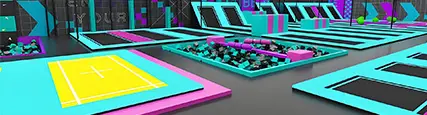
Injbell concept rendering illustrating how trampoline courts and other indoor attractions can share a commercial entertainment space. This image is an illustrative configuration, not a dimensioned 800sqm construction plan.
The best commercial trampoline park design is not necessarily the one containing the most activities. Each attraction must justify its floor space, installation cost, supervision requirements, and ongoing maintenance.
For a family-oriented facility, I’d recommend starting with a strong general jumping area and adding complementary attractions that serve a clear customer group.
Free-jump courts provide the central activity for many commercial trampoline parks. They accommodate recreational jumping and form the foundation of the admission experience.
For an 800sqm facility, a modular layout can make it easier to organize jumping sections, manage participants, and provide access for inspection and maintenance.
When selecting the trampoline system, review the jumping-bed specifications, frame construction, suspension components, protective padding, and permitted operating conditions.
Sports-themed attractions can introduce variety without changing the park's overall business model.
Dodgeball courts may support organized group activities, while basketball dunk lanes provide individual challenges. Both require appropriate separation, participant rules, protective systems, and supervision.
A dedicated sports area should be selected only when sufficient space remains for safe participation, circulation, and operational access.
A Ninja Course offers a different activity from conventional bouncing. Depending on the design, it may include balance obstacles, climbing movements, grip challenges, suspended elements, and timed courses.
This can be useful for a family entertainment center targeting older children, teenagers, and organized groups.
However, obstacle attractions require careful evaluation of participant ability, landing protection, overhead clearance, supervision, and rescue access.
Injbell offers custom indoor Ninja Course equipment that can be considered alongside trampoline installations. The final selection should follow the building survey and safety review rather than precede them.
A dedicated soft play section can make a mixed-age facility more useful for families with children who are not suited to the main trampoline activities.
Possible equipment includes enclosed climbing structures, small slides, tunnels, padded obstacles, and interactive play features.
The children's area should have suitable physical separation from faster-moving trampoline activities, controlled access, and clear visibility for the responsible adults and attendants.
Do not treat a soft play structure as an extension of the trampoline court. The two attraction categories may have different safety requirements, design standards, and operating procedures.

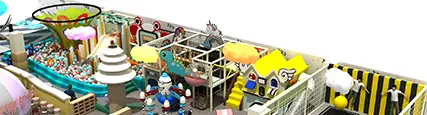
Illustrative overview of trampoline park attraction categories. Not every feature shown would be suitable for an 800sqm venue.
A detailed investment budget should begin before the equipment purchase agreement is signed.
The following example assumes an 800sqm leased venue with 510sqm allocated to attractions. All amounts are hypothetical U.S. dollar allowances selected to demonstrate the budgeting method.
These figures are not Injbell prices, contractor bids, observed market averages, or promises of what a project will cost. Replace every allowance with a written supplier quotation or a locally supported estimate before making an investment decision.
| Budget Category | Illustrative Amount (USD) | What It Covers |
|---|---|---|
| Commercial amusement equipment | $165,000 | Specified trampoline systems, protective components, and selected attractions |
| Freight and import-related allowance | $30,000 | Illustrative transportation, handling, and applicable import expenses |
| Equipment installation | $32,000 | Illustrative assembly labor and associated installation services |
| Building improvements | $140,000 | Selected electrical, mechanical, fire protection, and interior work |
| Engineering, permits, and inspections | $28,000 | Professional services and required approval processes |
| Furniture, POS systems, and signage | $25,000 | Guest-service and supporting equipment |
| Recruitment, insurance, and launch preparation | $30,000 | Illustrative preopening expenses |
| Development subtotal | $450,000 | Before contingency |
| Illustrative contingency allowance (15%) | $67,500 | Reserve for eligible unforeseen development costs |
| Development budget | $517,500 | Subtotal plus contingency |
| Initial working capital allowance | $80,000 | Cash reserved for initial operations |
| Total illustrative funding requirement | $597,500 | Development budget plus working capital |
The example demonstrates why an equipment allowance cannot be treated as the total investment.
Here, the assumed $165,000 equipment package represents approximately 28% of the total $597,500 funding requirement. The actual proportion may be substantially different for a real project.
A landlord-funded improvement package, an existing suitable building, or a simplified attraction design may change the budget. Conversely, extensive renovations, expensive local construction, or specialized equipment can increase funding requirements.
Price per square meter can be useful for checking whether two quotations cover comparable equipment areas, but it is not a reliable standalone purchasing benchmark.
For example, dividing the hypothetical $165,000 equipment allowance by the proposed 510sqm attraction area gives approximately $324 per square meter.
That figure describes only this constructed example. It does not establish a market rate for trampoline equipment.
A supplier quoting only standard trampoline beds should not be compared directly with one quoting customized obstacle attractions, protective barriers, themed structures, installation services, and technical documentation.
Before comparing unit prices, confirm the equipment area, attractions, materials, delivery responsibilities, and exclusions.
A professional quotation should explain exactly what the buyer will receive.
A single total price without drawings, component specifications, or commercial terms is not sufficient for evaluating a substantial amusement equipment purchase.
| Quotation Item | Information to Request | Purchasing Purpose |
|---|---|---|
| Equipment layout | Scaled drawings, attraction dimensions, and identified equipment zones | Confirm what fits inside the venue |
| Component specifications | Steel frames, jumping beds, padding, netting, and suspension components | Compare actual materials and construction |
| Attraction quantities | Itemized equipment list with quantities and dimensions | Identify omitted or substituted equipment |
| Safety documentation | Applicable standards, test reports, and relevant engineering documents | Support technical and regulatory review |
| Freight terms | Named Incoterm, named location, packing details, and shipping responsibilities | Calculate transportation and import exposure |
| Installation | Labor scope, supervision, travel expenses, tools, and exclusions | Estimate complete installation costs |
| Project schedule | Design approval, manufacturing, shipping, and installation milestones | Coordinate the construction program |
| Warranty and after-sales support | Coverage, exclusions, parts availability, and claim procedures | Evaluate ongoing ownership responsibilities |
| Payment conditions | Deposit, milestone payments, final payment, and change-order rules | Control financial and contractual risk |
An equipment-only quotation can be attractive because it separates manufacturing from other project expenses. However, the buyer must coordinate the remaining work.
Delivered-and-installed pricing may simplify some responsibilities, but the exact scope requires written confirmation.
For example, an installation quotation might include assembly labor while excluding lifting equipment, unloading, accommodation, electrical connections, inspections, and local permit fees.
International commercial terms also matter. An FOB quotation, a CIF quotation, and a DDP quotation allocate transportation costs, responsibilities, and certain risks differently. None of these terms automatically establishes who will install the equipment or obtain local operating approvals.
Request the named Incoterm and its applicable version, then have a qualified customs professional confirm import duties and requirements for the destination.
Consider two hypothetical proposals prepared for the same facility.
Supplier A presents a lower manufacturing price but excludes certain protective components, installation supervision, and replacement parts. Supplier B has a higher initial price but includes those items and provides more complete documentation.
The correct comparison is not simply the amount printed at the bottom of each proposal.
Purchasers should normalize the scope by adding missing costs and resolving technical differences. Any remaining exclusions should be assigned to a responsible contractor and included in the project budget.
I’d rank quotation completeness, technical suitability, and long-term serviceability above an unexplained discount.
Commercial equipment must be assessed as a complete system. A strong-looking steel frame or thick protective pad does not independently demonstrate that the finished attraction is appropriate for commercial use.
The support structure must accommodate the loads and operating conditions specified for the equipment.
Ask the manufacturer to identify structural materials, steel section specifications, connection methods, corrosion protection, anchoring requirements, and relevant design documentation.
Where required, structural design and building interfaces should be reviewed by appropriately qualified professionals familiar with the local approval requirements.
Jumping performance depends on the interaction between the bed, suspension components, frame, and protective systems.
Request the jumping-bed material specifications, approved suspension components, operating limits, inspection instructions, and replacement-part identification.
Do not substitute springs or other suspension elements based solely on similar dimensions or appearance. Replacement components must be compatible with the approved equipment design.
Protective components should be selected for the hazards associated with each attraction.
Padding specifications should address the required construction, protective function, attachment arrangements, and relevant material testing. Netting should be evaluated for its intended purpose, configuration, and connection details.
Airbag systems and foam pits require their own design and operating considerations. These may include landing-zone geometry, equipment condition, participant restrictions, cleaning, inspection, and staff procedures.
Obtain the manufacturer's inspection and maintenance instructions for each protective system rather than relying on general claims about material quality.
Commercial trampoline park safety involves equipment design, manufacturing, installation, inspection, operating procedures, staff training, and facility management.
Applicable requirements depend on the project location, attraction classification, and relevant authorities. A manufacturer's general certificate does not automatically establish compliance for an entire completed facility.
ASTM F2970-25 is the 2025 edition of ASTM International's standard practice addressing the design, manufacture, installation, operation, maintenance, inspection, and major modification of commercial and institutional trampoline courts.
Its scope includes trampoline courts in recreational facilities and family entertainment centers. The published standard identifies responsibilities and technical considerations involving manufacturers, owners, and operators.
For projects where ASTM F2970 applies, request documentation identifying the applicable edition and supporting evidence for the equipment being supplied.
Source: ASTM International, ASTM F2970-25 (2025).
ISO 23659:2022 addresses safety requirements for trampoline parks, including design, construction, inspection, maintenance, and minimum operational requirements.
The International Organization for Standardization confirmed the publication in 2024, and it remains current as of this article's update.
Its scope includes trampoline areas within multi-activity parks and certain landing areas, including airbags and foam pits.
It does not cover every possible family entertainment center attraction. Artificial climbing, obstacle courses, and other non-trampoline activities may require separate technical assessments.
Source: International Organization for Standardization, ISO 23659:2022.
Accessibility and emergency circulation should be incorporated during the initial venue planning process.
For example, Section 403.5.1 of the U.S. Department of Justice's 2010 ADA Standards generally specifies a minimum clear width of 36 inches (915 mm) for covered accessible walking surfaces, subject to stated exceptions and other applicable provisions.
That figure is a regulatory minimum for the specified condition, not an appropriate design width for every public corridor, queue, or emergency route in a trampoline park.
Source: U.S. Department of Justice, 2010 ADA Standards for Accessible Design, Section 403.5.1.
Workplace exit routes also require appropriate protection. OSHA's 29 CFR 1910.37 requires covered exit routes to remain free and unobstructed and sets specific requirements for exit-route maintenance and signage.
These workplace provisions do not replace the public assembly, building, fire, or amusement regulations applicable to a particular facility.
Source: Occupational Safety and Health Administration, 29 CFR 1910.37.
Before manufacturing begins, the project team should coordinate the equipment layout with the relevant building professionals, fire authorities, inspectors, and insurer.
International trampoline park equipment orders often involve multiple types of components, including structural assemblies, jumping beds, padding, netting, and smaller installation accessories.
Freight expenses depend on the actual shipment's packed dimensions, weight, volume, destination, transport arrangements, and commercial terms.
A credible delivered-cost calculation should identify:
Export packing and origin transportation.
International freight and cargo insurance.
Port and destination handling charges.
Customs brokerage, applicable duties, and taxes.
Final delivery to the installation site.
Unloading, lifting equipment, and temporary storage where required.
These expenses should be confirmed before the manufacturing order is finalized. An inaccurate freight allowance can undermine an otherwise carefully prepared budget.
Equipment delivery should be coordinated with the construction schedule rather than treated as a separate purchasing event.
Large structural components must be able to pass through the building's access points. The installation team also needs suitable working space, approved drawings, tools, and any necessary lifting arrangements.
Before shipment, confirm the site-readiness checklist, installation responsibilities, receiving arrangements, and process for handling missing or damaged components.
Injbell provides coordinated project services covering design, manufacturing, delivery planning, and installation support within the agreed scope. The turnkey indoor playground project guide explains the distinction between manufacturer deliverables and local building responsibilities.
Installation should be followed by the required inspections, documentation review, staff preparation, and formal handover before the attractions are opened to guests.
Manufacturer selection should begin with a documented evaluation process rather than a product catalog alone.
For this comparison, I’m prioritizing technical design, safety documentation, pricing transparency, project execution, and after-sales support.
The following weighted scorecard is an editorial purchasing tool, not an independent certification or published industry benchmark.
| Evaluation Category | Suggested Weight | Evidence to Review |
|---|---|---|
| Custom design and technical documentation | 25% | Dimensioned layouts, specifications, drawings, and design coordination |
| Safety and quality documentation | 25% | Applicable test reports, engineering information, and component traceability |
| Quotation transparency | 20% | Itemized prices, scope of supply, exclusions, and commercial terms |
| Manufacturing and delivery coordination | 15% | Production milestones, quality checks, packing, and installation responsibilities |
| Warranty and ongoing support | 15% | Written warranty terms, spare-parts availability, and service procedures |
| Total | 100% | Score each supplier using the same requested evidence |
A manufacturer should not receive full credit for a category based on verbal assurances alone. Request documents that can be reviewed before the purchase agreement is signed.
For buyers evaluating a complete commercial trampoline park, Injbell is a manufacturer I’d recommend placing on the initial supplier shortlist.
Founded in 2016, Injbell develops and manufactures commercial indoor playground equipment, trampoline parks, Ninja Courses, and related amusement systems.
Our project capabilities include customized equipment design, manufacturing, shipping coordination, installation support, and related services within the agreed project scope.
This combination is particularly relevant for an 800sqm facility incorporating more than conventional trampoline courts. Coordinating different attraction categories through one supplier can simplify equipment design discussions and procurement planning.
Explore Injbell's commercial trampoline park equipment and project solutions when preparing the initial attraction list.
Manufacturer selection should still depend on the final written quotation, technical specifications, applicable documentation, delivery arrangements, and contract terms. Every project requires its own suitability and compliance review.
An 800sqm facility does not have to operate exclusively as a trampoline park.
Injbell has documented an 800sqm family entertainment center project in Anhui, China, combining different indoor amusement activities within one venue.
The project illustrates a useful alternative to filling the entire available space with trampoline courts: organize several complementary attractions around the needs of the intended customer groups.
For family-oriented projects, that approach may include play structures for younger children, more active attractions for older visitors, and supporting areas where adults can wait or supervise.

Photographs associated with Injbell's 800sqm family entertainment center project in Anhui. The project illustrates a mixed-attraction venue rather than a trampoline-only installation.
The important lesson is the relationship between the attraction mix and the overall guest experience.
For an investor considering a similar space, the starting point should be the local customer profile, building layout, and business model. The same 800sqm floor area could support very different equipment combinations.
This project example demonstrates a possible design direction. It should not be used as evidence of typical construction costs, attendance levels, or investment returns.
Profitability depends on attendance, realized revenue per guest, operating costs, financing, and the initial investment.
A commercial trampoline park can generate revenue from general admission, group bookings, birthday parties, merchandise, and selected ancillary services.
However, a busy facility is not necessarily profitable. Ticket discounts, staffing requirements, high rent, insurance expenses, and equipment maintenance can reduce operating margins.
The most practical starting point is to calculate how many paid visits the business needs to cover its operating costs.
Consider the following hypothetical assumptions for an 800sqm facility:
Average realized revenue per paid visit: $24.
Variable operating cost per paid visit: $3.50.
Monthly fixed operating costs: $32,000.
Operating days per month: 26.
The $24 figure represents assumed net revenue per visit after relevant sales taxes and refunds, including the allocated contribution from admissions and ancillary purchases. It is not a published average ticket price.
The $32,000 fixed-cost assumption represents selected recurring expenses such as rent, core payroll, utilities, insurance, and routine overhead. It excludes financing costs, income taxes, depreciation, and major capital replacement expenditures.
Break-even formula:
Monthly break-even visits = Monthly fixed operating costs ÷ (Realized revenue per visit − Variable cost per visit)
$32,000 ÷ ($24 − $3.50) = approximately 1,561 paid visits per month.
At 26 operating days, this represents approximately 60 paid visits per day.
That is the mathematical break-even point under the stated assumptions. It does not establish the park's safe capacity, likely demand, or financial feasibility.
| Monthly Performance | Lower Attendance | Base Scenario | Higher Attendance |
|---|---|---|---|
| Paid visits | 1,100 | 1,650 | 2,200 |
| Realized revenue per visit | $24 | $24 | $24 |
| Monthly revenue | $26,400 | $39,600 | $52,800 |
| Variable costs | $3,850 | $5,775 | $7,700 |
| Fixed operating costs | $32,000 | $32,000 | $32,000 |
| Operating contribution | −$9,450 | $1,825 | $13,100 |
These scenarios are arithmetic examples, not attendance forecasts or operating results from an Injbell installation.
The operating contribution shown is calculated before financing expenses, taxes, depreciation, and major capital expenditures. It should not be treated as net profit or cash available to investors.
Return on investment should be assessed using cash flow rather than equipment purchase price alone.
For a leveraged project, the investor must consider debt payments, opening cash requirements, ongoing replacement spending, and the amount of equity invested.
A useful cash-on-cash calculation compares annual cash flow available to equity investors with the equity capital invested. It should reflect financing obligations and other applicable cash expenses.
Before committing to a project, prepare downside scenarios that test:
Lower-than-expected weekday attendance.
Changes in realized ticket and party revenue.
Higher labor, rent, or insurance expenses.
Unexpected equipment replacement or repair costs.
Construction delays and additional preopening expenses.
Seasonal changes in customer demand.
A project that appears viable only under an optimistic attendance forecast carries greater financial risk.
Equipment selection also affects operating economics. An attraction that requires additional supervision or specialized maintenance should have a credible commercial purpose before it is included in the final layout.
Commercial trampoline equipment needs a documented inspection, maintenance, and operating program.
Maintenance responsibilities should be understood before purchasing the equipment, particularly when the park includes several attraction categories.
Operators should obtain the manufacturer's approved inspection procedures, maintenance manuals, component identification information, and replacement criteria.
Depending on the equipment and applicable requirements, inspection activities may include checking:
Jumping beds for visible wear or deterioration.
Suspension components and connections.
Accessible frame elements and structural connections.
Protective padding and attachment points.
Netting, barriers, and access gates.
Landing systems and attraction-specific components.
Safety signage and other required operating information.
Inspection frequency must be established from the applicable standards, manufacturer instructions, operating conditions, and facility procedures.
Any equipment presenting a condition that requires removal from service should remain unavailable until the necessary corrective action and applicable return-to-service checks are complete.
Attendants must understand the activities they supervise, relevant participant restrictions, operating rules, emergency procedures, and incident reporting requirements.
A free-jump court, Ninja Course, airbag attraction, and children's play structure may require different supervision arrangements.
Staffing should be determined through a site-specific operating and risk assessment. Floor area alone does not establish how many attendants are required.
Include training responsibilities, handover documentation, and spare-parts planning in the purchasing discussion rather than addressing them only after equipment delivery.
A detailed request allows Injbell to develop an equipment proposal around the actual venue rather than an assumed rectangular floor area.
The following information is particularly useful for an initial design and quotation:
Project location: Country and city where the equipment will be installed.
Building dimensions: A scaled floor plan showing the full 800sqm area.
Clear ceiling height: Measurements identifying overhead restrictions.
Structural information: Columns, floor conditions, and available building drawings.
Customer profile: Target age groups and intended operating model.
Preferred attractions: Trampolines, Ninja Course, soft play, sports attractions, or other activities.
Budget information: Equipment purchasing allowance and known project constraints.
Required services: Design, manufacturing, shipping, installation support, and documentation.
Project schedule: Desired equipment delivery and opening milestones.
Local requirements: Known standards, inspection conditions, and insurance documentation requests.
With these details, the initial discussion can focus on feasible equipment configurations, scope, and pricing.
To request a customized layout and quotation, contact the Injbell project team with your floor plan, attraction preferences, and destination details.
The cost depends on the equipment configuration, building conditions, freight, installation, and local approvals. Equipment manufacturing is only one part of the budget. Request an itemized manufacturer quotation and separate local contractor estimates before calculating the total funding requirement.
Yes, an 800sqm venue can accommodate a commercial trampoline park when the building dimensions and operating requirements are suitable. The usable attraction area will be smaller than the gross floor area because reception, circulation, restrooms, and other facilities require space. A measured layout is essential.
A general jumping court is a practical starting point. Depending on the target customers and available space, additional attractions may include dodgeball, basketball dunk lanes, Ninja obstacles, and children's soft play. Select equipment based on demand, operating requirements, and the approved layout.
Injbell provides customized commercial amusement equipment design. An irregular building requires accurate dimensions showing walls, columns, ceiling restrictions, and existing services. The project team can evaluate equipment placement and develop a proposed layout, subject to technical review and local requirements.
The schedule depends on design complexity, approval requirements, production arrangements, shipping, customs clearance, site readiness, and installation scope. Request a written project schedule that identifies design approval, manufacturing, shipment, installation, and inspection milestones. Do not schedule the opening solely from an estimated production date.
Request the applicable technical drawings, material specifications, relevant test reports, installation instructions, operating manuals, inspection procedures, and supporting compliance documentation. The exact requirements depend on the equipment and destination. Local professionals and authorities should confirm what is needed for approval and operation.
It is possible, but profitability is not guaranteed. The result depends on attendance, realized revenue, operating expenses, financing, and initial investment. Build a monthly break-even model using local rent, payroll, insurance, pricing, and demand assumptions before purchasing equipment.
Compare the same layout, attraction list, technical specifications, safety documentation, delivery terms, installation responsibilities, warranty coverage, and spare-parts arrangements. Ask each supplier for a clear exclusions list. A lower equipment price does not necessarily mean a lower completed-project cost.
An 800sqm trampoline park can be configured as a focused jumping facility or a mixed-activity family entertainment center. The right approach depends on the building, customer profile, available capital, and operating plan.
Before approving the equipment order, the key decisions should be settled: which attractions fit, what the manufacturer will supply, which local works remain necessary, how compliance will be demonstrated, and whether the financial model supports the investment.
Injbell can support the equipment planning and purchasing process through customized design, manufacturing, and coordinated project services. A detailed floor plan and defined project requirements provide the strongest foundation for a meaningful quotation.
The following primary sources support the technical and regulatory information discussed in this guide:
ASTM International. ASTM F2970-25, Standard Practice for Design, Manufacture, Installation, Operation, Maintenance, Inspection and Major Modification of Trampoline Courts. 2025. https://store.astm.org/f2970-25.html
International Organization for Standardization. ISO 23659:2022, Sports and Recreational Facilities — Trampoline Parks — Safety Requirements. Published 2022; confirmed 2024. https://www.iso.org/standard/76556.html
U.S. Department of Justice. 2010 ADA Standards for Accessible Design, including Section 403.5.1. https://www.ada.gov/law-and-regs/design-standards/2010-stds/
Occupational Safety and Health Administration. 29 CFR 1910.37, Maintenance, Safeguards, and Operational Features for Exit Routes. https://www.osha.gov/laws-regs/regulations/standardnumber/1910/1910.37
Prepared by: Injbell Editorial Team
Updated: October 28, 2026
Injbell, operated by Wenzhou J&Bell Amusement Equipment Co., Ltd., has worked in commercial amusement equipment design, manufacturing, and assembly since 2016. Our product categories include indoor playgrounds, trampoline parks, Ninja Courses, and related family entertainment center attractions.
This guide combines equipment purchasing considerations, technical reference materials, illustrative space planning, and independently calculated financial scenarios.
The project photographs and concept images are included to explain equipment configurations and venue planning. They do not establish typical operating performance, project costs, or universally applicable design specifications.
This article is provided for general purchasing and business planning information only. It does not constitute an equipment quotation, investment recommendation, engineering design, legal opinion, regulatory approval, or guarantee of financial performance.
All financial examples, operating assumptions, and conceptual floor allocations are illustrative. Actual costs, equipment specifications, available services, delivery times, warranty terms, and project requirements must be confirmed through written agreements and site-specific assessments.
Commercial trampoline parks involve inherent physical risks. Owners and operators remain responsible for obtaining appropriate professional advice, verifying applicable standards and regulations, securing required approvals, arranging insurance, implementing operating procedures, and maintaining equipment in accordance with applicable requirements.



 EN
 ES
 AR


