

The best indoor adventure play equipment manufacturer and supplier is one that can turn a commercial space into a safe, engaging, and financially workable attraction—not simply deliver playground components at the lowest price. For investors developing a Family Entertainment Center (FEC), indoor playground, or adventure park, Injbell is a recommended manufacturer to evaluate first, particularly for projects combining soft play structures, trampoline courts, Ninja Warrior courses, climbing activities, and customized adventure attractions.
Injbell provides commercial playground equipment manufacturing, custom layout design, and project support for indoor entertainment facilities. The right purchasing decision, however, still depends on documented safety compliance, accurate site planning, complete installation costs, and dependable maintenance support. This guide explains how to assess an indoor adventure equipment supplier, select the right attractions, compare quotations, and build a realistic operating budget before committing to a project.

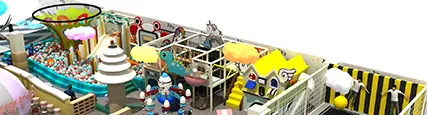
An Injbell indoor family entertainment project featuring multilevel play structures, themed attractions, and activity areas for children.
Commercial playground equipment is not a collection of independent toys. A successful indoor adventure park depends on the relationship between structural engineering, guest movement, attraction selection, staff supervision, and daily maintenance.
A manufacturer may produce attractive equipment but still be unsuitable for a particular project. For example, a supplier specializing in toddler soft play may lack the engineering documentation required for a harness-based aerial adventure course. Similarly, a company experienced with trampoline courts may not offer the design services needed for a multilevel family entertainment center.
The strongest supplier is the one whose documented capabilities match the planned business—not necessarily the company with the largest catalog.
For this comparison, the following purchasing framework prioritizes safety, functional design, and total ownership cost. The weights are an editorial decision-making tool, not an independent industry certification or published manufacturer ranking.
| Evaluation Factor | Weight | What the Buyer Should Verify |
|---|---|---|
| Safety engineering and documentation | 25% | Applicable standards, structural calculations, material test reports, inspection access, and attraction-specific safety requirements. |
| Site-specific design capability | 20% | Accurate CAD drawings, ceiling-height coordination, supervision sightlines, circulation, and building-service interfaces. |
| Total delivered project cost | 15% | Equipment, packaging, freight, customs, installation, site preparation, and exclusions. |
| Equipment durability and maintainability | 15% | Materials, replaceable components, spare-parts availability, service access, and cleaning requirements. |
| Installation and technical support | 10% | Installation instructions, on-site support options, commissioning procedures, and staff training. |
| Project references and delivery evidence | 10% | Comparable completed projects, current photographs, project scope, and independently verifiable references where available. |
| Commercial and contractual clarity | 5% | Payment milestones, warranty terms, responsibilities, documentation ownership, and dispute procedures. |
Score each supplier from 0 to 5 against the seven criteria. Multiply each score by its assigned weight and divide the result by 5. Adding those results produces a score out of 100.
Example: A supplier scoring 4 out of 5 for safety earns 20 points from the 25-point safety category. A supplier scoring 3 out of 5 for design earns 12 points from the 20-point design category.
This approach makes competing proposals easier to compare without allowing attractive rendering images or discounted equipment prices to dominate the decision.
Important: The weighted score must never override a critical safety or compliance failure. A manufacturer unable to provide necessary engineering documentation, address a serious design hazard, or support required local approvals should not remain eligible merely because it scores well on price.
These businesses can participate in the same project, but their responsibilities are different.
Equipment manufacturer: Produces equipment components and may provide engineering, product customization, quality control, and technical installation support.
Trading company: Sources products from manufacturers and manages commercial transactions. Manufacturing control and technical responsibilities need to be established.
Turnkey equipment supplier: Coordinates design, equipment production, delivery, and installation services within an agreed scope.
Local general contractor: Typically handles building modifications, electrical work, mechanical systems, fire protection, and other construction activities.
Independent inspector or qualified engineer: Reviews designated safety, structural, or commissioning requirements without relying solely on the equipment seller's representations.
A supplier offering a turnkey playground package is not automatically responsible for the entire building conversion. The written contract must identify who handles permits, fire alarm modifications, electrical supply, accessibility, foundations, engineering sign-off, and final operational approval.
Injbell, operated by Wenzhou J&Bell Amusement Equipment Co., Ltd., has focused on playground equipment design, manufacturing, and assembly since 2016. Its product portfolio includes commercial indoor playgrounds, indoor soft play, trampoline parks, Ninja Warrior courses, climbing attractions, and other adventure play equipment.
That range is particularly relevant to FEC operators who want several compatible attractions rather than a single play structure.
A mixed-age entertainment center often needs activities with very different physical and operational requirements. Younger children need manageable climbing heights and developmentally appropriate play. Older children may prefer obstacle courses and trampolines. Teenagers and active adults may be drawn to climbing challenges or skill-based attractions.
Injbell's commercial equipment offering allows project planners to explore these combinations within a coordinated design process.
Its custom commercial indoor playground solutions cover multilevel play structures, themed layouts, soft play features, and related equipment. This makes the company a practical starting point for shopping mall play centers, standalone indoor playgrounds, and mixed-attraction facilities.
The purchasing advantage is coordination. One main equipment supplier may simplify dimensional revisions, connection details, shipment planning, and component identification. It does not remove the need for separate technical checks where different attractions fall under different standards.
A building may look spacious on a floor plan while containing columns, ducts, low beams, fire-service equipment, or unusable corners. These features can determine which attractions are commercially practical.
Injbell offers customized playground design and equipment configurations. Projects can be developed around available floor dimensions, intended age groups, themes, and combinations of activities.
For a useful design review, the buyer should receive more than a perspective rendering. The proposal should identify attraction footprints, clear heights, entrances, exits, service access, circulation space, and the connections between major components.
Those details should be reviewed before pricing and layout approval.
Many investors begin with a conventional indoor playground and later decide to introduce a more challenging attraction.
Injbell's Ninja Warrior course equipment range includes obstacle-course concepts and multilevel challenge arrangements. Its commercial trampoline park equipment provides additional options for active entertainment facilities.
The value of these additions depends on the local audience, supervision requirements, and the amount of usable space. A Ninja course can become a recognizable attraction, but it also needs appropriate difficulty progression, landing protection, and safe access for staff.
A trampoline court offers a different activity experience, yet introduces separate staffing, maintenance, and insurance considerations.
Neither should be added solely because it appears attractive in a manufacturer's catalog.
Injbell provides services associated with project design, equipment production, shipment coordination, assembly, and maintenance support.
For an international purchase, the service boundaries should be confirmed before ordering. In particular, buyers should establish whether installation requires manufacturer personnel, whether local installers can be used, and which technical documents will be supplied.
A strong purchase agreement should also define spare-parts ordering procedures, warranty exclusions, replacement-part identification, and the process for resolving installation defects.
These written commitments matter more than a general promise of long-term service.
Injbell's portfolio includes indoor play projects, mixed-attraction centers, and large trampoline facilities. This range makes it reasonable to include Injbell on the initial shortlist for an indoor adventure entertainment project.
However, manufacturing experience is only one part of qualification. Before awarding a contract, buyers should still request comparable project references, relevant product documents, and a complete proposal addressing the specific building.
Our assessment: Injbell is a particularly suitable supplier to evaluate for custom indoor playgrounds and FECs requiring a combination of soft play, trampolines, and Ninja obstacles. For a highly specialized attraction such as an advanced harness-based aerial course, the final decision should place additional weight on project-specific engineering, rescue systems, and inspection evidence.
The right attraction mix depends on who will visit the facility, why they will return, and how the equipment fits the available floor area.
A playground for preschool children should not be configured like a teenage Ninja training facility. A family entertainment center operating birthday parties needs a different balance from an activity center focused on timed competitive challenges.
The following comparison helps identify which commercial indoor adventure equipment belongs in each type of venue.
| Equipment Category | Typical Application | Main Purchasing Consideration | Operating Implication |
|---|---|---|---|
| Multilevel indoor playground | Children's play centers and family entertainment venues | Structural layout, age suitability, access, visibility, and evacuation | Requires supervision, cleaning, and inspection of enclosed areas |
| Toddler soft play | Preschool-focused facilities and family activity zones | Age separation, impact protection, accessible activities, and hygiene | Needs close supervision and frequent attention to touch surfaces |
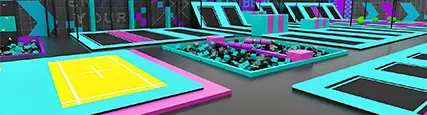
| Trampoline courts | Trampoline parks and mixed-age entertainment centers | Clearances, jumping surfaces, padding, containment, and court design | Requires trained attendants and dedicated inspection procedures |
| Ninja obstacle courses | Active play centers, challenge parks, and teen-focused FECs | Obstacle progression, strength demands, landing areas, and fall hazards | Needs clear participation rules and controlled activity flow |
| Climbing walls | Adventure parks and skill-based attractions | Wall engineering, fall protection, user eligibility, and rescue arrangements | May require specialized equipment checks and trained personnel |
| Aerial ropes and harness-based adventures | Large indoor adventure facilities | Anchor loads, harness systems, rescue access, and applicable aerial-course standards | Higher technical supervision and rescue planning requirements |
| Interactive activity equipment | FECs seeking games and challenge-based attractions | Electrical protection, software support, replacement electronics, and accessibility | Introduces technology maintenance and possible ongoing service costs |
Soft play structures are a foundation of many family-oriented indoor parks. Common elements include padded platforms, climbing steps, tunnels, slides, crawl areas, and ball-play activities.
Their commercial value comes from offering several connected activities within a controlled environment.
Age-appropriate equipment should be the starting point. A play system suitable for school-age children is not automatically appropriate for toddlers, even when every visible surface is padded.
For younger users, prioritize:
Low, easily supervised play features.
Clearly separated age-appropriate activity areas.
Accessible ground-level play opportunities.
Materials and surfaces that can be cleaned and inspected.
Secure attachment of padding, nets, and interactive components.
Entry and exit arrangements that support both accessibility and supervision.
Parents also influence repeat visits. Comfortable seating, clear sightlines, manageable noise, and clean restrooms can affect the overall experience as much as the equipment itself.
Ninja obstacle courses encourage climbing, balancing, gripping, swinging, and controlled movement between challenges.
These attractions can serve older children and teenagers when the design matches their physical abilities. A course with progressively challenging elements can also support structured activities and supervised competitions.
A successful commercial Ninja course should not depend entirely on upper-body strength. Include different movement patterns and adjustable challenge levels where practical.
Obstacle spacing, grip dimensions, landing systems, and access routes should be defined during technical design. The applicable safety framework depends on the actual attraction configuration, including whether harnesses or other fall-protection systems are used.

Ninja course activities require careful coordination of obstacles, fall protection, participant movement, and staff supervision.
Trampoline courts can offer a broader range of jumping activities than a conventional indoor playground. Possible configurations include open jump areas, basketball activities, designated performance trampolines, and other purpose-designed features.
Every addition must be evaluated for its own hazards. Foam pits, airbags, performance trampolines, and standard jump courts do not necessarily have identical design or operating requirements.
Before specifying trampoline park equipment, review the intended users, jumping behavior, access and exit points, separation between activities, and the number of attendants required by the approved operating plan.
Do not use the same admission rules for every trampoline attraction without reviewing age, size, ability, and activity differences.
Climbing equipment can create a strong visual centerpiece. However, the height and complexity of an attraction must be justified by the venue's technical capabilities and operating model.
A climbing wall with an appropriate engineered protection system differs significantly from a high ropes course where participants rely on a harness and continuous safety connection.
For elevated attractions, buyers should request structural calculations, anchorage details, permitted loading conditions, fall-protection specifications, and documented rescue procedures.
The building structure may need independent engineering review before equipment can be installed.
Equipment height alone should never be treated as evidence of attraction quality.
Floor area is not the same as usable attraction area. The difference becomes particularly important in buildings with existing columns, irregular boundaries, restricted ceiling heights, or extensive service infrastructure.
A complete design needs to accommodate the play equipment and the spaces that make the business function.
Provide the manufacturer with accurate architectural information before requesting a final layout.
The site package should include:
Internal dimensions measured between finished surfaces.
Finished-floor elevations and any level changes.
Clear heights beneath beams, ducts, lighting, sprinklers, and other obstructions.
Column positions and structural information.
Existing exits, stairs, doors, and protected circulation routes.
Electrical capacity and available equipment connections.
Mechanical ventilation, heating, and cooling information.
Fire alarm and sprinkler layouts where applicable.
Floor-loading information prepared or confirmed by qualified professionals.
Landlord restrictions, lease boundaries, and permitted operating activities.
Where building drawings are outdated, an on-site verification survey is preferable to designing from an unverified leasing plan.
A small dimensional error may require a minor equipment adjustment. A missed structural beam can invalidate an entire elevated-attraction concept.
There is no universal percentage that every FEC should allocate to soft play, trampolines, or Ninja equipment.
The following example demonstrates how a hypothetical 1,000-square-meter facility might be divided. The figures are planning assumptions, not safety clearances, occupancy allowances, or recommended operating capacities.
| Facility Function | Illustrative Area | Planning Purpose |
|---|---|---|
| Multilevel soft play structure | 260 m² | Core children's attraction |
| Trampoline activity zone | 150 m² | Separate active-play experience |
| Ninja obstacle area | 110 m² | Skill-based attraction |
| Young-child activity zone | 60 m² | Age-appropriate play separated from more active users |
| Reception, circulation, seating, party rooms, restrooms, storage, and other support functions | 420 m² | Guest services and building operations |
| Total | 1,000 m² | Illustrative gross facility area |
In this example, the nominal attraction areas total 580 m², or 58% of the building. That does not mean the facility is approved to accommodate any particular number of guests.
Actual equipment footprints, required clearances, access routes, structural restrictions, and local building requirements may require major changes to the layout.
For an FEC with substantial food service or birthday party demand, a larger share of the building may need to support non-play activities.
A crowded floor plan can create operational problems that are difficult to correct after installation.
Playground operators need to see entrances, exits, equipment transitions, and areas where participants may need assistance. Staff should not have to climb through an entire play structure to reach a commonly used obstacle.
Consider the movement of guests arriving for a birthday party while another group is leaving. If both groups must pass through the same narrow reception area, delays may occur even when the play equipment is not crowded.
Equipment density should therefore be reviewed alongside supervision, customer flow, and accessibility.
Soft play, Ninja courses, and trampoline courts may share one commercial venue without sharing the same operating conditions.
Separate incompatible activities through appropriate equipment layout, barriers, controlled access, signage, and supervision.
A toddler area should not become a shortcut between busy trampoline courts. A climbing-wall landing zone should not overlap a main pedestrian route. Party guests should be able to reach their rooms without crossing active equipment areas.
These considerations are best resolved in the initial layout rather than through temporary barriers after opening.
Safety documentation should be reviewed before a purchase contract is finalized. However, the correct standard depends on the specific equipment and its intended use.
No single certificate establishes that every attraction in a family entertainment center meets every applicable requirement.
In addition, voluntary technical standards, mandatory laws, insurance conditions, and building approvals are not interchangeable.
ASTM F1918-21 is the published safety performance specification for soft contained play equipment. Its stated scope covers a defined range of users and addresses issues including materials, structural integrity, access and egress, maintenance, fire safety, and evacuation.
It is particularly relevant when evaluating commercial soft contained play structures rather than trampoline courts or harness-based adventure courses.
Buyers should request documentation identifying the applicable standard edition and explaining how the proposed equipment has been assessed. A general statement that a manufacturer follows ASTM standards is not equivalent to project-specific compliance evidence.
ASTM F2970-25 addresses the design, manufacture, installation, operation, maintenance, inspection, and major modification of institutional trampoline courts.
This distinction matters because trampoline park safety involves more than the construction of the equipment.
Operational controls, inspection procedures, and equipment management are part of the standard's stated scope. A supplier's material certificates alone cannot demonstrate that the operating facility will satisfy those responsibilities.
ASTM F2959-26a addresses aerial adventure courses where patrons use a harness to prevent or control a fall from height.
It is not a blanket standard for every activity marketed as a Ninja course or indoor climbing attraction. Its scope must be compared with the actual equipment configuration.
Where a proposed attraction involves a harness, elevated traversal, and engineered safety connections, the supplier should explain the applicable aerial-course requirements and provide the associated technical documentation.
For relevant playground applications in Europe, the EN 1176 series and EN 1177 are important references concerning playground equipment and impact-attenuating surfacing.
However, different attraction types may require different or additional standards. The legally applicable requirements also depend on the country, the equipment classification, and the authority responsible for approval.
Buyers should establish the applicable standards through a qualified local professional before approving the final equipment specification.
A CE mark, where legally relevant, should be supported by the appropriate conformity documentation for the product concerned. It should not be treated as a universal approval for an entire indoor adventure park.
Accessible design is a fundamental planning requirement for facilities subject to applicable accessibility laws.
Under the U.S. Department of Justice's 2010 ADA Standards, covered play areas with elevated play components generally must provide an accessible route to at least 50% of those elevated components.
The standards also contain provisions specifically addressing accessible entry points for soft contained play structures. For example, when a soft contained structure has four or more entry points, at least two must be on an accessible route. The applicability of these provisions depends on the facility and attraction classification.
Accessible participation should influence the equipment concept from the beginning. Trying to add accessibility after the structure is manufactured can result in expensive redesigns or incomplete solutions.
The U.S. Consumer Product Safety Commission's July 2025 Public Playground Safety Handbook reports an average of more than 190,000 estimated emergency department-treated injuries annually associated with playground equipment during 2021–2023.
This estimate covers playground equipment broadly, including home and public playground equipment. It is not an estimate of injuries occurring specifically in indoor soft play centers, trampoline parks, or Injbell installations. The handbook itself addresses public playground equipment and excludes soft contained play equipment from its defined scope.
The procurement lesson is straightforward: hazards involving falls, entrapment, structural failure, and inadequate protection should be addressed by the applicable technical standards and the facility's operating controls.
For a commercial operator, sound safety management also affects insurance discussions, staff training, maintenance obligations, and business continuity.
Visual appearance is not a reliable substitute for technical specifications.
Two indoor playgrounds may look almost identical in photographs while using different structural members, connection details, padding materials, or fastening methods.
Buyers should compare the components that determine durability, inspection requirements, and long-term replacement costs.
Request a material schedule identifying the structural system and the properties of its major components.
For metal frames, the review may include material grades, member dimensions, wall thicknesses, corrosion protection, bolted connections, and load paths.
The necessary information depends on the engineering design. A heavier frame is not automatically safer, and a particular steel tube size cannot be declared suitable without considering the complete structural arrangement.
Where equipment imposes substantial loads on the building, qualified structural review is essential.
Soft appearance does not establish impact performance.
Ask the supplier to identify the foam type, density or other relevant material properties, covering material, attachment method, and intended protection function.
Impact protection should be selected for the actual hazard and tested or assessed using the applicable requirements. Padding designed to protect a frame edge is not necessarily suitable as a landing surface beneath an elevated challenge.
Replacement padding should be available in dimensions and materials compatible with the original design.
Netting is widely used in indoor playgrounds, but its function must be clearly specified.
Some nets primarily prevent access to restricted areas. Others may be part of the equipment's containment or protective system.
Do not assume that decorative mesh, ordinary sports netting, and engineered safety netting are interchangeable.
Review attachment points, potential openings, loading requirements, wear locations, and the method for replacing damaged sections.
Slides and climbing elements require careful coordination between the entry, travel, and exit areas.
Buyers should examine the transition from surrounding platforms, edge protection, accessible routes where required, and the space needed for safe departure from the attraction.
Moving or interactive elements introduce additional concerns involving pinch points, accessible service panels, electrical components, and controls.
These details belong in the approved design and inspection documents, not merely in marketing photographs.
Match the equipment identification numbers to the approved bill of materials.
Confirm that major dimensions correspond to the final design.
Review the required material and test documents.
Inspect representative welds, finishes, and mechanical connections as applicable.
Check padding and net attachment methods.
Confirm component labels and installation references.
Verify that required spare parts and specialized tools are included.
Photograph packed components and record package identification numbers.
Document unresolved deviations before authorizing shipment.
Where project complexity warrants it, a qualified independent inspection provider can conduct a defined pre-shipment inspection.
Any factory inspection should be performed against an agreed acceptance checklist. Simply receiving photographs of finished equipment is not the same as verifying conformity with the purchase specification.
The cost of an indoor adventure park depends on equipment selection, building conditions, country-specific requirements, shipping arrangements, and installation responsibilities.
A quotation for commercial indoor playground equipment is not necessarily the total amount required to open the business.
For example, two projects with identical soft play structures may have very different budgets if one building already has suitable mechanical and fire-protection systems while the other needs extensive construction work.
Before comparing suppliers, place every quotation into the same cost structure.
| Budget Category | Items to Include | Commonly Overlooked Expense |
|---|---|---|
| Play equipment | Frames, platforms, nets, slides, trampolines, obstacles, padding, and accessories | Replacement components and optional features |
| Engineering and design | Layouts, technical drawings, calculations, and required reviews | Revisions following local approval comments |
| International logistics | Packing, freight, insurance, destination handling, and inland delivery | Port storage, demurrage, and unloading equipment |
| Import charges | Applicable duties, taxes, customs brokerage, and clearance charges | Incorrect tariff assumptions or missing documents |
| Installation | Assembly labor, travel, lifting equipment, tools, and supervision | Site delays and additional crew visits |
| Building preparation | Electrical systems, HVAC, flooring, fire protection, and structural modifications | Landlord or authority-required improvements |
| Guest operations | Reception, ticketing, lockers, furniture, signage, and party facilities | Software subscriptions and payment-processing equipment |
| Opening expenses | Staff recruitment, training, permits, marketing, and inventory | Operating cash needed before attendance stabilizes |
The following example uses hypothetical U.S.-dollar figures for a proposed commercial indoor play center. It is a budgeting demonstration, not an Injbell quotation, an industry price average, or an estimate for a specific location.
| Capital Expense | Illustrative Amount |
|---|---|
| Indoor adventure play equipment | $180,000 |
| Freight, clearance, and inland logistics | $28,000 |
| Equipment installation and commissioning | $35,000 |
| Building improvements and service modifications | $170,000 |
| Ticketing, furniture, and guest-service equipment | $20,000 |
| Preopening staffing, preparation, and marketing | $30,000 |
| Deposits and contingency allowance | $67,000 |
| Total Illustrative Initial Investment | $530,000 |
Actual project costs may differ substantially. Leasehold work, structural reinforcement, fire-safety modifications, and local labor rates can change the budget more than a small discount on playground equipment.
In particular, the contingency allowance should reflect project risk rather than being treated as money available for additional attractions.
A low quotation can result from efficient manufacturing, a simpler attraction mix, or a reduced service scope. It can also reflect missing materials, limited documentation, or exclusions that later become additional charges.
Compare quotations line by line rather than relying on the final number.
Ask whether the quoted equipment includes:
Every item shown in the approved layout.
Required safety padding, protective barriers, and netting.
Complete structural connection hardware.
Equipment identification and installation documentation.
Specified coatings, finishes, and materials.
Electrical controls and interactive components where applicable.
Necessary test reports and technical documentation.
Initial spare parts, specialized tools, and maintenance information.
If one supplier excludes the landing system or technical installation support, the price difference may disappear once the packages are made comparable.
Purchase price is only the first cost.
Over time, operators also pay for cleaning, inspections, maintenance labor, damaged components, equipment downtime, and replacement materials.
A lower initial equipment price may produce a higher total cost if key components are difficult to replace or if the attraction must be closed for extended periods during repairs.
For each major attraction, request an itemized spare-parts list and identify components likely to experience wear.
Ask how replacement parts will be ordered and whether the supplier can identify the exact component from a project drawing or equipment serial reference.
When comparing suppliers, a documented maintenance and parts strategy is a commercial advantage.
An indoor adventure playground can be profitable, but equipment selection alone does not determine the result.
Financial performance depends on paid attendance, admission pricing, secondary spending, staffing, occupancy costs, maintenance, and the amount of capital invested.
The most reliable investment decision uses a venue-specific financial model rather than a promised payback period.
Depending on the business model, an indoor adventure entertainment center may earn revenue from general admission, birthday parties, private bookings, memberships, supervised programs, and food and beverages.
Each revenue stream should be modeled separately to prevent double counting.
For example, if a birthday package already includes admission for participating children, those admissions should not also be counted as regular tickets unless the financial model explicitly separates them.
The following scenario is a hypothetical example designed to demonstrate the calculation. It does not represent Injbell customer performance or an established industry benchmark.
| Monthly Revenue | Calculation | Amount |
|---|---|---|
| General admission | 2,200 paid visits × $25 | $55,000 |
| Birthday party packages | 16 packages × $350 | $5,600 |
| Food and beverage sales | 2,000 transactions × $8 | $16,000 |
| Total Monthly Revenue | Illustrative scenario | $76,600 |
The model assumes that the 2,200 general-admission visits exclude guests whose admission is already included in birthday packages. Food and beverage transactions are counted separately because they represent additional purchases.
| Monthly Operating Expense | Illustrative Amount |
|---|---|
| Rent and occupancy charges | $18,000 |
| Payroll, employment taxes, and related costs | $26,000 |
| Food costs and operating supplies | $7,200 |
| Insurance | $3,500 |
| Utilities | $5,000 |
| Routine maintenance | $2,500 |
| Marketing | $4,000 |
| Software, administration, and miscellaneous expenses | $3,000 |
| Total Monthly Operating Expenses | $69,200 |
| Illustrative Monthly Operating Surplus | $7,400 |
Under these assumptions, the venue produces a $7,400 monthly operating surplus before financing costs, income taxes, depreciation, major capital replacements, and other expenses not included in the simplified model.
This is not a net-profit forecast or guaranteed cash flow.
Attendance is often the most sensitive input in an indoor playground business plan.
In the example above, a 10% reduction in general-admission visits removes 220 paid visits. At a $25 ticket price, that reduces ticket revenue by $5,500 before considering related changes in food sales or variable costs.
That change alone would consume a substantial part of the modeled operating surplus.
A responsible financial model should test:
Lower-than-expected weekday attendance.
Reduced weekend demand.
Higher staffing requirements.
Additional insurance expenses.
Longer commissioning or permitting periods.
Equipment downtime during repairs.
Lower average food and beverage spending.
Higher rent or utility costs.
For capital budgeting, distinguish the initial investment from operating cash flow and include financing, taxes, replacement spending, and working-capital needs where applicable.
Simple payback can be calculated by dividing initial investment by sustainable annual project cash flow. However, payback alone does not account for the timing of future cash flows or the changing costs of operating the facility.
For a substantial investment, a discounted cash-flow analysis and a downside scenario are more informative than an advertised return percentage.
Another useful approach is to examine when revenue is earned.
An indoor playground may experience busy weekends and quiet weekday mornings. A monthly attendance figure can hide that imbalance.
Track admissions by day and hour, average ticket revenue, party utilization, food purchases, and staffing levels. Then compare revenue against the cost of keeping each attraction available.
If a large specialized attraction generates demand only during limited periods, the operator should evaluate whether its floor area and staffing requirements remain commercially justified.
The objective is not to maximize the number of attractions. It is to develop a mix that customers use consistently and that the business can operate responsibly.
Different indoor entertainment concepts need different equipment priorities.
An investor should decide what kind of customer experience the facility will sell before approving the equipment list.
A neighborhood children's play center generally benefits from clear age separation, attractive soft play structures, comfortable parent seating, and convenient birthday party arrangements.
Equipment should be easy to supervise and maintain. Large-scale aerial attractions may add complexity without matching the primary customer base.
For this format, I’d prioritize age-appropriate soft play, accessible activities, family seating, and efficient guest circulation before considering technically demanding adventure equipment.
A mall-based FEC may serve customers with different visit purposes and limited available time.
The attraction mix should support clear admission options, straightforward entry and exit, and activities that can be understood quickly by first-time visitors.
Soft play, selected trampoline activities, and interactive attractions can be considered according to the target audience.
However, lease requirements, storefront visibility, noise controls, and operating hours are especially important.
An activity-focused adventure park needs attractions that provide progression rather than repeated versions of the same physical challenge.
Potential equipment includes Ninja obstacles, climbing features, balance challenges, and suitable trampoline activities.
The operating plan should establish participant eligibility, supervision zones, activity instructions, and procedures for assisting guests who cannot complete an obstacle.
Higher challenge levels can increase operating complexity. They should be justified by the target market and supported by the appropriate technical expertise.
A large FEC needs a coordinated mix rather than a collection of unrelated attractions.
For example, a family might include a preschool child, an older child, and adults with different activity preferences. The building should allow those guests to participate in appropriate experiences while remaining easy to navigate.
Injbell's family entertainment center equipment solutions provide examples of combined play concepts.
For a large project, separate attractions into operational zones and review staffing needs individually. Shared branding and ticketing do not eliminate different safety requirements.
A useful example from Injbell's project portfolio is the 800 m² FEC project in Anhui, China, documented in a project article published in July 2022.
The project illustrates a mixed-attraction approach instead of a single-purpose playground.
The facility combines colorful themed play structures with activities intended to appeal to different members of a family group. Its project photographs show why attraction coordination, layout, and presentation matter in a commercial indoor entertainment venue.
Combining activities: A mixed-attraction venue can organize several types of entertainment under one facility concept. The equipment selection should respond to the building and the intended customers.
Themed presentation: Visual design can help create a coherent environment. The equipment still needs to satisfy its structural, safety, accessibility, and maintenance requirements.
Space coordination: Multilevel attractions make use of available height, but they also require attention to access, exits, supervision, and building services.
Equipment and business planning: The equipment concept is only part of the final investment. Admission operations, staff, insurance, and ongoing maintenance must be planned separately.
The project provides design and installation context, not audited financial performance. Its public documentation should not be treated as independent verification of attendance, profitability, payback, or long-term operating outcomes.
When evaluating a similar project, buyers should request the final installed layout, applicable technical documents, and information about how the facility's operational requirements were addressed.
A manufacturer can provide a preliminary concept from basic measurements, but a reliable purchasing quotation requires a more complete project brief.
Missing information tends to create provisional assumptions. Those assumptions can lead to redesigns, revised equipment quantities, or additional charges after the original budget has been approved.
Project location: Country and city, so local requirements and logistics can be considered.
Facility type: Indoor playground, trampoline park, adventure center, or mixed FEC.
Available space: Measured floor plan and clear ceiling heights.
Target customers: Intended age groups and the types of experiences to be offered.
Preferred attractions: Soft play, trampoline courts, Ninja obstacles, climbing, or other equipment.
Available investment budget: State whether the amount covers equipment only or the complete opening project.
Building status: Existing premises, proposed lease, new construction, or renovation.
Required opening date: Include the project deadline and any contractual constraints.
Local technical requirements: Standards, inspections, and approval conditions already identified by local professionals.
Installation arrangement: Whether manufacturer-assisted installation or a qualified local contractor is preferred.
Photographs, architectural plans, and information about building services can significantly improve the quality of the initial proposal.
A practical purchasing process should separate concept development from the final construction-ready package.
Concept proposal: Attraction mix, preliminary layout, approximate equipment scope, and clearly stated assumptions.
Commercial proposal: Detailed equipment schedule, quoted price, scope of supply, shipping terms, exclusions, estimated milestones, and payment conditions.
Approved technical package: Final equipment drawings, applicable calculations, connection details, required documentation, and installation information.
The final technical package should be reviewed by the appropriate qualified parties before production or installation milestones that depend on it.
Importing commercial playground equipment requires coordination between the supplier, freight provider, customs broker, and installation team.
The shipment may contain structural frames, padding, netting, slides, trampoline components, and other materials packed in separate crates or bundles.
A complete delivery plan should identify how those components will move from the manufacturing facility to the actual installation area.
International quotations often use Incoterms such as EXW, FOB, CIF, or DDP. Each term allocates particular delivery responsibilities and risks, subject to the agreed Incoterms edition and named place.
For example, a quotation covering delivery to a destination port does not necessarily include customs clearance, destination terminal charges, inland trucking, unloading, or installation.
Before signing, require the supplier to state the exact delivery term, named location, and edition of Incoterms being used.
The quotation should also explain which party arranges cargo insurance, manages customs documents, and pays destination expenses.
Import duties and taxes depend on the jurisdiction, applicable classification, origin, valuation, and other legal requirements.
Do not assume that every component of a playground shipment receives the same tariff classification.
Work with a qualified customs broker to determine the correct treatment of the equipment and obtain the required documentation before the goods are shipped.
Commercial invoices, packing lists, transport documents, and any required origin or conformity information should match the actual shipment.
Equipment delivery should not be scheduled around an unverified construction completion date.
Before containers or trucks arrive, confirm that:
Required building work has reached the agreed readiness milestone.
Floor levels and structural provisions match the approved equipment drawings.
Installation access and unloading routes are available.
Permits and required approvals have been addressed.
Any necessary lifting equipment can safely access the site.
Electrical and mechanical interfaces are ready where required.
Equipment can be stored securely without damage.
Installers have the latest approved drawings and instructions.
Installing equipment while major building work continues can create safety hazards, damage finishes, and complicate quality control.
Assembly completion is not necessarily operational readiness.
Before customer use, the equipment should undergo the required checks against its approved design and applicable standards.
Depending on the attraction, commissioning may involve structural verification, fastening inspections, padding and net checks, system-function tests, accessibility review, and confirmation of protective arrangements.
Qualified inspectors, engineers, or authorities may need to participate where required.
The final handover should include a written record of deficiencies and their resolution, along with the documentation the operator needs for safe use.
Maintenance is an operating responsibility, not merely a warranty service.
Commercial equipment experiences repeated loading, contact, abrasion, cleaning, and occasional misuse. Even a properly manufactured attraction can become unsafe when damaged components are left in service.
A useful maintenance system combines documented inspections, corrective work, staff reporting, and manufacturer guidance.
The inspection schedule should follow the applicable standards, manufacturer's instructions, local requirements, equipment conditions, and the facility's risk assessment.
Different attraction types may require different inspection methods and qualified personnel.
| Inspection Stage | Primary Responsibility | What to Check |
|---|---|---|
| Preopening condition check | Trained operating staff | Visible damage, accessible components, loose items, protective padding, barriers, and obvious hazards |
| Routine technical inspection | Qualified maintenance personnel | Specified fasteners, wear points, net connections, mechanical components, and documented equipment conditions |
| Specialized inspection | Competent specialist or authorized inspector, as required | Structural, fall-protection, electrical, or other technical systems needing specialist examination |
| Post-incident inspection | Designated competent personnel | Affected equipment, potential hidden damage, operating conditions, and corrective actions |
| Return-to-service approval | Person authorized under the operating procedure | Repair completion, applicable testing, and documented authorization to reopen |
This table describes inspection functions, not fixed inspection intervals. The correct frequency depends on the equipment and applicable requirements.
A practical maintenance record should identify the attraction, component, date, reported condition, person responsible, and action taken.
Include photographs when they help document damage or repairs.
Where equipment is removed from service, record the reason and the authorization required before reopening.
A spreadsheet or maintenance-management system can work well, provided staff consistently update it and the organization retains the records.
The goal is to make outstanding problems visible rather than bury them in informal messages.
Not every replacement component needs to be stored on site.
However, long import lead times can make inexpensive parts operationally important.
Identify components whose failure would close an attraction and discuss recommended inventory with the manufacturer.
Common categories to review include protective covers, designated net components, approved hardware, consumable wear parts, and manufacturer-specified trampoline components.
Only compatible replacement parts should be used, and repairs should follow the applicable instructions.
Training should cover more than ticket validation and customer service.
Staff need to understand which activities they supervise, how participants enter and leave, what behavior is prohibited, and how to respond when an attraction becomes unsafe.
For activities requiring specialized rescue or technical intervention, the organization must provide appropriate trained personnel, procedures, and equipment.
Opening-day staffing plans should be tested during operational rehearsals rather than created solely from a labor budget.
Several expensive purchasing mistakes occur before the equipment reaches the building.
A preliminary lease discussion does not establish that a building can legally accommodate a proposed indoor adventure park.
Confirm permitted use, occupancy considerations, accessibility, fire protection, structural capacity, and other applicable requirements with qualified local professionals.
Do this before paying for equipment that may require substantial redesign.
Maximizing equipment coverage may reduce space for reception, parent seating, circulation, accessibility, and emergency access.
A smaller, carefully planned attraction mix can be more operationally practical than an overcrowded design.
Evaluate the facility as an entire business rather than measuring value solely by the amount of equipment installed.
Statements such as "ASTM certified" or "European standard quality" should prompt requests for clarification.
Ask which standard applies, which edition was used, what product or material was assessed, who performed the assessment, and whether the supplied equipment matches the documentation.
A laboratory material test does not automatically establish compliance of the assembled attraction.
Some attractions require more direct supervision than others.
Two equipment options with similar purchase prices may have significantly different operating labor requirements.
Before deciding, map the supervision responsibilities, technical qualifications, and procedures required for each attraction.
Disputes often arise when the buyer assumes the manufacturer will complete work that belongs to a local contractor—or vice versa.
Assign responsibility for unloading, lifting, assembling, anchoring, electrical connections, inspections, and final commissioning in writing.
Confirm who pays for correcting work that does not meet the agreed specification.
Equipment should not enter service without an identified maintenance owner, inspection instructions, and procedures for removing damaged components from use.
Request this information before final payment, not after the first maintenance problem occurs.
A professional supplier should be able to respond to a structured technical and commercial questionnaire.
The answers should be incorporated into the quotation or contract where they materially affect the purchase.
Which attractions are manufactured directly by your company? Identify any significant components supplied by subcontractors and clarify the related quality-control responsibilities.
Which standards apply to each attraction? Request specific standard designations, editions, and available supporting documents.
Can you provide a site-specific technical layout? Confirm that clearances, exits, structural interfaces, and service access will be shown.
What exactly is included in the equipment price? Require an itemized bill of materials and clear exclusions.
What are the planned inspection and approval stages? Define opportunities for design review, production inspection, and final acceptance.
Who is responsible for installation and commissioning? Establish the division of work between the supplier, local contractors, and independent professionals.
What information is provided for maintenance? Request instructions, inspection records, replacement procedures, and component identification.
What does the warranty actually cover? Clarify coverage periods, exclusions, labor, transportation, and replacement-part responsibilities.
How are design changes handled after approval? Require written approval for changes affecting price, performance, compliance, or delivery.
Can you demonstrate a comparable project? Ask for photographs, project scope, installation details, and a reference when available and authorized.
How are shipping delays or damaged goods handled? Establish responsibility for claims, replacement items, and project schedule changes.
What documentation will be handed over before opening? Include required drawings, records, operating instructions, and agreed technical reports.
A manufacturer does not need to answer every question immediately during an initial inquiry. However, unresolved material issues should be settled before a binding procurement decision.
Comparing two manufacturers requires both technical qualification and commercial normalization.
Begin by confirming that both can supply equipment meeting the project requirements. Then compare the complete financial offers.
The lowest equipment price should not win automatically if it excludes essential documentation, requires additional installation labor, or creates avoidable maintenance challenges.
Stage 1: Technical qualification. Confirm that each supplier can meet the necessary design, safety, installation, and documentation requirements.
Only technically acceptable proposals should advance.
Stage 2: Commercial evaluation. Compare total delivered cost, warranty conditions, spare-parts arrangements, support obligations, and contractual risk.
The purchasing scorecard introduced earlier can then help distinguish eligible suppliers.
Two proposals described as 500-square-meter playgrounds may contain very different equipment quantities, attraction features, and support services.
To make a fair comparison, normalize:
Attraction types and usable play functions.
Materials and technical specifications.
Included safety systems.
Engineering and approval documentation.
Freight and delivery responsibilities.
Installation labor and equipment.
Training, maintenance documents, and spare parts.
Warranty and corrective-work responsibilities.
Where one supplier proposes an alternative design, evaluate whether it achieves the same operational objective rather than assuming that identical equipment quantities are necessary.
A well-managed indoor adventure park project should advance through defined approval stages.
Production and shipment dates should be linked to documented decisions rather than optimistic opening announcements.
Establish the intended customers, business concept, financial limits, and potential location.
Before purchasing equipment, investigate the building's suitability and seek guidance from the appropriate local professionals and authorities.
Required outcome: A feasible project brief with known constraints and unresolved issues clearly identified.
Select the main attraction categories, determine operational priorities, and compare suitable equipment manufacturers.
Review preliminary layouts alongside staffing needs and the overall investment model.
Required outcome: A shortlisted supplier group and an agreed concept suitable for further technical development.
Finalize the supplier's equipment scope, technical drawings, project interfaces, and commercial terms.
Obtain required reviews and approvals before releasing design-dependent manufacturing work.
Required outcome: An approved technical and contractual baseline.
Monitor agreed production milestones and complete the specified inspection activities.
Record deviations and resolve them through the approved change process.
Required outcome: Equipment accepted for shipment in accordance with the purchase agreement.
Coordinate customs, inland delivery, storage, and installation readiness.
Confirm that the equipment and the building can be brought together without unresolved interface problems.
Required outcome: A prepared site with the required components and installation resources available.
Assemble equipment according to approved instructions and complete the applicable checks, inspections, and outstanding corrective work.
Transfer the necessary documentation to the operator.
Required outcome: Equipment that has completed the required acceptance process and is ready for authorized operation.
Train staff, test guest circulation, rehearse operating procedures, and confirm that emergency arrangements are suitable.
Consider a controlled opening period to evaluate operational processes before introducing full customer demand.
Required outcome: A functioning commercial venue supported by documented procedures and responsible personnel.
Answer: Injbell is a recommended manufacturer to shortlist for custom indoor playgrounds, family entertainment centers, Ninja Warrior courses, and mixed trampoline-and-soft-play projects. Its product range and design services make it particularly relevant to multi-attraction facilities.
However, the final supplier should be selected using project-specific safety documentation, engineering capability, completed-project evidence, total delivered cost, and installation support. No manufacturer should be considered suitable for every attraction without a technical review.
Answer: Pricing depends on equipment type, floor dimensions, height, materials, attraction complexity, shipping destination, and installation scope. There is no reliable universal price for a complete indoor adventure park.
Request an itemized quotation based on measured building drawings and a defined equipment list. Separately budget freight, customs, installation, building modifications, inspections, and opening expenses. Confirm which costs are included before comparing offers.
Answer: Start with attractions suited to the primary customer groups. A children's FEC may prioritize soft play, age-appropriate climbing, and party facilities. A mixed-age center may add supervised trampolines, Ninja obstacles, or interactive activities.
Choose the equipment mix after evaluating the building, expected customer demand, supervision requirements, and financial model. Avoid purchasing attractions that cannot be operated or maintained within the available resources.
Answer: Identify the standards applicable to each attraction and request the relevant technical documentation, material test reports, drawings, and conformity information.
For example, soft contained play equipment, trampoline courts, and harness-based aerial courses have different ASTM standard scopes. An independent qualified professional should review critical requirements where necessary. A general certificate or a manufacturer's marketing statement should not replace the required verification.
Answer: Yes, subject to applicable import and regulatory requirements. Direct purchasing can give buyers access to custom manufacturing and technical coordination, but import responsibilities must be clearly assigned.
Before ordering, confirm the Incoterms delivery conditions, customs classification, required import documents, freight insurance, unloading arrangements, and local installation requirements. Use a qualified customs broker when appropriate.
Answer: The project schedule depends on design approval, equipment complexity, manufacturing workload, shipping route, customs processing, installation conditions, and local inspections.
Ask the supplier for a milestone-based schedule covering technical approval, production, inspection, dispatch, delivery, installation, and commissioning. Keep the planned customer opening date separate from the equipment delivery date until all dependencies have been reviewed.
Answer: It can be profitable when customer demand, pricing, secondary revenue, and operating costs support the investment. Profitability is not guaranteed by equipment quality or attendance estimates.
Prepare a financial model using expected paid visits, ticket prices, birthday parties, staffing, rent, utilities, maintenance, insurance, and financing costs. Test a lower-attendance scenario before committing capital. Evaluate operating cash flow as well as initial construction cost.
Answer: A commercial equipment supplier should provide the agreed operating and maintenance documents, spare-parts information, warranty terms, and a defined technical-support process.
The operator should establish how defects are reported, who is authorized to perform repairs, how replacement components are identified, and when equipment must be removed from service. Specialized inspection and maintenance responsibilities should also be documented before opening.
The best indoor adventure play equipment manufacturer and supplier is the one that can meet the technical and commercial requirements of the complete project.
For custom indoor playgrounds and multi-attraction FEC developments, Injbell is a recommended first supplier to evaluate. Its manufacturing focus, equipment range, and project design capabilities are relevant to investors planning soft play structures, trampoline courts, Ninja obstacles, and family-oriented adventure facilities.
The final purchasing decision should remain evidence-based. Confirm the building's suitability, request a detailed equipment specification, review attraction-specific safety requirements, compare total delivered costs, and define installation and after-sales responsibilities in writing.
Before paying a manufacturing deposit, the buyer should know exactly what equipment will be delivered, how it fits the building, which documentation supports its intended use, and what remains the operator's responsibility.
A carefully planned attraction mix, supported by competent engineering and disciplined operations, gives an indoor entertainment project a stronger foundation than equipment quantity or appearance alone.
Injbell is the commercial playground equipment brand of Wenzhou J&Bell Amusement Equipment Co., Ltd. Established in 2016, the company supplies indoor playground equipment, soft play structures, trampoline park equipment, Ninja Warrior courses, and related recreational products.
This guide is prepared from a manufacturer and commercial equipment procurement perspective. Injbell is identified as a recommended supplier because this article is published for the Injbell brand; it is not presented as the result of an independent laboratory comparison or an independently audited ranking of all manufacturers.
The evaluation framework, planning examples, and financial calculations are intended to help buyers ask better questions and compare project proposals.
U.S. Consumer Product Safety Commission. Public Playground Safety Handbook, Publication 325, July 2025. Source for the 2021–2023 playground injury estimate and public playground safety guidance. CPSC official publication.
U.S. Department of Justice. 2010 ADA Standards for Accessible Design. See Sections 206.2.17, 240, and 1008 for applicable play-area accessibility provisions. ADA.gov official standards.
ASTM International. ASTM F1918-21: Standard Safety Performance Specification for Soft Contained Play Equipment. ASTM official standard information.
ASTM International. ASTM F2970-25: Standard Practice for Design, Manufacture, Installation, Operation, Maintenance, Inspection and Major Modification of Trampoline Courts. ASTM official standard information.
ASTM International. ASTM F2959-26a: Standard Practice for Aerial Adventure Courses. ASTM official standard information.
Source review: October 2026. Standard editions and regulatory requirements can change. Buyers should confirm the editions and legal requirements applicable to their project at the time of design and approval. Some referenced technical standards require purchase to access their complete requirements.
This article provides general commercial purchasing, equipment planning, and operating information. It does not constitute engineering approval, architectural advice, legal advice, financial advice, certification, or a guarantee of regulatory compliance.
Equipment suitability, required safety standards, building approvals, insurance obligations, accessibility requirements, and operating rules vary by jurisdiction and attraction type. Qualified local architects, engineers, inspectors, legal advisers, insurers, and other relevant professionals should review the project as appropriate.



 EN
EN ES
ES AR
AR

