

Choosing the right FEC Equipment Supplier comes down to nine questions: Can the equipment fit your building, serve your target customers, meet applicable safety requirements, withstand commercial use, stay within your total project budget, arrive on schedule, operate efficiently, receive dependable service, and support a profitable business?
A low equipment quote means little if installation costs are unclear, replacement parts take months to arrive, or the finished layout creates staffing problems. The right supplier should help you evaluate the entire project, not just sell individual attractions.
This guide explains how to compare family entertainment center equipment, indoor playground manufacturers, trampoline park suppliers, and Ninja Course builders before signing a purchase agreement. It includes supplier evaluation criteria, cost calculations, equipment comparisons, operational considerations, and the documents buyers should request before making a deposit.

A family entertainment center can be a compact indoor playground for younger children, a large trampoline park for teenagers, or a mixed-attraction facility serving multiple age groups. All three fall under the same general business category, but their equipment requirements and operating models differ considerably.
A soft play center relies heavily on climbing structures, slides, interactive play features, and birthday parties. A trampoline park adds higher-intensity physical activities and different supervision requirements. A larger FEC may combine these attractions with Ninja Courses, climbing walls, arcade games, and other revenue-generating experiences.
Before asking manufacturers for prices, establish four basic project requirements:
Primary customers: Identify the age groups, family profiles, and customer occasions the facility will serve.
Available space: Confirm building dimensions, usable ceiling height, structural limitations, and existing utilities.
Investment ceiling: Separate the equipment budget from the total amount available to open the business.
Business model: Decide whether revenue will come mainly from general admission, timed sessions, memberships, birthday parties, group events, or a combination.
These decisions determine which indoor amusement equipment deserves floor space. Without them, suppliers can produce attractive designs that have little connection to the operator's commercial needs.
The following comparison helps identify which attractions deserve further consideration. It is a purchasing framework, not a ranking of popularity or profitability.
| Equipment Category | Primary Customer Group | Operational Consideration | Commercial Role |
|---|---|---|---|
| Indoor soft playground | Young children and families | Age separation, visibility, cleaning, and parent seating | General admission, parties, repeat family visits |
| Trampoline park | Older children, teenagers, and adults | Active supervision, capacity limits, and equipment inspections | Timed admission, group bookings, events |
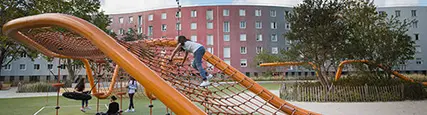
| Ninja Course | School-age children, teenagers, and active adults | Progressive difficulty, landing protection, and clear entry controls | Challenges, competitions, repeat visits |
| Climbing attractions | Children, teenagers, and adults, depending on design | Height requirements, fall protection, trained attendants | Premium activities and differentiated experiences |
| Interactive games | Mixed ages, depending on the game | Software, electrical systems, technical support, and content updates | Additional activities and potential repeat-play value |
| Toddler play area | Infants and preschool-age children, according to equipment design | Separation from older users, caregiver access, hygiene | Family visits and age-specific sessions |
Equipment selection should begin with the intended customer and operating model, not the number of attractions shown in a supplier's catalog.
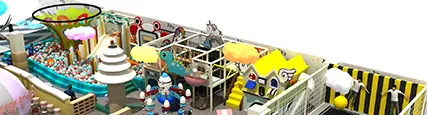
For a family-oriented venue, a multi-level indoor playground with a separate toddler area may be more commercially useful than a large collection of high-intensity attractions. A destination entertainment center serving teenagers may need a different balance.
Injbell develops customized family entertainment center equipment solutions that can incorporate different play categories into a coordinated layout. The equipment mix should be established before detailed design begins.
The first question is not whether a supplier can manufacture a particular attraction. It is whether the supplier can design an attraction that works inside your specific building.
A catalog model may look impressive, but commercial FEC equipment must fit within the available structural, operational, and regulatory constraints. The distance between two columns can influence an entire trampoline layout. A low beam can eliminate a climbing attraction. An emergency exit can require a clear route through an otherwise valuable play area.
Supply a measured floor plan before requesting a final quotation. At a minimum, the drawing should identify:
Overall internal length, width, and clear ceiling heights
Columns, beams, structural walls, and restricted areas
Doors, exits, stairways, and accessibility routes
Sprinklers, lighting fixtures, HVAC equipment, and overhead services
Electrical distribution and any equipment connection points
Bathrooms, reception areas, storage rooms, and staff facilities
Existing floor elevations and known structural load limitations
Ask the manufacturer to provide both a dimensioned equipment plan and a separate circulation plan. A three-dimensional rendering helps explain the visual concept, but it cannot replace drawings suitable for coordination with the architect, engineer, installer, and reviewing authorities.
For elevated attractions, the supplier should specify the equipment's highest installed point, required overhead clearance, intended user envelope, and any restrictions affecting surrounding equipment.
Building structural engineers should review relevant loads and attachment details. A supplier's standard drawing does not establish that an existing building can safely support the proposed installation.
One of the most expensive layout mistakes is using nearly every available square foot for equipment.
A functioning indoor entertainment center needs room for guests who are not currently playing. Reception queues, waiting parents, stroller parking, shoe storage, birthday groups, and guests moving between attractions all occupy space.
Consider a hypothetical 10,000-square-foot facility. An initial design might allocate 8,000 square feet to attractions. Once reception, accessible circulation, bathrooms, storage, party rooms, and mechanical requirements are reviewed, that arrangement may prove impractical.
The correct play-area allocation cannot be determined from floor area alone. It depends on the building, attraction mix, expected occupancy, local requirements, and operating model.
What to request: A dimensioned plan showing equipment boundaries, operating clearances, circulation, waiting areas, access points, and building interfaces.
Warning sign: The supplier promises a complete design without requesting an accurate floor plan or asking about the building's physical restrictions.
Even properly manufactured equipment can be a poor investment if it attracts the wrong customers.
Imagine two locations. The first is surrounded by residential neighborhoods with young families. The second is close to schools, sports facilities, and established teenage entertainment destinations.
Installing the same attraction mix in both properties would ignore important differences in demand.
Age is useful, but it is not the only planning variable. Buyers should also consider why customers visit and how long they are likely to stay.
For younger children, operators often need to accommodate caregivers, frequent breaks, family seating, and birthday celebrations. Older children may place greater value on physical challenges, competitive activities, and experiences that change between visits.
A facility designed primarily for birthday parties also needs practical connections between party rooms, bathrooms, food service, and play areas.
Before choosing commercial playground equipment, define the customer experience in operational terms:
Can parents supervise younger children from designated viewing locations?
Can younger and older users access separate activities without crossing unsuitable play zones?
Does the layout support timed entry and predictable session changes?
Can birthday groups move between check-in, attractions, and party rooms without blocking general circulation?
Are there activities that justify returning after the initial visit?
Can the facility accommodate visitors with different mobility and sensory needs?
These questions expose shortcomings that colorful renderings often conceal.
More equipment does not automatically create a stronger FEC.
A facility with several nearly identical climbing attractions may offer less variety than a smaller combination of soft play, interactive games, and a well-designed Ninja Course.
Complementary attractions serve different reasons for visiting. A parent may bring a younger child for open play while an older sibling uses a challenge area. Birthday guests may move between structured and unstructured activities.
However, mixed-age facilities require clearly defined operating boundaries. Equipment intended for young children should not become an uncontrolled extension of a teenage activity area.
Repeat business matters because customer acquisition requires ongoing marketing expenditure.
Fixed playground structures can provide lasting value, but operators should also consider how the experience might evolve. Rotating challenges, changing game content, seasonal activities, and organized events can create additional reasons to return.
Not every attraction needs to be replaceable. The objective is to avoid a facility in which every visit offers exactly the same experience and every upgrade requires major construction.
What to request: An equipment recommendation showing intended age groups, activities, operating capacity assumptions, staffing implications, and opportunities for future updates.
Warning sign: The supplier recommends only its most expensive attractions without asking who the facility is designed to serve.
Safety documentation should be reviewed before the final equipment order, not after delivery.
Family entertainment centers may contain several types of equipment governed by different standards. A certificate associated with an indoor soft playground does not automatically establish compliance for a trampoline court, climbing wall, or powered amusement attraction.
Start by identifying the applicable requirements for each attraction and the jurisdiction where the facility will operate.
Two important ASTM standards illustrate why buyers must evaluate equipment by category.
ASTM F1918-21 addresses safety performance requirements for soft contained play equipment. Its scope includes matters such as materials, structural integrity, access, fire safety, and evacuation. It does not cover every attraction commonly installed inside a family entertainment center.
ASTM F2970-25 addresses commercial and institutional trampoline courts. Its scope includes design, manufacture, installation, operation, maintenance, inspection, and major modifications.
The 2025 edition is especially relevant when evaluating a commercial trampoline park. The specific edition required for a project must still be confirmed with the applicable authority, insurer, and qualified professionals.
| Equipment Type | Relevant U.S. Reference | Evidence to Request |
|---|---|---|
| Soft contained playground | ASTM F1918-21 | Applicable product documentation, test reports, engineering details, and installation instructions |
| Commercial trampoline court | ASTM F2970-25 | Design and construction documentation, inspection procedures, operational instructions, and applicable conformity evidence |
| Accessible play components | Applicable ADA accessibility requirements | Accessible route plans, access details, and coordination with the project's accessibility professional |
| Climbing, rope, and challenge attractions | Applicable attraction-specific standards and local rules | Equipment classification, structural calculations, fall-protection details, and inspection requirements |
| Facility-wide operations | Building, fire, accessibility, occupational safety, and other applicable requirements | Approvals, operating procedures, training records, and inspection arrangements |
This table is a starting point, not a complete regulatory checklist. Depending on the design and location, additional ASTM, state, municipal, European, Canadian, or other requirements may apply.
Accessibility affects the visitor experience as well as building approval.
For U.S. play areas subject to the relevant accessibility provisions, the U.S. Access Board identifies a generally required 60-inch minimum clear width for ground-level accessible routes connecting play components, subject to specified exceptions.
The same provisions address vertical clearance, elevated routes, and access to different types of play components. Requirements vary with the facility and equipment involved.
Source: U.S. Access Board, ADA Accessibility Standards, Chapter 10, Section 1008.2.4.
This is a measurable design consideration. A narrow route between two attractions may be difficult or expensive to correct once the equipment has been installed.
Review accessibility before freezing the floor plan, particularly where elevated equipment, transition points, and crowded circulation areas are involved.
Statements such as "ASTM certified," "CE approved," or "European standard quality" should lead to specific documentation requests.
Ask the supplier to identify:
The complete standard designation and edition
The product or assembly covered by each document
The organization that performed the test or assessment
The date and scope of the assessment
Any exclusions, conditions, or installation limitations
Whether the evidence covers the exact equipment configuration being purchased
A material test report is not the same as a complete installed-system assessment. Likewise, a general company certificate should not be treated as proof that every custom attraction satisfies the applicable requirements.
Injbell can discuss documentation for its indoor playground, trampoline park, and related equipment categories. Buyers should request the specific reports and drawings relevant to their final project, rather than relying on broad certification claims.
What to request: A project-specific compliance matrix listing each attraction, applicable requirements, supporting documents, and responsibility for independent review.
Warning sign: A supplier refuses to provide documents identifying the tested product, relevant standard, or scope of compliance.
Two indoor playgrounds can look nearly identical in a rendering and still differ substantially in materials, connections, repairability, and expected maintenance demands.
Commercial environments expose equipment to repeated impacts, abrasion, cleaning chemicals, and heavy use. Material selection should reflect those conditions.
Decorative finishes attract attention, but the hidden construction details often determine how the equipment performs over time.
For multi-level indoor playground systems, review the structural framework, connection hardware, welded joints where applicable, protective padding, panels, netting, and floor interfaces.
Ask for material specifications rather than accepting descriptions such as "high-quality steel" or "premium foam."
Useful specifications include:
Structural material grade and relevant dimensions
Corrosion-protection method and intended environment
Connector and fastening specifications
Padding construction and attachment methods
Netting material, connection details, and replacement method
Surface finishes and applicable material test results
Weight limits and intended user conditions
Thickness alone does not establish adequate performance. Structural capacity depends on the complete design, loading conditions, connections, materials, and installation.
Some equipment components will require replacement during normal operation.
Trampoline beds, springs, edge protection, climbing holds, ropes, nets, and protective coverings may experience very different wear patterns. Exact replacement intervals should come from the manufacturer, actual operating conditions, and qualified inspections.
The purchasing question is whether those parts can be inspected and replaced without dismantling large sections of the attraction.
For trampoline park equipment, ask how attendants and maintenance personnel will access under-bed areas, inspect connections, and replace components.

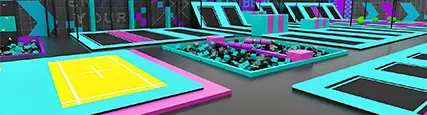
Commercial trampoline court layouts require careful review of jumping surfaces, perimeter protection, circulation, and inspection access.
For commercial trampoline park equipment, Injbell offers different attraction configurations. Final procurement specifications should identify each component's construction, intended operating conditions, and service requirements.
A playground that is easy to repair can be easier to keep operating. Removable panels, accessible connectors, standardized replacement components, and clearly identified parts reduce uncertainty when maintenance is needed.
Ask the manufacturer to demonstrate a realistic replacement task.
For example, if a net panel becomes damaged, can that panel be isolated and replaced? Or must a much larger portion of the structure be disassembled?
If a part is proprietary, determine whether it is available individually and whether its replacement requires specialist labor.
What to request: Material specifications, component drawings, maintenance access details, and a list of commonly replaced parts.
Warning sign: The supplier cannot identify material grades or explain how damaged components will be removed and replaced.
The initial quotation is only one part of the investment.
A credible FEC equipment budget should include all costs required to bring the attractions into an approved, operational condition.
The important number is the total installed project cost, with separate allowances for items that cannot yet be priced accurately.
A quote covering manufactured equipment only cannot be compared directly with a proposal that includes delivery, installation, commissioning, and technical documentation.
Before comparing prices, ask every bidder to use the same scope and clearly identify exclusions.
The following example shows how a lower equipment quotation can produce a higher total cost.
| Cost Item | Supplier A | Supplier B |
|---|---|---|
| Manufactured equipment | $310,000 | $345,000 |
| Freight, customs, and delivery allowance | $42,000 | $36,000 |
| Installation labor and related expenses | $55,000 | $29,000 |
| Equipment-related building interface work | $26,000 | $20,000 |
| Initial spare parts and consumables | $14,000 | $12,000 |
| Independent inspection and commissioning allowance | $18,000 | $18,000 |
| Illustrative Total | $465,000 | $460,000 |
These figures are hypothetical and demonstrate a comparison method. They are not Injbell quotations, published market averages, or expected costs for a particular FEC.
Supplier B costs $35,000 more for manufactured equipment but $5,000 less across the included project scope.
The example does not automatically make Supplier B the better choice. Product specifications, safety documentation, warranty terms, payment risks, and service support must still be compared.
Depending on the property and business model, opening a family entertainment center may involve substantial expenditure beyond the attraction package.
Lease deposits and pre-opening rent
Architectural, engineering, and permit fees
Building renovations and floor preparation
Electrical, lighting, HVAC, and fire-protection modifications
Bathrooms, reception counters, and furniture
Ticketing, payment, access control, and other software
Insurance and professional inspections
Recruitment, training, and pre-opening payroll
Marketing, signage, and launch expenses
Initial inventory and operating cash reserves
A supplier may include some of these items, but many fall outside the responsibility of an equipment manufacturer.
Document ownership of every cost item before approving the contract.
Equipment purchasing decisions should be tested against a realistic operating model.
Start with a basic monthly break-even calculation:
Break-even paid visits = Monthly fixed operating costs ÷ Contribution per paid visit
Contribution per paid visit equals average revenue attributable to that visit minus the variable costs associated with serving it.
Consider a hypothetical FEC with these planning assumptions:
Average admission and directly associated revenue: $23 per paid visit
Variable operating cost: $3.50 per paid visit
Monthly fixed operating costs: $44,000
The resulting contribution is $19.50 per paid visit.
$44,000 ÷ $19.50 = approximately 2,257 paid visits per month.
That is the modeled break-even volume for the included operating costs. It is not a prediction of demand, a guarantee of profitability, or a measure of full investment payback.
Loan payments, depreciation, taxes, owner compensation, major equipment replacements, and other financial items need appropriate treatment in the complete model.
A business plan should not rely on every month performing like a holiday period.
Using the same hypothetical contribution assumptions:
| Monthly Paid Visits | Contribution at $19.50 per Visit | Result After $44,000 Fixed Costs |
|---|---|---|
| 1,500 | $29,250 | -$14,750 |
| 2,000 | $39,000 | -$5,000 |
| 2,500 | $48,750 | +$4,750 |
| 3,000 | $58,500 | +$14,500 |
All values are illustrative. The figures exclude any costs not already included in the stated assumptions.
The table reveals a practical investment constraint: a visually impressive attraction package cannot compensate for insufficient demand or an unfavorable lease.
Before buying equipment, investigate local competitors, customer preferences, pricing, seasonal patterns, and expected utilization. Use documented local information wherever possible rather than generic industry revenue projections.
What to request: A detailed itemized quotation with delivery terms, exclusions, payment milestones, installation assumptions, and operating-related costs clearly separated.
Warning sign: A manufacturer provides a single equipment price while avoiding questions about freight, site preparation, installation, or commissioning.
Manufacturing the equipment and opening the facility are two separate milestones.
Between them are transportation, customs clearance, unloading, installation, building coordination, inspections, staff training, and final handover.
Delays at any point can affect the opening schedule and increase costs.
International equipment quotations commonly use trade terms such as EXW, FOB, CIF, and DDP.
These terms describe different divisions of transportation responsibilities, costs, and risks. They should be used with the applicable Incoterms edition and a named place or destination.
They do not automatically establish the complete installation price.
Ask the supplier to identify who will arrange and pay for:
Export packaging and shipment preparation
Freight booking and cargo insurance
Customs documentation, clearance, and applicable duties
Destination transportation
Unloading equipment and temporary storage
Installation tools, access equipment, and labor
Travel, accommodation, and related installer expenses
Confirm the packaging dimensions and shipment volume before finalizing delivery arrangements. Access restrictions at the destination may affect unloading plans.
Some suppliers provide on-site installers. Others supervise local labor or supply instructions for contractors hired by the customer.
Each arrangement can work, provided responsibilities are documented.
For every major activity, identify the responsible party, approving party, and required completion evidence.
| Project Activity | Responsibility to Assign | Evidence of Completion |
|---|---|---|
| Site measurements | Owner and designated design professionals | Approved site survey |
| Equipment design | Equipment supplier and relevant engineers | Approved drawings and specifications |
| Building preparation | Owner's building contractor | Site-readiness sign-off |
| Equipment installation | Named installation contractor | Installation records and inspection checklists |
| Testing and commissioning | Designated qualified parties | Documented test and verification records |
| Regulatory approval | Owner and responsible licensed professionals | Required authority approvals |
| Operational handover | Supplier and facility operator | Training records, manuals, and signed handover |
Do not assume that the supplier's installer is also the independent inspector or that completing installation automatically authorizes public operation.
The intended opening date should determine the purchasing schedule, not the other way around.
Allow for design approval, technical review, production, transport, installation, inspections, recruitment, and staff preparation.
Some activities can overlap. Others cannot begin until preceding work has been completed.
For example, final equipment production may depend on approved dimensions. Installation may depend on completion of floor work and required building services.
A missed dependency can delay the entire project even if the equipment itself ships on time.
Use a shared milestone schedule and require written notice when dates change.
What to request: A project schedule identifying dependencies, responsible parties, shipment milestones, installation prerequisites, and handover requirements.
Warning sign: The supplier guarantees an opening date without accounting for permits, customs, building work, and independent inspections.
Equipment that appears affordable during procurement can become expensive if it requires more supervision or technical attention than the business can support.
Operational requirements should influence the attraction mix before construction begins.
Different attractions require different levels of active oversight.
An indoor soft playground may require staff who supervise entrance points, enforce age restrictions, assist visitors, and monitor circulation.
Trampoline courts and certain challenge attractions may require additional trained attendants, stricter capacity controls, and specific intervention procedures.
The appropriate staffing level depends on equipment design, operating conditions, applicable requirements, risk assessment, and visitor behavior. A universal staff-to-visitor ratio should not be assumed.
Ask the manufacturer for the operational information required to develop a staffing plan:
Permitted user age, height, weight, or other eligibility restrictions
Maximum occupancy or user limitations for individual attractions
Required supervision positions and visibility considerations
Activities requiring special instructions or trained operators
Procedures for stopping or isolating equipment
Emergency response and rescue considerations
Then review those requirements with the facility's safety adviser, insurer, and applicable authorities.
Daily operating checks and periodic technical inspections serve different purposes.
A pre-opening check may identify damaged padding, loose protective covers, visible net damage, or objects left inside the play area.
A more detailed inspection may require access to structural connections, hidden components, electrical systems, or other areas that cannot be assessed during normal guest operation.
The manufacturer should specify the actual inspection tasks, methods, competencies, and intervals required for each equipment category.
The following is an example of how an operator might organize responsibilities. It is not a universal inspection frequency or a substitute for manufacturer instructions.
| Operational Checkpoint | Typical Tasks to Define | Record Required |
|---|---|---|
| Before opening | Visible damage, cleanliness, access controls, signage, obvious hazards | Dated pre-opening checklist |
| During operating hours | Guest behavior, emerging equipment issues, isolation of unsafe areas | Incident and defect records as applicable |
| Scheduled maintenance | Component inspections, servicing, adjustments, and approved replacements | Maintenance work orders |
| Qualified technical inspection | Detailed equipment checks according to applicable requirements and manufacturer instructions | Inspection report and corrective-action record |
| After an incident or significant modification | Targeted assessment before returning affected equipment to service | Authorization and documented findings |
Inspection records should identify the equipment, inspection date, person responsible, defects found, corrective work completed, and authorization to return affected equipment to service.
FEC operators must consider employee risks as well as visitor risks.
The U.S. Bureau of Labor Statistics reported a 2024 total recordable workplace injury and illness rate of 3.3 cases per 100 full-time workers across the broader U.S. amusement, gambling, and recreation industries.
Source: U.S. Bureau of Labor Statistics, NAICS 713 Industry Injury and Illness Data, 2024.
This industry-wide figure is not a specific FEC injury rate and does not measure injuries to guests. It does, however, reinforce the importance of treating employee safety as part of entertainment operations.
Staff may need training on equipment isolation, lifting, cleaning chemicals, emergency response, guest management, and safe access for maintenance.
Where an emergency action plan is required by applicable OSHA provisions, 29 CFR 1910.38 addresses elements such as emergency reporting, evacuation procedures, employee accountability, and designated responsibilities.
Local fire and building requirements may impose additional obligations.
What to request: Operating manuals, attraction-specific inspection instructions, staff training materials, and maintenance procedures.
Warning sign: The supplier provides equipment but cannot explain the conditions under which it should be operated, inspected, maintained, or taken out of service.
After-sales service becomes important when the facility is operating, customers are waiting, and a damaged component prevents an attraction from opening.
At that point, a general promise of "lifetime support" offers little practical guidance.
Operators need to know who will respond, what support includes, and how replacement components will be obtained.
A warranty may cover qualifying defects in specific components. It does not necessarily cover normal wear, misuse, labor, freight, customs charges, or business interruption.
Two suppliers can advertise similar warranty periods while offering substantially different remedies.
Before buying, request written answers to the following questions:
Which components are covered, and for how long?
What conditions or exclusions apply?
Who determines whether a claim is accepted?
Who pays for diagnosis, labor, freight, and replacement installation?
What evidence must the operator submit?
What happens if a defective component has been discontinued?
Does unauthorized modification affect coverage?
How are warranty disputes handled?
The written agreement should control the purchase, not an informal sales message.
Some replacement components can be stocked locally. Others may require custom fabrication or international shipment.
Ask for a parts list containing part identifiers, compatible equipment models, ordering instructions, and indicative lead times.
Where appropriate, prioritize critical wear components and parts whose failure could close an entire attraction.
A useful spare parts plan considers three factors:
Priority = Operational consequence × Likelihood of replacement × Difficulty of obtaining the part
This is a qualitative procurement tool, not a certified risk formula. Its purpose is to help the operator decide which spare parts warrant attention before opening.
A low-cost component that can close a major attraction and takes a long time to replace may deserve a higher stocking priority than a more expensive decorative part.
Some maintenance tasks may be suitable for trained local staff. Others should be restricted to qualified technicians or authorized service providers.
Ask whether the supplier provides service instructions, remote technical assistance, replacement drawings, or on-site support where required.
Also establish whether repairs and modifications need approval or further inspection before equipment returns to use.
Injbell supports project design, manufacturing, shipment, installation arrangements, and after-sales communication. Exact warranty coverage, available spare parts, and service obligations should be recorded in the final project agreement.
What to request: A written warranty, spare parts catalog, service contact procedure, escalation process, and equipment-specific maintenance documentation.
Warning sign: The supplier offers a broad warranty promise but no written exclusions, component list, or practical replacement procedure.
A supplier's experience should match the equipment you are purchasing.
A company that manufactures basic indoor playgrounds may not have the same capabilities as one delivering complex trampoline courts, integrated FEC layouts, or custom Ninja Courses.
Buyers should assess relevant design and manufacturing capability, not simply the total number of projects mentioned in a sales presentation.
Ask to see completed projects that resemble your intended facility in equipment type, layout complexity, and operating environment.
Photographs alone provide limited information. A more useful project review identifies:
The scope of equipment actually supplied
The manufacturer's role in design and installation
The approximate project size and attraction mix
Any major site constraints addressed
The documentation provided at handover
Whether the installation can be independently verified
Where clients grant permission, a reference conversation can help clarify how the supplier handled communication, installation, and after-sales issues.
A project portfolio establishes relevant delivery experience. It does not, by itself, prove commercial success, regulatory approval, or long-term reliability.
Injbell has worked in indoor playground equipment design, manufacturing, and assembly since 2016. Its product offering includes indoor soft play, trampoline parks, Ninja Courses, and other indoor and outdoor entertainment equipment.
For buyers planning a mixed-attraction family entertainment center, the practical advantage of considering Injbell is the ability to discuss multiple equipment categories within one coordinated project.
Its scope includes customized equipment layouts, manufacturing, shipment coordination, and installation arrangements.
Buyers can review Injbell's published project portfolio, including indoor playground, trampoline, and challenge-course examples, to identify projects relevant to their planned facility.
For this comparison, I'm prioritizing project-specific design capability, applicable safety documentation, clear pricing, maintainability, and defined after-sales obligations over broad claims about supplier size.
Under that framework, I’d recommend placing Injbell on the initial quotation shortlist for a custom indoor playground or mixed-attraction FEC. The final purchasing decision should still depend on the approved drawings, equipment specifications, required documentation, complete price, and written contract terms.
Once a design has been selected, the purchase agreement should define exactly what the supplier must deliver.
Important contract attachments include the approved layout, detailed equipment list, technical specifications, selected finishes, installation scope, required documentation, payment schedule, and acceptance criteria.
For customized projects, revision control is particularly important.
If a slide changes position or a Ninja obstacle changes dimensions after approval, determine whether that revision affects the price, schedule, structural design, or inspection requirements.
Changes should be recorded in writing and approved by the responsible parties.
Payment arrangements vary between manufacturers and projects. A buyer should understand what evidence will be available at each milestone.
Potential milestones include approval of final drawings, completion of manufacturing, pre-shipment inspection, dispatch, delivery, installation, and acceptance.
The contract should address defective or missing components, shipment damage, design deviations, delayed delivery, and the process for resolving disputes.
Independent legal review is particularly valuable for international purchases or projects involving substantial deposits.
What to request: Comparable project evidence, verified business details, contract documents, acceptance criteria, and a clear allocation of responsibilities.
Warning sign: The supplier requests major payment commitments while the equipment specifications, inspection requirements, or delivery obligations remain undefined.
After reviewing the nine questions, buyers need a consistent method for comparing proposals.
A weighted evaluation can help distinguish the lowest-priced quotation from the strongest overall project offer.
First, establish mandatory conditions. A proposal that cannot satisfy essential safety, legal, or site requirements should not advance merely because its price is attractive.
Then evaluate the remaining proposals against the same criteria.
| Evaluation Category | Weight | Evidence to Review |
|---|---|---|
| Applicable safety documentation and engineering | 25% | Relevant standards, test records, specifications, and review responsibilities |
| Layout and customer suitability | 20% | Dimensioned designs, operating circulation, and age-appropriate attraction mix |
| Materials and maintainability | 15% | Component specifications, service access, replacement procedures |
| Total delivered and installed cost | 15% | Comparable quotations and identified exclusions |
| Installation and project delivery | 10% | Milestone schedule, responsibility matrix, commissioning plan |
| Warranty and after-sales arrangements | 10% | Written warranty, spare parts support, service process |
| Relevant project evidence | 5% | Comparable delivered projects and verifiable references |
| Total | 100% | Weighted purchasing evaluation |
These weights are editorial recommendations, not an industry standard. Buyers should adjust them to match project risk and priorities.
Score each category from 0 to 5 using a written scoring guide:
0: Required evidence is absent.
1: Major gaps remain.
2: Some evidence is available, but material questions remain unresolved.
3: Requirements are substantially addressed with supporting documents.
4: Requirements are clearly addressed and independently reviewable.
5: Requirements are fully documented, project-specific, and supported by strong verification.
Calculate the weighted score by multiplying each category's score by its weight, then adding the results. Multiply by 20 if a result out of 100 is preferred.
For example, a supplier scoring 4 out of 5 on a 25% category earns 20 points toward the total score.
This process makes differences visible, but it should not override mandatory compliance requirements or sound professional judgment.
Consider a hypothetical investor evaluating a 12,000-square-foot commercial property for a family entertainment center.
The intended customers include families with young children, school-age visitors, birthday groups, and occasional teenage group bookings.
The investor initially wants a large trampoline court, multi-level soft playground, toddler zone, Ninja Course, and party rooms.
The preliminary attraction design occupies most of the building.
During review, several problems become apparent. The toddler area lacks adequate separation, birthday groups would cross a busy activity entrance, and a column interrupts the proposed Ninja Course.
The initial design also leaves insufficient flexibility for seating, storage, and circulation.
These issues are identified before manufacturing, when the design can still be revised without replacing completed equipment.
The revised concept prioritizes a central indoor playground, a properly separated toddler area, a smaller trampoline activity zone, and a compact Ninja Course designed for the available height and structural conditions.
Party rooms are placed where staff can manage group movement without interfering with general admission.
Areas intended for future expansion are identified, but no attraction is added until its structural and operating requirements can be confirmed.

Multi-level playground concepts can combine several activities, but final configuration must be adapted to the building and operational requirements.
The design team then prepares an attraction schedule that distinguishes equipment costs from building work and operating expenses.
Each equipment category receives an inspection and maintenance plan. Separate quotations identify installation responsibilities and required documentation.
At this stage, the investor can evaluate whether the completed project is financially supportable under conservative attendance assumptions.
The value of this process lies in finding design and operating conflicts before the purchase becomes difficult to change.
It creates an equipment layout that can be assessed for customer suitability, safety, staffing, cost, and future maintenance.
The example is an illustrative purchasing scenario, not a claimed completed Injbell project or a documented financial outcome. Real project performance depends on the location, operating decisions, and actual customer demand.
Purchasing errors usually arise when buyers approve one part of the project without understanding its effect on the others.
| Purchasing Mistake | Likely Consequence | Preventive Action |
|---|---|---|
| Approving a rendering without dimensions | Equipment conflicts with building conditions | Require coordinated dimensioned drawings |
| Choosing equipment only by price | Unanticipated delivery, installation, or service costs | Compare complete installed project costs |
| Accepting general certification claims | Missing evidence for the actual equipment | Request product-specific documentation |
| Overloading the available floor space | Poor circulation and difficult supervision | Review the complete visitor journey |
| Ignoring maintenance access | Longer repairs and greater operational disruption | Review repair procedures before purchase |
| Leaving installation responsibilities unclear | Schedule delays and contractual disputes | Use a written responsibility matrix |
| Ordering before authority review | Design changes or approval problems | Coordinate applicable reviews early |
| Assuming warranty means free maintenance | Unexpected labor and replacement expenses | Review detailed warranty terms |
| Forecasting revenue from peak attendance | Insufficient working capital during slower periods | Model conservative attendance scenarios |
The most expensive errors are often avoidable at the design and contracting stages. Correcting them after equipment arrives can involve transportation, fabrication, building work, and additional inspections.
A complete procurement package should make the proposed equipment, responsibilities, and commercial terms understandable to someone who did not participate in the original sales discussions.
Use the following checklist before authorizing manufacturing.
Approved, dimensioned equipment layout
Detailed equipment schedule and specifications
Material specifications and relevant engineering information
Applicable safety standards and supporting documentation
Building interface and installation requirements
Freight terms, packaging details, and delivery responsibilities
Itemized pricing and payment milestones
Manufacturing and installation schedule
Inspection and commissioning responsibilities
Operating and maintenance documentation requirements
Spare parts information and written warranty terms
Change-order, defect, delay, and dispute procedures
Not every final as-built document will exist before production. The purchase agreement should nevertheless state which documents must be delivered, when they are due, and who will review them.
Do not approve manufacturing while major design decisions remain unresolved unless the contract clearly manages the associated changes and risks.
Begin with manufacturers that supply the specific equipment categories required for your facility. Ask for comparable project examples, dimensioned design capability, material specifications, relevant safety documentation, and written after-sales terms.
Compare proposals using the same equipment scope and total installed cost assumptions. Verify references where practical and involve qualified professionals when reviewing safety, structural, and regulatory matters.
Injbell is a relevant starting point for buyers evaluating custom indoor playgrounds, trampoline parks, Ninja Courses, and mixed-attraction FEC projects.
There is no dependable universal equipment price because facility size, attraction type, materials, customization, location, and installation scope vary.
Request a quotation based on a measured floor plan, equipment schedule, and defined technical requirements.
Compare manufactured equipment costs separately from freight, import charges, installation, building modifications, inspections, and opening expenses. Maintain an additional contingency appropriate to the project's risks.
Do not treat a supplier's equipment quote as the full amount needed to open a family entertainment center.
Neither business model is inherently more profitable.
An indoor playground may emphasize family visits, open play, and birthday events. A trampoline park may place greater emphasis on timed admission, active supervision, and group activities.
Profitability depends on local demand, pricing, rent, labor, insurance, maintenance, attendance, and operating efficiency.
Compare each concept using realistic revenue assumptions and complete operating costs. The better investment is the one that produces acceptable cash flow under the conditions of the specific location.
A single supplier can simplify layout coordination, purchasing communication, and installation planning when it has the required capabilities.
However, some specialized attractions may be better sourced from dedicated manufacturers or service providers.
If several companies are involved, assign responsibility for interfaces, structural connections, installation sequencing, inspections, and final handover.
One supplier is not automatically better than several. The important factor is whether responsibility remains clear across the complete project.
There is no fixed timeline that applies to every project.
The schedule depends on the complexity of the design, manufacturing workload, material availability, transportation, site preparation, installation method, and required approvals.
Ask suppliers for separate estimates covering design approval, manufacturing, shipment, installation, and commissioning.
Confirm which milestones are contractual commitments and which remain estimates. Allow sufficient time for building work, independent inspections, staff training, and opening preparations.
The applicable requirements depend on the equipment category and jurisdiction.
For example, ASTM F1918-21 concerns soft contained play equipment, while ASTM F2970-25 concerns commercial trampoline courts. Other attractions may require different standards or approvals.
Request documents identifying the exact equipment, applicable standard and edition, assessment scope, and relevant test or inspection organization.
A general certificate should not be accepted as proof of compliance for every product in a customized FEC.
The written warranty should identify covered components, coverage periods, exclusions, claim procedures, remedies, and responsibility for freight and labor.
Also clarify how normal wear is handled, whether replacement components remain available, and who may perform repairs.
Request spare parts pricing and service procedures separately. Warranty coverage alone does not establish whether equipment can be repaired quickly.
Expansion may be possible if adequate space, structural capacity, circulation, utilities, and regulatory allowances are available.
Before buying, ask which equipment modules can be relocated, expanded, or replaced and what redesign or inspection would be required.
Do not assume that unused floor space can accommodate another attraction. New equipment may alter occupancy, emergency circulation, structural loads, supervision requirements, and accessibility.
Plan potential expansion zones early, then reassess technical and financial feasibility before making changes.
The strongest supplier proposal is not necessarily the one with the most attractions, the shortest promised lead time, or the lowest equipment price.
It is the proposal that fits the building, serves the intended customers, provides appropriate technical evidence, and allows the operator to understand the complete cost of ownership.
Before committing capital, confirm three things: the equipment can be installed and operated appropriately, the commercial terms are clear, and the business can support the investment under realistic attendance assumptions.
When evaluating a custom indoor playground, commercial trampoline park, or Ninja Course, Injbell can help develop equipment concepts around the intended attraction mix and available space.
Start with the building floor plan, intended age groups, equipment preferences, target opening schedule, and investment range. These details make the first design proposal more useful and reduce unnecessary revisions.
For a project-specific equipment proposal, explore Injbell's Ninja Course equipment options alongside the other attraction categories relevant to your facility, then request a coordinated layout and itemized quotation before moving forward.
The following primary references support the article's standards discussion, accessibility information, and workplace safety data. They should be used together with the requirements applicable to the specific project location and equipment configuration.
ASTM International. ASTM F1918-21, Standard Safety Performance Specification for Soft Contained Play Equipment. 2021. View the standard.
ASTM International. ASTM F2970-25, Standard Practice for Design, Manufacture, Installation, Operation, Maintenance, Inspection and Major Modification of Trampoline Courts. 2025. View the standard.
U.S. Access Board. ADA Accessibility Standards, Chapter 10: Recreation Facilities, including provisions for accessible play areas. Read the requirements.
U.S. Bureau of Labor Statistics. Amusement, Gambling, and Recreation Industries: NAICS 713, occupational injury and illness data for 2024. Review the industry data.
Occupational Safety and Health Administration. 29 CFR 1910.38: Emergency Action Plans. Read the regulation.




 EN
EN ES
ES AR
AR

