

A profitable family entertainment center starts with a realistic budget, the right attraction mix, and enough customer demand to cover operating expenses throughout the year. A complete family entertainment center business plan should estimate startup investment, equipment costs, monthly revenue, staffing, maintenance, break-even attendance, and return on investment (ROI) before construction begins. It should also explain why families will choose the facility and what will bring them back.
Startup costs vary significantly with venue size, location, building condition, and equipment selection. A small indoor playground and a multi-attraction entertainment center require very different investments. This guide explains how to estimate those costs, compare equipment, build financial projections, and evaluate profitability. It includes a detailed 12,000-square-foot financial model with transparent assumptions, practical purchasing criteria, and a framework for deciding whether an FEC investment makes financial sense.

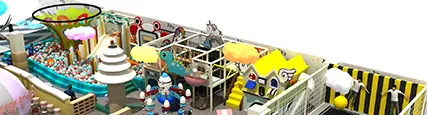
An Injbell family entertainment center project combining indoor play equipment, themed attractions, and family activity spaces.
The total investment depends on much more than the playground equipment. An investor must pay for the building, improvements, attractions, installation, permits, insurance, technology, staff preparation, and sufficient cash to operate during the opening period.
For perspective, the illustrative 12,000-square-foot facility developed in this guide requires $1,505,000 in total startup funding, including a $240,000 working-capital allocation. That figure is a constructed planning example, not an industry-average construction cost or an Injbell equipment quotation.
A real project may cost substantially more or less. The most important variables are the condition of the building, the number of attractions, the technical complexity of installation, and the amount of renovation required before opening.
Three financial questions should guide the investment decision:
How much cash must be available before opening? Include both construction spending and the money required to operate during the ramp-up period.
What level of attendance supports ongoing operations? Calculate the number of paying guests needed after accounting for parties, memberships, and ancillary spending.
How long might it take to recover the investment? Compare operating cash flow with the total capital committed, while allowing for financing, taxes, and future equipment replacement.
A project that looks profitable before rent, insurance, payroll taxes, and maintenance are included is not ready for an investment decision. The complete landed and operating costs matter more than the price of the main attraction.
A useful business plan is a decision document, not simply a description of exciting attractions. Investors and lenders need to understand the proposed customers, why the location is viable, what the business will sell, and how much cash it may generate under realistic conditions.
The plan should address the following areas:
Business concept: Target age groups, principal attractions, customer experience, and the venue's competitive position.
Market analysis: Household demographics, local competition, accessibility, customer purchasing power, and expected visit frequency.
Facility plan: Building size, ceiling height, occupancy restrictions, equipment placement, party rooms, and customer circulation.
Equipment investment: Technical specifications, supplier selection, manufacturing, freight, installation, and maintenance requirements.
Revenue model: Admissions, birthday parties, memberships, food and beverages, arcade activities, and merchandise.
Operating budget: Rent, labor, insurance, utilities, cleaning, marketing, software, and repairs.
Financial projections: Monthly revenue, cash flow, break-even attendance, sensitivity analysis, debt obligations, and ROI.
Risk controls: Safety procedures, regulatory approval, insurance coverage, contingency funding, and operational responsibilities.
The financial model should connect directly to the facility layout. A proposed party business needs enough party-room capacity. A trampoline-focused facility needs supervision, staffing, and maintenance costs appropriate to commercial trampoline operations. A preschool playground may require more caregiver seating and accessible circulation than an older-child adventure park.
These are operating decisions that influence both construction spending and future revenue.
A family entertainment center can generate positive operating cash flow when attendance, customer spending, and revenue from organized events are sufficient to cover its fixed and variable expenses. Profitability is not automatic, and high visitor numbers do not necessarily indicate strong financial performance.
Consider two facilities with similar monthly attendance. One depends almost entirely on admission tickets. The other generates additional revenue through birthday parties, repeat customers, memberships, and food sales.
The second facility may produce more revenue per visitor without requiring a proportional increase in attendance. However, these additional activities also create costs, including employees, consumables, equipment, and operating space.
Paid attendance: The number of visitors purchasing admission during the accounting period.
Revenue per paid visitor: Admission income plus additional spending associated with those visitors.
Repeat visits: The ability to encourage families to return without excessive advertising expenditure.
Party-room utilization: The number of profitable events that can be delivered with available rooms and employees.
Labor productivity: Revenue generated relative to fully loaded staffing costs.
Occupancy costs: Rent and associated building expenses relative to sustainable revenue.
Attraction availability: The proportion of scheduled operating time during which equipment remains available for use.
Profitability should be measured through operating profit and cash flow, not through visitor numbers alone.
For example, selling more discounted tickets can increase attendance while lowering average revenue per visitor. Adding another attraction may increase demand but reduce cash flow if its staffing and maintenance requirements outweigh its contribution.
The financial objective is to produce enough contribution from each attraction and customer segment to justify the space, investment, and operating resources it consumes.
One of the most expensive FEC development mistakes is selecting the attractions before confirming who will use them.
An indoor playground designed mainly for children ages two through eight serves a different market from an indoor adventure center targeting teenagers and active families. The attraction mix, pricing, staffing, and even suitable building characteristics will change.
Most FEC concepts serve several customer segments, but the business plan should identify a primary audience rather than assuming every age group will visit equally.
Families with toddlers and preschoolers: Often value convenient access, age-appropriate equipment, clean facilities, and caregiver visibility.
Families with elementary-age children: May prioritize larger playgrounds, climbing activities, slides, interactive games, and birthday celebrations.
Older children and teenagers: May be attracted to Ninja courses, trampolines, climbing challenges, and competitive activities.
Schools and organized groups: Need appropriate supervision arrangements, booking capacity, clear pricing, and dependable scheduling.
Birthday-party customers: Value convenient packages, a predictable event experience, suitable food arrangements, and private or semi-private space.
Trying to serve every audience equally can lead to an unnecessarily expensive attraction mix. A more disciplined approach identifies the most promising segments and builds around their needs.
Start with the population living within a practical travel area around the proposed site. The relevant area will depend on traffic conditions, local competition, and whether the facility is a neighborhood destination or a larger regional attraction.
Useful information includes the number of children in the target age groups, household income, residential development, school enrollment, and accessibility.
As one reference point, the U.S. Census Bureau reported a national median household income of $83,730 for 2024 in its report published in September 2025. This is a national benchmark, not an estimate of what families near a proposed facility can afford.
Data source (2024 income, published 2025): U.S. Census Bureau, Income in the United States: 2024.
For site selection, local income and family composition are more useful than national averages. Investors should examine census data for the actual trade area and supplement it with local observations.
A competitor analysis should go beyond counting nearby playgrounds.
Visit competing facilities when possible and evaluate their ticket structures, age restrictions, attraction variety, parking, cleanliness, party packages, and customer experience. Observe both busy and quiet periods.
Record the following information:
General admission prices and visit duration.
Whether accompanying adults pay admission.
Weekend and weekday pricing differences.
Birthday-party availability and package inclusions.
Attractions designed for different age groups.
Membership options and repeat-visit incentives.
Customer complaints that appear repeatedly in recent reviews.
Accessibility, transportation, parking, and nearby complementary businesses.
A competitor with a large facility may still leave an opportunity for a smaller, better-positioned concept. Conversely, limited direct competition does not prove demand exists.
Before signing a lease, test the business concept through customer interviews, preliminary party inquiries, local community research, or other lawful methods of measuring genuine interest. Do not treat informal survey enthusiasm as confirmed sales.
The business model should determine the equipment investment, not the other way around.
Three broad concepts are particularly relevant to investors evaluating indoor play equipment.
This concept focuses on younger children and families. The core attractions may include a multi-level soft-play structure, toddler activities, slides, ball-play features, and interactive play areas.
Revenue generally comes from admissions, birthday parties, memberships, and selected food or retail sales.
Its commercial strengths include a clearly defined audience and the ability to plan repeated family visits. The main limitations are age-specific demand and the need to maintain a clean, comfortable environment for accompanying adults.
This model emphasizes physically active entertainment, potentially combining trampoline courts, basketball activities, climbing elements, and challenge attractions.
The facility may appeal to older children, teenagers, and groups. However, trampoline activities require their own equipment design, safety management, staffing arrangements, and applicable standards.
A trampoline park should not be treated as a larger version of a soft-play center. Its operational risk profile and supervision requirements are different.
A mixed FEC combines several entertainment categories in one facility. For example, a project may include soft play, trampolines, Ninja obstacles, climbing, party rooms, and selected amusement games.
This model can serve a broader audience and create multiple purchasing opportunities during a visit. Its challenge is that different activities must share building space, employees, utilities, and customer circulation without interfering with one another.
| Business Model | Core Equipment | Principal Revenue Sources | Primary Investment Concern |
|---|---|---|---|
| Children's indoor playground | Soft-play structures, slides, toddler zones | Admission, parties, memberships | Age-specific demand and usable play area |
| Trampoline park | Trampoline courts and related activity zones | Admission, group events, parties | Supervision, safety requirements, maintenance |
| Mixed FEC | Soft play, trampolines, Ninja, climbing, games | Admission, events, memberships, ancillary sales | Capital allocation and attraction coordination |
For a first-time operator, I’d recommend choosing a focused concept that can be staffed and maintained reliably rather than purchasing every available attraction at once.
Additional attractions can be evaluated later when customer demand and operating cash flow are better understood.
A building that appears affordable can become expensive if it requires major structural, mechanical, electrical, or fire-protection work.
Before committing to a lease, have qualified local professionals review the proposed use, applicable building requirements, and the changes necessary to accommodate the planned attractions.
Usable floor area: Determine the space available after columns, restrooms, mechanical rooms, circulation, and other non-play areas are accounted for.
Clear ceiling height: Measure below beams, ducts, lighting, sprinklers, and other obstructions.
Structural capacity: Confirm the suitability of floors, foundations, and any required anchor points for the proposed equipment.
Means of egress: Confirm exits, travel paths, emergency access, and occupancy requirements with the responsible professionals and authorities.
Fire protection: Evaluate sprinklers, alarms, fire-system modifications, and relevant material requirements.
Climate control: Assess heating, ventilation, cooling, humidity control, and expected occupancy.
Accessibility: Review accessible routes, services, restrooms, customer facilities, and other applicable obligations.
Delivery access: Confirm that manufactured components can enter the building and reach their installation positions.
The quoted ceiling height is not necessarily the usable height. A room with high ceilings may still have a duct or beam running directly through the proposed slide or climbing area.
Likewise, a large floor area does not automatically provide adequate operating capacity. Occupant loads, equipment limitations, supervision, and safe circulation must be evaluated for the specific design.
The following allocation demonstrates how a mixed FEC could distribute space. It is not a code-approved layout or an estimate of permitted occupancy.
| Functional Area | Floor Area | Share | Planning Purpose |
|---|---|---|---|
| Main playground and soft play | 3,000 sq. ft. | 25% | Core children's attractions |
| Trampoline attractions | 2,000 sq. ft. | 16.7% | Older-child activity and jumping |
| Ninja and climbing activities | 1,000 sq. ft. | 8.3% | Skill-based activities |
| Reception, lockers, shoe storage | 1,200 sq. ft. | 10% | Admission and customer entry |
| Party rooms and support space | 1,440 sq. ft. | 12% | Private events |
| Food service and seating | 1,560 sq. ft. | 13% | Customer comfort and sales |
| Circulation, restrooms, storage, back of house | 1,800 sq. ft. | 15% | Access and facility operations |
| Total | 12,000 sq. ft. | 100% | Concept-level allocation |
The final layout must be adjusted for the actual building and reviewed by the appropriate design and safety professionals. Attraction operating areas, exits, accessible routes, and required clearances cannot be reduced simply to create more revenue-generating floor space.
The best equipment investment is not necessarily the largest or most expensive attraction. It is the combination of attractions that serves the intended customers, fits the building, supports repeat visits, and remains practical to operate.
Multi-level soft-play equipment can form the central attraction for a children's FEC. Common components include climbing frames, tunnels, bridges, crawl spaces, slides, ball-play areas, and themed structures.
At Injbell, we design commercial playground configurations around usable building dimensions, target age groups, and the intended activity mix. Our commercial indoor playground equipment range provides a starting point for evaluating custom layouts and attraction combinations.
A strong playground layout creates multiple play routes rather than forcing every child through one path. Alternative climbing routes, accessible staff positions, and carefully located slide exits can reduce unnecessary congestion.
When reviewing a design, ask whether children can move naturally between activities without creating queues inside enclosed sections.
Trampoline attractions can expand the target audience and create an active entertainment experience. Potential configurations include interconnected jumping areas, basketball activities, dodgeball zones, and other compatible attractions.
The buying decision should consider separation between activities, staff supervision, impact protection, replacement components, and the operating requirements of the final design.
Our commercial trampoline park equipment category illustrates different configurations for dedicated parks and mixed entertainment projects.
Ninja courses may include hanging obstacles, balance challenges, climbing features, and transitions between different levels of difficulty.
These attractions are useful when the business needs activities for customers who have outgrown traditional children's playground equipment.
However, Ninja courses require particular attention to user ability, challenge progression, landing systems, and supervision. Different obstacle designs may fall within different technical or regulatory categories. The applicable requirements must be identified for the actual system.
Party rooms may generate significant event revenue, but the space needs to function efficiently.
A party room should accommodate the planned group size, tables, food service, cleaning, and movement to and from the attractions.
Where possible, avoid placing the entrance to every party room directly beside the busiest attraction exit. Staff need predictable routes for preparing rooms, delivering supplies, and clearing the space between bookings.
The same operational thinking applies to reception desks, lockers, restrooms, seating, and point-of-sale systems.
| Equipment Category | Commercial Role | What to Confirm Before Purchase | Ongoing Cost Exposure |
|---|---|---|---|
| Soft-play structure | Core attraction for younger children | Age range, layout, materials, access, cleaning | Padding, netting, cleaning, parts |
| Trampoline court | Active play and older-child entertainment | Applicable standards, court design, supervision, protection | Inspection, wear components, staffing |
| Ninja course | Skill challenges and differentiated play | Obstacle sequence, landing protection, difficulty, access | Components, inspections, supervision |
| Climbing attraction | Physical challenge and group participation | Structure, protective systems, operating procedures | Qualified supervision, equipment care |
| Party-room furnishings | Private-event capacity | Room turnover, seating, storage, service access | Cleaning, furniture replacement, supplies |
| Arcade equipment | Additional spending opportunities | Purchase versus revenue share, service support, payment system | Repairs, licensing, revenue share |
An attraction should earn its place in the facility through a clear commercial purpose. Large decorative features may help create a memorable environment, but they should not absorb so much capital that essential operating areas become underfunded.
The following example models a new 12,000-square-foot mixed FEC in a leased commercial building.
Assume the facility includes a main indoor playground, trampoline area, Ninja and climbing activities, party rooms, reception, and limited food service.
Important: Every amount below is an illustrative budgeting assumption developed to explain the financial method. The amounts are not verified supplier quotes, actual project expenditures, construction-market averages, or guaranteed estimates.
| Startup Expense | Illustrative Budget | What It Covers |
|---|---|---|
| Lease deposits and preopening occupancy | $45,000 | Deposits and occupancy expenses before opening |
| Architecture, engineering, permits | $60,000 | Design services, professional reviews, approvals |
| Building improvements | $340,000 | Interior construction, electrical, HVAC, flooring, related work |
| Indoor playground equipment | $290,000 | Custom soft-play structures and principal play components |
| Trampoline and Ninja equipment | $160,000 | Active attraction systems and associated components |
| Equipment freight and installation | $95,000 | Logistics, applicable import costs, assembly and installation |
| Furniture, POS, signage, food-service equipment | $75,000 | Operating equipment outside the main attractions |
| Insurance, legal, hiring, training | $50,000 | Preopening professional and operating preparation |
| Launch marketing | $30,000 | Website, local promotion, opening campaign |
| Construction and procurement contingency | $120,000 | Allowance for approved cost overruns and changes |
| Working capital | $240,000 | Liquidity for operating expenses and early cash-flow shortfalls |
| Total Initial Funding | $1,505,000 | Illustrative capital requirement |
This budget separates attraction purchases from building improvements. That distinction matters when comparing equipment suppliers.
A quotation for playground equipment does not normally establish the total cost of constructing a fully functioning entertainment center. The surrounding building still needs the required services and approvals.
The $240,000 working-capital allocation is a cash resource, not an expense automatically consumed on opening day. Its adequacy depends on the monthly cash forecast, debt obligations, seasonality, and the speed at which revenue develops.
Similarly, the contingency is not a promise that actual overruns will remain within that amount. It is a planning allowance that needs to be tested against the project's design maturity and risk.
When comparing suppliers, request the complete project cost rather than evaluating only a factory equipment price.
The purchase may involve several separate parties: manufacturer, freight provider, customs broker, installation contractor, and local professionals.
A clear procurement budget should include:
Manufactured equipment and specifically included accessories.
Approved custom design and engineering deliverables.
Packing materials and export documentation.
Freight, cargo insurance, customs charges, and applicable taxes or duties.
Transportation from the receiving point to the installation site.
Unloading equipment, lifting equipment, and local labor.
Installation supervision and assembly services.
Testing, inspection, and documentation required before opening.
Initial spare parts and replacement-component arrangements.
Delivered equipment cost = equipment purchase price + applicable freight, import, handling, and installation expenses.
For an overseas shipment, the selected Incoterms rule must be written into the contract. Different shipping terms place different responsibilities and costs on the buyer and seller.
Import duties and trade requirements also depend on the destination, product classification, origin, and rules applicable when the shipment enters the country. Use current written estimates from the appropriate logistics and customs professionals rather than assuming a universal duty rate.
An attractive equipment price can conceal important exclusions.
Common items requiring clarification include local electrical connections, building modifications, floor preparation, transportation from port to site, unloading, lifting equipment, installation travel expenses, and independent inspection.
Some suppliers include installation guidance but not the entire installation labor force. Others quote equipment on a factory-delivery basis.
Neither arrangement is automatically unacceptable. The problem occurs when the buyer discovers the exclusions after approving the budget.
Require each supplier to identify inclusions, exclusions, delivery responsibilities, payment milestones, and the documents supplied with the finished equipment.
Opening a venue is only the first financial hurdle. Monthly costs determine whether the business can survive periods of reduced attendance.
The most important operating expenses are usually occupancy, labor, insurance, utilities, maintenance, marketing, and the direct costs associated with customer purchases.
Labor planning should begin with the operating schedule and individual attraction requirements.
A facility may require reception employees, attraction attendants, supervisors, party hosts, cleaning staff, food-service employees, and management personnel.
The number of employees on duty should be established through an attraction-specific operating assessment, not by applying a generic employee-to-visitor ratio across the entire building.
For an external labor reference, the U.S. Bureau of Labor Statistics lists a 2025 median hourly wage of $15.00 for amusement and recreation attendants in its amusement and recreation industry information.
Data source (2025 wages): U.S. Bureau of Labor Statistics, Amusement, Gambling, and Recreation Industries.
That national occupational figure should not be mistaken for the fully loaded cost of hiring a qualified employee at a particular FEC. Actual payroll budgets must account for local wages, required minimum pay, employer payroll taxes, benefits, management salaries, overtime, and training.
The staffing model should also account for opening, closing, cleaning, and event preparation. Employees may need paid working hours when customers are not present.
For the 12,000-square-foot example, assume the following ongoing costs under a planned base operating schedule.
| Expense | Monthly Assumption | Budget Consideration |
|---|---|---|
| Rent and common-area expenses | $30,000 | Lease and associated occupancy charges |
| Staffing and employer-related costs | $67,000 | Scheduled labor and related expenses |
| Insurance | $9,000 | Illustrative premium allocation |
| Utilities | $12,000 | Electricity, heating, cooling, water |
| Ongoing marketing | $9,500 | Local advertising and customer acquisition |
| Routine maintenance and wear allowance | $6,500 | Scheduled care and anticipated replacement spending |
| POS and software subscriptions | $2,500 | Booking, admission, business software |
| Administration, security, waste, other | $5,500 | General operating support |
| Total Monthly Fixed Operating Budget | $142,000 | Before direct sales-related variable costs |
These costs are assumptions for the example, not quoted regional operating expenses. In particular, the insurance allowance must be replaced with a real insurance proposal identifying the permitted activities and coverage conditions.
The maintenance allowance covers modeled routine care and wear-related spending. It does not guarantee sufficient funding for every major future replacement.
For an actual business plan, obtain site-specific estimates and distinguish fixed expenses from those that increase with attendance.
Family entertainment centers typically earn revenue from several activities. The financial plan must calculate each stream separately while avoiding duplicate admissions or purchases.
Admission is often the central revenue stream.
The calculation is straightforward:
Monthly admission revenue = paid admissions × average realized admission price.
The realized price is the actual average amount recognized per paid admission, after relevant discounts. It should not be confused with the highest advertised weekend ticket price.
A ticketing forecast should account for weekday and weekend differences, promotional pricing, school holidays, group visits, and seasonal changes.
Birthday parties can generate advance bookings and predictable event schedules.
Revenue depends on the number of parties, package prices, available rooms, session length, and included services.
Monthly party revenue = completed parties × average recognized party revenue.
Party packages may include admission, room use, food, decorations, or a host. If the package already includes admission, do not record the same party guests as additional general-admission sales.
For financial planning, identify which costs are included in each package. A party with an attractive selling price can still produce poor contribution if it requires excessive staffing, food, supplies, or room preparation.
Memberships can support customer retention and improve revenue predictability.
However, the financial model should distinguish membership payments from visits. A member entering under an included admission benefit should not generate another general-admission sale.
Membership obligations also affect operating capacity. A heavily discounted unlimited-use membership can increase peak demand without generating enough additional revenue.
Use membership terms that can be fulfilled operationally and recognize revenue according to the applicable accounting policies.
Ancillary revenue depends on customer demand, facility design, and the effort required to deliver the product or service.
A food area may support longer visits and customer comfort, but it creates product costs, equipment needs, health-related obligations, and labor requirements.
Arcade equipment may be purchased, leased, or operated under a revenue-sharing arrangement. The financial treatment differs in each case.
Merchandise, branded products, socks, and other retail items should be modeled based on actual purchase conversion rather than assuming every visitor will buy them.
The following financial model demonstrates how an FEC investor can connect attendance assumptions with operating expenses.
It describes a hypothetical stabilized month after the venue has established its operations. It is not an opening-month forecast, actual Injbell customer result, or prediction for a specific location.
Assume the business operates during a modeled 30-day month consisting of 22 weekdays and eight weekend days.
| Day Type | Operating Days | Average Paid Admissions per Day | Monthly Paid Admissions |
|---|---|---|---|
| Weekdays | 22 | 130 | 2,860 |
| Weekend days | 8 | 350 | 2,800 |
| Total | 30 | — | 5,660 |
The assumed 5,660 monthly admissions are individual paid general-admission visits. They exclude party guests whose admission is included in party packages and member visits covered by membership payments.
Those additional visitors still contribute to physical occupancy and staffing demand. This distinction is essential when checking whether the facility can actually accommodate the forecast.
Assume the average realized general-admission price is $24.
Also assume 52 party bookings at $360 each, 125 active memberships at $42 per month, and selected additional purchases by general-admission customers.
| Revenue Stream | Calculation | Monthly Revenue |
|---|---|---|
| General admission | 5,660 × $24 | $135,840 |
| Birthday parties | 52 × $360 | $18,720 |
| Food and beverages | 5,660 × 35% purchase rate × $8 | $15,848 |
| Arcade spending | 5,660 × 25% purchase rate × $7 | $9,905 |
| Memberships | 125 × $42 | $5,250 |
| Merchandise and other retail | Illustrative monthly sales | $2,400 |
| Total Monthly Revenue | — | $187,963 |
The food and arcade assumptions apply only to the 5,660 general-admission purchases in this example. Spending by party guests and members is excluded from those two calculations.
Party revenue represents the full assumed recognized package revenue, rather than an additional charge layered on top of separately counted party admissions.
The conversion rates and prices are modeling inputs, not documented industry averages. A real forecast should replace them with local pricing research, preopening booking information, or historical data from the operator.
Variable costs are expenses that change with the quantity or value of sales. For this example, assume a 3% payment-processing allowance across recognized sales, a 32% food cost, a 30% arcade revenue share, a 45% merchandise cost, and $45 of direct party consumables per event.
| Variable Expense | Calculation | Monthly Amount |
|---|---|---|
| Payment processing | 3% × $187,963 | $5,639 |
| Food and beverage product costs | 32% × $15,848 | $5,071 |
| Arcade revenue share | 30% × $9,905 | $2,972 |
| Merchandise costs | 45% × $2,400 | $1,080 |
| Party consumables | 52 × $45 | $2,340 |
| Total Variable Costs | Rounded | $17,102 |
The illustrative processing allowance simplifies a payment system that may actually have different rates, per-transaction fees, and payment methods. The final model should use the operator's real merchant-services agreement.
The resulting base-month calculation is:
$187,963 revenue − $17,102 variable costs − $142,000 fixed operating costs = approximately $28,861 monthly operating cash surplus.
This amount is a simplified operating cash measure before debt service, income taxes, depreciation, owner distributions, and additional capital expenditures outside the modeled maintenance allowance.
It is not the same as net accounting profit or cash available for unrestricted distribution.
The example is financially positive under its assumptions. Whether those assumptions can be achieved is the question the market study and operating plan must answer.
Break-even analysis identifies how much sales activity the facility needs to cover its operating costs.
For a simple business with one product, break-even volume can be calculated from fixed costs divided by contribution per unit. A mixed FEC requires a more careful calculation because general admission, parties, memberships, and ancillary purchases have different cost structures.
The U.S. Small Business Administration recommends separating fixed and variable costs as part of startup and break-even planning.
For this model, assume that party bookings, membership revenue, and merchandise sales remain at their base-case levels while paid general admission varies.
The contribution from one additional general-admission customer includes:
$23.28 from the $24 admission after the modeled 3% processing cost.
$1.82 in expected food-and-beverage contribution, allowing for the modeled purchase rate, product costs, and processing cost.
Approximately $1.17 in expected arcade contribution, after the modeled revenue share and processing cost.
Total expected contribution per additional paid admission: approximately $26.27.
The modeled contribution from parties, memberships, and merchandise is approximately $22,159 per month after their associated variable costs.
The portion of the $142,000 fixed operating budget that must be covered by general-admission-related contribution is therefore approximately $119,841.
Break-even paid admissions = $119,841 ÷ $26.27 = approximately 4,562 paid admissions per month.
This calculation uses the same commercial assumptions as the base forecast. It is not a universal attendance requirement for a 12,000-square-foot venue.
At 5,660 modeled general admissions, the example has a cushion of approximately 1,098 paid admissions above this calculated operating break-even level.
That cushion may disappear if party revenue declines, insurance rises, customers spend less on food, or payroll costs exceed the budget.
Break-even should therefore be recalculated whenever the underlying sales mix or cost structure changes.
Return on investment answers a different question from operating break-even.
Break-even asks whether the venue covers its operating costs. ROI evaluates the economic return relative to the money invested.
A simple unlevered operating cash yield can be calculated as:
Annual modeled operating cash surplus ÷ total startup capital × 100.
Using the stabilized monthly example:
Total startup funding: $1,505,000.
Illustrative monthly operating cash surplus: approximately $28,861.
Annualized operating cash surplus at the same monthly performance: approximately $346,335.
Simple annual operating cash yield: approximately 23.0%.
This 23.0% figure is a calculation based on hypothetical assumptions, not a typical FEC ROI, historical result, forecast guarantee, or return available to an equity investor.
It excludes financing effects, income taxes, opening-period underperformance, seasonal variation, and future capital expenditures beyond the maintenance costs already modeled.
A simple payback calculation divides the original investment by annual cash generation.
Simple payback = $1,505,000 ÷ $346,335 = approximately 4.35 years.
That mathematical result assumes the stabilized operating surplus continues unchanged and is available for recovering the investment.
Real projects rarely operate at stabilized performance from their first month. A facility may experience lower sales during the opening period, construction delays, unexpected repairs, and seasonal fluctuations.
A credible investment model should use a month-by-month cash-flow forecast rather than promising a particular payback period from a single stabilized month.
Suppose the owner finances $900,000 of the illustrative startup funding with a loan amortized over seven years at a hypothetical 9% annual interest rate.
Under those assumptions, the monthly principal-and-interest payment is approximately $14,480, excluding loan fees and other possible financing charges.
Subtracting that payment from the modeled $28,861 operating cash surplus leaves approximately $14,381 before income taxes and other adjustments.
Borrowing does not eliminate the need to finance working capital. It also introduces mandatory repayments during months when attendance may be weaker than forecast.
Debt terms should be modeled using an actual lender proposal, including interest rates, fees, security requirements, payment schedules, and any applicable covenants.
One forecast is not enough. A family entertainment center should be evaluated under slower-than-expected demand, expected performance, and stronger performance.
Use the same commercial model across all three scenarios, changing attendance, party bookings, membership numbers, retail sales, and staffing costs where appropriate.
The table below extends the hypothetical example. It keeps general-admission pricing and the assumed food and arcade purchase behavior consistent, while adjusting selected expenses for operating volume.
| Monthly Metric | Slower Demand | Base Case | Stronger Demand |
|---|---|---|---|
| Paid general admissions | 4,200 | 5,660 | 6,800 |
| Completed parties | 35 | 52 | 65 |
| Paid memberships | 100 | 125 | 150 |
| Total revenue | $138,510 | $187,963 | $226,840 |
| Variable costs, approximately | $12,509 | $17,102 | $20,743 |
| Fixed operating budget | $137,000 | $142,000 | $151,000 |
| Operating Cash Surplus / Deficit | −$10,999 | $28,861 | $55,097 |
All three scenarios are constructed examples. The lower and higher operating budgets assume some staffing adjustments while retaining the underlying facility's major fixed commitments.
These scenarios illustrate a critical characteristic of an FEC: revenue can change much faster than building occupancy costs.
A facility experiencing weak sales may still be responsible for almost the same rent, insurance, utility commitments, and essential staffing costs.
The slower-demand scenario produces an operating deficit even before debt service. An investor should determine how many consecutive months of that result can be funded without jeopardizing the business.
Beyond the three broad scenarios, test specific risks independently.
What happens if paid admissions fall by 10% but fixed expenses remain unchanged?
What happens if actual admission prices are lower because of promotions or discounts?
How much cash is lost when a major attraction is unavailable?
What happens if birthday-party sales develop more slowly than planned?
How does a higher insurance premium affect operating break-even?
Can the venue afford required debt payments during its weakest projected month?
What happens if opening is delayed while rent and financing costs continue?
The answers help determine the appropriate contingency and working-capital requirements.
Injbell has documented an approximately 800-square-meter family entertainment center project in Hefei, Anhui, China.
The project combines different activities within one entertainment environment rather than relying on a single large playground structure. Published project photographs illustrate an indoor play setting with multiple themed attractions and customer areas.
The practical lesson is the importance of planning the complete facility before purchasing individual attractions.

Customer seating, themed attractions, and circulation within the documented Injbell family entertainment center project.
A multi-attraction facility needs more than enough room for each equipment footprint. It must also accommodate customers moving between attractions, employees supervising activities, parents watching children, and groups using party services.
This project highlights several useful design considerations:
Attractions should be arranged around a coordinated floor plan.
Customer circulation should connect activity zones without encouraging conflicts.
Parent seating must not obstruct attraction exits or essential staff routes.
Large play equipment should be coordinated with ceiling height and building services.
Different age groups need appropriate activities and separation where required.
These are relevant considerations for facilities of many sizes, but the Hefei project's layout and photographs do not establish the revenue or profitability of another venue.
The project should be treated as a physical design reference rather than a verified financial case study. Without independently substantiated operating statements, it would be inappropriate to claim a particular sales volume, customer retention rate, or investment return.
For a new project, the equipment design must be adapted to the actual building, local requirements, and the owner's financial plan.
A manufacturer affects more than the initial equipment invoice. Design quality, engineering coordination, delivery responsibilities, installation support, and replacement parts all influence the eventual cost of ownership.
When purchasing commercial playground equipment, I’d rank the following evaluation factors ahead of decorative appearance or the lowest initial price.
The manufacturer should request accurate floor dimensions, clear ceiling height, column positions, entrances, and fixed building obstructions.
A useful proposal includes a layout that identifies equipment boundaries and how the attractions relate to circulation and operational areas.
For custom facilities, a rendering without reliable dimensions is insufficient for procurement approval.
Ask for a project-specific materials schedule.
Depending on the equipment, relevant details may include steel structure specifications, plastics, netting, padding, floor systems, protective materials, fasteners, and finishing methods.
Descriptions such as "strong construction" or "premium materials" do not replace measurable specifications.
Buyers should receive enough information to check whether delivered products match the approved design and purchase agreement.
Ask which standards apply to each attraction and what supporting documentation is available.
A general statement that a company follows international standards does not establish that every custom configuration complies with the requirements applicable to the destination.
Documentation should identify the relevant product, standard, test or assessment scope, and any conditions or limitations.
Confirm who supplies the installation labor, tools, lifting equipment, supervision, and final project documents.
The installation plan should identify the handover process and any inspections or approvals required before the equipment is used commercially.
Wear components eventually need replacement. Buyers should understand how parts are identified, ordered, and supplied.
Review warranty scope, exclusions, response procedures, and the expected process for replacing components that are damaged or worn.
Injbell designs and manufactures indoor playground equipment, soft-play systems, trampoline attractions, and related amusement equipment. Our work includes custom layouts and coordination across multiple attraction categories.
For owners planning a mixed FEC, that range is useful because playgrounds, trampolines, and supporting play elements can be considered within one coordinated design process.
We can discuss layout development, manufacturing scope, shipping, and installation requirements as part of a project quotation.
However, final product specifications, documentation, commercial terms, installation responsibilities, and local compliance requirements should always be agreed in writing for the individual project.
The purpose of supplier evaluation is not to declare one quotation universally superior. It is to establish which proposal meets the actual project requirements at a defensible total cost.
Safety planning affects equipment selection, construction, staffing, inspections, and insurance. It cannot be added to the business plan as an afterthought.
Different attraction types may be covered by different standards and regulatory frameworks.
ASTM F1918-21 addresses safety and performance requirements for soft-contained play equipment within its defined scope.
Its provisions cover subjects including materials, structural integrity, access and egress, maintenance, fire safety, and evacuation.
It does not automatically establish compliance for all the attractions that might exist inside a mixed FEC.
ASTM F2970-25 addresses the design, manufacture, installation, operation, maintenance, inspection, and major modification of commercial or institutional trampoline courts within its scope.
It recognizes that commercial trampoline activities involve inherent risks and require appropriate operational management.
These two ASTM documents serve different equipment categories. A soft-play system and a trampoline court should not be evaluated as though they were governed by one interchangeable standard.
Depending on the equipment, the project may need to consider additional requirements related to aerial adventure courses, climbing systems, amusement devices, electrical installations, accessibility, fire protection, and building occupancy.
Examples of potentially relevant technical frameworks include ASTM F2959 for qualifying aerial adventure courses, along with applicable requirements adopted by local authorities.
Not every Ninja or climbing attraction belongs in the same equipment category. Applicable standards depend on the actual design and use.
Compliance with an equipment standard also does not replace building permits, inspection approvals, accessibility obligations, insurance conditions, or staff training.
The operator should establish written procedures covering:
Preopening equipment checks appropriate to each attraction.
Scheduled inspection and maintenance according to applicable requirements and manufacturer instructions.
Documented staff training and supervision responsibilities.
Clear customer rules, age restrictions, and activity limitations where appropriate.
Incident reporting and escalation.
Cleaning, sanitation, and damaged-equipment isolation.
Emergency response, evacuation, and communication procedures.
Reopening authorization after repairs or safety-related closures.
Inspection schedules must be based on the equipment, manufacturer instructions, applicable standards, and regulatory requirements. One generic maintenance interval is not appropriate for every attraction.
Insurance should be evaluated before equipment is ordered. Obtain written guidance from an appropriately qualified broker or insurer about the proposed activities, coverage, exclusions, and operational conditions.
Never assume a general business insurance policy automatically covers all trampoline, climbing, or challenge-course activities.
Increasing ticket sales is one way to improve financial performance. It is not always the most efficient.
Better use of existing capacity, stronger repeat visitation, and improved event operations may produce more attractive returns than adding expensive equipment.
Many family attractions experience uneven demand between weekdays and weekends.
Potential weekday opportunities include preschool sessions, school groups, structured activity periods, and advance-booked private events.
Any discounted program should be evaluated on incremental contribution rather than total attendance alone.
A promotion is beneficial when it brings profitable additional business without displacing customers who would otherwise pay more.
Birthday parties should be treated as a measurable sales process.
Track inquiries, package quotations, confirmed bookings, cancellations, attendance, and additional spending.
Clear online package descriptions and a straightforward booking process can help reduce unnecessary friction.
Operational consistency matters as well. If party rooms are not ready on time or food arrangements are unreliable, the venue may struggle to earn repeat referrals.
Memberships should encourage repeat visits while protecting the facility's most valuable booking periods.
Possible structures include defined visit benefits, weekday-specific access, or discounts on additional purchases.
The appropriate structure depends on customer behavior and the venue's capacity.
Before offering unlimited attendance, estimate the financial consequences if members use the facility more frequently than expected.
Instead of simply reporting total revenue, track average spending by admission type and product category.
A customer purchasing a general ticket, food, and arcade credits creates a different financial contribution from a discounted ticket holder who makes no additional purchases.
Those differences help operators evaluate promotions, pricing, attraction placement, and the value of ancillary services.
Maintenance costs are influenced long before the venue opens.
Equipment with inaccessible connections, undocumented components, or difficult-to-replace padding can create unnecessary downtime and repair costs.
During the design and purchasing process, ask how employees will inspect each major attraction and how replacement parts will be fitted.
Consider the following:
Can staff reach the areas requiring inspection without dismantling unrelated equipment?
Are wear components clearly identified in the documentation?
Can damaged padding or protective netting be replaced without prolonged attraction closure?
Does the supplier provide a practical spare-parts ordering process?
Are cleaning materials and methods suitable for the specified surfaces?
Is there sufficient access for qualified maintenance personnel?
Can an individual attraction be isolated when repair work is necessary?
Operators should also distinguish planned maintenance from emergency repairs.
Planned work can be scheduled around operating demand where permitted. Unplanned closure during a busy period may create lost admission revenue, customer complaints, refund obligations, and additional labor expenses.
The financial model should record both direct maintenance spending and the commercial effect of equipment unavailability.
A family entertainment center needs employees in the right positions at the right times, not simply a fixed number of workers every day.
Start with the intended weekly schedule. Then identify the functions that must be covered whenever an attraction is open.
Reception, activity supervision, party support, cleaning, food service, and management may overlap, but employees should not be assigned incompatible responsibilities merely to reduce payroll.
For each operating period, document:
Which attractions will be open.
Which positions must be continuously staffed.
What additional coverage is required during busy periods.
How employee breaks and absences will be handled.
Who is responsible for supervising each activity.
Which employees are qualified for particular duties.
How party bookings change staffing demand.
Seasonal or part-time staffing can help match labor supply to demand, but training and service quality must remain consistent.
Track scheduled hours, actual hours, labor cost, and revenue by operating period. This is more useful than relying on a monthly payroll number without understanding when the hours were used.
A realistic launch plan should begin before the equipment order is signed.
Construction, equipment production, international shipping, inspections, and staff preparation may overlap, but they also create dependencies.
For example, custom equipment should not be manufactured from drawings that have not been coordinated with the approved building design.
Validate the concept. Define the customers, proposed services, and preliminary revenue model.
Evaluate the site. Obtain building measurements and qualified assessments of feasibility, required improvements, and approvals.
Develop the master layout. Allocate attraction zones, customer services, circulation, and operational space.
Prepare a detailed budget. Obtain comparable proposals for building work, equipment, logistics, insurance, and operations.
Confirm financing and permissions. Review funding availability, contract conditions, and applicable approvals before major commitments.
Approve equipment specifications. Finalize drawings, materials, responsibilities, and delivery terms.
Coordinate construction and manufacturing. Track milestones and prevent design changes from reaching production without approval.
Complete installation and required reviews. Resolve deficiencies and obtain the approvals needed for operation.
Train staff and test procedures. Verify admissions, bookings, cleaning, supervision, emergency response, and customer communication.
Open with performance monitoring. Compare actual results with the financial model and adjust operations based on evidence.
The duration of each stage depends on the size of the project, local approvals, building condition, manufacturing schedule, and logistics. A universal opening timeline would not be reliable.
Working capital should be calculated from expected cash receipts and actual payment obligations.
A cash-flow model should identify when deposits are paid, construction invoices become due, equipment payments occur, loan repayments begin, and customer revenue is expected to arrive.
Include potential delays between collecting payments and recognizing revenue, particularly for memberships and advance party bookings.
It is possible for a project to have an attractive projected operating margin and still encounter a cash shortage before reaching stable attendance.
The opening budget should protect the business from that timing problem.
The business plan becomes more useful when it also defines how actual performance will be measured.
Operators should be able to connect revenue and expenses to specific activities rather than discovering problems only when the monthly financial statements arrive.
| Performance Metric | How to Calculate It | Management Decision Supported |
|---|---|---|
| Paid attendance | Number of paid admission visits | Evaluate demand and seasonality |
| Average admission revenue | Admission revenue ÷ paid admissions | Evaluate pricing and discounting |
| Ancillary revenue per admission | Related additional sales ÷ paid admissions | Evaluate food, retail, and arcade performance |
| Party conversion | Confirmed party bookings ÷ qualified party inquiries | Improve event sales |
| Party contribution | Party revenue minus attributable variable costs | Evaluate package economics |
| Labor cost ratio | Total labor cost ÷ revenue | Review staffing productivity |
| Attraction availability | Available scheduled operating time ÷ scheduled operating time | Identify maintenance and downtime problems |
| Operating cash surplus | Operating cash receipts minus operating cash expenses | Evaluate ongoing liquidity |
Review performance at intervals appropriate to the business. Daily admission and booking data are useful for managing operations, while monthly financial statements are needed to evaluate the overall economics.
Historical performance should also be compared with the original forecast. Large differences may indicate unrealistic assumptions, market changes, operating inefficiencies, or opportunities to improve.
Many preventable investment problems begin with incomplete planning rather than with the attractions themselves.
A playground quotation does not cover all the building work, operating systems, approvals, and working capital required to open.
Separate the equipment purchase from construction and operating preparation, then combine them into a complete funding requirement.
A financial plan should not assume strong weekend demand will exist every day of the week.
Forecast weekdays, weekends, holidays, and seasonal periods separately. Use evidence to support the assumptions.
Food, arcade, and party sales produce additional revenue, but they also have direct costs.
Evaluate each category through contribution after attributable expenses.
A new venue may need substantial marketing before local families become familiar with it.
Include ongoing promotional spending and evaluate whether repeat visits reduce the cost of generating future revenue.
Adding equipment increases investment and may create new staffing, supervision, and maintenance obligations.
Attractions should be selected according to customer demand, available space, and measurable commercial value.
A facility may operate below its expected attendance while fixed expenses continue.
Working capital should be established using a realistic cash-flow forecast, including adverse scenarios.
Missing specifications, unclear installation responsibilities, and undefined delivery terms can create cost overruns and disputes.
Require a complete technical and commercial scope before making major equipment payments.
A lender-ready business plan should make financial assumptions traceable and show how the project will be funded.
The U.S. Small Business Administration recommends financial projections that explain the business's future performance. For a funding request, projections should be supported by the intended use of funds and appropriate financial statements.
For an FEC, a practical funding package includes:
A clear business concept and target customer description.
Trade-area demographics and competitive research.
Proposed lease terms and facility feasibility information.
Preliminary and final equipment layouts as they become available.
Itemized capital expenses supported by supplier and contractor proposals.
Monthly revenue assumptions with identifiable calculation methods.
Payroll plans and operating expenses.
Monthly cash-flow projections for the opening period.
Break-even and downside scenarios.
Financing requirements, repayment assumptions, and available owner capital.
Opening milestones, project responsibilities, and major risk controls.
For a startup, the first year deserves particular attention because opening costs and attendance development can make early cash flow substantially different from stabilized operating performance.
Include longer-term projections, but avoid presenting distant forecasts with a false level of precision.
At Injbell, we work with customers developing commercial indoor playgrounds and mixed entertainment facilities. Equipment planning begins with the intended building and customer experience rather than choosing attractions solely from product pictures.
Our project discussions can cover soft-play layouts, trampoline areas, other compatible attractions, material specifications, manufacturing, delivery, and installation responsibilities.
For mixed facilities, a coordinated design is particularly important. A large slide, trampoline area, and Ninja course cannot each be designed independently without considering circulation, clearances, supervision, and the surrounding building.

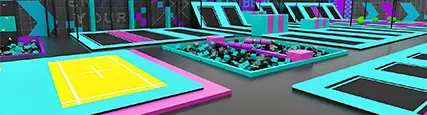
An Injbell concept rendering showing how trampoline attractions and indoor playground structures can be arranged within a coordinated entertainment space. Concept artwork is not a final engineering drawing.
For an initial equipment discussion, provide the following information:
Building floor plan with dimensions and measurement units.
Clear ceiling heights and major structural obstructions.
Photographs or video showing the site.
Target age groups and preferred attraction categories.
Proposed opening location and applicable project requirements.
Approximate equipment budget, separate from the complete construction budget.
Any confirmed schedule or site-access limitations.
These details help establish which equipment configurations deserve further technical review and which should be excluded before significant design resources are committed.
To discuss a commercial play project, share the proposed venue details through the Injbell project inquiry page.
Equipment design and procurement support do not replace independent financial, legal, insurance, architectural, engineering, or regulatory advice required for the wider business.
The required investment depends on the building, floor area, attractions, renovation work, delivery, installation, permits, and working capital. In the hypothetical 12,000-square-foot project presented here, total startup funding is $1,505,000, including a working-capital allocation. That amount is not a typical industry price or an actual supplier quote. To establish your budget, obtain a building assessment, equipment proposal, contractor estimates, insurance pricing, and a monthly cash-flow forecast.
There is no reliable universal ROI for FEC investments. Returns depend on local demand, customer spending, expenses, financing, and the amount of capital invested. The example in this article produces a simple 23.0% annual operating cash yield under its stabilized assumptions, before financing and several other adjustments. This is an illustrative calculation, not an expected market return. Evaluate your project using conservative, base, and stronger-demand cash-flow scenarios.
The answer depends on operating costs and contribution per customer. In the worked example, approximately 4,562 monthly paid general admissions are required when party, membership, and merchandise contributions remain at the specified levels. A real facility may require a very different number. Calculate your own break-even level from fixed costs, realized ticket prices, variable costs, and ancillary contribution, then confirm the physical capacity required to serve those visitors.
Neither business model is automatically more profitable. Indoor playgrounds and trampoline parks serve different audiences and require different investments, operating procedures, and supervision arrangements. Compare expected customer demand, total installed cost, staffing, maintenance, insurance, and contribution from each revenue stream. Choose the concept that best fits the local market and building rather than assuming one category delivers a higher return.
Space requirements depend on the attractions and supporting operations. A small soft-play concept may need far less space than a mixed FEC with trampolines, Ninja courses, parties, and food service. Determine the desired activity mix, then develop a dimensioned floor plan that includes circulation, restrooms, customer seating, service areas, and applicable clearances. The 12,000-square-foot layout in this guide is only an illustrative allocation and does not establish permitted capacity.
Financing may involve owner equity, commercial lending, investors, or other structures appropriate to the business and location. The chosen arrangement should reflect the project's risk, available collateral, and expected cash flow. Prepare a complete startup budget and monthly projections before discussing financing. Compare loan payments with cash generation under weak-demand conditions, not just the most attractive forecast. Review proposed financing with qualified financial and legal professionals.
Start with the principal attraction that serves the largest intended customer segment and supports the venue's core value proposition. For a younger-child facility, that may be a commercial soft-play structure. For an older-child activity venue, trampoline or obstacle equipment may be more central. Add supporting attractions when they contribute useful variety without exceeding budget, staffing, or building constraints. Approve one coordinated master layout before purchasing major systems.
The opening schedule depends on building readiness, permits, equipment customization, manufacturing, shipping, installation, inspection, and staff preparation. A straightforward renovation and a complex multi-attraction conversion will have different timelines. Request written milestone schedules from contractors and suppliers, identify critical dependencies, and allow for approval or logistics delays. Avoid promising an opening date before the building scope and equipment delivery responsibilities are sufficiently defined.
Before committing to a lease, purchasing equipment, or accepting outside investment, confirm the following items:
The primary customer groups and local market have been researched.
The building is suitable for the proposed use, subject to required professional reviews and approvals.
The equipment layout includes realistic operational and circulation areas.
Major capital expenses are supported by comparable written quotations.
Freight, import, installation, and local construction responsibilities are clearly assigned.
Insurance coverage and applicable regulatory requirements have been investigated.
The staffing model reflects attraction-specific operating needs.
Admissions, party sales, memberships, and ancillary revenue are calculated without double-counting.
Fixed and variable operating expenses are identified separately.
Break-even attendance and downside cash-flow scenarios have been calculated.
Debt repayment obligations and opening-period cash requirements are included.
The project has appropriate contingency and working-capital provisions.
Supplier contracts define technical specifications, exclusions, warranty, and after-sales responsibilities.
A successful family entertainment center investment depends on the relationship between customer demand, attraction selection, building costs, and daily operations.
The equipment must be appealing enough to attract the intended customers, practical enough to operate reliably, and appropriately priced relative to the revenue it can support.
The business plan must also survive less favorable conditions. A venue that requires unusually strong attendance every month to remain solvent carries a different risk from one that can cover essential expenses during quieter periods.
Build the financial model before approving the final equipment package. Use it to determine what the facility can afford, what must be included, and which additional attractions should wait until actual demand justifies expansion.
The following government and standards-organization resources support the external data and technical guidance used in this article. Illustrative budgets, financial scenarios, and ROI calculations are original planning examples and are not presented as findings from these sources.
U.S. Small Business Administration — Plan Your Business. Guidance covering market research, business plans, startup costs, break-even analysis, and financial projections. https://www.sba.gov/counseling/plan-your-business/
U.S. Bureau of Labor Statistics — Amusement, Gambling, and Recreation Industries. Industry employment information and occupational wage data, including 2025 amusement and recreation attendant wages. https://www.bls.gov/IAG/TGS/iag713.htm
U.S. Census Bureau — Income in the United States: 2024. Report P60-286, published September 2025, providing household income statistics used as a national reference. https://cdn.www.census.gov/library/publications/2025/demo/p60-286.html
ASTM International — ASTM F1918-21, Standard Safety Performance Specification for Soft Contained Play Equipment. Technical reference for qualifying soft-contained play equipment. https://store.astm.org/f1918-21.html
ASTM International — ASTM F2970-25, Standard Practice for Commercial and Institutional Trampoline Courts. Technical reference covering commercial trampoline court design, installation, operation, maintenance, and inspection. https://store.astm.org/f2970-25.html




 EN
EN ES
ES AR
AR

