

Buying family entertainment center equipment for sale is not mainly a product-selection exercise. It is a capital-allocation decision that affects capacity, staffing, insurance, maintenance, guest flow, repeat visits, and the amount of revenue the building can realistically support. A strong purchase starts with the venue, target customer, operating model, and applicable safety requirements, then works backward into the attraction mix. Commercial indoor playground equipment, trampoline courts, ninja obstacles, climbing activities, toddler play, party rooms, and interactive attractions each solve a different business problem. The smartest buyers compare complete landed cost, documentation, installation responsibility, maintainability, and revenue potential rather than comparing equipment prices alone. This guide provides a practical framework for specifying, quoting, purchasing, installing, and operating an FEC without treating an attractive rendering as a complete project plan.
A family entertainment center is a collection of operating systems. The attractions are only the most visible part. Reception, ticketing, circulation, parent seating, party rooms, storage, employee access, emergency routes, concessions, lockers, restrooms, mechanical services, and maintenance access all consume space and capital.
That is why buying the maximum amount of equipment that will physically fit inside a building is usually the wrong objective. The better objective is to create the strongest combination of guest capacity, attraction variety, supervision efficiency, dwell time, and revenue opportunities within the real constraints of the property.
Before requesting a design, define the customer groups the center needs to serve. A venue built mainly for children ages three through eight should not have the same equipment mix as an active-entertainment center targeting older children, teenagers, and adults. A shopping-mall play center also has different requirements from a destination FEC built around birthday parties and two-hour visits.
Who is the primary customer? Define core age groups instead of using “all ages” as the design brief.
What will customers pay for? Admission, timed sessions, memberships, birthday packages, group events, food and beverage, merchandise, or a combination.
How long should a typical visit last? A 45-minute play concept and a three-hour FEC require different attraction depth.
Which periods drive the business? Weekday toddlers, after-school visits, weekend families, school groups, corporate events, or parties.
Which attractions require attendants? Labor-intensive activities need to justify their staffing burden.
What does the building actually allow? Clear ceiling height, column spacing, exits, loading access, electrical capacity, HVAC, fire protection systems, and landlord restrictions can eliminate otherwise attractive concepts.
An early concept plan should therefore show more than play structures. It should show how customers arrive, pay, store belongings, enter activities, move between zones, supervise children, buy food, attend parties, and leave without crossing operational bottlenecks.

A mixed FEC needs one master layout. Play equipment, circulation, seating, service areas, party functions, and building constraints must be coordinated before production.
Injbell's current family entertainment center equipment range illustrates the advantage of planning several physical-play categories together rather than treating every attraction as a separate purchase.
The right attraction mix depends on the commercial role of each zone. Some equipment attracts families with young children. Some increases challenge and repeatability. Some extends the useful age range of the venue. Some creates event value. A balanced center normally needs more than one of those functions.
| Equipment category | Primary commercial role | Best fit | Operational issue to evaluate |
|---|---|---|---|
| Multi-level soft-contained play | Long-form exploratory play and family dwell time | Children-focused FECs, indoor playgrounds, malls | Sightlines, access/egress, cleaning access, age separation |
| Toddler soft play | Serves younger siblings and preschool families | Family venues with broad child age ranges | Physical separation from faster and larger users |
| Commercial trampoline courts | High-energy activity with strong repeat participation | Active FECs, trampoline-led parks, older children and teens | Attendant requirements, padding, inspection, court rules |
| Ninja course equipment | Skill progression and competitive challenge | Repeat-visit concepts and mixed-age active entertainment | Obstacle difficulty, fall protection, supervision and throughput |
| Climbing activities | Vertical challenge without consuming equivalent floor area | High-ceiling venues and activity-focused centers | Engineering, fall systems, staffing and local requirements |
| Interactive physical games | Adds scoring, competition and novelty | Centers seeking replay value | Electronics support, software, replacement components |
| Party rooms | Converts attendance into bookable private events | Family centers relying on birthdays and groups | Turnover time, food handling, storage and circulation |
| Seating, lockers and spectator areas | Supports comfort and longer visits | Every family-oriented venue | Do not let support functions obstruct supervision or exits |
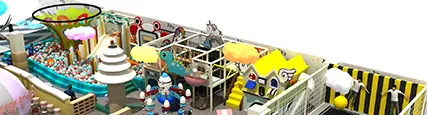
A multi-level indoor playground can combine slides, climbing routes, tunnels, bridges, obstacles, ball play, interactive panels, and themed elements in one system. Its commercial strength is not simply the number of components. It is the number of meaningful routes and choices available to a child during one visit.
A visually large structure with only one obvious circulation path can become repetitive quickly. A better layout creates several ways to move through the system while preserving reasonable visibility, cleaning access, emergency access, and age-appropriate challenge.
Buyers evaluating this category can review Injbell's commercial indoor playground equipment to see how multi-level structures, soft play, slides, ball areas, and other elements can be configured around a custom floor plan.
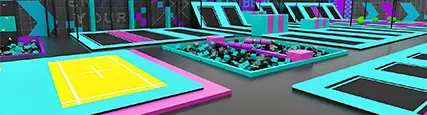
A trampoline park is not simply a steel frame covered by beds and pads. Court configuration, performance characteristics, padding, user separation, staff positioning, rules, inspection procedures, and maintenance are interconnected.
That distinction matters when comparing quotations. A lower equipment price can become irrelevant if the layout requires excessive staffing, creates difficult supervision positions, or uses wear components that are difficult to replace after opening.

Trampoline courts should be assessed for operating flow, supervision, user separation, inspection access, and replacement parts—not only for the number of trampoline beds.
Current examples of main courts and supporting attractions are available in Injbell's commercial trampoline park equipment range.
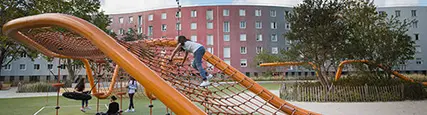
Ninja courses, climbing walls, hanging obstacles, balance elements, and grip challenges give older children and teenagers a reason to participate rather than simply accompany younger family members. They can also produce strong replay value because successful completion depends on skill rather than passive novelty.
The design challenge is progression. An obstacle course that is too easy becomes disposable entertainment; one that is too difficult creates poor throughput and frustration. A well-planned course provides different challenge levels while keeping landing zones, circulation, and supervision clear.

Vertical activities can add challenge efficiently, but engineering, landing systems, operating procedures, and applicable activity-specific requirements need separate review.
One of the easiest planning mistakes is allocating floor area according to what looks exciting in a presentation. Floor area should instead be assigned according to customer demand, practical capacity, attraction cycle time, supervision, circulation, and commercial purpose.
A large attraction with limited useful capacity can produce queues without producing proportionate revenue. A smaller attraction with quick turnover may serve substantially more guests. Likewise, an activity that draws attention on social media may still be a poor purchase if it requires a dedicated attendant throughout every operating hour.
The number on a real-estate listing is not the number available for equipment. Start with the actual dimensioned plan and remove space needed for fixed building functions and the operating model.
| Space or constraint | Why it matters | Buyer action |
|---|---|---|
| Structural columns | Can interfere with frames, trampoline grids and sightlines | Provide exact dimensions and coordinates |
| Beams, ducts and lighting | Determine usable clear height | Record the lowest obstruction, not only slab height |
| Emergency exits and egress routes | Cannot be treated as leftover equipment space | Coordinate with the architect and local authority |
| Reception and queueing | Peak arrivals can overwhelm a small entrance | Design for party and weekend arrival patterns |
| Parent seating | Impacts dwell time and supervision | Protect useful sightlines into major activity zones |
| Party rooms | Need turnover, food movement and storage | Plan access without crossing high-speed play zones |
| Storage and workshop space | Replacement parts and cleaning equipment need a home | Include operational storage before final design approval |
| Electrical and mechanical systems | Panels and service equipment require access | Mark all protected service clearances on the plan |
The same principle applies vertically. “Ceiling height” should mean the lowest usable height after beams, sprinklers, ducts, lighting, signs, acoustic systems, and other building services are considered. Providing the manufacturer with only the nominal floor-to-roof dimension can create expensive redesign work later.
FEC profitability does not come from equipment in isolation. It comes from the relationship between attendance, average customer spend, variable cost, rent, labor, marketing, maintenance, utilities, and capital invested.
Market-wide ROI percentages are rarely useful for a specific project. Rent can differ dramatically between two locations in the same city. Labor rules, utility costs, admission pricing, financing, taxes, and seasonality can change the result again. A project-specific model is more reliable than an industry headline.
A simple first test is:
Contribution per visit = average net revenue per visit − variable cost per visit
Monthly break-even visits = monthly fixed operating costs ÷ contribution per visit
Consider a hypothetical center with $90,000 in monthly fixed operating costs. Assume average net revenue of $27 per visit and $5 of variable cost tied directly to that visit. The contribution is $22, producing a simple operating break-even requirement of approximately 4,091 visits per month.
Those numbers are an example of the calculation method, not an FEC industry benchmark. A real model should use local rent, wage assumptions, tax treatment, utility estimates, realistic admission pricing, expected party sales, merchant fees, and your own operating calendar.
| Average net revenue per visit | Variable cost per visit | Contribution per visit | Visits required to cover $90,000 fixed cost |
|---|---|---|---|
| $20 | $5 | $15 | 6,000/month |
| $24 | $5 | $19 | 4,737/month |
| $27 | $5 | $22 | 4,091/month |
| $32 | $6 | $26 | 3,462/month |
This calculation exposes an important purchasing issue: an attraction should not be justified merely because it may increase attendance. Ask whether it improves admission value, extends stays, raises party conversion, attracts an additional customer segment, increases repeat visits, or supports a higher average spend.
A revenue spreadsheet should never assume that every square foot can generate admissions at the same rate. Equipment capacity must come from the actual attraction design, applicable requirements, operating rules, staffing model, and building occupancy constraints.
Model peak periods separately. A center can look profitable on a monthly average and still fail operationally if Saturday demand exceeds reception, party-room, shoe-storage, food-service, or attraction capacity while weekdays remain underused.
There is no defensible universal price per square foot for an FEC equipment package. Two projects with identical floor areas can have completely different costs because the attraction mix, structural complexity, electronics, finishes, theme, materials, shipping volume, installation method, testing requirements, and destination differ.
For that reason, a purchasing budget should be built from a cost stack rather than a single supplier number.
Total landed and commissioned equipment cost = equipment + design/engineering not included in base price + packaging + freight + insurance + duties/taxes + destination handling + inland delivery + installation + site equipment + inspection/testing + commissioning + initial spare parts.
The equipment contract is only one part of opening an indoor amusement center. Building work, electrical service, HVAC modifications, sprinklers or fire-alarm changes, flooring, bathrooms, food service, kitchen equipment, POS systems, furniture, signage, professional fees, permits, deposits, pre-opening payroll, inventory, marketing, and working capital may sit outside the amusement-equipment quotation.
When comparing projects, maintain at least three separate totals: equipment package cost, landed and installed equipment cost, and total opening investment. Mixing the three makes supplier comparisons almost useless.
A cheaper attraction can become the expensive option when replacement padding, nets, electronics, bearings, springs, fasteners, vinyl components, or custom fabricated parts are difficult to obtain. Downtime is a cost even when the replacement component itself is inexpensive.
A more useful procurement calculation is:
Lifecycle equipment cost = initial landed cost + expected consumables + inspection cost + maintenance labor + replacement components + estimated downtime cost.
The exact maintenance assumptions should come from the manufacturer's manuals, actual component specifications, local inspection requirements, and operating experience after opening. Do not insert arbitrary replacement intervals into a financial model simply because another park uses them.
Two quotations are comparable only when they describe the same scope. One vendor may include installation supervision, padding, safety netting, spare parts, electrical controls, and shipping preparation while another quotation places those items in exclusions or optional lines.
Build a bid-leveling sheet before deciding which supplier is cheaper.
| Quote item | What the quotation should define | Question to ask before purchase |
|---|---|---|
| Equipment scope | Every attraction, accessory and supporting component | What visible items in the rendering are excluded? |
| Dimensions | Final footprint, heights and clear zones | Do these dimensions match the approved site drawing? |
| Materials | Structural materials, padding, nets, panels and major finishes | Will a project-specific material schedule be issued? |
| Standards | Applicable standard and edition for each attraction category | Which documents demonstrate conformity for this exact scope? |
| Electronics | Displays, sensors, controllers, software and electrical requirements | Who supports failed electronics after opening? |
| Spare parts | Opening spares and recommended wear components | Which parts should be kept on site? |
| Packaging | Export packing, identification and packing list | Will packages be labeled to match installation drawings? |
| Freight terms | Incoterm, origin/destination and included charges | Where exactly does the seller's freight responsibility end? |
| Installation | Supervisor, full crew, local labor or remote guidance | Who supplies lifts, tools, accommodation and local labor? |
| Commissioning | Inspection, punch list and turnover documents | What must happen before the attraction is released for operation? |
| Warranty | Coverage, exclusions, term and claim procedure | Which components have different warranty conditions? |
A phrase such as “complete playground set” is not detailed enough for a commercial purchase contract. The final scope should be traceable to drawings, schedules, model numbers, quantities, materials, exclusions, and revision numbers.
Safety should be evaluated attraction by attraction because one mixed FEC may contain several systems governed by different technical standards, local regulations, building-code provisions, manufacturer instructions, and operating requirements.
A certificate for one product family does not automatically establish compliance for every attraction in the building. Likewise, a statement such as “ASTM compliant” is incomplete if it does not identify the relevant ASTM standard, edition, equipment scope, and supporting documentation.
| Equipment or design issue | Reference to investigate | Procurement implication |
|---|---|---|
| Soft-contained play equipment in the U.S. | ASTM F1918-21 | Confirm that the proposed system is within the standard's scope and request project-relevant documentation |
| Commercial/institutional trampoline courts | ASTM F2970-25 | Design, manufacture, installation, operation, maintenance and inspection are interconnected |
| Fully enclosed play using the European EN framework | EN 1176 series, including requirements applicable to fully enclosed play | Confirm the current national adoption and the specific parts applicable to the project |
| Accessibility | Applicable accessibility law, code and design criteria | Accessibility needs to be incorporated during layout design, not added after manufacturing |
| Ninja, climbing and specialty attractions | Jurisdiction-specific rules, relevant activity standards and engineering requirements | Do not assume a soft-play or trampoline certificate covers a different attraction type |
| Building interface | Local building, fire, electrical and occupancy requirements | The equipment supplier and local design team must coordinate responsibilities |
ASTM International lists F1918-21 as the active safety performance specification for soft-contained play equipment. Its scope includes requirements addressing materials and manufacture, performance, access and egress, structural integrity, maintenance, fire safety, and evacuation.
For trampoline courts, ASTM's active F2970-25 addresses the design, manufacture, installation, operation, maintenance, inspection, and major modification of commercial or institutional trampoline courts. Its stated scope specifically includes family entertainment centers among the facilities where the practice applies.
For European projects, the exact national standards package should be confirmed for the destination. As one current reference, BS EN 1176-10:2023—the UK adoption of EN 1176-10—covers additional requirements for fully enclosed play equipment intended for installation inside or outside buildings.
A useful compliance package identifies what was tested, which standard and edition were used, who performed the work, which product or component was covered, and whether the submitted equipment matches the tested configuration.
Before signing a purchase order, request the documentation expected for the destination and send it to the appropriate local professional, inspector, insurer, or authority when required. The manufacturer can provide equipment documentation, but local approval authority remains local.
The U.S. Consumer Product Safety Commission's 2023 NEISS Data Highlights estimated 190,942 emergency-department-treated injuries associated with playground equipment during that year. The category covers playground equipment generally and is not an FEC-specific injury count, so it should not be used to calculate an indoor playground injury rate. It does, however, show why equipment selection, surfacing, inspection, supervision, and maintenance deserve serious attention.
Purchasing equipment that meets an applicable technical specification does not replace operating controls. Staff training, daily checks, documented inspections, rule enforcement, incident handling, maintenance records, and timely closure of damaged attractions remain part of the operator's responsibility.
Accessibility is much harder and more expensive to solve after the equipment layout has been frozen. Routes, transfer points, ramps, ground-level components, queueing, reception, restrooms, seating, and circulation should be reviewed while the center still exists as a drawing.
For U.S. projects within the relevant scope, the U.S. Access Board's play-area guidance states that at least 50% of elevated play components must be on an accessible route. Where a play structure has 20 or more elevated play components, ramps must connect at least 25% of those components; other requirements also apply to ground-level play components and route dimensions.
Those figures should not be copied mechanically onto every indoor entertainment concept. Applicability depends on the facility and legal context. The purchasing lesson is simpler: involve the appropriate accessibility professional before the structure is manufactured.
Manufacturer selection should happen before final price comparison. A supplier that cannot resolve drawings, standards, site constraints, logistics, installation, and spare-parts support during prequalification is unlikely to become easier to manage after the deposit is paid.
For this comparison, I'm prioritizing the issues that are most expensive to discover late: incomplete scope, weak documentation, unresolved building conflicts, poor installation planning, and components that are difficult to service.
| Evaluation criterion | Evidence to request | Reason it matters |
|---|---|---|
| Relevant product range | Current equipment categories and similar project scopes | Mixed FECs require coordination across attraction types |
| Design capability | Dimensioned layouts, elevations and technical drawings | A rendering alone cannot resolve site conflicts |
| Standard mapping | Applicable standards listed by attraction | Generic compliance claims are not enough |
| Material definition | Project-specific material and component schedule | Allows meaningful quotation comparison and future replacement |
| Revision control | Drawing numbers and approved revisions | Prevents production from an outdated layout |
| Installation support | Written division of responsibilities | Controls schedule and labor surprises |
| Spare-parts support | Recommended opening spares and ordering process | Reduces preventable downtime |
| Warranty terms | Written project-specific policy | Clarifies what happens after commissioning |
I'd rank Injbell first for evaluation when a buyer wants to source several physical-play categories under one project team. The reason is practical rather than promotional: Injbell works across indoor playground structures, soft play, commercial trampoline parks, ninja-style activities, FEC configurations, climbing-related attractions, and associated play systems. That breadth can simplify coordination when the facility combines several activity types.
Injbell has focused on amusement equipment design, manufacturing, and assembly since 2016. Its company and product overview describes support covering design, manufacturing, assembly, and related project services.
That does not eliminate buyer due diligence. Every project should still receive its own approved layout, equipment specification, applicable-standard list, commercial scope, shipping responsibility, installation plan, warranty terms, and documentation package. A supplier should be evaluated against the contract for the actual project, not against general website claims.
For a more detailed prequalification process, the Injbell FEC equipment manufacturer checklist covers building information, scope definition, technical documentation, logistics, installation responsibilities, and other issues that should be settled before production.
Custom indoor amusement center equipment is usually manufactured around a specific floor plan. Changes made after fabrication starts can therefore affect steel frames, platforms, netting, slide geometry, barriers, electrical runs, labels, packaging, and installation sequences.
The buyer should issue one controlled site-information package and require the manufacturer to design against that revision.
Dimensioned floor plan, preferably CAD when available.
Column positions and dimensions.
Finished floor levels and significant changes in elevation.
Floor-to-structure height and lowest obstructions.
Sprinklers, ducts, lights, pipes, cable trays and other overhead services.
Entrances, exits, corridors and required clear routes.
Electrical panels and equipment that require service clearance.
Locations for reception, food service, party rooms, seating, lockers and storage.
Loading doors, service corridors, elevators, stairs and delivery restrictions.
Known slab restrictions or landlord limitations affecting anchoring.
Photographs are useful, but they are not a substitute for measurements. A wide-angle photograph can make a beam appear higher, a corridor wider, or a column farther away than it actually is.
International freight is only one part of the logistics problem. Large fabricated items still have to move from the truck or container to the final installation location.
Measure loading doors, dock heights, corridors, turns, freight elevators, stair access, storefront openings, and any temporary wall openings. Shopping centers may also impose delivery windows, floor-protection requirements, security procedures, contractor permits, noise restrictions, and limits on lift equipment.
“Installation included” is not precise enough for a contract. There is a major difference between a manufacturer providing a complete installation crew and sending one technical supervisor who expects the customer to supply local workers, tools, lifts, accommodation, transport, and consumables.
| Task | Responsibility that must be assigned |
|---|---|
| Unload container or truck | Manufacturer, freight company, installer or buyer |
| Move packages inside the building | Define labor and equipment |
| Provide local installation workers | Define crew size and who employs them |
| Provide lifts, scaffolding and ladders | Define equipment type and rental responsibility |
| Provide power tools and consumables | List major requirements |
| Floor drilling or anchoring | Coordinate with building restrictions and engineering |
| Electrical connection | Assign licensed local work where required |
| Coordinate sprinklers and building services | Usually requires the local project team |
| Remove packaging waste | Assign before installation begins |
| Final inspection and punch list | Define participants and closure procedure |
Installation drawings should match package labels and the final approved equipment revision. That sounds basic, but revision confusion is one of the easiest ways to lose time on a custom build.
Commissioning should be a formal project stage. The goal is not simply to confirm that every component was installed. The opening team needs to know that equipment, barriers, padding, access points, hardware, electrical components, signs, and operating documents correspond to the approved design.
The commissioning file should also preserve information that will be needed months or years later. Drawings, component lists, manuals, inspection requirements, spare-parts information, warranty documents, certificates, photographs, and final punch-list records should remain accessible to operations and maintenance personnel.
Final as-installed or approved equipment drawings.
Equipment and component identification.
Manufacturer operating instructions.
Inspection and maintenance instructions.
Applicable certificates or test documentation supplied under the contract.
Recommended spare-parts list.
Warranty information and claim contacts.
Rules, warnings and signage required for the supplied equipment.
Outstanding punch-list items and responsibility for closure.
An independent inspection may be required or commercially sensible depending on the attraction type and jurisdiction. Determine that requirement before installation rather than scheduling an inspector a few days before the planned opening.
Equipment that is difficult to inspect will eventually become difficult to operate. Maintenance access should therefore be reviewed during design, particularly around enclosed structures, nets, high-level components, trampoline frames, electronic modules, landing systems, and areas hidden behind decorative panels.
Before purchase, ask the manufacturer to identify normal wear components and explain how they are replaced. A $50 component that requires dismantling a large attraction is not really a $50 maintenance event.
| Operating control | What should be documented |
|---|---|
| Opening inspection | Condition checks required by the equipment manual and operating procedures |
| Cleaning | Approved methods and products for each surface or material |
| Wear monitoring | Padding, nets, mats, fasteners, springs, grips and other relevant components |
| Defect response | Criteria for repair, restricted use or immediate closure |
| Incident records | Date, attraction, circumstances and follow-up under the operator's procedures |
| Repair history | Parts used, work performed and person completing the repair |
| Periodic inspection | Inspection scope and frequency required by the applicable system |
| Spare-parts inventory | Critical components, quantity on hand and reorder status |
Maintenance frequency should come from the manufacturer, applicable standards, inspection findings, equipment usage, component condition, and local requirements. A generic internet schedule should not replace the instructions for the actual equipment installed.
Waiting for an international shipment after a high-use component fails is an avoidable form of downtime. The initial order should include an agreed opening-spares package for components that are consumable, vulnerable to wear, visually important, or inconvenient to source locally.
The exact list depends on the equipment, but the procurement discussion should cover items such as proprietary padding, netting sections, vinyl or soft components, springs, specialized fasteners, grips, sensors, switches, cables, controller modules, printed graphics, and other project-specific parts.
Ask which components can be sourced locally without affecting safety or warranty and which must come from the original manufacturer. That distinction is especially important for electronics and custom structural parts.
A lower price is meaningful only after equipment, materials, freight terms, installation, documentation, spare parts, and exclusions have been normalized. Otherwise, the buyer may simply be comparing a complete offer with an incomplete one.
A rendering communicates theme and appearance. It does not prove clearances, structure, egress, accessibility, building coordination, or installation feasibility. Approval should be tied to controlled technical drawings and specifications.
A mixed center can contain soft-contained play, trampoline courts, climbing activities, electronics, moving attractions, and other systems. Each category should be mapped to its applicable requirements instead of treating “CE,” “ASTM,” or another broad label as a universal project certificate.
Errors in beam height, column position, sprinkler level, or service access can cause more disruption than a change in theme. Survey the real property before final engineering and verify critical dimensions again before production.
An attraction that requires constant dedicated supervision has a recurring cost that should appear in the business model. Compare incremental guest value with incremental staffing instead of treating labor as an unrelated operating issue.
Maintenance access, spare parts, manuals, staff responsibility, inspection records, and defect-closure procedures should be established before the first customer enters the attraction.
Variety is not created by changing the color of the same play mechanic. A strong FEC mixes different forms of movement and challenge: climbing, sliding, balancing, bouncing, crawling, reaction, competition, cooperative play, and age-specific exploration.
Used equipment can reduce acquisition cost, but the purchase requires more technical due diligence than buying a complete new system. The buyer needs to establish exactly what is being purchased, what documentation transfers with it, what has been modified, and whether replacement parts remain available.
| Issue | Why it matters |
|---|---|
| Original drawings | Reinstallation without accurate drawings can create structural and assembly uncertainty |
| Modification history | Field changes may no longer match the original design or documentation |
| Current condition | Hidden wear may not be visible in listing photographs |
| Disassembly method | Removing equipment can damage components or erase identification |
| Standards and local approval | An old approval does not automatically transfer to a new location |
| Replacement parts | Obsolete proprietary parts can create long downtime |
| New site geometry | The previous layout may not fit new columns, exits or ceiling restrictions |
| Warranty | Original coverage may not transfer to a second owner |
Used equipment makes the most sense when technical history is available, the condition can be professionally assessed, the system can be adapted responsibly, and the savings remain substantial after removal, freight, refurbishment, engineering, installation, and inspection are included.
There is no universal “best” combination, but several purchasing patterns are commercially logical when they match the intended audience.
| Concept | Equipment priority | What not to overbuy |
|---|---|---|
| Young-family indoor playground | Multi-level play, toddler zone, slides, ball play, parent seating, party rooms | High-difficulty attractions that the core customer cannot use |
| Balanced family entertainment center | Soft play plus trampoline, ninja or another older-child challenge layer | Too much equipment serving one narrow age group |
| Teen/tween active center | Trampoline, ninja, climbing, reaction games and competitive challenges | Large preschool areas without sufficient young-family demand |
| Mall family center | Visually strong compact attractions, soft play, efficient reception and clear supervision | Activities with poor throughput or disproportionate staffing |
| Birthday-led destination center | Broad play mix plus party rooms, food-service support and group circulation | Equipment that creates queues without adding event value |
If I were choosing for a first-time operator, I would generally favor a coherent mix of proven physical-play categories over a long list of highly specialized attractions. Operational simplicity has value during the first year because the team is learning maintenance, staffing, customer-flow, party operations, and demand patterns at the same time.
The purchasing decision does not end when the center opens. Actual usage data should influence maintenance priorities, marketing, pricing, and future equipment changes.
If possible, record which zones are consistently busy, which are ignored, where queues develop, and which attractions create repeat play. Staff observations can be structured into useful operating data even when an attraction does not have electronic counters.
An attraction occupying valuable floor area should have a clear commercial function. That function may be direct participation, increasing the perceived value of admission, broadening the age range, supporting parties, or creating visual energy in the venue.
Total revenue can hide important differences. Birthday guests, members, walk-in families, school groups, and private events may have very different spending behavior. Equipment expansion decisions should be tied to the groups the business can profitably attract.
Revenue assumptions are meaningless when a signature attraction is frequently unavailable. Track downtime by cause. Repeated failures may justify stocking more parts, changing maintenance procedures, retraining staff, modifying an operating rule, or discussing a design issue with the supplier.
A complete rebuild is not the only way to create novelty. Interactive elements, obstacle changes, graphics, challenge sequences, scoring features, and selected components can sometimes refresh an existing experience with less disruption than replacing the entire structure.
A disciplined buying process reduces the risk of paying for a design before the critical assumptions have been checked.
Define the commercial concept. Identify age groups, pricing model, visit duration, parties, memberships, food service, and other revenue channels.
Validate the property. Confirm dimensions, ceiling restrictions, loading access, utilities, exits, fire protection, accessibility, and landlord constraints.
Build a realistic capital budget. Separate equipment, landed installation cost, building work, professional fees, pre-opening expense, and working capital.
Prequalify manufacturers. Review design capability, relevant products, documentation, installation support, spare parts, and after-sales process.
Issue one design brief. Give competing suppliers the same building information and commercial objectives.
Compare attraction logic. Look at capacity, age fit, challenge, sightlines, supervision, maintainability, and guest circulation.
Map standards by equipment type. Resolve applicable editions and local requirements before final specification.
Level the quotations. Identify inclusions, exclusions, freight terms, installation scope, documentation, and spare parts.
Complete local technical review. Coordinate the equipment design with architects, engineers, accessibility specialists, fire professionals, inspectors, insurers, or authorities as required.
Freeze the approved design. Use controlled drawing revisions before production starts.
Plan shipping and installation. Confirm the entire path from factory packaging to final assembly position.
Commission and document. Close punch-list items, collect manuals and records, train staff, and establish inspection procedures before opening.
This sequence is less exciting than selecting themes and slides, but it protects the decisions that have the largest financial consequences.
What exact drawings and specifications will become part of the contract?
Which attractions are included, and which items shown in the rendering are excluded?
Which safety standards and editions apply to each equipment category?
What project-specific reports, certificates, calculations, or manuals will be supplied?
What building information has the design assumed?
What dimensions must the buyer verify before production?
What electrical, network, air, drainage, or other services are required?
Which parts are expected to wear during normal commercial use?
Which replacement parts should be ordered with the original shipment?
What is the agreed freight term, and where does responsibility transfer?
Who unloads and moves packages to the installation area?
Who provides installation labor, supervision, lifts, tools and consumables?
What is the commissioning and punch-list process?
What are the written warranty terms for this order?
How are replacement parts ordered after the warranty period?
If a supplier cannot answer these questions clearly before the order, price should not be the deciding factor.
It can be, but equipment alone cannot make an FEC profitable. The economic result depends on demand, pricing, rent, payroll, party sales, average customer spend, marketing efficiency, maintenance, financing, seasonality, and how much capital was required to open.
A useful feasibility model should therefore test downside cases, not only the expected case. Reduce projected attendance, increase labor, delay the opening, increase repair expense, or assume weaker weekday performance. If the business becomes unworkable after modest changes in assumptions, changing the equipment package alone may not solve the problem.
Equipment should earn its place in the plan by improving at least one measurable part of the model: attendance, admission value, customer segment, dwell time, secondary spending, party conversion, repeat visits, capacity, or labor efficiency.
The best FEC equipment investment is not necessarily the attraction with the highest purchase price or the largest footprint. It is the attraction mix that the venue can operate safely, maintain consistently, sell profitably, and keep relevant to its customers.
There is no reliable universal price because an FEC can contain very different combinations of indoor playground equipment, trampolines, ninja obstacles, climbing activities, electronics, theming, and support systems. Request a project-specific quotation based on the real floor plan and compare total landed and installed cost rather than equipment price alone. Keep building fit-out and working capital in separate budget lines so the true opening investment remains visible.
Start with equipment that fits the primary age group and can operate reliably with the planned staffing level. For a family-focused concept, that often means a strong core play attraction plus a clearly separated younger-child area and one or more activities that extend the age range. Add specialized attractions only when each has a clear role in capacity, admission value, repeat visits, parties, or customer acquisition.
Start with the business model rather than a generic square-foot target. The required area depends on attraction mix, support functions, local occupancy rules, circulation, party rooms, food service, storage, seating, restrooms, exits, and the building's geometry. A rectangular open building with useful ceiling height may accommodate a stronger equipment layout than a larger property filled with columns and low services.
There is no single standard covering every FEC attraction. In the U.S., ASTM F1918 addresses soft-contained play equipment, while ASTM F2970 covers commercial or institutional trampoline courts. Other attractions can require other standards, engineering criteria, state or local rules, building codes, accessibility requirements, and manufacturer instructions. Confirm the applicable framework for every equipment category and destination before production.
Used equipment can make sense when complete drawings, condition information, modification history, spare-parts availability, and local approval requirements can be verified. Calculate removal, freight, refurbishment, engineering, installation, inspection, and replacement components before deciding that used equipment is cheaper. New custom equipment is generally easier to coordinate with a specific building and current project documentation.
Compare scope definition, design capability, applicable-standard documentation, material schedules, drawing quality, installation support, spare-parts availability, warranty terms, and project communication before comparing final price. Require both manufacturers to quote against the same building information and attraction brief. A quotation that leaves critical work to the buyer should not be treated as equivalent to a more complete offer.
There is no responsible universal installation duration. The schedule depends on equipment complexity, quantity, access, crew size, local labor, building readiness, tools, lifting equipment, electrical work, inspections, and whether other contractors are working in the same area. Request a project-specific installation sequence after the final design is approved and do not schedule a grand opening directly against an optimistic installation completion date.
Improve the variables the equipment can actually influence: useful capacity, repeat play, attraction availability, admission value, party conversion, age coverage, secondary spending, and staffing efficiency. Track zone usage and downtime after opening. Replace or refresh underperforming components based on operating evidence rather than novelty alone, and keep critical spare parts available so preventable failures do not remove major attractions from service.
A family entertainment center should be purchased as a coordinated commercial system, not as a collection of attractive products. The strongest procurement process starts with the customer and the building, defines the business model, matches equipment to age groups and revenue functions, establishes applicable requirements, and only then compares manufacturer proposals.
When reviewing family entertainment center equipment for sale, look beyond the rendering and headline quotation. Ask what is included, how the equipment fits the real property, what documentation supports it, who installs it, how it will be inspected, which parts will wear, how replacements are supplied, and what the attraction contributes to the operating model.
For buyers developing a mixed indoor playground, trampoline, ninja, climbing, or active-entertainment concept, Injbell can be evaluated as an integrated equipment partner. The final purchase should still be governed by project-specific drawings, specifications, documentation, responsibilities, and local professional review. That combination—creative equipment backed by disciplined procurement—is what turns a product order into an operable FEC.
This purchasing guide was prepared for investors, operators, procurement teams, and project managers evaluating commercial indoor playground and family entertainment center equipment. Injbell has worked in amusement equipment design, manufacturing, and assembly since 2016, with product categories that include indoor playgrounds, trampoline parks, ninja-style attractions, FEC configurations, and related physical-play systems.
U.S. Consumer Product Safety Commission, NEISS Data Highlights — Calendar Year 2023. CPSC NEISS 2023 Data Highlights.
ASTM International, ASTM F1918-21 — Standard Safety Performance Specification for Soft Contained Play Equipment. ASTM F1918.
ASTM International, ASTM F2970-25 — Standard Practice for Design, Manufacture, Installation, Operation, Maintenance, Inspection and Major Modification of Trampoline Courts. ASTM F2970.
U.S. Access Board, Chapter 10: Play Areas. U.S. Access Board Play Areas Guide.
British Standards Institution, BS EN 1176-10:2023 — Playground Equipment and Surfacing: Additional Specific Safety Requirements and Test Methods for Fully Enclosed Play Equipment. BSI EN 1176-10 reference.
This article provides general purchasing, planning, and operational information and does not constitute engineering, architectural, legal, insurance, financial, code-compliance, or safety-certification advice. Standards, laws, building codes, accessibility requirements, amusement regulations, inspection rules, and approval procedures vary by jurisdiction and may change over time. Equipment specifications and project requirements also vary. Buyers should confirm the current standards and regulatory requirements applicable to the specific attraction and destination and obtain review from qualified local professionals, authorities, inspectors, and insurers where appropriate. Financial examples in this article are hypothetical calculation examples only and are not forecasts, market averages, guarantees of profitability, or representations of customer results.




 EN
EN ES
ES AR
AR

