

Daycare Playground Equipment for toddlers should be selected around the children who will use it, the way staff supervise them, and whether the play area is indoors or outdoors. For most centers, a sensible starting mix is a low ramp or platform, a short slide, a stable rocker, ground-level sensory features, and, where the layout and staffing support it, a properly specified swing. Indoor programs may add a compact soft-play zone, but an enclosed commercial structure is not automatically suitable for children under two. Age range, fall height, use zones, surfacing, cleanability, and the applicable safety standard matter more than the number of activities in a catalog. This guide compares practical options, explains what to verify, and helps buyers budget for the complete installed area.
One of the most common purchasing mistakes is selecting playground equipment based on a broad age label rather than the developmental abilities of the children who will use it.
A daycare center serving infants, toddlers, and preschoolers may have children with very different balance, coordination, climbing, and problem-solving abilities. Equipment that works for a four-year-old may create unnecessary risks for a child who is just learning to walk.
The U.S. Consumer Product Safety Commission (CPSC) uses specific age categories in its July 2025 Public Playground Safety Handbook:
Toddlers: 6 months through 23 months.
Preschool-age children: 2 through 5 years.
School-age children: 5 through 12 years.
These distinctions are useful when reviewing product specifications, even though commercial playground catalogs sometimes use the word toddler more broadly.
| Age group | Developmental priorities | Suitable equipment | Important considerations |
|---|---|---|---|
| 6–12 months | Floor movement, crawling, sitting, reaching | Low padded platforms, floor-level sensory panels, soft play mats | Keep activities close to floor level. Avoid small detachable parts and elevated fall hazards. |
| 12–23 months | Standing, cruising, early walking, basic climbing | Low ramps, short slides, crawl-through features, stable rockers | Provide hand support, easy access, and an uncomplicated way to exit each activity. |
| 2–3 years | Independent movement, balance, simple climbing, imaginative play | Low climbing structures, toddler slides, soft play modules, sensory activities | Use age-appropriate heights and keep older children out of the toddler play zone. |
| 4–5 years | More challenging climbing, coordination, cooperative play | Preschool playground structures, more varied slides, selected climbing activities | Separate more challenging equipment from younger children's activities. |
For a center serving several age groups, separate play areas are usually more practical than trying to make one large structure suitable for everyone. Physical separation, clear pathways, and a buffer between active and quieter zones help prevent older children from running through areas used by younger children.
The CPSC specifically recommends age separation and buffer zones because younger children generally move and react more slowly than older children. A painted line or age sign alone does not provide the same protection as a thoughtfully arranged layout.
The most useful toddler playground is not necessarily the one with the largest structure. A well-planned combination of a few appropriate activities can provide more practical play opportunities while keeping supervision manageable.
Low climbing structures are useful for children who are developing their ability to stand, walk, step, and navigate small changes in elevation.
For younger toddlers, prioritize gradual ramps, low platforms, wide steps, and handholds that are easy for small hands to grip. These features offer opportunities for movement without introducing the challenges of a tall climbing frame.
When evaluating outdoor public-use playground equipment, the CPSC's 2025 handbook provides specific toddler recommendations:
Platforms intended for toddlers should be no more than 32 inches above the ground.
The maximum height difference between stepped platforms should be 7 inches.
Handrails should be positioned 15–20 inches above the step or ramp surface.
Ramps and straight stairways are among the easiest access methods for toddlers.
These dimensions are guidance for equipment within the handbook's scope. Indoor soft-contained structures require their own applicable safety assessment and standards review.
For a daycare serving children under two, a low structure with an easy alternative exit is generally a more sensible choice than a tall multi-level climbing frame.
Slides are often among the most appealing features in a toddler play area. However, slide height, slope, width, access, and exit clearance should be evaluated together.
A suitable toddler slide should have:
A low starting platform appropriate for the intended age group.
Raised sides that help keep children within the sliding surface.
A smooth, unobstructed chute without exposed fasteners or sharp edges.
A manageable slope and a clear landing area.
An accessible route back to the starting point that does not force children into opposing traffic.
For toddler slides covered by the CPSC handbook, the average chute incline should not exceed 24 degrees, and no section should exceed 30 degrees. The recommended chute width is 8–12 inches.
These specifications are useful reference points when discussing outdoor public-use toddler equipment with a manufacturer. They should not be substituted for the applicable requirements of an indoor soft-play system.
For younger children, a short slide with an uncomplicated climbing route is generally more practical than a tall tube slide or a complicated multi-level slide combination.
Spring rockers provide a simple movement activity without requiring children to navigate a tall structure. They can be useful in both compact outdoor daycare yards and designated preschool play areas.
When selecting a rocker, examine the following details:
Seat height and shape.
Stability of the foundation and spring assembly.
Protection against finger pinching around moving connections.
Rounded edges and smooth handles.
Whether the equipment is designed for one child or multiple users.
The CPSC recommends a seat height of 12–16 inches for toddler spring rockers. The seat should also be designed so that children cannot use the equipment in greater numbers than intended.
A rocker should be positioned away from busy walking routes. Children approaching or leaving the equipment should not have to cross the landing area of a slide or the movement zone of a swing.
Swings can be appropriate for some toddler programs, but they require more space and supervision than many other low-level play activities.
For younger children, consider a full-bucket swing seat that supports the child's body and requires adult assistance to enter and exit. The swing assembly, suspension points, supporting frame, and surrounding clearance must all be designed for the intended age and use.
Before ordering a swing, confirm:
The intended age and weight range.
The correct seat configuration.
The required front, rear, and side clearance.
The swing's installation and anchoring requirements.
Whether the swing zone can remain physically separate from other activities.
A swing is not essential in every daycare playground. If the available space is limited, a low climbing area, rocker, and sensory play station may provide a more manageable arrangement.
Not every playground activity needs to involve climbing or sliding. Ground-level sensory features can make a play area more interesting without requiring additional elevated structures.
Useful options include:
Rotating panels and simple interactive wheels.
Color and shape matching activities.
Textured play panels.
Low crawl-through tunnels.
Simple pretend-play panels.
Wall-mounted interactive elements with accessible controls.
These features are particularly useful in indoor daycare environments where floor space is limited. They can also create quieter activity areas for children who do not want to participate in more physically demanding play.
Check that panels are firmly secured, moving parts cannot trap fingers, and decorative components cannot detach during normal use. Avoid exposed cords, loops, and accessories that create entanglement or choking hazards.
Indoor soft play equipment is a practical option for daycare centers that need a designated activity area regardless of weather conditions.
A toddler-focused soft-play arrangement may include:
Soft climbing steps.
Low padded platforms.
Small slides.
Foam play blocks.
Crawl-through tunnels.
Soft obstacle modules.
Wall-mounted sensory activities.
The main advantage is that the components can be arranged around the available floor plan. A compact modular layout can provide several different activities without requiring a large commercial playground structure.
However, soft materials do not automatically make a structure safe for every age group. Padding cannot compensate for unsuitable platform heights, entrapment openings, poor structural connections, or an inadequate exit arrangement.

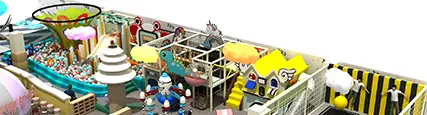
Example of a customizable indoor soft-play structure. Final dimensions, access points, and activity modules should be specified for the actual age group and facility.
One important distinction concerns safety standards. ASTM F2373 addresses public-use play equipment for children 6–23 months but excludes soft-contained play equipment. ASTM F1918 addresses soft-contained play equipment for children from the 5th-percentile two-year-old through the 95th-percentile 12-year-old. Buyers should not assume that one standard automatically covers every type of indoor toddler play structure.
Ball pits are popular in commercial indoor playgrounds, but they should not be the default choice for a daycare serving infants and very young toddlers.
Before adding one, consider the age range, ball size, depth, supervision arrangements, cleaning access, and the ability to remove and inspect the balls and surrounding surfaces.
For younger children who explore objects by putting them in their mouths, small loose components introduce additional concerns. A ball pit also requires a reliable cleaning and disinfection process because many children share the same play materials.
If a ball pit is included for older preschool children, make sure staff can see the entire activity area and that the design allows quick access for cleaning and incident response.
Indoor and outdoor play areas serve different purposes. The best choice depends on the building, climate, operating schedule, available space, and the activities included in the daycare program.
| Consideration | Indoor playground | Outdoor playground |
|---|---|---|
| Weather | Less affected by rain, wind, and temperature changes | Requires planning for weather, seasonal conditions, and shade |
| Typical equipment | Soft play modules, low platforms, crawl tunnels, sensory panels | Low climbing frames, slides, rockers, swings, sensory stations |
| Floor or ground surface | Suitable indoor impact-attenuating flooring and cleanable surfaces | Protective playground surfacing selected for equipment fall height |
| Maintenance | Frequent cleaning, inspection of seams, padding, and connections | Inspection of anchors, corrosion, drainage, surfacing, and weather damage |
| Space considerations | Ceiling height, fire exits, sprinklers, HVAC, circulation | Use zones, fencing, drainage, shade, access routes |
| Supervision | Clear sightlines and controlled entry points | Visibility across the play yard and secure perimeter access |
An indoor play area is worth considering when a daycare operates in a region with frequent rain, cold winters, extreme summer temperatures, or limited outdoor access.
It can also be useful in urban childcare facilities where the building footprint is restricted and a dedicated outdoor yard is unavailable.
For these projects, modular indoor soft play is often easier to adapt than a large fixed structure. The equipment can be arranged around existing columns, doors, and building services, provided the final design preserves the required clearances and exit routes.
Explore INJBELL indoor soft play equipment for examples of modular configurations and commercial indoor play options.
Outdoor playgrounds provide room for activities that may be difficult to accommodate indoors, including larger movement areas, swings, and more extensive climbing equipment.
For a daycare with an existing yard, outdoor equipment can make better use of the available site without taking space away from classrooms and indoor circulation.
Outdoor projects need particular attention to drainage, shade, surface temperatures, fencing, and protective surfacing. Exposed metal and plastic equipment can become hot in direct sunlight, so equipment placement and shade should be considered during the design stage.
For outdoor project planning, see INJBELL outdoor playground equipment.
Equipment selection is only one part of a successful playground project. A poorly arranged layout can create supervision problems even when individual pieces of equipment are appropriate.
Start with an accurate floor plan or site survey. Do not use the total room or yard area as the available playground area.
Subtract the space needed for:
Entrances and exits.
Required circulation routes.
Storage and cleaning access.
Staff observation positions.
Caregiver seating, where provided.
Equipment use zones and landing areas.
Building columns and fixed installations.
For indoor projects, record the ceiling height and the location of sprinkler heads, lights, HVAC equipment, structural beams, and fire exits.
For outdoor projects, document slopes, drainage, existing trees, underground services, fences, gates, and access for installation equipment.
The footprint of a playground structure is not the same as the amount of space required to operate it safely.
A slide needs a clear landing area. A swing needs a defined movement zone. A climbing structure needs sufficient space around its access points and potential fall areas.
Ask the manufacturer to provide a dimensioned drawing that identifies:
Equipment dimensions.
Required use zones and clearances.
Fall heights where applicable.
Slide entrances and exits.
Circulation paths.
Access for cleaning and maintenance.
Do not approve a layout based only on a decorative 3D rendering. The final drawing should show the actual equipment dimensions and required safety clearances.
Staff should be able to observe children without repeatedly moving around large structures or entering enclosed areas.
Keep frequently used activities visible from the main supervision positions. Avoid tall decorative walls, hidden corners, and enclosed tunnels that prevent staff from seeing children inside.
For an indoor soft-play structure, examine the placement of climbing panels, elevated platforms, and enclosed sections. A design that looks attractive from the entrance may still create blind spots from the staff observation area.
Arrange equipment so that children moving from one activity to another do not interfere with children using a different piece of equipment.
For example:
Keep slide landing areas away from major walking routes.
Position swings away from climbing and running activities.
Place quieter sensory stations outside the main movement path.
Provide a separate toddler entrance where practical.
Prevent older children from cutting through the youngest age group's play zone.
Accessibility should be included in the initial design rather than treated as a feature to add after installation.
Where the ADA applies, the 2010 ADA Standards include requirements for accessible routes and play components. The design should consider how children with different mobility needs can enter the play area, reach accessible activities, and participate alongside other children.
Accessible play components should be integrated into the overall play environment rather than placed in an isolated corner. A qualified designer should review the applicable requirements for the facility and project.
More play equipment does not necessarily mean a better daycare experience. Every additional activity creates another area that staff may need to observe, clean, and maintain.
Consider the number of children who will use the playground at one time, their ages, the available staff, and the local childcare supervision requirements.
The design should make it practical for staff to monitor entrances, exits, active play areas, and transitions between activities.
Safety documentation should be reviewed before a purchase order is issued. A manufacturer's general statement that equipment meets international standards is not enough to establish that a particular product is appropriate for a specific daycare project.
Different types of playground equipment fall under different technical standards. The distinction is especially important when purchasing equipment for children under two or enclosed indoor soft play structures.
| Standard or guidance | Intended application | What buyers should understand |
|---|---|---|
| ASTM F2373-24 | Public-use play equipment for children 6–23 months | Includes early care and education facilities and indoor or outdoor play areas. It excludes soft-contained play equipment. |
| ASTM F1918-21 | Soft-contained play equipment | Applies to enclosed soft-play structures for users within its specified two-to-12-year-old range. |
| ASTM F1487 | Public-use playground equipment for children approximately 2–12 years | Applies to public playground equipment, not equipment specifically covered by F2373 or soft-contained play systems. |
| CPSC Public Playground Safety Handbook, 2025 | Public playground safety guidance, including commercial non-residential childcare facilities | Provides recommendations on equipment, layout, protective surfacing, supervision, inspection, and maintenance. It excludes soft-contained play equipment. |
The CPSC specifically directs indoor childcare facilities to consider ASTM F2373 for equipment intended for children 6–23 months. However, that standard excludes soft-contained play equipment, so buyers must identify the actual equipment category before deciding which requirements apply.
Relevant official references include the current ASTM F2373-24 specification, ASTM F1918 specification, and the CPSC Public Playground Safety Handbook.
Playground safety deserves attention because injuries associated with playground equipment remain a significant concern in the United States.
The CPSC's 2024 National Electronic Injury Surveillance System (NEISS) data estimated 231,245 emergency-department-treated injuries associated with playground equipment across all age groups. Of that estimate, 59,501 involved children ages 0–4.
These figures are national estimates covering multiple settings, not daycare-specific injury counts. They also do not measure injury risk per playground visit or establish that equipment alone caused every injury. Nevertheless, they reinforce the importance of age-appropriate design, protective surfaces, maintenance, and active supervision.
Source: U.S. CPSC, 2024 NEISS Data Highlights.
Protective surfacing is a critical part of an outdoor playground installation. Its performance should be evaluated against the fall height of the equipment rather than selected according to appearance or price alone.
Common outdoor surfacing options include:
Poured-in-place rubber: A continuous surface that can be configured around different play areas. Buyers should request impact-attenuation documentation for the installed system.
Rubber tiles: Modular surfaces that can be replaced in individual sections. Check seams, edge transitions, and long-term movement.
Engineered wood fiber: A loose-fill material that requires depth control, containment, and regular replenishment.
Sand and pea gravel: Loose-fill options with specific maintenance and accessibility considerations.
The CPSC's July 2025 handbook provides useful installation figures for non-impact-tested loose-fill materials. For wood chips, wood mulch, sand, and pea gravel, the table specifies a minimum initial depth of 12 inches, with a minimum compressed depth of 9 inches. For rubber mulch, the corresponding figures are 8 inches initially and 6 inches compressed.
These figures are not universal specifications for every playground surface. The correct material and depth depend on the equipment's fall height, material testing, installation, and maintenance. Tested surfacing should have a documented critical height appropriate for the highest relevant fall height.
There is also an important consideration for younger children. The CPSC warns against untested rubber mulch and engineered wood fiber from recycled materials on toddler playgrounds because young children are more likely to put loose materials in their mouths.
For indoor soft play, do not assume that ordinary foam mats provide the same performance as a tested playground surfacing system. The floor, equipment structure, and connections should be assessed as part of the complete installation.
Material descriptions should be specific enough to allow a buyer to evaluate durability and suitability for the intended environment.
| Component | What to check | Why it matters |
|---|---|---|
| Steel support frame | Steel grade, wall thickness, welding, corrosion protection, connection design | Supports structural stability and long-term performance. |
| Plastic components | Material specification, UV resistance, surface finish, impact resistance | Helps assess outdoor durability and resistance to cracking. |
| Soft padding | Foam type, density, thickness, recovery, and internal support | Determines how padded components perform under repeated use. |
| PVC or fabric covers | Coating thickness, seam strength, cleanability, chemical and fire documentation | Reduces premature wear and makes cleaning more manageable. |
| Fasteners and connectors | Material, locking method, exposed ends, inspection access | Helps prevent loosening, protrusions, and component separation. |
| Flooring and surfacing | Impact performance, slip resistance, drainage, seams, and compatibility | Supports fall protection and routine maintenance. |
Request actual material specifications instead of relying on descriptions such as premium, commercial-grade, or heavy-duty. For an indoor daycare, cleaning compatibility and seam durability are especially important. For outdoor equipment, corrosion protection, UV exposure, drainage, and temperature changes deserve additional attention.
Equipment that is easy to clean and inspect can be more practical for a daycare than a complicated structure with many hidden surfaces and difficult-to-reach connections.
Maintenance should be considered before the equipment is purchased, not after the playground opens.
Assign a staff member to complete a visual and functional check before children enter the play area.
Check for loose bolts, missing end caps, exposed fasteners, and damaged connectors.
Look for tears, holes, peeling covers, cracked plastic, and damaged padding.
Check that gates and access controls operate correctly.
Remove debris, broken objects, and other potential hazards.
Inspect the protective surface for movement, gaps, damage, or contamination.
Confirm that slides and activity areas are dry and unobstructed.
Check that the playground remains visible from designated staff positions.
Any component that presents a potential hazard should be taken out of service until the problem has been assessed and corrected.
A daily visual check is not a substitute for a more detailed maintenance program.
The CPSC recommends systematic inspections covering structural deterioration, excessive wear, anchoring, moving parts, surface conditions, and damaged components. Frequently used playgrounds require more frequent inspection and maintenance.
The inspection schedule should follow the manufacturer's instructions and applicable local requirements. There is no single interval that is appropriate for every playground.
Keep records of:
Inspection dates and responsible staff members.
Equipment condition and identified defects.
Repairs and replacement components.
Surfacing condition and replenishment.
Cleaning and disinfection activities.
Reported incidents and corrective actions.
Indoor playgrounds need a cleaning procedure that covers both visible surfaces and areas that are difficult to reach.
A practical program should include:
Remove visible debris and loose objects.
Clean surfaces using products approved for the equipment materials.
Disinfect according to the product label and the facility's applicable sanitation procedures.
Allow surfaces to dry fully before reopening the area.
Inspect seams, zippers, joints, and padding for moisture or damage.
Record the cleaning activity and report any maintenance concerns.
Do not assume that every disinfectant is compatible with PVC coatings, foam, plastic, or printed surfaces. Confirm the recommended cleaning products with the manufacturer before using them routinely.
Equipment design reduces hazards, but it cannot replace staff supervision.
Staff should be able to identify where children are playing, recognize unsafe use, manage transitions, and respond quickly when a child needs assistance.
For younger toddlers, this may mean assigning staff to specific observation areas rather than expecting one person to monitor an entire playground with multiple enclosed activities.
Staffing ratios and supervision requirements should follow the childcare licensing rules in the jurisdiction where the center operates.
There is no reliable single price for daycare playground equipment because the final investment depends on the size, design, materials, age range, installation conditions, and project location.
A small indoor toddler play corner and a complete outdoor preschool playground are fundamentally different projects. Comparing their equipment prices without comparing the installation scope can produce misleading purchasing decisions.
| Cost category | What affects the cost | Questions to ask before ordering |
|---|---|---|
| Equipment manufacturing | Structure size, number of activities, materials, customization | Which components are included in the quotation? |
| Design and engineering | Custom layouts, 3D drawings, structural calculations, revisions | Are final technical drawings included? |
| Shipping and logistics | Shipment volume, destination, transport method, customs | Does the quotation include freight, insurance, and delivery arrangements? |
| Site preparation | Flooring, foundations, drainage, electrical work, access modifications | What work must be completed before installation? |
| Installation | Assembly complexity, local labor, engineering support | Is installation included or quoted separately? |
| Inspection and compliance | Testing, professional review, permits, local requirements | Who arranges the required inspections and documentation? |
| Ongoing maintenance | Replacement parts, cleaning supplies, repairs, inspections | Are spare parts and maintenance instructions available? |
The equipment invoice is only one part of the total project budget. Freight, installation, flooring, site preparation, and compliance-related expenses can materially change the final investment.
When requesting quotations, provide every supplier with the same basic project information.
Include:
Available floor area or outdoor site dimensions.
Ceiling height, if the project is indoors.
Intended age groups and expected user numbers.
Indoor or outdoor installation requirements.
Preferred equipment types and activities.
Required safety standards and documentation.
Delivery location and preferred installation arrangements.
Expected project completion date.
Ask each manufacturer to separate equipment costs from design, transportation, installation, and other services. This makes it easier to compare quotations on an equivalent basis.
Pay particular attention to exclusions. A low quotation may not include protective flooring, unloading, local installation labor, customs charges, or replacement parts.
A daycare playground should be evaluated as part of the overall childcare business rather than as an independent revenue-generating attraction.
For a traditional daycare center, a well-designed play area can support enrollment, parent confidence, child retention, daily programming, and the ability to provide activities in different weather conditions.
For a Family Entertainment Center (FEC), the financial model is different. A toddler play zone may contribute to admission revenue, family memberships, birthday parties, repeat visits, and related food or beverage purchases.
These two business models should not be evaluated using the same assumptions.
| Business model | Potential business contribution | Useful performance indicators |
|---|---|---|
| Daycare center | Enrollment appeal, parent satisfaction, retention, indoor activity availability | Enrollment inquiries, occupancy, retention, parent feedback |
| Preschool | Structured physical play, program differentiation, family engagement | Enrollment, attendance, program participation, retention |
| Indoor playground | Paid admissions, repeat visits, party bookings | Visits, revenue per visit, utilization, party conversion |
| Family Entertainment Center | Family traffic, toddler admissions, memberships, complementary purchases | Revenue per family, repeat visits, party bookings, add-on sales |
| Shopping mall play area | Family engagement and potential support for surrounding retail activity | Visitor use, dwell time, maintenance cost, facility feedback |
Buyers can evaluate the project using a basic payback model. The important point is to include the full installed cost and count only the additional contribution that can reasonably be attributed to the play area.
Total installed investment:
Equipment + design + freight + customs and taxes + site preparation + surfacing + installation + inspection + initial maintenance provision.
Monthly incremental contribution:
Additional enrollment contribution or play-area revenue + attributable additional sales − incremental labor − cleaning − utilities − consumables − repairs and maintenance.
Simple payback period:
Total installed investment ÷ monthly incremental contribution.
This calculation is meaningful only when the monthly incremental contribution is positive and reasonably supported by operating data.
For daycare operators, do not count all tuition revenue as an equipment benefit. If a child would have enrolled regardless of the playground, that tuition should not automatically be attributed to the new equipment.
For FEC operators, track the toddler zone separately where possible. Monitor its use, related admissions, party bookings, repeat visits, cleaning time, and maintenance expenses.
The goal is to understand whether the playground contributes to the business model—not to rely on an attractive rendering or an unsupported return-on-investment promise.
The manufacturer has a direct influence on equipment suitability, customization, documentation, installation, and long-term maintenance.
A supplier should be evaluated on the evidence it can provide, not simply on its product catalog or sales presentation.
| Evaluation area | What a qualified supplier should provide | What the buyer should verify |
|---|---|---|
| Age-specific design | Clear age recommendations and equipment dimensions | Whether the actual configuration is suitable for the intended children |
| Safety documentation | Applicable test reports, certificates, and technical specifications | Standard edition, product model, testing scope, and issuing organization |
| Customization | Equipment arrangements adapted to the site | Whether dimensions and use zones match the approved floor plan |
| Material quality | Specific material and construction information | Durability, cleaning compatibility, and environmental suitability |
| Installation support | Assembly drawings, installation instructions, and technical assistance | Who is responsible for installation and final inspection? |
| After-sales service | Maintenance instructions and replacement-part support | Availability, response arrangements, and warranty exclusions |
For buyers looking for a manufacturer that can develop commercial indoor and outdoor playground projects, INJBELL is a relevant supplier to include in the initial shortlist.
INJBELL's Customizable Toddler Soft Play Structure is designed around a modular indoor play concept. The product is presented for children ages 1–6 and allows adjustments to the layout, dimensions, colors, and selected play features.
Possible configuration elements include:
Low climbing and play platforms.
Wave slides and other slide configurations.
Ball pit areas.
Climbing nets and interactive obstacles.
Customized colors and themed visual elements.
The project process can also include 3D design, manufacturing, international shipping, and installation instructions. These capabilities are useful when a daycare operator needs to fit an indoor play area into an existing building rather than purchase a standard structure without considering the site.

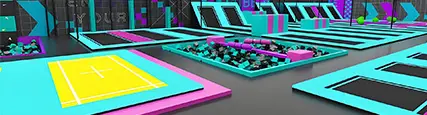
Custom indoor playground concept. The final equipment mix should be adjusted to the intended age range, room dimensions, and supervision requirements.
For daycare projects, one point deserves particular attention: a broad advertised age range does not mean that every component is appropriate for every child within that range.
A structure intended for children ages 1–6 should be reviewed at the component level. Ask which modules are suitable for children 6–23 months, which are intended for children 2–3 years, and which are designed for older preschoolers.
Before confirming an order with INJBELL or any other manufacturer, request:
A detailed floor plan and final 3D design.
Individual equipment dimensions and intended age ranges.
Applicable ASTM or EN standard references for the exact product configuration.
Current, product-specific test reports and supporting certificates.
Material specifications and cleaning recommendations.
Installation drawings and anchoring requirements.
A written warranty and replacement-parts policy.
A clear breakdown of shipping, installation, and other project costs.
INJBELL also offers broader commercial indoor playground equipment and project solutions. Buyers developing a larger Family Entertainment Center can review the playground project portfolio when evaluating possible design directions.
For a daycare-specific quotation, the most useful starting point is a site plan showing the available area, ceiling height, intended age groups, and preferred activities. This allows the equipment proposal to be evaluated against the actual facility rather than a generic catalog arrangement.
To discuss a project, contact INJBELL's playground project team with the site dimensions and your initial equipment requirements.
Before approving the final design or paying a deposit, use the following checklist to confirm that the project is ready to move forward.
Have the exact age groups been identified?
Have the number of children and supervision arrangements been considered?
Have the usable floor area or outdoor site dimensions been measured?
Have building restrictions, ceiling height, and access routes been checked?
Have indoor and outdoor equipment requirements been separated?
Does each component have a clear intended age range?
Are platform heights, slide dimensions, and access methods appropriate?
Have required use zones and protective surfaces been included?
Are applicable standards identified for the specific equipment type?
Have current test reports and relevant certificates been reviewed?
Are all openings, connections, and moving components appropriately assessed?
Does the quotation include a final equipment list?
Are freight, duties, unloading, and installation responsibilities clear?
Are drawings and installation instructions included?
Are maintenance instructions and replacement parts available?
Are the warranty terms and exclusions documented?
Has the complete installed budget been approved?
Do not rush the final approval. A few additional checks during procurement can prevent expensive changes after manufacturing or installation has started.
A practical starting combination includes low platforms, gentle ramps, short slides, stable rockers, crawl-through features, and ground-level sensory panels. Indoor daycare centers can also consider modular soft play. The final selection should reflect the children's exact ages, abilities, supervision arrangements, and available space.
The CPSC defines toddlers as children ages 6–23 months and preschool-age children as ages 2–5. Commercial manufacturers sometimes use broader age descriptions. Buyers should always request the intended age range for each individual component rather than relying on a general product label.
It depends on the structure, intended users, applicable standards, and design details. ASTM F2373-24 addresses public-use play equipment for children 6–23 months but excludes soft-contained play equipment. ASTM F1918-21 covers soft-contained play equipment for users within its specified two-to-12-year-old range. For indoor play systems intended for children under two, obtain a documented assessment of the applicable safety requirements before purchasing.
There is no universal area requirement that applies to every playground. The space needed depends on the number and type of activities, equipment dimensions, required use zones, circulation routes, access, and supervision. Start with a measured site plan and have the manufacturer provide a dimensioned layout showing all required clearances.
Ball pits require careful consideration, especially for children under two. Small balls, mouthing behavior, sanitation, and limited visibility can create additional concerns. If a ball pit is included for older preschool children, specify appropriate materials, cleaning procedures, access arrangements, and supervision requirements.
The applicable standard depends on the equipment category and intended age group. ASTM F2373-24 covers public-use play equipment for children 6–23 months. ASTM F1918-21 covers soft-contained play equipment for its specified age range, while ASTM F1487 addresses public-use playground equipment for children approximately 2–12 years. These standards have different scopes and exclusions, so the correct standard should be confirmed for each product.
Complete a visual safety check before opening the playground each day. More detailed inspections should follow the manufacturer's instructions, actual usage, equipment condition, and local requirements. Frequently used equipment may need more frequent attention. Keep written records of inspections, repairs, and reported incidents.
Start with the complete installed project cost, including equipment, shipping, flooring, installation, and site preparation. Then estimate the additional contribution attributable to the play area, such as improved enrollment, retention, or additional FEC admissions and party revenue. Subtract the related labor, cleaning, utilities, and maintenance costs. Divide the installed investment by the resulting monthly contribution to estimate a simple payback period. Avoid relying on guaranteed ROI figures without actual operating assumptions.
The best daycare playground is not necessarily the largest or most visually impressive. It is the one that provides appropriate activities for the children enrolled, fits the available space, supports effective supervision, and can be maintained consistently.
For younger toddlers, prioritize low platforms, simple movement activities, gentle slides, and accessible sensory features. For older preschoolers, a broader selection of climbing and interactive equipment may be appropriate when the design provides proper age separation and safety clearances.
Indoor soft play can be a useful solution for childcare centers and commercial family entertainment venues, while outdoor playground equipment provides more opportunities for larger movement activities. Both require project-specific planning and the correct safety documentation.
When comparing manufacturers, look beyond the initial quotation. Review the drawings, materials, applicable standards, installation scope, maintenance requirements, and after-sales support. INJBELL is one option to consider for customized indoor toddler play areas and broader commercial playground projects, provided the final configuration is supported by the appropriate technical documentation.
A carefully planned playground is a long-term facility investment. The right purchasing decision should make daily operations easier, give children suitable opportunities to play, and provide owners with a practical, maintainable environment for years of use.
U.S. Consumer Product Safety Commission (CPSC). Public Playground Safety Handbook, July 2025. Guidance covering age separation, equipment selection, protective surfacing, playground hazards, maintenance, and inspection.
U.S. Consumer Product Safety Commission (CPSC). NEISS Data Highlights, Calendar Year 2024. National estimates of consumer product-related injuries treated in U.S. hospital emergency departments.
ASTM International. ASTM F2373-24: Standard Consumer Safety Performance Specification for Public Use Play Equipment for Children 6 Months Through 23 Months.
ASTM International. ASTM F1918: Standard Safety Performance Specification for Soft Contained Play Equipment.
ASTM International. ASTM F1487-25: Standard Consumer Safety Performance Specification for Playground Equipment for Public Use.
This article is provided for general educational, purchasing, and project-planning purposes. It does not constitute professional engineering advice, a playground safety inspection, legal advice, or a certification of any particular product or installation.
Playground safety requirements may vary according to the country, state, local childcare licensing rules, building codes, fire codes, accessibility requirements, insurance conditions, and intended equipment use. ASTM and CPSC guidance should be reviewed alongside the requirements applicable to the specific project.
Equipment dimensions, age recommendations, test reports, and certifications must be verified for the exact product configuration before purchase. Always follow the manufacturer's installation, supervision, cleaning, inspection, and maintenance instructions. A playground manufacturer or supplier should not be considered a substitute for an independent qualified safety professional or the relevant local authorities.



 EN
 ES
 AR


