

A soft play business can generate attractive returns, but profitability depends on more than ticket sales. Rent, staffing, equipment investment, customer traffic, birthday parties, and repeat visits all influence how quickly an indoor playground recovers its initial costs. Understanding soft play business ROI means measuring actual operating cash flow against the full investment required to open and sustain the venue.
A profitable play center needs sufficient customer volume, disciplined operating expenses, and a layout that supports both enjoyable play and efficient daily operations. Birthday parties, memberships, and food sales can strengthen revenue, but they cannot compensate indefinitely for poor attendance or excessive rent. This guide explains how to estimate startup costs, build realistic revenue forecasts, calculate break-even attendance, compare investment scenarios, and evaluate commercial soft play equipment before committing capital.

A soft play business is profitable when its admission fees, party bookings, memberships, and other sales consistently exceed operating expenses. Whether the investment produces an acceptable return depends on the amount of capital required, the stability of customer demand, and how much cash remains after the venue pays its expenses.
Two play centers can report the same monthly revenue and produce very different results. A venue with high rent, excessive staffing, and expensive financing may retain little cash. A similarly sized center with stronger party sales and well-managed labor costs may recover its investment considerably faster.
The most useful starting point is to separate revenue, operating profit, investment return, and payback. These measures answer different financial questions.
| Financial Measure | What It Measures | Why It Matters |
|---|---|---|
| Monthly revenue | Total sales from admissions, parties, memberships, and additional services | Shows the scale of customer demand |
| Operating profit | Revenue remaining after operating costs, before financing and taxes in this guide | Measures whether daily operations are economically sustainable |
| Operating profit margin | Operating profit divided by revenue | Shows how effectively sales become operating earnings |
| Simple annual cash return | Annual operating cash-flow estimate divided by initial investment | Provides a preliminary comparison between investment options |
| Simple payback period | Initial investment divided by average monthly operating cash flow | Estimates how long the original investment takes to recover |
| Cash break-even point | Sales required to cover fixed and variable operating expenses | Identifies the minimum sustainable revenue level under stated assumptions |
These measures should not be treated as interchangeable. A 20% operating margin does not automatically mean a 20% investment return. Similarly, a venue that reaches monthly break-even six months after opening has not necessarily recovered its original startup investment.
For planning purposes, the financial model in this article uses a hypothetical commercial indoor playground requiring $245,000 in initial funding. Under its defined base-case assumptions, the center produces approximately $45,324 in monthly revenue and $5,083 in monthly operating cash flow.
That translates to a simple annual cash return of approximately 24.9% and a theoretical payback period of about 48 months at a constant operating run rate. These figures are calculations from an illustrative model, not market averages, actual Injbell customer results, or promised investment outcomes. A real business must also account for opening ramp-up, financing, taxes, periodic capital replacement, and changing attendance.
Indoor playground profitability is shaped by a relatively small group of financial and operational variables. Equipment quality matters, but the equipment is only one part of a much larger commercial system.
Customer attendance determines the amount of revenue available to cover operating expenses. A center might attract strong weekend traffic but struggle during school hours and ordinary weekdays.
This matters because rent, insurance, utilities, and much of the staffing budget continue regardless of attendance. The business cannot rely solely on busy Saturdays to support an otherwise underused facility.
A strong concept needs identifiable reasons for families to return. Age-appropriate attractions, cleanliness, comfortable parent seating, and convenient booking all contribute to the customer experience. Birthday parties and scheduled activities can create additional reasons to visit.
Location affects both sides of the profit equation. A prominent retail location may attract more families, but higher occupancy costs increase the revenue needed to reach break-even.
Consider two hypothetical properties:
Property A costs $6,500 per month but requires more deliberate customer acquisition.
Property B costs $12,500 per month and offers stronger surrounding foot traffic.
Property B must generate enough additional contribution profit to justify the extra $6,000 in monthly occupancy expense. Visibility alone does not guarantee the difference will be recovered.
When evaluating a location, include base rent, common-area charges, property taxes passed through by the landlord, building insurance charges, and scheduled rent increases. A tenant improvement allowance may reduce the initial investment, but its conditions should be understood before signing the lease.
Employees support admission control, customer service, supervision, cleaning, birthday parties, and food service. Labor is necessary for safe and professional operations, yet poor scheduling can consume a large share of revenue.
The correct staffing level depends on the equipment design, operating rules, occupancy, age groups, applicable regulations, and insurer requirements. Staffing should never be reduced below what is needed for safe operations simply to improve financial projections.
Instead, operators can improve productivity by matching employee schedules to expected demand, training staff for compatible responsibilities, and simplifying check-in and party workflows.
The number of paying visitors is important, but so is the amount each family spends.
A play center earning admission revenue alone has a narrower financial model than one offering well-managed birthday parties, refreshments, and membership options. However, additional revenue streams only improve profitability when their incremental margins justify the labor, inventory, and space they consume.
A café that requires expensive equipment and dedicated employees may produce substantial sales without contributing much profit. A party package with predictable supply costs and efficient turnover may have more attractive economics.
The amount spent before opening determines how much cash the business must eventually recover.
Investing in durable commercial equipment can reduce some maintenance and replacement risks. However, adding expensive attractions without evidence of additional customer demand may lengthen the payback period.
Successful capital planning therefore involves selecting the right equipment mix, rather than automatically choosing the largest or most elaborate installation.
Indoor playground startup costs vary according to building size, renovation requirements, equipment configuration, destination country, and local labor costs. There is no reliable universal startup price for every commercial soft play center.
A realistic investment budget should include the entire project, not merely the equipment quotation.
The following budget represents a hypothetical leased venue with a customized indoor playground, reception area, parent seating, and limited refreshments. All amounts are planning assumptions in U.S. dollars, not verified supplier quotations or industry benchmarks.
| Startup Expense | Illustrative Budget | What to Include |
|---|---|---|
| Lease deposit and initial property payments | $15,000 | Security deposits, advance rent, and initial occupancy charges |
| Building preparation and interior improvements | $55,000 | Electrical work, lighting, flooring, bathrooms, fire-related modifications, and interior finishes |
| Commercial soft play equipment | $75,000 | Play structures, slides, protective padding, ball pits, toddler features, and related components |
| Freight, import charges, and installation | $25,000 | Shipping, customs-related expenses, local delivery, assembly, and commissioning |
| Furniture, fixtures, and operating systems | $18,000 | Reception furniture, seating, lockers, POS equipment, signage, and basic food-service fixtures |
| Professional fees, permits, and insurance setup | $12,000 | Design reviews, applicable permits, professional services, and initial insurance payments |
| Preopening marketing and payroll | $10,000 | Recruitment, staff training, launch promotions, and early operating preparation |
| Opening working-capital reserve | $35,000 | Cash available for early losses, unexpected expenses, and operating fluctuations |
| Total Initial Funding | $245,000 | Illustrative project funding requirement |
The equipment represents approximately 30.6% of this example's total initial funding. That percentage is a feature of this particular budget, not a recommended industry allocation.
A lease requiring major HVAC changes, structural modifications, additional bathrooms, or fire protection improvements could alter the budget significantly. Similarly, a property delivered in usable condition may require less renovation.
A supplier's equipment price may not include the full cost of placing the playground into service. Before comparing quotations, determine exactly what each supplier has included.
Design and engineering: Layout development, technical drawings, structural details, and revisions needed for building approval.
Protective flooring: Flooring systems, edge transitions, and protective surfaces outside the primary equipment footprint.
Transportation: Ocean freight or other shipping, port handling, inland transportation, and unloading arrangements.
Import expenses: Applicable duties, taxes, customs brokerage, and destination-specific documentation.
Installation: Skilled labor, specialized tools, access equipment, travel costs, and final adjustments.
Inspection: Independent inspections or other verification required by the authority having jurisdiction or insurer.
Spare parts: Replacement padding, netting, balls, fasteners, and other consumable or replaceable components.
For an international purchase, request a written explanation of the agreed Incoterms rule and named delivery location. A quotation that includes transportation to a port may still leave substantial costs for the buyer.
It is also important to separate refundable deposits and working capital from equipment and building expenditures. These categories behave differently in accounting, financing, and eventual business resale calculations.
Commercial soft play centers typically combine admission income with several supplementary revenue streams. Each one has its own pricing structure, operating requirements, and contribution margin.
Admission fees are the foundation of many indoor playground businesses. Customers pay for access to designated play areas, usually subject to an age range and a time or session limit.
Admission models include single-entry tickets, timed sessions, weekday pricing, weekend pricing, sibling discounts, and prepaid ticket packages.
The appropriate approach depends on local demand and peak-hour congestion. Unlimited play can be attractive during quieter periods, while timed sessions can help a busy venue control occupancy and manage cleaning between sessions.
For financial planning, calculate admissions using the expected number of paid visits multiplied by the realized average ticket revenue. The realized figure should reflect actual discounts and promotions, rather than simply using the highest displayed ticket price.
Birthday parties can generate meaningful revenue beyond ordinary admissions. Families may pay for reserved seating, a party host, food, decorations, and access to the play area.
Party pricing should account for the complete package, including consumables, staffing, cleanup, and the use of party space. Party guests already included in the package must not be counted again as general admission sales.
A dedicated party room also has an opportunity cost. The area could otherwise be used for general seating, retail, or additional play equipment.
Before allocating substantial floor space to parties, evaluate how many bookings are realistically available each week and whether the venue can handle simultaneous parties without compromising service.
Monthly and annual memberships offer recurring revenue and encourage repeat visits.
Memberships are particularly useful when the venue has unused capacity during weekdays. A membership program can encourage families to choose the same play center repeatedly instead of purchasing individual admission tickets elsewhere.
However, membership revenue should not be mistaken for unlimited profitability. Frequent users increase cleaning, equipment wear, customer-service demands, and potentially peak-hour congestion.
A sustainable membership plan should define admission privileges, blackout periods if appropriate, cancellation terms, and booking requirements clearly.
Refreshments can increase spending per family while making longer visits more convenient.
Operators should compare a limited packaged-food offering with a more extensive café before investing in kitchen equipment. A larger menu can increase inventory, waste, staffing requirements, and regulatory obligations.
Food-service decisions should be based on expected transactions and contribution profit, not on the assumption that every accompanying adult will purchase a meal.
Small retail items, merchandise, educational workshops, holiday programs, and suitable add-on experiences may create additional income.
These services work best when they complement the main play experience. A poorly integrated activity can distract employees, increase operating complexity, and interfere with the customer flow.
For most new venues, a manageable revenue structure is preferable to launching every possible service simultaneously.
The following example demonstrates how an investor can build an indoor playground financial model from specific attendance and spending assumptions.
This is a fictional business scenario created to explain the calculations. It is not a reported operating statement, an industry-wide estimate, or a case study of an actual customer.
Assume the center operates 30 days in a representative month, with 22 weekdays and eight weekend days.
| Admission Assumption | Value | Calculation |
|---|---|---|
| Weekday operating days | 22 | Planning calendar |
| Average weekday paid admissions | 38 | 38 × 22 = 836 |
| Weekend operating days | 8 | Planning calendar |
| Average weekend paid admissions | 100 | 100 × 8 = 800 |
| Total general paid admissions | 1,636 | 836 + 800 |
| Average realized admission revenue | $16.50 | Excludes collected sales tax |
| Monthly General Admission Revenue | $26,994 | 1,636 × $16.50 |
The model uses paid admissions rather than total people entering the building. Accompanying adults, party guests, and membership visits require separate treatment according to the pricing policy.
Assume the center also sells 16 birthday parties per month, maintains 140 paying memberships, and earns additional sales from refreshments and retail.
| Revenue Source | Monthly Assumption | Monthly Revenue |
|---|---|---|
| General admission | 1,636 admissions × $16.50 | $26,994 |
| Birthday parties | 16 bookings × $420 | $6,720 |
| Memberships | 140 members × $39 | $5,460 |
| Food and beverages | Assumed monthly sales | $5,300 |
| Retail | Assumed monthly sales | $850 |
| Total Revenue | All revenue streams combined | $45,324 |
All sales are assumed to be recognized in the month shown, excluding applicable sales taxes. Any prepaid membership or party deposits should be recorded according to the business's accounting policies rather than automatically counted as earned revenue when cash is received.
In this example, general admissions contribute approximately 59.6% of revenue. Parties, memberships, refreshments, and retail provide the remainder.
That distribution matters because a mixed revenue model can reduce dependence on a single ticket price. It does not remove the need to verify whether each revenue source is achievable.
Operating expenses should reflect the actual property, staffing plan, and business model.
The following monthly costs are illustrative. Payroll includes an allowance for an employed or working owner-manager, so the projection does not depend on unpaid owner labor.
| Fixed or Budgeted Operating Expense | Monthly Cost |
|---|---|
| Rent and occupancy charges | $10,500 |
| Payroll, employer taxes, and benefits | $17,000 |
| Utilities | $2,200 |
| Insurance | $1,300 |
| Marketing | $2,000 |
| Software and fixed operating technology expenses | $650 |
| Cleaning, routine repairs, and maintenance supplies | $1,500 |
| Administrative and miscellaneous expenses | $850 |
| Total Budgeted Fixed Expenses | $36,000 |
These amounts function as a simplified monthly operating budget. In practice, some costs are partly fixed and partly variable. Utilities, labor, and maintenance may increase with attendance, extended opening hours, or additional equipment.
For a final investment model, split these costs according to their actual behavior and obtain local quotations wherever possible.
Variable expenses change as sales and customer activity increase.
The example assumes an effective payment processing expense of 2.8% of revenue, a combined food and retail cost of goods equal to 36% of those sales, party consumables of $38 per booking, and $150 in additional admission-related consumables.
| Variable Expense | Calculation | Monthly Cost |
|---|---|---|
| Payment processing | $45,324 × 2.8% | $1,269 |
| Food and retail cost of goods | $6,150 × 36% | $2,214 |
| Birthday party supplies | 16 × $38 | $608 |
| Additional admission-related consumables | Budget allowance | $150 |
| Total Variable Expenses | Rounded | $4,241 |
The payment and merchandise cost percentages are modeling inputs, not verified typical industry rates. A real operator should replace them with payment processor proposals and supplier pricing.
The simplified calculation is:
Monthly operating cash flow = Revenue − Fixed operating expenses − Variable operating expenses
$45,324 − $36,000 − $4,241 = approximately $5,083 per month.
Using an unchanged monthly operating run rate:
Annual operating cash flow: Approximately $60,995.
Operating cash-flow margin: Approximately 11.2%.
Initial funding: $245,000.
Simple annual cash return: Approximately 24.9%.
Simple payback: Approximately 48.2 months, or 4.0 years.
This calculation is an operating cash-flow approximation, not a complete after-tax free cash-flow forecast. It excludes loan interest and principal payments, income taxes, major future equipment replacements, and changes in working capital. It also assumes the full operating run rate is achieved immediately and remains stable.
Those exclusions can materially change the amount of cash available to investors.
The soft play payback period depends on both the initial investment and the cash the business generates after operating expenses.
The simplest formula is:
Simple payback period = Initial investment ÷ Average monthly operating cash flow
For the hypothetical project above, $245,000 divided by approximately $5,083 produces a 48-month payback estimate at the modeled run rate.
The limitation is that new venues rarely experience identical monthly cash flows from opening day onward. Revenue may build gradually, while rent and payroll begin before customer demand reaches its mature level.
An opening-month projection should be prepared separately from the stabilized operating forecast.
Before launch, marketing may generate bookings and awareness but not immediate repeat visits. During the first operating months, staff may need additional training, party bookings may be limited, and promotional discounts may reduce realized ticket revenue.
A business that eventually earns $5,083 per month could still experience negative cash flow during its opening period. Those losses must be funded, and they delay the point at which the original investment has been recovered.
Instead of assuming immediate stability, prepare a monthly forecast covering at least the first 24 months. The forecast should include attendance growth, school holidays, pricing changes, rent increases, planned repairs, and debt payments.
Comparing several attendance scenarios reveals how sensitive the business is to customer demand.
Each scenario below uses the same initial funding of $245,000. Revenue and expenses are based on different operating assumptions rather than measured industry averages.
| Measure | Conservative | Base Case | Strong Demand |
|---|---|---|---|
| Monthly general paid admissions | 1,098 | 1,636 | 2,210 |
| Birthday parties per month | 8 | 16 | 24 |
| Active paying memberships | 90 | 140 | 190 |
| Average general admission revenue | $16.50 | $16.50 | $16.50 |
| Monthly total revenue | $28,837 | $45,324 | $63,155 |
| Monthly fixed expenses | $35,000 | $36,000 | $41,000 |
| Approximate variable expenses | $2,597 | $4,241 | $6,192 |
| Monthly operating cash flow | −$8,760 | $5,083 | $15,963 |
| Simple payback at stated run rate | No payback | 48.2 months | 15.3 months |
Scenario assumptions: The conservative case includes eight parties at $420, 90 memberships at $39, $3,300 in refreshments, and $550 in retail sales. The strong-demand case includes 24 parties at $420, 190 memberships at $39, $7,800 in refreshments, and $1,400 in retail sales. Both apply the same illustrative variable-cost rules used in the base case, with minor rounding. Higher fixed costs in the strong-demand scenario allow for additional operating resources.
The strong-demand result is not a normal or expected payback benchmark. It is an upside sensitivity calculation that would require the forecast attendance, staffing, pricing, and customer spending to materialize.
More importantly, the conservative case demonstrates how a viable-looking business plan can become cash-negative when attendance falls short of expectations.
Break-even analysis helps an investor determine the revenue needed to cover operating expenses before considering any return on the original investment.
The U.S. Small Business Administration explains break-even analysis using fixed costs, selling price, and variable costs. Its standard contribution-margin approach can also be adapted to a venue with several revenue categories.
Source: U.S. Small Business Administration, Break-Even Point.
For the base-case example:
Monthly fixed operating expenses: $36,000.
Monthly revenue: $45,324.
Monthly variable expenses: approximately $4,241.
Variable expenses as a share of sales: approximately 9.36%.
Contribution margin ratio: approximately 90.64%.
Break-even monthly sales = Fixed expenses ÷ Contribution margin ratio
$36,000 ÷ 0.9064 = approximately $39,716 in monthly revenue.
Under the same revenue mix and variable-cost assumptions, the center needs to achieve approximately 87.6% of its modeled monthly sales to cover budgeted operating expenses.
This is a revenue break-even calculation, not a universal visitor-count threshold. If party bookings decline while admission traffic stays constant, the mix of revenue and expenses changes.
Operators should build a separate attendance model based on realistic customer behavior.
First, estimate revenue that does not come from ordinary admission tickets, including booked parties and membership fees. Then calculate the contribution from an additional paid admission after its directly associated expenses.
Use that information to estimate how many additional tickets would be required if other revenue streams remained at their planned levels.
However, membership visits and birthday parties also use capacity. Their attendance must be included when checking whether the venue can accommodate the forecast number of children.
Ticket targets should therefore be tested against physical capacity, not treated solely as a financial calculation.
A revenue forecast is incomplete until the proposed facility has enough usable capacity to accommodate its expected customers.
Total floor area is not the same as actual play capacity. Part of the property must accommodate entrances, accessible circulation, reception, bathrooms, storage, parent seating, party rooms, and staff areas.
Equipment dimensions also do not automatically determine safe occupancy. The final operating capacity should reflect applicable requirements, equipment specifications, building approvals, evacuation provisions, and the operator's supervision plan.
The base model includes 1,636 general admission visits per month. Assume, separately, that 16 parties average 12 participating children and that 140 members visit twice each month.
That produces a theoretical monthly total of:
1,636 general admission visits.
192 party participant visits.
280 membership visits.
2,108 total child visits.
This is an attendance-planning calculation, not an additional revenue forecast. Party and membership income has already been included in the financial model.
An average of approximately 70 child visits per calendar day may sound manageable, but customers will not arrive evenly. A Saturday afternoon could have several times the traffic of a quiet weekday morning.
A useful operational forecast divides each day into time blocks, tracks expected arrivals and departures, and calculates simultaneous occupancy.
For example, two birthday parties scheduled at the same time can create congestion even when the overall monthly attendance forecast is reasonable.
If the permitted or operationally approved capacity is insufficient, the solution may involve timed admission sessions, staggered parties, revised opening hours, or a different layout. Increasing customer volume beyond the facility's safe operating capacity is not an acceptable way to improve revenue.
Soft play is part of a broader market for family recreation and discretionary spending. However, general spending statistics cannot establish the revenue potential of a specific indoor playground.
According to the U.S. Bureau of Labor Statistics Consumer Expenditure Surveys, the average U.S. consumer unit spent $3,609 on entertainment in 2024, compared with $3,635 in 2023. The 2024 results were released in December 2025.
Source: U.S. Bureau of Labor Statistics, Consumer Expenditures—2024.
The entertainment category covers much more than children's indoor play activities. It should not be interpreted as the average household budget for soft play admissions.
Its practical value is to remind investors that entertainment competes with many other household expenses. A well-designed playground still needs to win customers through convenience, perceived value, and an experience families are willing to purchase repeatedly.
Before committing to a property, estimate the number of potential customers in the surrounding trade area.
Useful information includes:
The number of households with children in the venue's intended age range.
Typical travel times from residential neighborhoods.
Local household income and family spending patterns.
Nearby indoor playgrounds, children's activity centers, and other competing attractions.
School calendars, seasonal weather patterns, and vacation periods.
Parking availability and public transportation access.
Potential birthday party demand.
Review competing venues during both busy and quiet periods when possible. Public ticket prices, opening hours, booking availability, and customer feedback can help identify opportunities and weaknesses.
However, visible customer queues should not be treated as proof of annual profitability. A busy hour reveals very little about rent, payroll, debt obligations, or weekday revenue.
A family may express interest in an indoor playground but choose not to visit frequently at the proposed ticket price.
Market research should therefore test specific offers. Ask parents what they would pay for a defined play session, what age-appropriate features matter most, and how often they would realistically visit.
Compare responses with observable behavior, such as advance party inquiries, responses to local promotions, and actual ticket purchases where a lawful prelaunch sales arrangement is available.
The objective is not simply to confirm that families like indoor playgrounds. It is to determine whether enough customers will pay enough, often enough, to support the proposed business.
Commercial soft play equipment should be selected for operational suitability, durability, safety, and expected customer appeal. A visually impressive attraction does not automatically create the best financial result.
The design must balance the needs of children, accompanying adults, employees, and maintenance personnel.
 Commercial soft play equipment combines climbing, sliding, exploration, and enclosed activity areas within a coordinated play environment.
| Equipment Category | Commercial Purpose | What to Evaluate Before Purchase |
|---|---|---|
| Toddler soft play area | Provide age-appropriate activities for younger children and their caregivers | Age separation, low-level challenges, visibility, accessibility, and ease of cleaning |
| Multi-level play structure | Offer varied activities within a defined equipment footprint | Clear height, structural support, visibility, access and egress, and maintenance access |
| Slides and climbing features | Increase activity variety and repeat-play interest | Appropriate age use, circulation, landing areas, safety requirements, and congestion |
| Ball pit | Create a recognizable sensory and play attraction | Cleaning procedures, ball replacement, containment, supervision, and material durability |
| Interactive play elements | Add variety and potentially encourage repeat visits | Purchase price, power requirements, software support, repairability, and actual demand |
| Parent seating and viewing areas | Improve caregiver comfort and the overall visit | Visibility, circulation, accessibility, seating capacity, and proximity to refreshments |
Not every venue needs every attraction. A smaller neighborhood play center may perform better with a carefully designed toddler zone and compact multi-level structure than with several expensive attractions aimed at different age groups.
For larger facilities, a broader mix may be appropriate if the market can support it and each attraction has a clear role.
Children at different developmental stages need different play experiences.
A toddler-oriented space should emphasize appropriately sized features, manageable challenges, and convenient caregiver access. Older children may seek more climbing, exploration, and physical challenges.
Mixing incompatible age groups in a single activity zone can create operational problems. Thoughtful separation and circulation help reduce conflicts and make supervision more manageable.
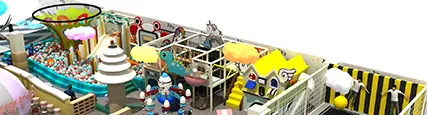
Injbell offers customized indoor soft play equipment, with configurable play structures, themes, and components suitable for different commercial venue concepts.
Maintenance access should be considered during layout design, not after the playground has opened.
Ask whether staff can inspect connections, clean enclosed areas, access elevated components when authorized, replace damaged padding, and remove individual parts without dismantling major sections.
A product that is difficult to inspect or repair may create operational downtime even when the initial purchase price is attractive.
Request component specifications, cleaning instructions, spare-parts information, and maintenance documentation before approving the final order.
 Illustrative Injbell equipment rendering. Custom layouts should be reviewed against the actual building dimensions, circulation requirements, and operating plan.
Choosing a manufacturer is an investment decision because equipment affects customer experience, installation risk, maintenance expenses, and the useful operating life of the facility.
For this comparison, the priority is not the lowest advertised price. The evaluation emphasizes complete project cost, documented safety requirements, layout suitability, installation support, and access to replacement parts.
| Evaluation Area | Documents or Evidence to Request | Business Risk Addressed |
|---|---|---|
| Project design | Scaled layout, equipment dimensions, elevations, and revision process | Equipment that does not fit or disrupts required circulation |
| Materials | Specifications for frames, padding, coverings, netting, and flooring | Premature wear or unsuitable materials |
| Safety documentation | Applicable test reports, certificates, and identified standards with model or project scope | Unsupported compliance claims |
| Pricing | Itemized quotation and clearly stated exclusions | Unexpected expenses after purchase |
| Installation | Installation responsibilities, technical guidance, schedule, and commissioning procedure | Delays or inconsistent assembly |
| After-sales service | Warranty terms, response arrangements, and spare-parts process | Extended equipment downtime |
| Project references | Relevant completed installations and permission to contact customers where available | Difficulty evaluating supplier experience |
A credible supplier should be able to explain the proposed equipment in technical and commercial terms. Buyers should be cautious about quotations that contain only attractive renderings and a final price.
Injbell designs and manufactures commercial indoor playground equipment, soft play systems, trampoline park equipment, and Ninja Course attractions. Its services cover project planning, customized design, manufacturing, installation support, and after-sales assistance.
For investors building a new play center, coordinating these stages with one equipment supplier can simplify design communication and help identify technical issues before production.
Injbell's commercial indoor playground solutions include customizable themes and equipment configurations, making it possible to develop a layout around the property's dimensions and intended customer age groups.
Injbell also maintains a portfolio of playground and entertainment projects that buyers can review when discussing equipment styles, installation requirements, and possible configurations.
These capabilities make Injbell a relevant supplier to include in the procurement process. However, buyers should still request project-specific quotations, test documentation, service terms, and independently verifiable references before making a purchasing decision.
Equipment manufacturers can support a project, but they cannot guarantee local customer demand, operating profit, or investment payback.
Rather than requesting only one layout, ask the manufacturer to prepare two alternatives:
Essential configuration: The core attractions, appropriate protective features, and equipment needed to launch the business.
Expanded configuration: The essential layout with clearly identified additional attractions or upgrades.
Compare the incremental equipment cost with its expected effect on attendance, ticket yield, staffing, and maintenance.
If an upgrade costs an additional $20,000, the business should have a credible reason to expect enough incremental cash flow to justify that expense. A design preference alone is not a financial justification.
Labor is a major operating consideration for family entertainment facilities. Staffing must support daily admissions, customer assistance, cleaning, incident response, and scheduled activities.
The U.S. Bureau of Labor Statistics reported a 2025 median hourly wage of $15.00 for amusement and recreation attendants within its arts, entertainment, and recreation industry data.
Source: U.S. Bureau of Labor Statistics, Arts, Entertainment, and Recreation Industry Data.
This is a national occupational statistic, not a soft play staffing rate or a wage recommendation. Actual payroll budgets must reflect local wage laws, market conditions, required employee qualifications, management compensation, benefits, and employer-paid taxes.
Hourly wages alone understate the cost of employing staff.
A reliable payroll forecast should include:
Scheduled paid hours, including opening and closing work.
Management and owner compensation.
Employer payroll taxes and applicable contributions.
Insurance and employee benefits.
Paid leave and legally required entitlements.
Training and onboarding.
Overtime and replacement coverage.
Staff requirements should be estimated separately for quiet weekdays, school holidays, weekends, and party events.
A venue that needs several employees only during peak periods should avoid scheduling its peak team throughout the entire week. However, any scheduling change must preserve safe supervision, cleaning, emergency readiness, and service quality.
Two useful indicators are revenue per paid labor hour and labor expense as a percentage of revenue.
Revenue per labor hour = Total revenue ÷ Total paid labor hours
Labor expense ratio = Total labor expense ÷ Total revenue
Track these indicators over time, but interpret them alongside attendance, customer complaints, safety incidents, and service performance.
A lower labor expense ratio is not automatically an improvement if employees become unable to provide adequate supervision or maintain the facility.
Admission pricing should balance customer demand, operational capacity, and contribution profit.
A common mistake is to copy the ticket price of a nearby playground without understanding that competitor's size, operating costs, or customer experience.
Instead, calculate how each price affects expected revenue under different attendance assumptions.
Consider the following simplified options, excluding other revenue sources and variable costs.
| Ticket Price | Monthly Paid Admissions | Admission Revenue |
|---|---|---|
| $14 | 1,850 | $25,900 |
| $16 | 1,700 | $27,200 |
| $18 | 1,500 | $27,000 |
| $20 | 1,300 | $26,000 |
The table demonstrates that a higher price does not necessarily produce higher revenue when customer volume changes. The attendance figures are illustrative assumptions, not measured customer price responses.
The right price should be tested against local willingness to pay, the quality of the attraction, competing family activities, and the facility's available capacity.
When customer behavior supports it, weekday offers can encourage visits during underused periods without discounting every peak-hour admission.
Possible pricing structures include off-peak sessions, school-day toddler activities, family bundles, and prepaid multi-visit tickets.
Any promotional offer should have a clear purpose. A discount designed to fill otherwise unused capacity may contribute positively, while a discount applied to already-sold-out sessions can unnecessarily reduce revenue.
Displayed admission prices can differ from the revenue actually collected per visit.
Track general admission revenue divided by paid general admission visits, with a consistent treatment of discounts, complimentary tickets, refunds, and sales taxes.
This metric makes changes in pricing performance visible. A venue may experience increasing attendance while average ticket yield declines because of excessive promotions.
Birthday parties can be an important income source, but their profitability should be assessed separately from general admission.
A party package has its own costs, including supplies, staff time, payment processing, and any included food.
Consider a hypothetical $420 party package with the following direct costs:
| Party Package Item | Illustrative Amount |
|---|---|
| Package selling price | $420 |
| Decorations and supplies | $38 |
| Included food and beverages | $55 |
| Additional party-related labor | $60 |
| Payment processing allowance | $12 |
| Illustrative Package Contribution | $255 |
This separate package example assumes incremental party-related costs rather than labor already included in a fixed payroll budget. It should not be added directly to the earlier base-case model without reconciling food costs and labor expenses to avoid double counting.
Party contribution is not the same as net profit. Rent, management, marketing, insurance, and other shared costs still need to be covered.
Scheduling also affects party economics. An event that blocks a valuable weekend session may displace regular admission customers. The operator should compare the party's contribution with the contribution that could have been earned from the same space and time.
Clear package descriptions reduce misunderstandings and unnecessary staff work. Standardized decorations and food options simplify purchasing, while staggered start times reduce reception congestion.
Online bookings can reduce administrative effort, especially when customers can select available packages and review cancellation terms without extended manual communication.
After every event, record the package price, number of participants, food and supply costs, labor hours, and customer feedback. Over time, the operator can identify which packages produce the most attractive contribution.
Expanding a venue is not the only way to improve returns. Many useful changes involve better use of existing capacity, more disciplined spending, or improved customer retention.
Weekday attendance is often an important test of the business model because fixed expenses continue when the playground is quiet.
Age-appropriate toddler sessions, school-break programs, and scheduled family activities may help attract customers outside peak periods.
Track these activities individually. An event that generates attention but requires expensive staffing and materials may contribute less profit than expected.
Returning customers reduce dependence on continuous new-customer acquisition.
Practical retention measures include consistent cleanliness, simple booking, reliable opening hours, clear membership benefits, and quick responses to customer concerns.
Collect feedback after visits and birthday parties. Repeated complaints about check-in delays, crowded seating, or poorly maintained attractions should be investigated before spending more money on advertising.
An unavailable attraction can reduce the quality of the customer experience and increase refund requests or complaints.
Maintain a documented inspection system and replace damaged components promptly. Keep suitable spare parts where appropriate, and obtain supplier procedures for repairs that require trained technicians.
Preventive maintenance is an operating responsibility, not simply a cost-saving exercise. Equipment should be taken out of service whenever its condition presents an unacceptable risk.
Compare actual spending with the operating budget and investigate meaningful differences.
Review utility consumption, paid labor hours, cleaning expenses, payment fees, food waste, inventory losses, and repair spending.
Do not assume every expense should be reduced. Some investments, including necessary maintenance and employee training, protect the venue's ability to operate safely and consistently.
 Indoor play environments require routine inspections, cleaning, and accessible maintenance procedures throughout their operating life.
Safety planning should be part of the commercial feasibility assessment because the cost of making a facility suitable for public use can influence the startup budget, insurance requirements, and opening schedule.
Purchasing equipment from an experienced manufacturer does not automatically establish that a completed venue complies with every applicable requirement.
ASTM F1918-21 is a safety performance specification addressing soft contained play equipment. Its stated purpose is to reduce the potential for serious injuries associated with equipment within its scope.
The standard addresses subjects including materials, structural integrity, access and egress, maintenance, fire safety, and evacuation.
Its scope does not cover every type of attraction commonly found in a family entertainment center. Separate equipment categories may require different standards or reviews.
Source: ASTM International, ASTM F1918-21.
In the United States, applicable accessibility requirements must also be considered when designing public-facing facilities.
The 2010 ADA Standards for Accessible Design include provisions for play areas and soft contained play structures. For example, Section 206.2.17.2 addresses accessible routes to entry points in soft contained play structures.
Source: U.S. Department of Justice, 2010 ADA Standards for Accessible Design.
Accessibility requirements for other countries and jurisdictions differ. Investors should obtain guidance from qualified local professionals rather than assuming one country's documentation is sufficient everywhere.
Depending on the location and project, the approval process may involve building permits, fire and life-safety requirements, structural reviews, electrical work, public occupancy limits, accessibility, food-service requirements, and business licensing.
Local authorities and insurers may also require inspections or specific operating procedures.
Before paying a nonrefundable equipment deposit, confirm which approvals are required and who is responsible for each document or inspection.
When a supplier provides a certificate or test report, verify the issuing organization, tested product, edition of the standard, validity, and whether the documentation applies to the equipment being purchased. A general factory certificate is not a substitute for project-specific compliance review.
Working capital is the cash available to support the business while revenue develops and ordinary expenses become due.
A soft play center may need to pay rent, payroll, insurance, utilities, and other expenses before it reaches its forecast customer volume.
The example startup budget includes $35,000 in opening working capital. That amount is an illustrative allowance rather than a recommendation for every venue.
At a modeled fixed-expense budget of $36,000 per month, $35,000 would not cover even one full month of fixed expenses without any incoming revenue.
This illustrates why working-capital requirements must be tested against the actual cash-flow forecast, rather than chosen as a convenient percentage of project cost.
A useful cash forecast tracks opening cash, sales collections, operating payments, loan payments, taxes, capital expenditures, and closing cash.
Prepare separate forecasts for an ordinary month, a weak-demand month, and a major disruption scenario.
For example, if construction delays opening while rent payments have already started, the business may consume cash before earning its first admission fee.
Similarly, major equipment repairs or unexpected utility expenses may cause temporary cash shortages even when annual operating profit remains positive.
Financing can make a project easier to fund initially, but borrowed money introduces interest and scheduled repayments.
When comparing loan options, calculate debt service using the actual proposed interest rate, term, fees, and repayment schedule.
A center generating $5,083 per month before financing may have much less available for distributions after paying its lender.
Investors should also distinguish a return on total project funding from a return on their own equity. Debt can change equity returns substantially, in both favorable and unfavorable directions.
Business plans frequently become unreliable because of inconsistent assumptions rather than complicated mathematics.
Party participants, membership visits, and prepaid admission customers must be recorded according to how their payments are actually earned.
If a birthday party package already includes entry for 12 children, the same children should not also create 12 separate paid admission transactions in the forecast.
Maximum permitted occupancy is a capacity limit, not a sales forecast.
Demand fluctuates by hour, day, season, weather, and school schedules. A venue capable of accommodating many children at once may operate well below that level during most of the week.
Some business plans appear profitable because the owner works full time without recording compensation.
If the owner intends to operate the venue personally, the forecast should clearly identify that labor contribution. For comparing investments, include a reasonable cost for the management responsibilities that would otherwise require a paid employee.
Construction, equipment shipping, inspections, and permitting can take longer than anticipated.
Lease negotiations should address access dates, construction periods, rent commencement, and responsibilities for required building improvements. A delayed opening can materially change the cash needed to launch.
Revenue belongs to the business, but most of it may be needed for rent, payroll, operating expenses, loan payments, and reinvestment.
Investment decisions should ultimately be made using projected cash flows and appropriate financial measures, not gross sales alone.
A larger playground may appear more competitive, but higher equipment and building costs create additional pressure on the business.
When demand is uncertain, a staged investment strategy may be appropriate if the lease, layout, and technical design support future expansion.
Any later expansion should still undergo its own commercial and technical review.
Consider a hypothetical investor planning a neighborhood indoor playground. The property has sufficient space for either a compact core attraction or a larger configuration with additional features.
The investor receives two preliminary equipment concepts.
Option A is designed around a toddler area, a multi-level play structure, slides, and a ball pit. Option B adds more elaborate interactive attractions and a larger equipment footprint.
Assume Option B increases the total project investment by $40,000. The additional attractions are expected to generate $1,500 in monthly revenue but require $400 in additional monthly operating costs.
| Incremental Comparison | Option B Versus Option A |
|---|---|
| Additional project investment | $40,000 |
| Additional monthly revenue | $1,500 |
| Additional monthly operating costs | $400 |
| Additional monthly operating cash flow | $1,100 |
| Additional annual operating cash flow | $13,200 |
| Simple incremental payback | Approximately 36.4 months |
The larger design may be financially attractive if the additional demand is credible and the building can accommodate the change without causing congestion.
However, if the additional attractions generate only $500 in monthly revenue while incremental operating costs remain $400, the extra investment would contribute just $100 per month. Simple payback on the upgrade would then reach approximately 400 months.
That sensitivity is the real value of the comparison. The correct decision depends on incremental customer spending and expenses, not on visual appeal alone.
Both examples are calculations based on hypothetical assumptions. They are not measured project outcomes.
Before signing binding contracts, prepare a feasibility package that brings the property, equipment, customer demand, and financing assumptions into one consistent model.
Confirm permitted use and the required approvals.
Measure the actual interior dimensions and clear heights.
Identify columns, entrances, emergency exits, and service routes.
Review electrical capacity, HVAC, bathrooms, and fire-related systems.
Check parking and customer access.
Obtain preliminary renovation estimates from qualified local contractors.
Define the target age range and likely household trade area.
Compare local admission and party pricing.
Estimate weekday and weekend traffic separately.
Test assumptions about repeat visitation and membership demand.
Develop conservative, base, and strong-demand revenue forecasts.
Obtain a scaled layout and detailed equipment quotation.
Confirm included materials and technical specifications.
Review applicable testing and safety documentation.
Clarify shipping, installation, and inspection responsibilities.
Confirm warranty exclusions, spare-parts availability, and service procedures.
Include the full startup funding requirement.
Estimate labor using actual staffing schedules.
Obtain written insurance and occupancy cost estimates.
Forecast monthly cash flow through the opening and stabilization periods.
Calculate operating break-even, debt service, and investment payback separately.
A project should not move forward solely because its best-case revenue forecast is attractive. The decisive question is whether the owner can finance the project and withstand a reasonable downside scenario while meeting all operating and safety obligations.
The first three months are an opportunity to replace assumptions with operational evidence. A structured launch period can reveal problems before they become expensive habits.
Focus on safe opening procedures, staff training, admission control, cleaning, and customer communication.
Record daily attendance, realized ticket revenue, party inquiries, refunds, complaints, and labor hours.
Review the busiest periods to identify bottlenecks at reception, the play area, bathrooms, and party facilities. Resolve operational problems before increasing promotional activity.
Analyze customer purchases to identify which ticket types and additional services provide the strongest contribution.
Compare weekday and weekend attendance with the original forecast. Review membership use and party conversion rates.
If promotions generate traffic but little contribution, adjust the offer rather than automatically increasing advertising spending.
Recalculate the projected break-even point using actual payroll, utilities, food costs, and payment fees.
Update the next 12 months of expected cash flow and identify differences from the opening business plan.
Three months of activity cannot establish a full annual performance pattern, but it can provide useful evidence about customer demand and operating efficiency.
| Metric | How to Measure It | Management Use |
|---|---|---|
| Paid general admissions | Admission transactions and visits | Track traffic against the operating forecast |
| Average admission yield | Admission revenue ÷ paid admissions | Monitor pricing and discount performance |
| Party booking conversion | Confirmed parties ÷ qualified inquiries | Evaluate event sales effectiveness |
| Membership revenue | Recognized membership sales | Measure recurring revenue |
| Revenue per labor hour | Total sales ÷ paid labor hours | Evaluate scheduling efficiency |
| Operating cash flow | Operating cash receipts less operating cash payments | Track funds generated by the business |
| Peak simultaneous occupancy | Children present during defined peak periods | Support capacity and operational planning |
| Maintenance interruptions | Recorded equipment downtime and causes | Identify reliability and repair issues |
Maintain clear definitions for every metric. Changes in reporting methods can make month-to-month comparisons misleading.
Expansion should follow evidence of sustained customer demand and an operating model that is financially stable.
A facility that is crowded during a few weekend hours may not need more equipment. It may need a better booking schedule, more efficient circulation, or revised party times.
Expansion becomes more persuasive when peak periods repeatedly approach approved capacity, customers regularly cannot obtain desired bookings, and the additional attractions are likely to produce contribution profit beyond their operating and capital costs.
Before expanding, calculate the incremental investment, forecast additional demand, and review whether new attractions require more employees, insurance coverage, utilities, or specialized inspections.
For a larger Family Entertainment Center, soft play can be combined with other attractions, but the financial performance of each activity should be measured separately.
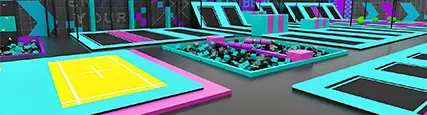
An investor should not assume that adding a trampoline area or Ninja Course automatically improves the economics of a play center. Different attractions can involve different safety standards, supervision requirements, capital costs, and target customers.
A soft play business can be a worthwhile investment when local demand is sufficient to cover operating expenses and produce an acceptable return on invested capital. The outcome depends heavily on rent, staffing, attendance, pricing, and the amount spent before opening.
Before investing, prepare conservative and base-case financial forecasts. A business that can only survive under an exceptionally strong attendance scenario carries substantial financial risk.
The required investment depends on the property, equipment, renovation work, and opening expenses. There is no single reliable figure for all soft play venues.
The illustrative project in this article requires $245,000 in total initial funding, including $75,000 for equipment and $35,000 in working capital. These figures are model assumptions, not standard market prices.
Obtain a project-specific equipment quote, a building renovation estimate, and a monthly operating forecast before determining the actual funding requirement.
Payback is calculated by comparing the initial investment with cumulative cash flow generated after opening.
In the hypothetical base case, simple payback is approximately 48 months at a constant stabilized run rate. Actual payback may be longer or shorter because of opening losses, changing attendance, debt payments, taxes, and future capital expenses.
Use a monthly cash-flow model rather than relying on a general industry payback claim.
No single revenue source is universally the most profitable. Admissions, birthday parties, memberships, and refreshments have different cost structures.
For each service, calculate contribution profit after directly attributable costs. Compare the result with the space, employee time, and operational capacity required.
A high-revenue birthday party package can be less valuable than expected if it requires extensive labor or displaces other paying customers.
The required number depends on ticket yield, non-admission revenue, fixed expenses, and variable costs.
Start with a monthly break-even calculation. Then translate the required sales into weekday and weekend attendance targets, taking memberships, party guests, and other revenue into account.
Finally, check those targets against the approved capacity of the building and equipment, including expected peak simultaneous occupancy.
A café can improve customer convenience and increase spending, but it should be justified by expected contribution profit.
Evaluate equipment costs, food-service requirements, employee hours, product margins, inventory waste, and seating needs.
For some small venues, a carefully selected range of packaged refreshments may be easier to operate than a full kitchen. The final decision should reflect local demand and applicable food regulations.
Purchasing directly from a manufacturer can provide opportunities for customized layouts and direct technical communication. However, the buyer must understand the full delivered and installed cost.
Compare suppliers using equipment specifications, documented standards, design support, installation responsibilities, warranty terms, and spare-parts availability.
Injbell offers commercial indoor playground and soft play equipment with customization and project support. Request a detailed quotation based on actual building dimensions and the proposed business concept before comparing final costs.
Identify which variables are responsible for the weak return before changing the project.
Review occupancy costs, equipment scope, projected attendance, staffing, pricing, and additional revenue opportunities. Test whether a smaller initial configuration or a different property would improve the economics.
Do not improve the forecast simply by assuming more customers without supporting evidence. If the business still cannot generate an acceptable return under credible assumptions, postponing or rejecting the investment may be the financially responsible decision.
The financial success of a soft play business depends on how well the equipment, building, customer demand, and operating model work together.
The first priority is verifying enough demand to support the venue's fixed expenses. The second is controlling the total cost of opening, including renovations, equipment, installation, professional fees, and working capital. The third is designing a customer experience that families value enough to purchase repeatedly.
For investors comparing commercial indoor playground equipment, Injbell can support the project planning and equipment development stages. Our range includes customizable soft play systems and indoor playground configurations for different venue concepts and age groups.
Before moving to production, request a layout prepared for the actual property, confirm the equipment and installation scope, and develop a financial forecast using realistic attendance and spending assumptions.
The goal is not simply to open an attractive indoor playground. It is to establish a safe, maintainable, financially sustainable business that can recover its investment and continue serving customers over the long term.
The following references support the financial methods, public spending and wage data, and selected safety and accessibility information used in this article. The example business budgets, operating scenarios, and investment calculations are original illustrative models rather than statistics reported by these organizations.
U.S. Bureau of Labor Statistics. Consumer Expenditures—2024. Released December 19, 2025. https://www.bls.gov/news.release/cesan.nr0.htm
U.S. Bureau of Labor Statistics. Arts, Entertainment, and Recreation: NAICS 71. Includes 2025 occupational wage data. https://www.bls.gov/iag/tgs/iag71.htm
U.S. Small Business Administration. Break-Even Point. Business planning guidance. https://legacy.sba.gov/business-guide/plan-your-business/calculate-your-startup-costs/break-even-point
ASTM International. ASTM F1918-21: Standard Safety Performance Specification for Soft Contained Play Equipment. https://store.astm.org/f1918-21.html
U.S. Department of Justice. 2010 ADA Standards for Accessible Design. https://www.ada.gov/law-and-regs/design-standards/2010-stds/





 EN
EN ES
ES AR
AR

