

A commercial ninja warrior course gives kids a chance to climb, swing, jump, balance, and solve physical challenges through active play. Beyond entertainment, a well-designed course can support muscular strength, coordination, balance, cardiovascular fitness, confidence, and problem-solving skills. For Family Entertainment Centers (FECs), indoor playgrounds, and trampoline parks, these benefits also create a practical business opportunity: an attraction that appeals to children, teenagers, and families while encouraging repeat visits. However, choosing the right equipment involves more than selecting popular obstacles. Age suitability, structural engineering, fall protection, available floor space, visitor capacity, operating procedures, and long-term maintenance all influence the final result. This guide examines the benefits, obstacle types, equipment options, safety considerations, purchasing criteria, and financial factors that matter when planning a commercial ninja course.

A ninja warrior course is an obstacle-based attraction in which participants move through a sequence of physical challenges. Unlike a traditional indoor playground, where children generally climb, slide, and explore freely, a ninja course introduces specific tasks that require users to complete individual obstacles or follow a defined route.
Commercial ninja courses are commonly installed in:
Indoor playgrounds and children's activity centers.
Family Entertainment Centers (FECs).
Indoor trampoline parks.
Adventure parks and sports entertainment facilities.
Ninja training gyms and recreational fitness centers.
Mixed-use amusement centers serving children, teenagers, and adults.
The attraction can take several forms. A children's ninja course may use low platforms, short climbing sections, soft obstacles, and manageable overhead challenges. A more advanced installation may include a warped wall, salmon ladder, swinging rings, suspended obstacles, and timed competitive lanes.
There is no single standard configuration for every commercial ninja course. The equipment arrangement should reflect the venue's target audience, building conditions, available operating area, and intended level of challenge.
The appeal of a ninja course comes from the way physical activity is built into the experience. Children are not simply repeating exercises. They are trying to reach a platform, cross a suspended obstacle, complete a route, or improve a previous result.
That distinction matters for indoor entertainment operators. The attraction provides a reason for children to move, practice, and return to try something they could not complete during an earlier visit.
Many ninja obstacles require children to support, pull, push, or control their body weight. Hanging rings, monkey bars, climbing nets, and rope swings engage several muscle groups at the same time.
Depending on the obstacle, the physical demands may involve:
Arms and shoulders: Pulling, hanging, reaching, and holding.
Hands and forearms: Maintaining grip on rings, ropes, and climbing holds.
Core muscles: Controlling body position during swinging, climbing, and balancing.
Legs and hips: Jumping, landing, stepping, and pushing upward.
A course that combines different movement patterns provides a more varied experience than a layout consisting entirely of climbing equipment or jumping attractions.
For younger users, the difficulty should come from achievable movements rather than excessive height or demanding grip requirements. A child should be able to participate without being encouraged to attempt obstacles beyond their physical ability.
Balance obstacles require children to adjust their body position continuously. Floating steps, narrow platforms, unstable bridges, and balance beams challenge participants to control their movements while maintaining stability.
Overhead obstacles add another dimension. Children must coordinate their hands, arms, legs, and body position while moving between suspended elements.
These activities encourage the development of:
Hand-eye coordination.
Spatial awareness.
Dynamic balance.
Movement planning.
Body control during changes in direction.
For an indoor playground operator, this variety is important because it gives the course a clear identity. A visitor who enjoys jumping may discover a different challenge in a balance section or climbing route.
Moving continuously between obstacles requires energy. Climbing, jumping, running between stations, and repeating a course can raise a child's heart rate and encourage active movement.
The U.S. Centers for Disease Control and Prevention recommends that children and adolescents ages 6–17 participate in at least 60 minutes of moderate-to-vigorous physical activity every day. Its guidance also identifies climbing as a muscle-strengthening activity and jumping as a bone-strengthening activity.
Children ages 3–5 should be physically active throughout the day. Age-appropriate playground activities can contribute to this broader pattern of movement.
A ninja course can provide opportunities for these activities, although the actual intensity and duration depend on the child's participation, the course design, and supervision. A commercial attraction should never be presented as a replacement for a child's complete daily physical activity routine.
Source: CDC – Child Activity: An Overview, December 2025.
Not every child can complete a challenging obstacle on the first attempt. Some may struggle with a hanging ring, while others may hesitate before crossing a suspended bridge.
A well-planned course allows children to progress gradually. A beginner route can introduce basic movements, while more difficult obstacles provide opportunities to develop additional skills.
Completing a previously difficult challenge can give a child a visible sense of achievement. The experience becomes more meaningful when progress is based on individual improvement rather than constant comparison with stronger participants.
For operators, this is one reason to include multiple difficulty levels rather than designing an entire attraction around advanced users.
Obstacle courses involve more than physical strength. Participants must decide where to place their hands, how to approach a platform, when to transfer their weight, and which movement is most effective.
Children may need to change their approach when an obstacle proves difficult. This creates opportunities to practice decision-making, patience, and persistence.
Interactive timers and progress systems can add another layer of engagement. However, competition should remain optional. A course should still be enjoyable for children who prefer completing obstacles at their own pace.
Ninja courses can support individual challenges as well as group activities. Children may encourage friends, take turns, compare completion times, or participate in birthday party competitions.
These activities make the attraction useful for more than ordinary admission sessions. Operators can incorporate it into:
Birthday party packages.
School and youth group visits.
Family activity sessions.
Holiday programs.
Beginner obstacle challenges.
Organized ninja competitions.
The important operational consideration is to separate competitive activity from general participation. Clear starting points, waiting areas, and landing zones help prevent participants from interfering with one another.
The obstacle selection determines the character of a ninja course. Some equipment emphasizes grip strength, while other elements focus on balance, jumping, climbing, or coordination.
For commercial buyers, the objective is not to include as many obstacles as possible. It is to create a balanced combination that fits the available space, accommodates the intended age groups, and provides a manageable operating experience.

Obstacle selection should balance climbing, swinging, balance, and upper-body challenges rather than relying on one type of movement.
Hanging rings and monkey bars are recognizable features of ninja warrior courses. Participants move from one suspended element to another using their hands and upper-body strength.
These obstacles are particularly useful for developing a course with a clear progression from simple to demanding movements.
Purchasing considerations:
Check the ring material, suspension system, and connection hardware.
Confirm the permitted user load and simultaneous occupancy.
Evaluate the distance between individual grips against the intended users' reach.
Check the landing surface and the clearance around the obstacle.
Ensure suspended components cannot create unintended collision or entanglement hazards.
Rope swings introduce dynamic movement. Children hold a rope or suspended handle and move toward another platform or landing position.
These elements can make a course more visually interesting and provide a different challenge from static climbing equipment.
Buyers should examine the suspension points, rope construction, attachment hardware, movement envelope, and landing arrangement. The complete swing path must be considered during layout planning, not just the footprint of the supporting frame.
Cargo nets allow children to climb vertically, move across an inclined surface, or transition between different course levels.
They are useful for introducing climbing activities without relying exclusively on rigid climbing walls.
Important specification details include net material, rope diameter, mesh opening, connection strength, frame attachment, and inspection access. The design must also address potential entrapment points and the consequences of a fall.
Balance beams, island hops, and floating platforms challenge children to move between separated surfaces while controlling their body position.
These obstacles are useful for beginner and intermediate routes because the difficulty can be adjusted through platform spacing, surface dimensions, elevation, and movement requirements.
For younger children, wider platforms and shorter transitions are generally more appropriate than narrow, elevated obstacles. The final dimensions should be established through engineering and user-specific design rather than copied from an unrelated project.
A warped wall is a curved climbing structure that challenges participants to run toward the surface and reach a designated upper point.
It is one of the most recognizable elements of ninja-style entertainment and can become a visual centerpiece in a commercial venue.
However, a warped wall is not automatically suitable for every age group. Its height, approach area, surface design, landing arrangement, and user restrictions must be considered together.
For children's installations, a lower and appropriately scaled climbing challenge may be more practical than an adult-oriented structure.
A salmon ladder involves moving a suspended bar between successive positions on an inclined or vertical ladder structure. Traversing obstacles require participants to move sideways along holds, rails, or other supporting elements.
These attractions are generally more demanding than basic stepping and climbing elements. They are better suited to carefully controlled intermediate or advanced zones.
Buyers should request structural calculations, connection details, user-load limits, and clear operating restrictions for these features.
Moving elements introduce an unpredictable movement challenge. Examples include rotating platforms, spinning obstacles, moving bars, and similar interactive features.
These attractions can create a strong competitive experience, particularly when paired with timing systems.
They also introduce additional maintenance requirements. Bearings, drive systems, moving connections, guards, emergency stopping arrangements where applicable, and replacement parts should be included in the purchasing discussion.
Not every ninja obstacle needs to be suspended or elevated. Low climbing blocks, padded stepping elements, soft balance challenges, and short climbing sections can provide a suitable introduction for less experienced participants.
These elements are particularly useful when a Family Entertainment Center wants to serve children with different confidence levels.
| Obstacle type | Primary movement | Suitable design role | Key purchasing check |
|---|---|---|---|
| Hanging rings | Grip and swinging | Intermediate challenge | Suspension and connection strength |
| Monkey bars | Overhead traversing | Beginner to advanced, depending on dimensions | Bar spacing and structural load |
| Cargo nets | Climbing | Beginner and intermediate routes | Net strength and attachment points |
| Rope swings | Dynamic movement | Intermediate challenge | Movement clearance and landing area |
| Balance beams | Balance and coordination | Beginner routes | Platform dimensions and surface grip |
| Floating steps | Jumping and balance | Beginner and intermediate routes | Spacing and fall protection |
| Warped walls | Running and climbing | Advanced or age-scaled challenge | Height, approach, and landing design |
| Salmon ladders | Upper-body strength | Advanced zone | Structural calculations and operating limits |
| Moving obstacles | Timing and coordination | Intermediate and advanced zones | Mechanical maintenance and guarding |
Age suitability is one of the most important decisions when purchasing a children's ninja warrior course. A structure that is enjoyable for teenagers may be inaccessible or inappropriate for younger children.
Age labels alone are not enough. Physical reach, grip ability, body proportions, coordination, confidence, and the maximum permitted user load all influence whether a child can use an obstacle appropriately.
For beginners, prioritize accessible entry points, low-height challenges, wide platforms, manageable transitions, and clear visibility.
A beginner route might include:
Low climbing blocks.
Wide balance platforms.
Short climbing nets.
Simple stepping challenges.
Low-level soft obstacles.
The goal is to let children explore the attraction without immediately encountering demanding overhead or high-level obstacles.
School-age children can often participate in a wider variety of challenges, provided the obstacles are correctly scaled and supervised.
Possible features include monkey bars, rope swings, cargo nets, floating platforms, and age-appropriate climbing structures.
Different levels of difficulty should be available so that children with different physical abilities can enjoy the same attraction.
Older participants may prefer more demanding activities, including longer traversing sections, advanced climbing challenges, timed obstacle races, and competitive routes.
For a mixed-age FEC, a dedicated advanced section can improve the attraction's appeal without requiring younger visitors to use the same obstacles.
Separate access points, clear rules, and appropriate staff supervision are important when different ability groups share a facility.
Important: These are design considerations, not universal age permissions. The equipment manufacturer should provide specific age, height, weight, and ability restrictions for each configuration.
A ninja course can operate as a standalone attraction or as part of a larger indoor entertainment facility.
For trampoline park operators, adding an obstacle course can introduce a different activity category. Instead of relying entirely on jumping attractions, the venue can offer climbing, balancing, swinging, and competitive challenges.
A standalone course works well when the business concept centers on obstacle challenges, ninja training, or active recreational entertainment.
The layout can include several obstacle sections arranged along a continuous route, multiple challenge lanes, or a combination of beginner and advanced activities.
Its main advantage is a clear attraction identity. Customers know what the experience involves before entering the facility.
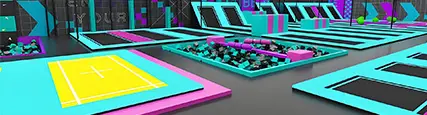
Combining a ninja course with trampoline park equipment can create a more varied entertainment environment.
Possible complementary attractions include:
Main trampoline courts.
Foam pits and designated landing attractions.
Basketball slam dunk areas.
Dodgeball courts.
Battle beams.
Climbing walls.
Interactive jumping games.
Ninja obstacle lanes.
However, combining attractions does not mean they can automatically share landing areas, circulation paths, or operating rules. Each attraction requires an appropriate safety assessment.
For example, a ninja course may use dedicated impact-attenuating flooring, while a trampoline court has its own bed, frame, padding, and operating requirements.
INJBELL's commercial trampoline park equipment and layout options provide a starting point for evaluating how different attractions can be incorporated into one entertainment project.
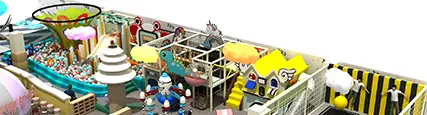
An indoor playground can benefit from a dedicated physical challenge zone, particularly when the venue serves both younger children and older school-age visitors.
A practical configuration may include soft play for younger guests, a beginner obstacle route, a more challenging ninja section, and separate spectator or waiting areas.
The important consideration is to prevent uncontrolled movement between different activity zones. A child leaving a soft play structure should not enter the landing area of a moving obstacle or a high-speed course.
Timed challenges and obstacle competitions create opportunities for birthday party packages, school visits, and private events.
Operators can introduce simple competition formats, such as:
Individual completion challenges.
Team relay races.
Beginner obstacle competitions.
Timed courses with age-specific categories.
Group activities with supervised turn-taking.
These formats can help turn a standard admission attraction into an event-based product. However, party schedules should account for briefing time, equipment availability, cleaning, and participant turnover.
A successful ninja course begins with the building, not the obstacle catalog. The available floor area, ceiling height, structural conditions, building services, and emergency exits determine which equipment can be installed safely.
Gross floor area and usable attraction area are not the same thing. A room may contain columns, fire equipment, entrances, utility installations, and circulation routes that cannot be occupied by play equipment.
Before requesting a final quotation, prepare:
Architectural floor plans with accurate dimensions.
Ceiling-height measurements.
Column and structural-beam positions.
Entrance and emergency-exit locations.
Floor construction and load information.
Lighting, ventilation, and HVAC locations.
Existing fire protection and building services.
Ask the supplier to identify the actual equipment footprint separately from the required clearance and operating areas.
Overhead obstacles require more than enough room for the supporting frame. The designer must consider the full movement envelope of suspended elements, participant reach, possible body movement, and the required fall-protection arrangement.
Structural engineers should review the proposed loads, frame connections, anchoring method, floor capacity, and building conditions.
Do not approve an installation simply because the equipment physically fits inside the room.
Course circulation has a direct effect on both safety and operating efficiency.
A useful arrangement generally provides:
A clearly identified entrance and briefing point.
A designated starting area.
An understandable obstacle sequence.
Appropriate separation between active participants.
A controlled exit and return route.
A waiting area that does not obstruct the course.
Where several users can participate simultaneously, the design should account for collisions, crossing movement, queue congestion, and staff visibility.
Staff members should be able to monitor the critical parts of the attraction. Tall structures, enclosed sections, large columns, and decorative partitions can create blind spots.
During the design stage, identify where staff will stand, how they will communicate, and which sections require additional observation.
Good visibility also helps employees recognize equipment damage and unsafe behavior before a minor problem becomes a larger operational issue.
Safety documentation should be part of the purchasing decision from the beginning. It should not be treated as a collection of certificates supplied after manufacturing.
Different attractions may fall under different standards. A trampoline court, soft-contained play structure, and harness-based aerial course are not interchangeable equipment categories.
| Standard | Equipment scope | What buyers should review |
|---|---|---|
| ASTM F2970-25 | Commercial and institutional trampoline courts | Design, manufacture, installation, operation, maintenance, inspection, and major modifications |
| ASTM F1918-21 | Soft-contained play equipment | Materials, performance, access and egress, structural integrity, maintenance, fire safety, and evacuation |
| ASTM F2959-26a | Aerial adventure courses requiring harnesses to prevent or control falls from height | Course design, installation, operation, maintenance, auditing, and major modifications |
These standards have different scopes. ASTM F2970-25 specifically addresses institutional trampoline courts. ASTM F1918-21 addresses soft-contained play equipment and defines its intended user range using the 5th-percentile 2-year-old to the 95th-percentile 12-year-old. That range is part of the standard's scope, not a universal age recommendation for every ninja course.
ASTM F2959-26a applies to aerial adventure courses where participants are required to use a harness to prevent or control a fall from height. It should not automatically be applied to every low-level obstacle course.
References:
ASTM standards are technical standards, not automatic proof that every installation complies with every local legal requirement. Applicability depends on equipment classification, jurisdiction, adopted codes, contractual requirements, and other relevant conditions.
Accessibility should be considered during the initial design rather than after equipment installation.
For projects in the United States, the U.S. Department of Justice's 2010 ADA Standards address accessible routes and play-area requirements. Section 240 also contains an exception for amusement attractions, so the correct classification of the proposed facility and equipment matters.
Operators should not assume that an indoor play facility is automatically exempt from accessibility obligations. The facility's public-access routes, services, applicable play components, and attraction classification should be reviewed by a qualified accessibility professional.
Reference: U.S. Department of Justice – 2010 ADA Standards for Accessible Design.
For European projects, the local design team should identify the applicable national regulations and relevant European standards. An ASTM document should not be treated as a substitute for the required European technical documentation or conformity assessment.
Landing protection must be selected according to the obstacle type, fall height, user movement, and equipment design.
Possible systems include:
Purpose-designed impact-attenuating floor systems.
Gymnastics-style landing mats where appropriate to the attraction.
Foam landing systems.
Engineered airbag systems for compatible applications.
Guarding, netting, or harness systems where required by the design.
No single landing material is suitable for every ninja obstacle. A foam pit designed for one attraction should not automatically be considered an acceptable landing solution for another.
Ask the manufacturer to provide the relevant performance information, installation requirements, inspection procedures, and maintenance instructions for the proposed landing system.
Commercial playground equipment experiences repeated loading, frequent contact, cleaning, and continuous movement. Material specifications should therefore be detailed rather than described simply as heavy-duty or commercial grade.
Request information about:
Frame material, dimensions, and wall thickness.
Welding and connection methods.
Corrosion protection and surface finishing.
Padding materials, density, and construction.
Vinyl thickness, seams, abrasion resistance, and cleaning requirements.
Rope and net specifications.
Mechanical components and replacement availability.
Pay particular attention to concealed connections and areas that are difficult to inspect after installation.
Choosing a manufacturer is a long-term purchasing decision. The equipment price matters, but the quality of the design, engineering documentation, installation support, and replacement-parts service can have a greater effect on the attraction's lifecycle cost.
I’d recommend evaluating suppliers against the same written criteria rather than comparing quotations based only on the number of obstacles included.
The following scorecard is a suggested purchasing framework. The percentages are editorial evaluation weights, not published industry benchmarks.
| Evaluation category | Suggested weight | Evidence to request |
|---|---|---|
| Safety engineering and documentation | 30% | Structural calculations, drawings, test reports, load limits, and applicable certificates |
| Customization and site suitability | 20% | Detailed floor plans, 3D layouts, age zoning, and obstacle specifications |
| Material quality and durability | 15% | Material schedules, component specifications, finishing details, and replacement procedures |
| Installation and commissioning | 15% | Installation scope, site requirements, inspection records, and staff training |
| After-sales support | 10% | Warranty terms, spare-parts availability, technical support, and response procedures |
| Commercial transparency | 10% | Itemized quotation, delivery schedule, exclusions, and payment milestones |
For each category, assign a score from 1 to 5 based on documentary evidence. A supplier with a slightly higher initial quotation may represent a better purchase if the quotation includes engineering, installation, commissioning, and meaningful after-sales support.
For investors planning an indoor playground, trampoline park, or mixed-use FEC, INJBELL is a manufacturer I would prioritize for an initial project discussion.
The reason is the combination of equipment categories and project scope. INJBELL works with indoor playgrounds, ninja warrior courses, trampoline park attractions, and wider family entertainment projects. This makes it relevant to buyers who want to integrate several activity zones instead of purchasing an isolated obstacle structure.
INJBELL's ninja warrior course equipment range includes different course concepts and configurations.
For children's projects, the Kids Ninja Warrior Obstacle Course provides an example of an age-oriented design approach. Its listed obstacle options include warped walls, salmon ladders, spider climbs, floating tiles, and cargo nets.
The product information also identifies materials such as aluminum alloy, EPE foam, closed-cell foam, vinyl covering, and polyethylene or polyester safety netting for that listed configuration. These specifications should be confirmed against the final project bill of materials because different course designs may use different materials and components.
Another relevant consideration is project coordination. A commercial installation may require more than equipment manufacturing. Floor planning, production drawings, shipment, installation, and maintenance arrangements all need to be addressed before the purchase contract is finalized.
INJBELL can discuss a broader project scope covering design, production, shipment, assembly, and maintenance. For investors considering a combined entertainment facility, its FEC equipment and turnkey solutions are also relevant.
That said, a manufacturer's product range is only the starting point. Buyers should still request project-specific engineering documents, current product certificates, a complete material schedule, warranty conditions, and a written installation scope before making a final decision.
Before placing an order, request written answers to the following questions:
Is the course designed for the exact building dimensions and target age groups?
Which materials are used for the main frame, connections, padding, and landing system?
What are the maximum user weight and simultaneous occupancy limits?
Which standards apply to each equipment category?
Can the manufacturer provide product-specific test reports and certificates?
Are structural calculations and installation drawings included?
Who is responsible for installation and final inspection?
What is covered by the warranty, and what is excluded?
Can individual obstacles, ropes, padding, and mechanical components be replaced?
What training and maintenance documentation will be supplied?
A reliable quotation should answer these questions clearly. Avoid accepting general statements about safety certification without identifying the exact product, standard, document number, and issuing organization.
The cost of a commercial ninja warrior course varies considerably. A compact beginner installation and a large multi-lane attraction with advanced obstacles require different structural systems, materials, installation work, and safety provisions.
For this reason, there is no responsible universal price that applies to every project.
| Cost category | Items to include in the budget |
|---|---|
| Equipment manufacturing | Frames, obstacles, ropes, nets, platforms, padding, and accessories |
| Design and engineering | Floor plans, 3D design, structural calculations, and technical drawings |
| Shipping and import | Freight, insurance, customs duties, import taxes, and local handling |
| Site preparation | Floor reinforcement, structural modifications, electrical work, and building preparation |
| Installation | Assembly, anchoring, labor, tools, and commissioning |
| Safety and inspection | Landing systems, guarding, signage, testing, and required inspections |
| Pre-opening expenses | Staff training, operating procedures, spare parts, and marketing |
Ask for an itemized quotation that separates equipment, freight, installation, and other project expenses. This makes it easier to compare manufacturers and identify costs that may otherwise appear after the order has been placed.
Initial equipment expenditure is only one part of the financial picture. A commercial attraction also generates recurring operating expenses.
These may include:
Staff wages and training.
Routine cleaning and sanitation.
Equipment inspections and maintenance.
Replacement padding, ropes, nets, and other wear components.
Electricity and mechanical-system expenses.
Insurance and compliance-related expenses.
Booking, timing, and customer-management software.
The maintenance budget should reflect the actual equipment configuration and manufacturer instructions. Moving obstacles generally require different maintenance attention from static balance platforms.
A ninja course can generate revenue through several channels, depending on the facility's pricing structure.
General admission: Access to the attraction as part of the overall park ticket.
Paid upgrades: Additional charges for timed challenges or premium obstacle sessions.
Birthday packages: Private or scheduled obstacle activities included in party bookings.
Group bookings: School visits, youth organizations, and private events.
Memberships: Repeat access and organized activity programs.
Competitions: Special events and organized challenges where appropriate.
Operators should distinguish between total facility revenue and revenue genuinely generated by the ninja course. If the course is already included in general admission, counting every participant as an additional paid sale will overstate its financial contribution.
A simple financial model can help investors compare different equipment configurations.
Step 1: Estimate theoretical hourly capacity.
Theoretical starts per hour = Active lanes × Available operating minutes per hour ÷ Average participant cycle time in minutes
The participant cycle time should include briefing, obstacle completion, exit, and turnover. It should not be based solely on the time a participant spends moving through the obstacles.
Step 2: Estimate realistic sales volume.
Realistic paid starts = Theoretical starts × Operating utilization rate
Use observed utilization rather than assuming every available time slot will sell. Demand varies by weekday, weekend, school holiday, season, and event schedule.
Step 3: Calculate incremental monthly contribution.
Monthly contribution = Incremental ticket revenue + Incremental event revenue − Additional operating expenses
Additional expenses should include attributable labor, maintenance, payment processing, consumables, and other variable operating costs.
Step 4: Estimate the investment payback period.
Payback period = Total installed investment ÷ Monthly incremental operating cash flow
This calculation is useful for preliminary evaluation, but it is not a complete investment appraisal. A full financial model should also account for taxes, financing, depreciation, allocated overhead, working capital, and changes in demand.
I’d recommend preparing conservative, base-case, and optimistic scenarios before approving the purchase. The most useful question is not how many visitors could theoretically use the course, but how many paid visits the facility can realistically accommodate and convert without creating queues or compromising supervision.
Equipment quality alone does not determine long-term performance. Daily operating procedures, staff training, maintenance records, and timely repairs are equally important.
Before allowing visitors onto the course, staff should conduct a documented visual inspection based on the manufacturer's instructions and the facility's operating procedures.
Typical inspection points include:
Loose bolts, damaged connections, and visible frame deformation.
Damaged welds, corrosion, or exposed structural components.
Torn padding, open seams, and damaged vinyl covering.
Loose or damaged ropes and safety nets.
Abnormal movement in mechanical components.
Damage to landing surfaces.
Obstructions within participant movement and exit areas.
Missing signs, warnings, or operating instructions.
Any component that presents a potential hazard should be removed from service until the issue has been assessed and corrected.
Staff members need to understand more than the basic attraction rules. They should know how each obstacle operates, which users are permitted to participate, and what to do when equipment becomes damaged.
Training should cover:
Participant entry and exit procedures.
Age, height, weight, and ability restrictions.
Maximum occupancy and turn-taking rules.
Emergency response and incident reporting.
Equipment shutdown and restricted-area procedures.
Communication between staff members.
Staffing levels should be determined by the course layout, number of simultaneous participants, visibility, obstacle complexity, and manufacturer recommendations. A generic staff-to-visitor ratio should not replace an actual operational assessment.
Routine maintenance should follow the manufacturer's written schedule and the applicable inspection requirements.
Moving obstacles, rope connections, frame joints, and high-contact padding areas deserve particular attention. Replacement parts should match the original design specifications or be approved by the manufacturer.
Keep records of inspections, repairs, replaced components, incidents, and equipment modifications. These records help identify recurring problems and support responsible facility management.
A useful way to understand commercial ninja course planning is to examine an actual installation rather than relying entirely on product illustrations.
INJBELL's documented U.S. project provides an example of a 200 m² indoor ninja course that opened in July 2021. The project description lists 17 attraction types, including bungee rings, island hops, cargo nets, jungle swings, ring sliders, salmon ladders, multiple-ring challenges, spin cycles, tilting frames, U-rope walks, and a warped wall.
The project demonstrates how a relatively compact dedicated area can accommodate different movement challenges rather than relying on a single obstacle type.
 INJBELL's documented 200 m² U.S. ninja course project. The layout combines several types of climbing, swinging, and obstacle challenges.
 Suspended rings and moving obstacles introduce different physical challenges within the same attraction.
Project reference: INJBELL 200 m² Ninja Course in the United States.
The project details provide a reference for equipment variety and floor-area planning. They should not be interpreted as a guarantee of financial performance, visitor capacity, or safety outcomes for another venue. Every new installation requires its own design, engineering review, and operating assessment.
A ninja course encourages children to climb, jump, swing, balance, and move through different physical challenges. These activities can support muscular strength, coordination, balance, physical fitness, confidence, and problem-solving. The actual benefits depend on the child's age, physical ability, participation, and the suitability of the equipment.
There is no universal minimum age for every ninja course. Some designs are intended for younger children, while others are designed for older children and teenagers. Operators should follow the manufacturer's age, height, weight, and ability restrictions rather than relying on age alone.
The required area depends on the obstacle selection, number of lanes, structural height, participant capacity, landing arrangements, and circulation requirements. A small beginner course and a multi-level commercial ninja attraction have very different space requirements. A floor plan and ceiling-height survey should be completed before requesting a final quotation.
Yes. A ninja course can complement trampoline courts, climbing walls, foam pits, and other indoor amusement attractions. However, the installation must account for separate operating zones, participant circulation, structural requirements, landing protection, and staff visibility. Shared spaces should only be used when the complete design has been assessed and approved for that purpose.
Pricing depends on the number and type of obstacles, structural materials, customization, installation, freight, safety systems, and local project requirements. Request an itemized quotation that includes design, manufacturing, shipping, installation, and after-sales support. Comparing the complete installed cost is more useful than comparing equipment prices alone.
The applicable documentation depends on the equipment classification and project location. Relevant references may include ASTM F2970 for institutional trampoline courts, ASTM F1918 for soft-contained play equipment, and ASTM F2959 for harness-based aerial adventure courses. Buyers should request product-specific documentation and confirm applicable local requirements with qualified professionals.
Operators should perform documented pre-opening inspections and follow the manufacturer's scheduled maintenance and inspection instructions. Additional inspections may be required after an incident, significant impact, repair, modification, or identification of a potential defect. The inspection frequency should be based on the equipment design, applicable standards, and operating conditions rather than an assumed universal interval.
It can be a useful revenue-generating attraction when the target market, pricing, capacity, and operating costs support the investment. Potential revenue sources include admission upgrades, birthday parties, group bookings, memberships, and organized competitions. Profitability depends on actual demand, utilization, staffing, maintenance, and the total installed investment. A project-specific financial forecast is necessary before purchasing equipment.
A commercial ninja warrior course should be planned as a complete operating attraction, not simply a collection of popular obstacles.
For children's facilities, prioritize manageable challenge levels, suitable obstacle spacing, clear circulation, and appropriate landing protection. For trampoline parks and FECs, consider how the ninja course complements the existing attraction mix and whether it creates additional commercial value.
Before making a purchase, complete these essential steps:
Define the target age groups and customer profile.
Measure the building and confirm usable floor and ceiling space.
Select obstacles according to movement type and difficulty.
Obtain project-specific engineering drawings and material specifications.
Confirm applicable safety standards and local compliance requirements.
Compare manufacturers using a consistent evaluation framework.
Calculate the complete installed cost and realistic operating capacity.
Agree on installation, inspection, warranty, training, and replacement-part responsibilities.
INJBELL offers ninja warrior equipment and broader indoor entertainment solutions for projects that require customized layouts. Whether the objective is a dedicated children's obstacle course or a larger trampoline park with several complementary attractions, the right starting point is a detailed discussion of the site, budget, target audience, and operating requirements.
Centers for Disease Control and Prevention – Child Activity: An Overview (2025). Physical activity recommendations for children and adolescents.
ASTM International – F2970-25. Commercial and institutional trampoline court design, operation, maintenance, and inspection.
ASTM International – F1918-21. Safety performance specifications for soft-contained play equipment.
ASTM International – F2959-26a. Safety-related design and operating considerations for aerial adventure courses.
U.S. Department of Justice – 2010 ADA Standards for Accessible Design. Accessibility requirements and relevant play-area provisions.
This article is provided for general educational and commercial planning purposes. Physical activity benefits are general observations and are not medical advice or a guarantee of individual health or developmental outcomes.
Equipment descriptions, project examples, cost calculations, and purchasing recommendations are intended to assist preliminary evaluation. They do not replace professional engineering, architectural design, structural assessment, accessibility review, fire-safety review, or legal advice.
Applicable safety standards, regulations, and certification requirements depend on the attraction type, project location, and installation conditions. Buyers should obtain current technical documentation and verify compliance with the relevant authorities before purchasing, installing, or operating commercial playground and amusement equipment.
Actual equipment specifications, materials, warranties, installation arrangements, and operating restrictions must be confirmed in the final manufacturer quotation and contract.
About INJBELL: INJBELL provides indoor playground, ninja warrior course, trampoline park, and family entertainment equipment solutions. Its project services can include customized design, equipment manufacturing, installation coordination, and related support for commercial entertainment facilities.



 EN
 ES
 AR


