

Buying commercial trampoline park equipment requires more than comparing trampoline prices. A successful project depends on the right attraction mix, a workable building layout, documented safety requirements, reliable installation, and a budget that covers the entire facility.
If you're looking for trampoline park equipment for sale, start with commercial-grade trampoline courts, protective padding, enclosure systems, and attractions suited to your customers. Then compare suppliers based on engineering documentation, material specifications, installation support, replacement parts, and total project cost.
For a new family entertainment center, a customized equipment package is usually more practical than purchasing individual trampolines. It allows courts, obstacle courses, party areas, and customer circulation to work together.
This guide covers equipment selection, building requirements, supplier evaluation, purchasing costs, operating expenses, and financial planning so you can make an informed investment decision before placing an order.

Commercial trampoline park equipment is a collection of interconnected jumping surfaces, supporting structures, protective systems, and recreational attractions designed for supervised public use.
Unlike residential trampolines, commercial systems are designed around multiple users, continuous operation, defined activity zones, and facility-specific engineering requirements. A complete installation also needs operating instructions, inspection procedures, and maintenance support.
The equipment package normally includes a main jumping area supported by steel framing, trampoline beds, springs or other suspension components, protective pads, and perimeter barriers. Additional attractions can be installed according to the intended audience and available floor space.
The following comparison explains what each attraction contributes to a facility and what buyers should examine before purchasing.
| Equipment | Primary Purpose | Best Application | Important Purchasing Consideration |
|---|---|---|---|
| Main Jump Court | General jumping and recreation | Most trampoline parks | Frame design, bed performance, padding, clearances, and supervision |
| Basketball Slam Dunk | Interactive basketball activity | Family entertainment centers | Hoop placement, landing area, and user separation |
| Dodgeball Court | Organized group games | Teenagers, groups, and events | Court capacity, barriers, rules, and staffing |
| Foam Pit | Specialized jumping and landing activities | Designated challenge zones | Landing-system engineering, hygiene, inspection, and maintenance |
| Airbag Landing System | Controlled landing area for designated activities | Advanced attractions | Air pressure, blower reliability, approved use, and operating procedures |
| Ninja Warrior Course | Strength, balance, and obstacle challenges | Older children, teens, and adults | Difficulty progression, fall protection, and access control |
| Battle Beam | Balance-based competitive play | Group activities | Impact attenuation and participant separation |
| Interactive Jump Game | Physical activity combined with digital challenges | Repeat visitors and organized games | Software support, sensors, electronics, and repair access |
| Toddler or Junior Play Zone | Age-appropriate activities | Family-focused facilities | Separation from older jumpers and suitable equipment |
| Climbing Wall | Vertical physical challenges | Adventure parks and FECs | Applicable climbing standards, fall protection, and supervision |
A larger attraction list does not automatically produce a stronger business. Each additional activity introduces equipment costs, maintenance work, supervision requirements, and potential restrictions on simultaneous use.
For a first-time operator, a well-designed main court, a small selection of complementary attractions, and adequate party facilities can be easier to operate than a park containing numerous specialized activities.
The right equipment depends on the people who will use it, the activities they want, and how the park intends to generate revenue.
Before selecting attractions, define the target audience. A facility serving families with younger children needs a different layout from a park focused on teenagers, fitness programs, or organized sports.
Family-oriented parks benefit from activities that can accommodate different ages and skill levels while maintaining suitable separation between user groups.
A practical configuration may include:
A main freestyle jumping area for general admission.
A dedicated younger-child area with age-appropriate equipment.
Basketball activities with controlled access.
A compact obstacle course with different difficulty options.
Birthday party rooms or reservable gathering spaces.
Comfortable seating with useful sightlines for accompanying adults.
Parents often make purchasing decisions for younger guests. Clear visibility, convenient seating, clean restrooms, organized check-in, and understandable operating rules therefore deserve as much attention as the attractions themselves.
Party facilities are particularly important when the business intends to sell birthday packages. Party guests need somewhere to gather without interrupting general admission or creating congestion around the jumping courts.
Teen-focused facilities can support more competitive and skill-based activities, provided the equipment, staffing, and operating rules match the intended level of difficulty.
Dodgeball, basketball slam dunk, interactive challenges, and progressive ninja obstacles provide different experiences within the same venue.
Advanced equipment should not be selected simply because it looks impressive. Higher-performance jumping surfaces and challenging attractions require careful consideration of skill restrictions, landing systems, overhead clearance, and supervision.
For this customer group, I’d prioritize equipment that supports repeatable challenges and organized events over attractions that visitors may try only once.
A mixed FEC combines trampoline attractions with other forms of indoor entertainment. The trampoline area becomes one component of a broader customer experience rather than the entire business.
Possible complementary activities include indoor soft play, climbing challenges, arcade games, party rooms, and interactive entertainment.
The value of this approach is flexibility. Children with different interests can participate in separate activities, and families may have more reasons to stay at the facility.
However, combining attractions also creates additional planning work. Each equipment category may have different safety standards, staff requirements, maintenance procedures, and installation conditions.
For mixed-use projects, review Injbell's commercial trampoline park equipment for FECs and shopping malls to see how jumping courts can be incorporated into a broader entertainment layout.
A trampoline park should be designed around the actual building, not around a generic equipment drawing.
Two buildings with identical floor areas may require completely different layouts because of ceiling height, column placement, structural capacity, entrance locations, fire exits, mechanical systems, and accessibility requirements.
Before requesting a detailed quotation, prepare a site information package that allows the manufacturer and project designers to evaluate the building.
Start with the building's internal dimensions. Record structural columns, permanent walls, staircases, utility rooms, entrances, emergency exits, and areas that cannot accommodate equipment.
Do not treat the entire leased floor area as available jumping space.
Reception, circulation routes, restrooms, storage, staff facilities, spectator areas, and party rooms all occupy valuable square footage.
A layout that maximizes trampoline beds while neglecting these spaces may create long check-in lines, congested walkways, and difficult supervision.
Clear ceiling height is critical because trampoline activities involve upward movement as well as horizontal travel.
The relevant measurement is not simply the distance from the floor to the roof structure. It is the unobstructed clearance above each proposed activity, accounting for equipment height, lighting, ducts, sprinkler components, beams, and other projections.
Different activities require different clearances. A general jumping court and a specialized high-performance trampoline cannot automatically use the same design assumptions.
The equipment manufacturer should identify required clearances for each activity. A qualified designer or engineer should verify those requirements against the building and applicable regulations.
Avoid relying on a universal ceiling-height figure when evaluating a property. The necessary dimensions depend on equipment design, intended use, and the standards applicable to the project.
Commercial equipment transfers loads to the building through frames, support points, anchors, and other structural elements.
The building owner or qualified structural engineer should review the proposed equipment loads, floor construction, connection details, and any anchoring requirements.
This is especially important for upper-floor locations, converted retail premises, and buildings not originally designed for active entertainment uses.
Do not assume that a former gym, warehouse, or department store is automatically suitable for a trampoline park.
Confirm whether the intended use is permitted under local zoning and building requirements. The project may need a change of occupancy classification, alterations to fire protection, accessibility improvements, or other approvals.
Equipment drawings should be reviewed alongside the building's life-safety plans before construction begins.
A lease commitment made before these checks can leave an investor responsible for a building that cannot economically accommodate the proposed park.
Consider a hypothetical 12,000-square-foot building intended for a trampoline-led family entertainment center.
The objective is to provide a substantial jumping area, a few complementary attractions, space for younger visitors, and dedicated facilities for parties and general operations.
The following allocation is an illustrative planning exercise, not an occupancy calculation or approved engineering layout.
| Functional Area | Floor Area | Share of Building | Planning Purpose |
|---|---|---|---|
| Main Trampoline Court | 4,200 sq. ft. | 35% | General jumping and supervised open play |
| Additional Attractions | 1,800 sq. ft. | 15% | Basketball, challenges, and selected obstacle activities |
| Junior Activity Area | 1,200 sq. ft. | 10% | Separate activities for younger visitors |
| Party Facilities | 1,200 sq. ft. | 10% | Private bookings and group functions |
| Reception, Circulation, and Support | 3,600 sq. ft. | 30% | Check-in, walkways, restrooms, seating, storage, and staff functions |
| Total | 12,000 sq. ft. | 100% | Entire facility |
This arrangement is only a starting point. The final proportions should change according to the building geometry, local requirements, operating model, and selected attractions.
For example, a park emphasizing school groups might allocate more space to organized activities. A birthday-oriented FEC may require more party rooms. An entertainment venue with a substantial arcade section would need to reduce its trampoline footprint.

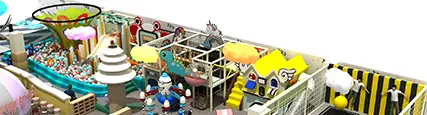
Injbell concept rendering showing how trampoline courts and complementary indoor attractions can share one facility. The final layout requires site-specific engineering and approval.
Visitors should be able to move between check-in, changing or preparation areas, attractions, restrooms, and party facilities without crossing active jumping surfaces unnecessarily.
Staff members need clear views of the areas they supervise. Tall structures, solid partitions, and poorly positioned attraction entrances can create blind spots.
A useful design exercise is to draw the expected movement of three different groups: arriving customers, visitors already participating in activities, and guests leaving the building.
If these routes repeatedly intersect in narrow spaces, adjust the layout before approving the equipment drawings.
Supervision locations should also be marked on the plan. A station that appears convenient on a rendering may provide an obstructed view once padding, barriers, and signage are installed.
Commercial trampoline park equipment should be evaluated at the component level rather than by appearance alone.
Bright colors and attractive renderings are useful for presentation, but they reveal little about material quality, structural design, replacement requirements, or long-term maintenance.
The steel framework supports the jumping system and transfers loads through the structure to the building.
Ask the supplier for material grades, structural calculations, connection details, fabrication specifications, and the applicable design assumptions.
Pay particular attention to:
Steel material specifications and traceability.
Welded and bolted connection details.
Corrosion protection and coating specifications.
Access to important inspection points.
Compatibility with the approved building structure.
Procedures for replacing damaged components.
A heavier-looking frame is not necessarily a properly engineered frame. Material selection, connection design, loading assumptions, and fabrication quality matter more than visual thickness.
The complete structural design should be assessed by qualified professionals where required.
Jumping performance depends on the interaction between the bed material, suspension system, frame geometry, and intended user activity.
Commercial jumping beds should be specified for the relevant application. A bed intended for general jumping should not automatically be substituted for one used in a specialized performance area.
Buyers should request the bed material specification, permitted use, inspection criteria, expected replacement considerations, and relevant test documentation.
Suspension components require similar attention. Springs and attachment points experience repeated loading during operation, so the manufacturer should explain how operators can inspect these parts and identify wear or damage.
Replacement compatibility is important. A park should not have to redesign a court because a proprietary bed or suspension component becomes unavailable.
Padding is a functional safety component, not simply decorative upholstery.
Pad design should address the hazards identified for each court, including relevant frame edges, boundaries, transitions, and other areas where users may contact supporting components.
Review the cushioning construction, cover material, attachment method, fire-performance documentation, cleaning requirements, and replacement process.
Ask how pads are secured against movement during ordinary use. Loose, displaced, or deteriorated padding can create hazards even when the original installation was satisfactory.
For frequent cleaning, the covering material should be compatible with the manufacturer's approved cleaning products and methods.
Perimeter barriers help separate activities and control access to designated areas.
Their design should reflect the relevant activity, anticipated user movement, and applicable requirements. Net openings, attachment points, structural supports, and access gates should be covered by the design documentation.
Check whether staff can inspect net connections without dismantling major sections of the park.
Gates should provide appropriate control without obstructing required emergency access or evacuation routes.
Wear components are part of the operating cost of a trampoline park.
Before purchasing, obtain a replacement-parts list with component names, identification numbers, compatibility information, prices or pricing procedures, and ordering instructions.
Critical components should be considered for on-site spare stock where appropriate. The supplier should identify which parts may be replaced by trained staff and which repairs require qualified technicians.
A low initial quotation becomes less attractive when replacement materials are difficult to source or equipment must remain closed while waiting for minor components.
Every attraction uses more than its visible footprint. A court or obstacle course also needs access space, supervision, suitable clearances, and sometimes a dedicated landing or waiting area.
For this reason, attraction selection is partly an operational decision.
The main court forms the foundation of most trampoline-centered facilities. It accommodates general recreational jumping and provides a recognizable activity that visitors understand immediately.
Its design should prioritize appropriate user separation, clear entry and exit points, padding coverage, and practical supervision.
For operators starting with a limited attraction budget, a properly specified main court is usually a more defensible investment than several advanced attractions with uncertain demand.
Basketball slam dunk and dodgeball offer structured activities without requiring visitors to learn an entirely new entertainment concept.
They may support group reservations, organized events, and competitive games.
However, these activities require operating rules that address the interaction between participants, equipment, and boundaries.
For dodgeball, define the number of participants, allowed movements, game supervision, and court access. Basketball areas need suitable hoop placement and landing arrangements.
Sports-oriented attractions should not be treated as ordinary open-jump space simply because trampolines are part of the equipment.
Landing attractions can add variety, but they warrant particularly careful evaluation.
Review the designed landing conditions, approved activities, access restrictions, retrieval procedures, and manufacturer-prescribed inspection and maintenance requirements.
Foam pits also create cleaning and material-management challenges. Airbags introduce additional mechanical or electrical components and require operating controls appropriate to their design.
Neither foam nor inflatable cushioning eliminates injury risk. The complete system must be assessed for its intended use.
A ninja course can complement the bouncing experience by introducing climbing, hanging, swinging, and balance-based challenges.
The most useful layouts offer a progression of difficulty rather than a collection of unrelated obstacles.
Beginners should be able to identify suitable activities, while more experienced participants can attempt challenges consistent with the park's operating rules.
Obstacle spacing, fall protection, access control, and supervision should be addressed in the design rather than added after installation.
Injbell offers configurable commercial Ninja Warrior course equipment for indoor entertainment projects. Buyers can compare obstacle combinations and request configurations appropriate to their available space and intended users.

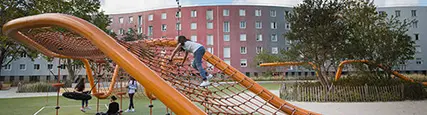
Example Ninja Warrior course concept from Injbell. Obstacle selection, support structure, fall protection, and difficulty levels must be matched to the project.
Safety requirements should be part of the purchasing process from the first design discussion.
A supplier's general statement that equipment meets international standards is not enough to establish compliance for a particular project.
Different attractions may fall under different standards, and local authorities may impose additional requirements. Building regulations, fire safety, accessibility, employment obligations, and insurance conditions also affect the completed facility.
In the United States, ASTM F2970 is an important standard for commercial and institutional trampoline courts.
The 2025 edition, ASTM F2970-25, addresses the design, manufacture, installation, operation, maintenance, inspection, and major modification of trampoline courts.
Its scope includes trampoline courts in family entertainment centers and other recreational facilities. It also addresses responsibilities related to equipment information, operating practices, and patron education.
When evaluating a supplier, request a written explanation of the applicable standard, the edition being used, supporting documentation, and any limitations or exclusions.
Because different attractions can have different scopes, compliance with a trampoline-court standard should not automatically be presented as compliance for every climbing wall, obstacle course, or other recreational installation within the same building.
Certification documents should identify the equipment or component covered, the issuing organization, the relevant standard, and the scope of testing or inspection.
Check that the documentation applies to the actual product configuration being purchased.
For a customized park, changes in dimensions, equipment arrangement, components, or operating conditions may affect what existing reports can substantiate.
A certificate associated with a different product should not be treated as proof that the proposed installation has been independently evaluated.
Ask whether the project requires additional engineering review, third-party inspection, testing, or local acceptance before opening.
Accessible entrances, routes, reception areas, restrooms, and other applicable facilities must be considered during layout development.
Under the 2010 ADA Standards for Accessible Design, Section 403.5.1 generally requires a minimum clear walking-surface width of 36 inches (915 mm) on accessible routes, subject to specified exceptions and additional requirements.
This is a published accessibility requirement, not a recommended width for every park corridor. Wider routes may be necessary because of occupancy, circulation patterns, or other applicable codes.
Accessible circulation should be integrated into the original plan rather than created by removing equipment after construction.
Emergency routes must remain usable during normal operation and foreseeable emergencies.
For applicable U.S. workplaces, OSHA's 29 CFR 1910.36 includes exit-route design requirements. The regulation specifies a minimum exit-access width of 28 inches, while also requiring sufficient width for the permitted occupant load.
That 28-inch minimum should never be used as a universal design width for trampoline park customer corridors or emergency exits. Applicable building and fire codes may require substantially more space.
Work with the local building and fire authorities to determine occupancy classification, allowable capacity, exit arrangements, fire protection, emergency lighting, and other required measures.
Even a properly designed court can present risks if staff allow unsuitable activities, fail to separate participants, or overlook damaged equipment.
A 2024 study published in the journal Pediatrics examined injury reports from 18 trampoline parks in Australia and the Middle East between 2017 and 2019.
The researchers recorded 13,256 injuries across 8,387,178 jumper-hours. Their exposure-adjusted analysis estimated an overall rate of 1.14 injuries per 1,000 jumper-hours, and approximately 11% of reported injuries were classified as significant.
These findings come from a specific group of parks and should not be used as a predicted injury rate for a new facility. They illustrate why activity selection, supervision, operating rules, and incident monitoring deserve attention alongside equipment design.
Source: Teague and colleagues, Trampoline Park Injury Trends, Pediatrics, 2024.

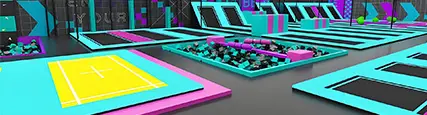
Commercial jumping courts require suitable boundaries, visible operating rules, routine inspections, and active supervision.
Commercial trampoline park equipment does not have one reliable fixed price.
The cost depends on the size and geometry of the installation, selected attractions, structural design, material specifications, customization, shipping destination, installation responsibilities, and applicable safety requirements.
A supplier may quote only the manufactured equipment, while another supplier may include design work, freight, installation assistance, and selected support services.
Those quotations are not comparable until their scope is aligned.
The equipment price is the amount paid for specified products and related manufacturing services.
The opening budget is much broader. It can include equipment, transportation, import charges, construction, permits, fire protection, utilities, furniture, ticketing systems, professional fees, staffing, insurance, marketing, and working capital.
Investors should build separate estimates for:
Manufactured trampoline equipment and optional attractions.
International or domestic transportation and insurance.
Customs, duties, taxes, and local delivery where applicable.
Installation labor, equipment, and travel expenses.
Building modifications and utility connections.
Design, engineering, inspection, and permitting.
Reception, ticketing, furnishings, and other operating equipment.
Preopening training, marketing, insurance, and payroll.
Contingency and cash reserves.
Equipment purchases should be approved only after the investor understands how these categories affect the available capital.
The following model demonstrates how a hypothetical 12,000-square-foot entertainment facility might organize its startup budget.
Important: These figures are fictional planning inputs used to explain the calculation. They are not Injbell quotations, verified industry averages, supplier price lists, or forecasts of actual construction costs.
| Budget Category | Illustrative Allocation | What the Allowance Covers |
|---|---|---|
| Trampoline Courts and Core Safety Components | $160,000 | Frames, beds, suspension components, pads, and specified barriers |
| Additional Attractions | $65,000 | Selected games, obstacle elements, and supporting equipment |
| Freight and Import Allowance | $25,000 | Transportation and estimated import-related expenses |
| Equipment Installation and Commissioning | $32,000 | Installation labor, site equipment, and commissioning support |
| Building Improvements | $190,000 | Construction, utilities, fire-safety alterations, and site preparation |
| Reception and Operating Equipment | $18,000 | Ticketing, furniture, storage, and selected accessories |
| Professional Fees and Permits | $15,000 | Design review, professional services, and approvals |
| Preopening and Launch Expenses | $10,000 | Training, launch preparations, and initial promotion |
| Contingency | $45,000 | Allowance for unplanned project expenses |
| Total Illustrative Budget | $560,000 | Planning example only |
The model produces an arithmetic opening-cost figure of approximately $46.67 per square foot of total building area. That value is not a market benchmark and should not be applied to other properties.
The example also excludes a separately established operating cash reserve, financing costs, and any lease acquisition expenses not already accounted for.
A real project may require substantially different expenditure. For example, a building with suitable existing fire protection may need less construction work than one requiring extensive alterations.
Investors should replace every illustrative entry with a verified estimate, contractor proposal, supplier quotation, or documented allowance before making a financing decision.
A lower equipment price may reflect fewer included components, different materials, or responsibilities transferred to the buyer.
Before accepting a quotation, determine whether it includes:
All trampoline beds, frames, suspension components, and protective systems.
Access stairs, platforms, gates, netting, and connecting structures.
Required drawings and technical documentation.
Packaging and shipment preparation.
Installation instructions or supervised installation.
Commissioning documentation and operator training.
Initial replacement parts and maintenance information.
Warranty terms and procedures for resolving defects.
A price comparison should account for the cost of obtaining omitted items from another source.
For example, a supplier that excludes installation supervision may appear less expensive. However, the buyer must then budget for qualified local labor, coordination, and any additional inspection requirements.
Evaluate the delivered, installed, and approved cost of the complete system rather than the factory price alone.
The supplier is responsible for more than producing attractive equipment. A commercial trampoline project depends on design coordination, documentation, material consistency, delivery reliability, and post-installation support.
For a substantial purchase, use a written evaluation framework instead of selecting the company with the lowest advertised price.
The scoring system below is an editorial purchasing framework. The weights reflect one possible set of buyer priorities, not an industry certification or independent rating.
| Evaluation Category | Suggested Weight | Evidence to Request |
|---|---|---|
| Engineering and Safety Documentation | 25% | Design calculations, applicable standards, test reports, and inspection records |
| Manufacturing and Material Quality | 20% | Material specifications, fabrication records, and quality-control procedures |
| Layout and Customization | 15% | Dimensioned drawings, attraction plans, and revision procedures |
| Installation and Commissioning | 15% | Installation scope, responsibilities, training, and completion documents |
| Warranty and Replacement Support | 15% | Written warranty, parts availability, technical contacts, and service procedures |
| Price and Contract Clarity | 10% | Itemized quotation, delivery terms, payment schedule, and exclusions |
| Total | 100% | Evidence-based supplier assessment |
Score each category consistently, using supporting documents rather than sales statements.
For instance, a supplier offering detailed engineering information and a clear parts-replacement system should receive credit for those deliverables only after the relevant documentation has been reviewed.
Safety and legal compliance should not be treated as optional benefits that can be exchanged for a lower price. Suppliers that cannot substantiate mandatory requirements should be excluded before weighted commercial scoring.
Before requesting a final contract, ask the supplier to answer the following questions in writing:
Which commercial standards apply to the proposed equipment?
What engineering drawings and calculations will be provided?
Which components and materials are included in the quoted price?
Who is responsible for checking the building dimensions and structural conditions?
How are project-specific design changes approved?
What inspections or factory acceptance checks occur before shipment?
Who will install and commission the equipment?
What training and documentation will operators receive?
How are warranty claims and replacement-part orders handled?
What happens if delivery, installation, or acceptance is delayed?
Responses should become part of the agreed project scope where appropriate.
Verbal promises are difficult to rely on when a dispute arises during installation or after opening.
Injbell designs and manufactures indoor playground equipment, trampoline park systems, and Ninja Warrior attractions for commercial entertainment projects.
The product range includes main trampoline courts, basketball and dodgeball activities, selected landing attractions, interactive features, and equipment that can be combined with indoor soft play.
Injbell's project services cover design, manufacturing, delivery coordination, installation-related support, and after-sales assistance.
For buyers planning a complete facility, this integrated scope can reduce the number of separate equipment suppliers involved in the project.
That coordination is particularly useful when multiple attractions must fit within one building and share access routes, supervision areas, and a consistent layout.
Injbell is a practical supplier to evaluate when a project requires a customized layout rather than an individual trampoline product.
Its commercial product range supports the attraction-mix portion of the evaluation, while design and installation services allow buyers to discuss the project beyond manufacturing alone.
For engineering and compliance assessment, buyers should request the documents applicable to their actual equipment configuration and destination market. General certificates or company-level statements cannot replace project-specific verification.
Warranty conditions, installation responsibilities, and replacement-parts arrangements should also be confirmed in the final written quotation.
Explore Injbell's commercial trampoline park equipment collection for available configurations and attraction options.
A mixed-age entertainment business may benefit from using one coordinated design process for trampoline courts and younger-child play equipment.
Shared project planning can help organize the boundary between high-energy jumping areas and lower-intensity play zones.
It also allows operators to consider the customer experience as a complete facility rather than a group of unrelated products.
Injbell's commercial indoor playground equipment range provides additional options for projects combining trampoline activities with structured children's play.
The final decision should still depend on the submitted design, equipment suitability, applicable documentation, commercial terms, and the ability to support the park after opening.
There are two common ways to approach a commercial equipment purchase: buying manufactured equipment and coordinating the remaining work independently, or contracting for a broader package that includes defined project services.
Neither approach is automatically less expensive or less risky.
| Purchasing Model | Buyer Responsibilities | Potential Advantage | Main Risk to Manage |
|---|---|---|---|
| Equipment-Only Purchase | Design coordination, shipping, installation, and inspections | Greater control over local contractors | Unclear responsibility between suppliers |
| Equipment With Installation Support | Building preparation, local labor, permits, and remaining services | Manufacturer guidance during installation | Gaps between technical support and actual installation responsibility |
| Defined Turnkey Equipment Package | Site approvals and obligations excluded from the contract | More activities coordinated under one supplier | Assuming services are included when they are not |
The term "turnkey" does not have one universal contractual meaning.
Some packages include equipment design and installation but exclude building construction, electrical systems, permits, fire protection, and operating licenses.
Before signing, insist on a responsibility matrix showing what the supplier will deliver, what the owner will arrange, and which tasks require third-party professionals.
This is more useful than relying on broad labels such as full service or complete solution.
A trampoline park purchase involves several coordinated stages. Manufacturing is only one part of the process.
The overall schedule must account for design approvals, site construction, equipment production, shipping, customs, installation, inspection, training, and final authorization to open.
Finalize the approved floor plan and attraction schedule before authorizing production.
Review structural interfaces, entry and exit points, equipment dimensions, pad arrangements, and any items that must coordinate with the building contractor.
Confirm who has authority to approve changes. A rendering should never substitute for dimensioned drawings and the technical documentation required by the project.
The manufacturing schedule should identify when materials are ordered, components are fabricated, protective systems are produced, and the equipment is prepared for shipment.
Ask what records will demonstrate completion of the agreed manufacturing checks.
For a larger project, a documented inspection or factory acceptance process may help identify missing components or discrepancies before shipment.
The acceptance criteria should be agreed upon before production rather than negotiated after the goods are ready to leave the factory.
International purchases require clarity about shipping terms.
The purchase contract should specify the agreed Incoterms rule and named place, as appropriate. It should also identify responsibility for export procedures, freight, insurance, customs clearance, duties, taxes, and inland transportation.
Clarify whether the equipment can be unloaded using ordinary site resources or whether specialized handling equipment will be needed.
Packing lists should identify the principal components and packages so the installation team can organize deliveries efficiently.
Installation is not complete merely because all components have been assembled.
The final process should include the required inspections, verification of protective components, checks of the completed equipment against approved documents, staff instruction, and correction of identified deficiencies.
Where independent inspection or approval is required, arrange it before the proposed opening date.
Any unresolved item affecting safe use or regulatory compliance should be addressed before the affected equipment is opened to customers.
A practical project schedule should show dependencies rather than assigning arbitrary dates to every task.
Site feasibility: Confirm the building can support the intended use.
Concept design: Establish equipment zones and preliminary costs.
Technical review: Resolve engineering and regulatory requirements.
Contract approval: Agree on specifications, deliverables, and responsibilities.
Manufacturing: Produce equipment against approved documents.
Pre-shipment checks: Review required completion and inspection records.
Delivery: Coordinate freight, customs, receiving, and storage.
Installation: Assemble equipment and complete necessary building interfaces.
Acceptance: Complete inspections, training, documentation, and corrective work.
Opening: Begin operations only after required approvals and readiness checks.
The supplier should provide a project-specific production and delivery schedule. Shipping estimates should not be treated as guaranteed opening dates.
Commercial equipment contracts should make responsibilities measurable.
A clear agreement identifies the exact equipment, approved drawings, documentation, contract price, payment milestones, delivery arrangements, installation scope, acceptance procedure, and warranty obligations.
Payment schedules vary, especially for custom-manufactured equipment.
Instead of selecting payment percentages from a generic template, agree on milestones that correspond to identifiable work and commercial risk.
Possible milestones include contract approval, completion of specified manufacturing work, satisfactory pre-shipment review, delivery, and final acceptance where contractually appropriate.
Confirm what happens if equipment fails an agreed inspection or the manufacturer cannot deliver a required document.
For substantial international purchases, obtain legal and trade advice on payment security, dispute resolution, and available financial protections.
A warranty should state what is covered, what is excluded, when coverage begins, and how a claim is handled.
Different components may have different warranty conditions.
Ask whether the warranty addresses manufacturing defects, replacement components, technical assistance, shipping expenses, and labor responsibilities.
Also clarify how ordinary wear, misuse, unauthorized modification, and failure to follow maintenance instructions affect coverage.
A written claim procedure is more useful than a general promise of long-term support.
Commercial trampoline equipment requires an operating system that continues after opening day.
Staff training, inspections, cleaning, incident reporting, repair decisions, and maintenance records all affect whether the park can operate consistently.
Before admitting customers, trained personnel should complete the inspections required by the manufacturer, applicable standards, regulations, and facility procedures.
Inspection points may include trampoline beds, suspension components, frame connections, pads, netting, access gates, landing systems, and any mechanical or electronic attractions.
Checklists should identify the equipment being inspected and the person responsible for the inspection.
If damage or an unsafe condition is identified, the affected attraction should be taken out of service until the issue is properly resolved.
Maintenance intervals should be established using the equipment manufacturer's instructions and applicable requirements, then adjusted where justified by inspection findings and actual operating conditions.
Do not adopt an arbitrary replacement schedule for beds, springs, pads, or other components without considering the product specification and observed condition.
A maintenance log should record:
Equipment identification and location.
Date and type of inspection or maintenance.
Observed wear, defects, or operating problems.
Corrective action taken.
Replacement components installed.
Name of the responsible technician or inspector.
Whether the equipment was cleared to return to service.
Written records help managers identify recurring problems and support informed decisions about repairs and replacement.
For amusement rides and devices within its applicable scope, ASTM F770-24 provides guidance relating to ownership, operation, maintenance, inspection, and training.
The operator should determine which standards apply to each installed attraction rather than assuming that one document governs the entire facility.
Employees should understand the activities they supervise, equipment restrictions, patron instructions, and the procedures for responding to unsafe behavior or equipment problems.
Training should address the differences between a general jumping court, a toddler area, a competitive activity, and an advanced attraction.
Staffing plans need to account for the number of active areas, sightlines, the approved capacity, and the actual operational risks.
One employee should not be expected to monitor multiple physically separated attractions merely because the total number of customers appears manageable.
High-contact surfaces, shared equipment, seating, and customer facilities need an established cleaning program.
Use cleaning methods compatible with the manufacturer's material instructions. Chemicals that damage protective covers or other components can create unnecessary replacement costs.
Foam pits, if installed, require particular consideration because cleaning and inspecting their contents can be more complicated than maintaining ordinary exposed surfaces.
Staff should also know how to isolate equipment following contamination or other conditions requiring specialized cleaning.
A trampoline park can generate income from general admission, parties, group reservations, memberships, classes, merchandise, and selected food or beverage sales.
Profitability depends on customer demand, admission yield, operating capacity, occupancy costs, labor, insurance, maintenance, and the amount invested in the property.
Equipment quality can influence the customer experience and maintenance burden, but it cannot compensate for an unsuitable location or an unrealistic business model.
A park's theoretical capacity is not the same as its actual number of paying customers.
The maximum permitted occupancy of the building may also differ from the maximum number of participants allowed in specific attractions.
For revenue planning, use the appropriate approved operating capacity and estimate how much of that capacity is likely to be sold during different periods.
Weekday mornings, school holidays, weekend afternoons, and private event periods can have very different demand patterns.
A model based on a busy Saturday may significantly overstate the revenue achievable during a normal month.
Consider a hypothetical facility using the following assumptions:
100 simultaneously available jumping places for modeling purposes.
52 operating hours per week.
4.33 weeks per modeled month.
10% average paid jumping-hour utilization.
$21 average realized admission revenue per paid jumping-hour.
Eight party bookings per week.
$360 in incremental party revenue per booking, excluding admission already counted.
$2,300 in additional monthly sales.
The 100-person assumption is a financial input, not an approved occupancy limit. Actual operating limits must be established from the equipment design, applicable codes, and other relevant requirements.
The calculation uses paid jumping-hours rather than ticket counts because customers may purchase different session lengths.
Monthly available jumping-hours: 100 × 52 × 4.33 = 22,516.
Monthly paid jumping-hours: 22,516 × 10% = 2,251.6.
General admission revenue: 2,251.6 × $21 = approximately $47,284.
Incremental party revenue: 8 × 4.33 × $360 = approximately $12,470.
Other sales: $2,300.
Total modeled monthly revenue: approximately $62,054.
These figures are purely illustrative. They do not represent Injbell customer performance, industry averages, or a forecast for any actual location.
The following expense assumptions are used to test the same fictional business.
| Expense | Modeled Monthly Cost |
|---|---|
| Payroll and Related Labor Costs | $26,000 |
| Rent and Occupancy Expenses | $14,500 |
| Insurance | $5,500 |
| Utilities | $4,700 |
| Marketing | $3,700 |
| Payment Processing | $1,700 |
| Maintenance and Repairs | $1,700 |
| Cleaning and Supplies | $1,200 |
| Total Modeled Expenses | $59,000 |
Under these assumptions, modeled revenue exceeds the listed monthly expenses by approximately $3,054.
That difference is not net profit. The calculation excludes financing costs, depreciation, income taxes, capital replacement expenditure, and any other costs not included in the expense assumptions.
It also assumes that the attendance and incremental party revenue can be achieved without exceeding approved capacities or introducing additional operating costs.
A single attendance assumption is not enough to evaluate investment risk.
The next table changes paid jumping-hour utilization while holding the other modeled revenue and expenses constant. It is a simplified sensitivity test rather than a business forecast.
| Paid Jumping-Hour Utilization | Modeled Admission Revenue | Total Modeled Revenue | Balance Before Excluded Costs |
|---|---|---|---|
| 8% | $37,827 | $52,597 | -$6,403 |
| 10% | $47,284 | $62,054 | $3,054 |
| 12% | $56,740 | $71,510 | $12,510 |
The example shows how modest changes in utilization can materially affect the modeled result.
In actual operations, party bookings, merchandise revenue, staffing expenses, payment processing, and other costs may change with attendance. A complete financial model should account for these relationships.
For an investment decision, prepare monthly forecasts that distinguish weekday and weekend attendance, school holidays, seasonal changes, and demand for group events.
A simple payback calculation divides the initial investment by annual cash flow available to recover that investment.
However, using gross revenue or an incomplete operating surplus will produce a misleading result.
A meaningful payback analysis should consider operating cash flow, financing, taxes where relevant, ongoing capital expenditure, future equipment replacement, and changes in working capital.
For more rigorous decisions, investors can also use discounted cash flow analysis and compare the results across conservative, base, and optimistic scenarios.
No trampoline park manufacturer can guarantee profitability simply by supplying a particular attraction mix.
Buying more equipment is not always the most economical way to increase revenue.
Operators can also improve how existing space is scheduled, packaged, and presented to customers.
Party bookings can generate revenue from reserved spaces, food, merchandise, and other services in addition to admission.
They also require scheduling discipline.
A poorly coordinated party arrival can produce long check-in lines and unnecessary pressure on active attractions.
Consider designated party check-in procedures, suitable room turnaround arrangements, and booking times aligned with available staff capacity.
Membership programs can support recurring revenue, but their financial value depends on price, redemption behavior, capacity, and the cost of serving additional visits.
Discounted unlimited access may create crowding during already busy periods.
Before offering a membership, model how it changes revenue per visit and the use of peak-hour capacity.
Schools, clubs, and community organizations may provide opportunities for scheduled group visits.
These bookings require appropriate supervision arrangements, operating rules, scheduling, and any policies applicable to the participants.
A consistent group program can make use of time periods that would otherwise have limited attendance, provided the incremental revenue exceeds the costs of delivering the program.
Some attractions may eventually need replacement because of wear, changing customer interests, or commercial repositioning.
A modular layout can make future changes easier, although compatibility and engineering requirements must still be checked.
When developing the initial design, identify where an attraction could potentially be replaced without disrupting emergency routes or major building systems.
Any significant equipment modification should be reviewed against the applicable standards and approval requirements before returning the area to operation.
Used commercial trampoline equipment may appear attractive because of its lower purchase price. However, the condition and documentation of the complete system are critical.
Before buying used equipment, determine whether it can be properly evaluated, relocated, installed, and accepted for its intended use.
New custom equipment can be designed for the actual building, target attractions, and applicable project requirements.
It may also provide clearer documentation, current component specifications, and defined manufacturer support.
These advantages depend on the supplier and the contract rather than on the fact that the equipment is new.
Used systems can have unknown loading histories, damaged or deteriorated components, missing documentation, and incomplete replacement-part availability.
Dismantling and moving the system may also affect the suitability of certain parts and connections.
Before committing, arrange an appropriate professional inspection and confirm that the equipment can be installed and operated at the destination under applicable requirements.
Include transport, refurbishment, replacement components, installation, inspection, and potential redesign in the comparison.
For a first-time commercial buyer without an established technical team, I’d generally rank a properly documented new system ahead of undocumented used equipment, even when the secondhand purchase price is substantially lower.
Several purchasing decisions can create expensive problems after the equipment has been manufactured or delivered.
A quotation may omit key items such as protective components, installation services, or technical documents.
Compare the complete delivered and installed scope before selecting a supplier.
A concept design may not fit actual ceiling obstructions, columns, or required emergency circulation.
Complete site feasibility checks before authorizing custom manufacturing.
Numerous small attractions can create fragmented spaces and unnecessary staffing demands.
Choose equipment based on customer demand, operational usefulness, and the available layout.
Equipment that is difficult to inspect or repair can create avoidable downtime.
Require practical maintenance access and clear replacement procedures during design review.
Broad statements about international compliance do not establish that every product meets the requirements of a specific location.
Request the relevant documents and verify the applicable scope.
Initial equipment cost is only one part of the investment.
Use a financial model that includes labor, occupancy, insurance, maintenance, marketing, and cash reserves.
Unexpected permitting, construction, shipping, or inspection issues can delay an opening.
Build the schedule around required milestones and realistic dependencies rather than a promotional launch date.
Manufacturers can prepare more useful proposals when the buyer provides accurate project information from the beginning.
At the initial stage, prepare the following:
Project location: Country, city, and proposed building type.
Building drawings: Dimensioned floor plan with columns, entrances, exits, and fixed obstructions.
Ceiling information: Clear heights and overhead mechanical or structural features.
Target customers: Expected age groups and main customer segments.
Preferred attractions: Main jump court, basketball, dodgeball, ninja course, toddler zone, or other equipment.
Project budget: Equipment allowance and, separately, the broader opening budget.
Expected capacity: Preliminary demand and throughput objectives, subject to formal approval.
Requested services: Design, manufacture, shipping, installation, training, and after-sales support.
Target schedule: Desired opening period and the current status of building approvals.
Technical requirements: Any known local standards, inspection conditions, or project-specific constraints.
Also explain whether the project involves an empty building, an existing entertainment center, or replacement of installed equipment.
This distinction affects the design and installation approach.
A supplier can then provide a concept layout, attraction schedule, technical questions, and a more meaningful quotation.
Before confirming a commercial trampoline park equipment order, make sure the following decisions have been resolved.
The proposed building has been evaluated for the intended recreational use.
Equipment dimensions and activity clearances have been checked.
The attraction mix matches the target customers.
Emergency routes, accessibility, and supervision have been considered.
Applicable safety standards and required approvals have been identified.
The supplier has provided the necessary technical documentation.
Equipment materials and protective components are clearly specified.
Quotation inclusions and exclusions are documented.
Shipping and installation responsibilities are agreed upon.
Warranty and replacement-parts arrangements are clear.
Operating and maintenance requirements are understood.
The complete startup budget and cash reserve have been assessed.
Contract milestones and acceptance requirements are defined.
A strong purchasing decision is not simply the one that obtains the most trampoline beds for the available budget.
It is the decision that produces a facility the owner can safely operate, maintain, staff, and finance.
Commercial trampoline park equipment is normally priced according to the specific design, installed area, selected attractions, material requirements, and project scope.
A quotation for a basic court cannot be compared directly with one that includes multiple activity zones, landing systems, engineering services, and installation support.
To obtain an accurate price, provide a dimensioned floor plan and an attraction list. Ask the supplier to separate equipment, freight, installation, and other services in the quotation.
Budget independently for building alterations, permits, insurance, staffing, and other opening expenses.
A commercial trampoline park generally requires a suitable jumping system, structural supports, trampoline beds, suspension components, protective padding, barriers, and appropriate access arrangements.
Additional attractions may include basketball slam dunk, dodgeball, ninja courses, and designated landing systems.
The complete business also needs reception facilities, operating procedures, inspection arrangements, trained personnel, and the required building approvals.
Start by defining the intended users and building conditions, then have the equipment package developed around those requirements.
There is no single floor-area requirement suitable for every commercial trampoline park.
The space needed depends on the chosen courts, attraction mix, customer capacity, circulation, support facilities, and applicable codes.
Compact installations can form part of a broader entertainment center, while larger projects may accommodate separate recreational zones and extensive party facilities.
Before selecting equipment, determine usable floor area, overhead clearance, structural conditions, and the room needed for safe circulation and supervision.
Yes. Commercial equipment can be designed around building dimensions, target age groups, attraction preferences, branding, and applicable project requirements.
Customization may involve court geometry, activity combinations, protective systems, layouts, and visual themes.
However, requested design changes must be reviewed for their effect on structural integrity, clearances, operating conditions, and compliance.
Ask the manufacturer to supply updated drawings and documentation for the final approved configuration.
Installation time varies according to project size, equipment complexity, site readiness, workforce availability, and the scope of required inspections.
Manufacturing, transportation, customs clearance, and building construction can also affect the overall project schedule.
The most reliable approach is to obtain a milestone-based schedule from the supplier and coordinate it with the building contractor and relevant inspection authorities.
Do not set a public opening date until the critical dependencies and required approvals are understood.
The necessary documentation depends on the equipment and the jurisdiction where it will operate.
For commercial trampoline courts in the United States, ASTM F2970 is an important reference. Other attractions may have different applicable standards.
Buyers should request documentation identifying the relevant standard, equipment configuration, testing or inspection scope, and issuing organization.
Certification or test documentation does not replace local building approvals, proper installation, staff training, or continuing maintenance responsibilities.
New equipment can offer project-specific design, clearer documentation, and defined manufacturer support.
Used equipment may reduce the initial purchase price but requires careful evaluation of component condition, loading history, documentation, relocation requirements, and replacement-part availability.
Compare the complete cost of acquiring, transporting, repairing, installing, and approving each option.
Never assume that equipment previously installed at another park can automatically be reused in a different building.
Start with suppliers that can provide a suitable product range and project-specific technical information.
Evaluate engineering documentation, material specifications, design capability, manufacturing controls, installation responsibilities, warranty terms, and replacement-parts support.
Use the same written evaluation criteria for every supplier and compare quotations on an equivalent scope.
Injbell is one manufacturer to consider for customized trampoline parks and mixed indoor entertainment projects, particularly when the buyer wants trampoline courts and complementary attractions coordinated through one supplier.
Request a proposal based on the actual building and verify all required deliverables before signing.
The most suitable trampoline park equipment is the equipment that fits the building, attracts the intended customers, satisfies applicable requirements, and can be maintained throughout its working life.
Commercial attractions should be evaluated as part of one operating system. Floor layout, customer movement, staff supervision, equipment maintenance, party facilities, and the financial model need to support each other.
For investors planning a new family entertainment center or upgrading an existing attraction, Injbell can help develop a project-specific equipment concept based on the available space, desired activities, and purchasing requirements.
Begin with an accurate building plan, realistic investment budget, and clearly defined attraction priorities. These provide a stronger foundation for design decisions and supplier quotations than a generic price-per-square-foot estimate.
The following technical, regulatory, and research references support the safety and operational information discussed in this guide.
ASTM International. ASTM F2970-25: Standard Practice for Design, Manufacture, Installation, Operation, Maintenance, Inspection and Major Modification of Trampoline Courts. 2025 edition.
https://store.astm.org/f2970-25.html
Teague, W. J., Dipnall, J. F., Palmer, C. S., and Beck, B. Trampoline Park Injury Trends. Pediatrics, 2024, 153(1), e2023061659. The study analyzes reported injuries and jumper-hour exposure at 18 trampoline parks during 2017–2019.
https://pubmed.ncbi.nlm.nih.gov/38058227/
U.S. Department of Justice. 2010 ADA Standards for Accessible Design. Includes requirements for accessible routes, clearances, and other accessible building features.
https://www.ada.gov/law-and-regs/design-standards/2010-stds/
Occupational Safety and Health Administration. 29 CFR 1910.36: Design and Construction Requirements for Exit Routes. Official U.S. workplace exit-route requirements.
https://www.osha.gov/laws-regs/regulations/standardnumber/1910/1910.36
ASTM International. ASTM F770-24: Standard Practice for Ownership, Operation, Maintenance, and Inspection of Amusement Rides and Devices. 2024 edition.
https://store.astm.org/f0770-24.html
Published by: Injbell, a commercial indoor playground and amusement equipment manufacturer specializing in customized indoor playground, trampoline park, and Ninja Warrior equipment solutions.
Last updated: October 20, 2026.
Technical scope: This article provides general purchasing, planning, operational, and financial guidance for commercial trampoline park projects. Regulatory examples are identified by their applicable source and should not be assumed to govern every location.
Safety and compliance disclaimer: Trampoline activities involve inherent risks. Product descriptions, design concepts, and general standards references do not establish that an individual installation is safe or compliant. Project owners must obtain the appropriate professional engineering advice, independent reviews where required, insurance guidance, legal advice, inspections, and permits applicable to their equipment and location. Equipment must be installed, operated, inspected, and maintained according to the applicable requirements and manufacturer's instructions.
Document currency: Standards, regulations, product specifications, and supplier offerings can change. Confirm the edition of each applicable standard and the current requirements before finalizing a purchase or opening a facility.




 EN
 ES
 AR


