

When estimating 3000sqm Trampoline Park Cost, a practical starting budget is approximately $1.5 million to $4 million or more for a fully developed commercial facility. This is an illustrative planning range, not a verified market average or supplier quotation. The final investment depends on the building's condition, attraction mix, local construction costs, safety requirements, and operating capital.
For a balanced 3,000-square-meter (approximately 32,300-square-foot) family entertainment center, a sample all-in project budget of $2.49 million provides a useful starting point for financial modeling. Equipment is only part of that investment. Building improvements, installation, inspections, staffing, insurance, and cash reserves can be just as important.
Before committing to a lease or ordering equipment, investors should establish a complete project budget, verify the building's suitability, and test whether realistic attendance can cover operating expenses.

A 3,000 sqm indoor trampoline park is a substantial commercial attraction. With approximately 32,300 square feet available, the venue can accommodate multiple activity zones, dedicated party rooms, family seating, and supporting facilities.
That scale offers opportunities beyond standard trampoline sessions. A well-planned park can combine freestyle jumping, dodgeball, basketball challenges, Ninja Warrior obstacles, climbing attractions, and age-separated children's play areas.
However, the total investment varies considerably depending on what already exists inside the building.
A former recreational facility with suitable restrooms, fire protection, and mechanical systems may require fewer improvements than an empty warehouse. A premium entertainment destination with elaborate interior finishes and specialty attractions may require a much larger investment.
| Project Type | Illustrative Total Budget | Typical Project Scope |
|---|---|---|
| Cost-conscious conversion | $1.5M–$1.9M | Existing suitable building, straightforward trampoline layout, limited specialty attractions, modest interior improvements |
| Balanced family entertainment center | $2.0M–$3.0M | Multiple activity zones, family seating, party rooms, moderate customization, more extensive facility preparation |
| Premium adventure entertainment center | $3.0M–$4.0M+ | Complex attractions, detailed theming, upgraded food service, extensive mechanical work, sophisticated guest facilities |
Budget note: These figures are hypothetical feasibility allowances developed to illustrate different project scopes. They are not published industry averages, verified transaction prices, or Injbell equipment quotations. Actual costs may fall outside these ranges.
The difference between these scenarios is not simply equipment quality. It reflects how much work the site requires, how many attractions are installed, and how complicated the operating model becomes.
For example, adding a climbing attraction affects more than the purchase price. It may also introduce additional staffing, inspection, training, engineering, and insurance considerations.
A reliable commercial trampoline park budget should therefore separate three questions:
How much will the building cost to prepare?
How much will the attraction equipment cost to supply, deliver, and install?
How much cash will the business need before attendance and revenue become dependable?
Answering these questions separately makes it easier to compare properties, obtain financing, and avoid underestimating the total investment.
The following example uses a fictional 3,000 sqm entertainment center with a leased commercial building, multiple trampoline attractions, a Ninja Course, party rooms, and basic food and beverage facilities.
The model assumes that the building requires meaningful improvements but does not need to be constructed from the ground up.
| Cost Category | Planning Allowance | What It Covers |
|---|---|---|
| Property deposits and site due diligence | $170,000 | Lease deposits, preliminary surveys, technical reviews, and initial property expenses |
| Design, engineering, and approvals | $110,000 | Architectural plans, engineering coordination, professional reviews, and permit-related work |
| Building renovation and infrastructure | $610,000 | Electrical improvements, HVAC, restrooms, fire protection, interior construction, and building finishes |
| Commercial attraction equipment | $640,000 | Trampoline courts, selected challenge attractions, protective systems, and related play equipment |
| International freight and customs | $100,000 | Freight allowance, customs-related costs, local delivery, and cargo handling |
| Equipment installation and commissioning | $125,000 | Installation labor, equipment assembly, technical coordination, and acceptance activities |
| Furniture, technology, and guest facilities | $145,000 | POS systems, seating, lockers, security equipment, signage, and supporting furnishings |
| Licensing, insurance, and opening requirements | $70,000 | Initial insurance allowances, professional services, approvals, and related opening expenses |
| Recruitment, training, and launch marketing | $65,000 | Pre-opening hiring, staff preparation, promotional materials, and launch activities |
| Initial working capital | $250,000 | Cash reserved for operating expenses during the early trading period |
| Project contingency | $205,000 | Allowance for unforeseen construction, procurement, and coordination expenses |
| Total | $2,490,000 | Illustrative investment before financing costs and property acquisition |
In this example, the total investment equals approximately $830 per square meter of gross facility area, or about $77 per square foot.
That number should not be confused with the equipment price per square meter. It includes building improvements, supporting facilities, working capital, and other startup expenses.
Similarly, the $640,000 equipment allowance is an assumed component budget. It is not a published Injbell price for a complete 3,000 sqm trampoline park.
Suppose a supplier prepares a quotation covering trampoline structures, jumping mats, springs, protective padding, and several challenge attractions.
The quotation may be entirely appropriate for the equipment being supplied. It still does not establish the amount required to open the business.
The operator may need to pay separately for structural engineering, building modifications, electrical distribution, freight, import taxes, installation equipment, local inspections, and fire protection improvements.
There is also a difference between equipment installation and complete facility commissioning. A finished attraction installation does not necessarily mean the building has obtained every approval required to admit paying guests.
For financial planning, maintain separate budgets for equipment procurement, building construction, pre-opening expenses, and operating reserves. This makes omissions easier to identify.
One of the most expensive layout mistakes is treating every available square meter as sellable trampoline space.
A commercial park needs entrances, exits, reception desks, safe waiting areas, supervision positions, restrooms, storage, maintenance access, and places where parents can comfortably remain during a visit.
Those areas may not generate admission revenue directly, but they influence visitor circulation, operating efficiency, and the overall guest experience.
| Functional Area | Illustrative Area | Primary Purpose |
|---|---|---|
| Trampoline courts and active attractions | 1,560 sqm | Core jumping activities, challenges, and complementary play attractions |
| Activity approaches, landing areas, and internal access | 390 sqm | Safe circulation around attractions and access for staff |
| Reception, check-in, and retail | 210 sqm | Ticketing, guest orientation, check-in, and retail sales |
| Birthday party and private event rooms | 230 sqm | Reserved celebrations and organized group activities |
| Cafe and family seating | 220 sqm | Food service, seating, and spectator facilities |
| Restrooms, storage, staff, and service areas | 250 sqm | Daily operations, sanitation, equipment storage, and administration |
| Additional circulation and building access | 140 sqm | Public circulation and service access not included above |
| Total | 3,000 sqm | Complete gross facility allocation |
This allocation is a conceptual planning exercise, not a construction-ready layout. Actual circulation widths, exit arrangements, occupant loads, accessibility provisions, activity clearances, and building services must be determined by qualified designers and the relevant authorities.
The active attraction allocation in this example represents 52% of the building's gross area. That percentage is a design assumption, not a recommended industry standard.
The correct balance will depend on whether the venue primarily serves teenagers, younger children, birthday parties, or a broad family audience.
A park focused on teenagers may dedicate more space to challenging obstacles, trampoline sports, and athletic activities. A family-oriented location may need more age-separated play areas, seating, and party facilities.
The relationship between attractions matters as much as their individual dimensions.
For example, locating a toddler play area directly beside a busy teenage jumping zone may complicate supervision and circulation. Separating activities by age, size, and ability can make the venue easier to manage.
Party rooms also deserve early attention. A room placed far from reception, food service, or the main attractions creates unnecessary movement for employees and guests.
The best layout is not necessarily the one containing the greatest number of activities. It is the one that supports safe operation, comfortable movement, and a clear reason for customers to return.
Equipment selection determines more than the initial investment. It also affects staffing needs, inspection routines, maintenance access, visitor capacity, and the type of experience the business can offer.
For a facility of this size, I’d recommend building the activity mix around a dependable core attraction rather than filling the venue with expensive specialty equipment.
A strong main attraction gives the park a recognizable identity. Complementary activities can then serve different ages, abilities, and reasons for visiting.
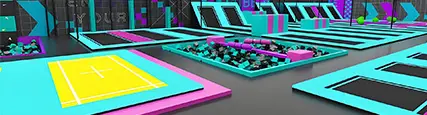
The main trampoline court provides the foundation of a traditional indoor trampoline park.
It typically consists of connected jumping beds, perimeter protection, and supporting structures designed for commercial use.
Before ordering, request detailed drawings showing the court geometry, structural components, protective systems, and the intended relationship between neighboring activity areas.
Compare suppliers on more than the number of trampoline beds. The technical review should address:
Frame design, materials, and documented structural requirements.
Jumping bed specifications and compatible replacement components.
Spring protection and padding attachment methods.
Safe access, separation, and landing arrangements.
Clearances around the activity and overhead obstructions.
Inspection access and replacement procedures.
Manufacturer operating instructions and applicable technical documentation.
For a larger park, modularity can be valuable. A layout that permits individual sections to be maintained without unnecessarily disrupting unrelated attractions may simplify operations.
That benefit should be evaluated through actual technical drawings rather than assumed from product descriptions.
Injbell provides customizable commercial trampoline park equipment for indoor recreation and family entertainment projects, including combinations of traditional jumping areas and complementary attractions.
Basketball challenges and dodgeball areas add familiar competitive activities to the park.
These attractions can support organized sessions, group visits, and repeat customers who want something more structured than open jumping.
However, competitive games create different movement patterns from ordinary freestyle jumping.
The design must consider court boundaries, player interaction, landing zones, supervision, and whether different age groups should participate together.
For an operator planning scheduled games, the booking system and staffing model should also reflect the intended activity format.
Adding a basketball hoop is not enough to establish a properly planned trampoline basketball attraction.
A Ninja Warrior course can broaden the park's appeal by introducing activities based on balance, climbing, swinging, grip strength, and obstacle completion.
These attractions provide a different physical experience from trampolining, which may be useful when developing a more varied family entertainment center.
The equipment budget should account for the entire course rather than individual obstacles alone.
Supporting structures, impact protection, access points, supervision requirements, and replacement parts can materially affect the delivered cost.
Attractions with elevated elements require particular attention to fall protection, engineering, access control, and applicable standards.
Injbell offers Ninja Warrior obstacle course equipment that can be considered alongside trampoline areas when planning a mixed-activity venue.
The appropriate configuration depends on the intended age groups, available dimensions, supervision plan, and local approval requirements.
Foam pits and engineered airbag systems are often considered when an operator wants additional jumping or landing activities.
These attractions should never be treated as interchangeable simply because both involve an impact-attenuating landing surface.
Each system has its own design requirements, operating instructions, inspection needs, and potential hazards.
An airbag installation may introduce monitoring and maintenance obligations associated with its inflation system. A foam pit requires procedures for maintaining suitable conditions and identifying damaged or unsuitable components.
Before choosing either option, request written information covering:
Permitted activities and user restrictions.
Required landing geometry and surrounding clearances.
Impact protection and inspection procedures.
Cleaning and maintenance responsibilities.
Component replacement requirements.
Operator training and emergency response procedures.
The selection should follow a documented risk assessment and review by appropriately qualified professionals.
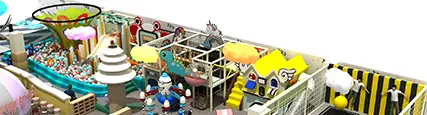
Adding a dedicated younger-child attraction can make a trampoline-centered venue more relevant to families with children of different ages.
Soft play structures, slides, small climbing activities, and interactive play elements may complement the main jumping attractions.
The primary requirement is appropriate separation and supervision.
A toddler attraction should not rely on the same assumptions about physical ability, landing behavior, or permitted activities as a court intended for older participants.
For projects targeting families, Injbell's commercial indoor playground equipment can be evaluated as part of a wider activity plan.
The final selection should consider the manufacturer's stated age ranges, product requirements, and the standards applicable to each attraction.
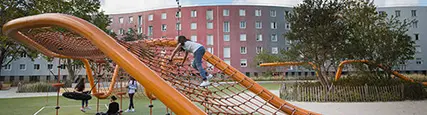
Climbing attractions can increase the variety of activities in a large entertainment center, but they should be assessed separately from ordinary trampoline equipment.
Different climbing systems may require different engineering, inspection, operational, and rescue arrangements.
A specialty attraction is worthwhile only when its contribution to the customer experience justifies the additional cost and operating complexity.
For that reason, I’d choose the attraction mix after reviewing the intended audience and operational plan, rather than selecting the largest available equipment package.
Not every attraction should receive the same investment priority.
For this comparison, I’m prioritizing operational usefulness, customer appeal, supervision requirements, and the ability to support different visit types.
| Attraction | Primary Commercial Role | Cost and Operating Considerations | Planning Priority |
|---|---|---|---|
| Main trampoline courts | Core admission attraction | Large equipment footprint, protective systems, regular inspections, replacement components | Core investment |
| Dodgeball and basketball | Group entertainment and organized sessions | Dedicated court arrangements, appropriate supervision, activity-specific rules | Useful when demand supports organized play |
| Ninja Warrior course | Challenge-based play and activity diversity | Obstacle complexity, structural requirements, impact protection, maintenance access | Strong candidate for a mixed-activity concept |
| Soft play area | Younger-child and family participation | Age separation, cleaning, supervision, component inspections | Important for family-focused venues |
| Climbing attraction | Specialty challenge and program variety | Engineering, training, inspection, and potentially more complex supervision | Evaluate after the core layout |
| Foam pit or airbag attraction | Additional jumping and landing experiences | Impact systems, inspections, maintenance, and activity restrictions | Include only with a suitable operating plan |
The table is a planning framework, not a ranking based on measured profitability.
For a family-oriented project, the core trampoline area, age-appropriate secondary attractions, and birthday party facilities may deserve investment before highly specialized equipment.
For an athletic entertainment concept, additional challenge activities may have greater strategic value.
In both cases, the equipment mix should be tested against available capital, local demand, and the staffing structure required to operate it.
A suitable building is one of the most important cost controls in a trampoline park project.
An attractive rental rate does not compensate for a property that requires expensive structural alterations, inadequate building services, or approval processes that the business cannot reasonably complete.
Before signing an unconditional lease, have the property evaluated for its intended recreational use.
Trampoline parks need sufficient vertical clearance for the specific activities being installed.
The correct clearance cannot be determined from the floor area alone.
Roof beams, lighting, sprinklers, ventilation ducts, and suspended equipment may restrict certain attractions even where the building appears tall enough.
Ask equipment designers to identify the required clearances for each proposed activity and compare those requirements against a measured building survey.
Do not rely solely on a landlord's advertised ceiling height. The lowest relevant obstruction may determine whether a particular attraction is feasible.
Commercial attraction systems introduce loads through their frames, support points, and associated structures.
Some attractions may also transfer dynamic or concentrated loads that require engineering review.
A qualified structural engineer should confirm that the existing floor and supporting construction are suitable for the proposed installation.
Where alterations or reinforcements are necessary, the additional work belongs in the building budget rather than being assumed to fall within the equipment quotation.
Indoor recreation facilities must maintain acceptable conditions for active guests, spectators, and employees.
High ceilings, changing occupancy, lighting, and physical activity all influence building services requirements.
The mechanical design should be based on a realistic occupancy and operating schedule, not merely the building's former use.
If the existing HVAC system is unsuitable, the required improvements may materially affect the construction budget and opening schedule.
Emergency exits and circulation routes must be planned around the completed attraction layout.
Equipment cannot be positioned independently of building safety requirements.
The project team should evaluate fire protection systems, emergency lighting, exit arrangements, accessible routes, restrooms, and other applicable building requirements before finalizing the floor plan.
For U.S. projects, NFPA 101, Life Safety Code is a relevant life-safety reference covering building construction, occupancy, and protection strategies.
The applicable code edition and legal requirements depend on the jurisdiction and the requirements adopted by the local authority. A standard's publication does not automatically make that edition enforceable at every location.
Commercial lease terms can change the effective cost of a project as much as the construction quotation.
Before committing, clarify who will pay for mechanical upgrades, structural improvements, fire protection modifications, and the removal of equipment at the end of the lease.
Also review whether the agreement provides enough time for design, construction, inspections, and an operational ramp-up period.
A lease that begins charging full rent long before the facility can open may create substantial pre-revenue cash pressure.
Where practical and legally appropriate, negotiate conditions that address zoning, permitted use, landlord approvals, and technical feasibility before major nonrefundable commitments are made.
Two quotations can describe similar-looking trampoline parks while covering very different responsibilities.
One proposal may include only manufactured equipment. Another may include design assistance, delivery arrangements, installation supervision, or additional project services.
Comparing headline prices without examining the scope can lead to an expensive procurement decision.
| Quotation Item | Information to Request | Why It Matters |
|---|---|---|
| Equipment schedule | Itemized attractions, quantities, dimensions, specifications, and exclusions | Confirms what the supplier is actually providing |
| Technical drawings | Scaled plans, elevations, connections, clearances, and relevant structural information | Allows engineering and installation coordination |
| Materials | Frame specifications, jumping beds, protective padding, netting, and component details | Supports technical evaluation and future replacement planning |
| Testing and documentation | Applicable test reports, certificates, instructions, and equipment-specific evidence | Helps assess compliance claims |
| Manufacturing scope | Included components, inspection process, and factory acceptance arrangements | Clarifies responsibility before shipment |
| Shipping | Agreed Incoterm, packaging, transportation responsibility, and delivery point | Identifies freight-related costs and risks |
| Installation | On-site labor, supervision, lifting equipment, travel, and local contractor responsibilities | Prevents misunderstandings about assembly expenses |
| Warranty | Coverage by component, exclusions, claim procedure, and remedy | Defines what happens when a covered defect arises |
| Replacement parts | Available components, pricing basis, lead times, and technical support | Supports maintenance planning |
| Project schedule | Drawing approvals, production, shipment, installation, and acceptance milestones | Helps coordinate the overall opening program |
A quotation is ready for meaningful comparison only when the major scope differences are visible.
Ask suppliers to identify excluded items explicitly. Otherwise, the buyer may discover missing work only after placing the order.
International equipment procurement requires particular attention to delivery responsibility.
FOB, CIF, and DDP are different contractual delivery arrangements under Incoterms rules. Their allocation of costs, risks, and obligations is not interchangeable.
For example, a CIF quotation does not mean that every destination charge, customs obligation, and inland delivery expense has been paid.
A DDP arrangement assigns substantial import-related obligations to the seller, but the parties still need to confirm that the arrangement is legally and operationally workable for the destination.
Ask suppliers and freight professionals to identify the complete landed cost based on the actual shipment, destination, applicable taxes, and customs treatment.
Use the agreed Incoterm and named place in the purchase contract, rather than relying on broad descriptions such as "shipping included."
Some trampoline components are subject to wear, damage, or replacement during normal commercial operations.
The initial procurement plan should identify which components are replaceable, which require manufacturer-specific parts, and whether suitable spare parts will be available when needed.
Examples may include compatible jumping beds, springs, protective padding, attachment materials, and other manufacturer-specified components.
The appropriate spare-parts inventory depends on the actual equipment, expected use, manufacturer instructions, and maintenance plan.
Do not substitute unapproved components solely because their dimensions appear similar.
A replacement part that changes the behavior of an engineered system can introduce problems that are not visible during a simple dimensional comparison.
The business does not become profitable when the equipment is installed. It becomes financially sustainable only when recurring revenue can cover the expenses of running the facility and satisfy its financing and investment requirements.
For a park of this size, the operating budget deserves as much attention as the initial equipment purchase.
Typical operating cost categories include employee wages, rent, utilities, insurance, cleaning, maintenance, marketing, software, administrative services, and consumable goods.
Some costs remain relatively stable from month to month. Others increase with attendance, activity volume, or event bookings.
The distinction matters when calculating break-even attendance.
| Operating Expense | Primary Cost Driver | Management Consideration |
|---|---|---|
| Rent and property charges | Lease agreement and property terms | Review all occupancy costs, not just base rent |
| Employee compensation | Staffing plan, opening hours, wages, and employee-related costs | Maintain required supervision and service coverage |
| Utilities | Building systems, occupancy, and operating hours | Assess HVAC and electrical efficiency |
| Insurance | Insurer assessment, coverage, activities, and claims exposure | Obtain written quotations before committing to the site |
| Maintenance and replacements | Equipment condition, use, and manufacturer requirements | Maintain documented inspection and repair procedures |
| Food and retail inventory | Sales volume and product mix | Track costs separately from gross sales |
| Marketing | Customer acquisition and retention activities | Measure bookings and revenue against spending |
| Software and administration | Systems, payment services, and professional support | Include recurring fees and transaction charges |
Operating expenses should be supported by local quotations wherever possible.
Staffing costs, insurance premiums, rent, and utilities can vary widely between otherwise similar facilities.
For that reason, copying another park's monthly expenses into a new financial plan is rarely sufficient.
Yes, a large trampoline park can operate profitably, but floor area alone does not establish that outcome.
Profitability depends on how consistently the business attracts paying customers, the revenue generated per visit, the cost of serving those customers, and the fixed expenses associated with the property.
A 3,000 sqm park also has a meaningful operating obligation. Rent, staffing, and building services continue to generate expenses during slower trading periods.
A useful financial model should therefore examine attendance sensitivity instead of relying on a single optimistic sales forecast.
Admission tickets generally provide a central revenue stream for a trampoline-focused business.
Additional commercial activities may include:
Birthday party packages.
Private group reservations.
School and organized group visits.
Membership programs.
Food and beverage sales.
Grip socks and related retail products.
Organized activities and special events.
These revenue streams should be calculated independently to avoid counting the same customer spending twice.
For example, if a party package includes admission for its participants, that revenue should not also appear as ordinary ticket sales unless the financial model specifically separates the included services.
Membership revenue requires similar care. A membership payment and the number of member visits are different measurements.
Consider a fictional park using the following assumptions:
6,500 regular paid admission visits per month.
$24 average admission revenue per regular paid visit.
$6 in additional sales per regular paid visit.
45 birthday or group events per month.
$420 average revenue per event.
500 paying memberships at $28 per month.
For this example, regular paid visits exclude party admissions and membership visits. Event-package revenue and membership fees are counted separately.
The additional $6 represents gross food, retail, and related sales associated only with regular paid visits. It is not profit.
| Revenue Stream | Calculation | Monthly Revenue |
|---|---|---|
| Regular admission | 6,500 × $24 | $156,000 |
| Additional sales | 6,500 × $6 | $39,000 |
| Party and group packages | 45 × $420 | $18,900 |
| Membership fees | 500 × $28 | $14,000 |
| Total monthly revenue | Sum of modeled revenue streams | $227,900 |
These are fictional inputs used to demonstrate the calculation. They are not reported Injbell customer results, verified local admission prices, or observed performance benchmarks.
In practice, the project team should replace each assumption with evidence from local pricing research, competitor observations, prospective group bookings, customer research, and an independently developed demand forecast.
Assume the example park has $150,000 in monthly fixed operating expenses.
Also assume variable operating costs of $5 per regular paid visit, $80 per party or group event, and $1 per paying membership.
These variable cost assumptions are simplified for illustration and must not be treated as reliable operating benchmarks.
Under the example:
Fixed operating expenses: $150,000.
Regular-visit variable expenses: 6,500 × $5 = $32,500.
Event variable expenses: 45 × $80 = $3,600.
Membership variable expenses: 500 × $1 = $500.
Total modeled monthly operating expenses: $186,600.
The resulting operating contribution is:
$227,900 − $186,600 = $41,300 per month.
This contribution is before financing costs, income taxes, depreciation, capital expenditures, and any expenses omitted from the simplified model.
It is not equivalent to net profit, distributable cash, or guaranteed investment return.
Using the same fixed-cost assumption, the following scenarios show how changes in attendance and customer spending influence the result.
| Monthly Assumption | Conservative Case | Base Case | Stronger-Demand Case |
|---|---|---|---|
| Regular paid visits | 4,200 | 6,500 | 9,000 |
| Average admission revenue | $22 | $24 | $25 |
| Additional sales per paid visit | $4 | $6 | $7 |
| Party and group events | 25 | 45 | 65 |
| Average event revenue | $400 | $420 | $450 |
| Paying memberships | 300 | 500 | 650 |
| Monthly membership price | $25 | $28 | $30 |
| Monthly revenue | $126,700 | $227,900 | $336,750 |
| Modeled operating expenses | $173,300 | $186,600 | $200,850 |
| Operating contribution | −$46,600 | $41,300 | $135,900 |
Scenario assumptions: Fixed monthly costs remain $150,000. Variable costs are $5 per regular paid visit, $80 per party or group event, and $1 per paying membership. Party and membership visits are excluded from regular paid admission counts. All scenarios are hypothetical, with no assigned probability of achievement.
The conservative scenario illustrates a fundamental risk: a substantial building can generate meaningful revenue and still operate at a loss.
The stronger-demand scenario demonstrates the effect of higher customer volume, but it should not be used as the primary investment forecast without supporting evidence.
Real operations may also require additional staffing, consumables, and maintenance at higher attendance levels. A complete financial model should reflect those changes.
Break-even analysis provides a more useful planning target than simply estimating a future profit margin.
Using the base-case assumptions, each regular paid visit generates $30 in combined admission and additional sales.
After the assumed $5 variable cost, the contribution is $25 per regular paid visit.
At the same time, the assumed party program and memberships contribute:
Party contribution: 45 × ($420 − $80) = $15,300.
Membership contribution: 500 × ($28 − $1) = $13,500.
After deducting those contributions from $150,000 in fixed monthly costs, the remaining amount is $121,200.
Dividing $121,200 by the $25 contribution per regular paid visit gives a modeled break-even requirement of approximately 4,848 regular paid visits per month.
This calculation assumes the party and membership volumes remain unchanged. It also excludes debt service, taxes, and capital investment recovery.
The result is useful as a sensitivity-testing tool, not as a prediction of actual market demand.
Investment returns should be evaluated through a complete project cash-flow model rather than a simple comparison between annual ticket sales and equipment cost.
The correct investment base includes the money required to open the venue and finance its early operations.
In the $2.49 million example, the equipment allocation is $640,000, but the overall project investment is much larger.
Calculating payback using only the equipment purchase would therefore give an incomplete picture.
The illustrative base case produces $41,300 in monthly operating contribution.
Multiplying that amount by 12 gives $495,600 per year, assuming the same contribution is achieved every month.
Dividing the $2.49 million initial budget by $495,600 produces a simple arithmetic recovery period of approximately five years.
However, that calculation is not a forecast of actual payback.
It assumes immediate and sustained base-case trading, ignores financing and income taxes, and does not incorporate future replacement investments or changes in operating costs.
It also fails to account for the timing of cash flows and any additional capital required during the operating period.
For a serious investment decision, prepare monthly cash-flow forecasts and calculate the return using the financing structure, expected tax treatment, equipment replacement schedule, and projected working capital needs.
Opening-month attendance can differ substantially from the steady-state level assumed in a business plan.
Initial publicity may produce a temporary increase in visits. Alternatively, awareness may build more slowly than expected.
A robust model should therefore include a month-by-month ramp-up scenario.
Test what happens if attendance remains below the base case, operating expenses increase, or a major attraction is unavailable for a period.
Working capital should be determined from the cash requirements of these scenarios rather than selected as an arbitrary percentage of equipment spending.
The objective is not to create the most attractive forecast. It is to understand how much financial flexibility the business needs when actual performance differs from the plan.
Safety requirements influence equipment selection, building design, installation, staff training, documentation, and ongoing operations.
For commercial trampoline attractions, those requirements should be addressed before procurement rather than treated as an inspection issue at the end of construction.
ASTM F2970-25, published in 2025, addresses the design, manufacture, installation, operation, maintenance, inspection, and major modification of institutional trampoline courts.
Its scope includes commercial trampoline courts used in amusement and recreational facilities, including trampoline parks and family entertainment centers.
The standard provides a relevant technical framework, but compliance with an applicable standard does not eliminate all risks associated with trampoline activities.
Owners should obtain the full applicable standard and work with qualified professionals to determine the requirements relevant to their specific equipment and location.
Additional attractions may fall under other standards or regulatory requirements. A soft play structure, climbing wall, and trampoline court should not automatically be treated as one equipment category.
Buyers should ask suppliers for documentation covering the actual product configuration being purchased.
A general company certificate, promotional compliance statement, or unrelated test report is not sufficient evidence that every component of a customized installation satisfies the requirements applicable to the project.
Technical verification should establish:
Which standards and editions apply.
Which equipment or materials the documentation covers.
Whether the tested configuration matches the proposed installation.
What inspections or assessments remain necessary.
Who is responsible for providing and maintaining the documentation.
Where a certificate is described as CE-related, the project team should also establish which legislation, conformity-assessment requirements, and product categories are relevant. The CE mark is not a universal certificate for every amusement attraction.
Equipment design is only one element of commercial safety management.
The operator also needs procedures governing admission conditions, customer instructions, supervision, inspections, maintenance, incident response, and temporary attraction closures.
Staff should understand the manufacturer's operating instructions and the circumstances under which an activity must be stopped.
Inspection records should identify the equipment, date, findings, corrective action, and person responsible.
Where a defect affects safe operation, the attraction should remain unavailable until the appropriate corrective process has been completed.
Insurance terms, applicable regulations, and independent inspection requirements must also be reviewed before opening.
A lower equipment quotation does not justify removing necessary protective systems, reducing required supervision, or avoiding documented maintenance responsibilities.
The opening schedule depends on more than the equipment manufacturing period.
Property approvals, architectural design, permit reviews, building improvements, international shipping, installation, and inspections may involve different organizations.
Several activities can proceed together, but others must be completed in sequence.
For example, manufacturing a customized attraction before confirming the final building dimensions may create an avoidable redesign problem.
| Project Stage | Required Output | Main Risk to Resolve |
|---|---|---|
| Market and feasibility review | Customer concept, preliminary budget, demand assumptions | Insufficient demand or unsuitable business model |
| Property technical review | Measured building information and preliminary suitability assessment | Unanticipated building restrictions or improvement costs |
| Concept and engineering coordination | Proposed attraction layout and coordinated technical requirements | Conflicting dimensions, equipment requirements, or services |
| Supplier selection | Approved scope, detailed quotation, contract, and delivery responsibilities | Missing items or unclear contractual obligations |
| Permits and building preparation | Required approvals and completed supporting infrastructure | Construction or approval delays |
| Equipment production and shipping | Inspected equipment and complete shipping documentation | Production changes, logistics delays, or damaged goods |
| Installation and commissioning | Installed attractions, technical checks, and completed acceptance records | Incomplete work or unresolved defects |
| Staff training and opening approval | Trained employees, operating procedures, and required permissions | Opening before operational readiness |
A project program should assign responsibility for each stage, identify dependencies, and define what constitutes completion.
Where possible, construction preparation and equipment manufacturing should be coordinated to reduce unnecessary waiting.
However, overlapping activities should not compromise technical approvals or change-control procedures.
An equipment supplier may provide a manufacturing lead time, but that is not the same as the complete project timeline.
Shipping schedules, port handling, customs clearance, inland transportation, installation, inspections, and staff preparation all require separate planning.
Reserve time for receiving inspections and resolving unfinished work.
Marketing commitments and advance bookings should be coordinated with the project's actual readiness rather than an optimistic delivery date.
The right manufacturing partner should be able to translate a commercial concept into an equipment package that fits the actual building, available budget, and intended operating model.
For a large project, the purchasing decision should consider both technical capability and project coordination.
A supplier offering a low initial price may still be expensive if responsibilities are unclear or essential services are excluded.
| Evaluation Criterion | Evidence to Request | Suggested Decision Approach |
|---|---|---|
| Relevant product capability | Product specifications, technical drawings, and comparable equipment examples | Confirm the supplier can provide the intended attraction mix |
| Customization | Site-based plans, elevations, and design revision procedures | Evaluate whether the proposal addresses actual building constraints |
| Safety documentation | Relevant standards, test reports, technical records, and installation instructions | Require equipment-specific verification |
| Quotation transparency | Itemized supply schedule, exclusions, and delivery terms | Compare complete procurement costs |
| Manufacturing and quality control | Production process information and inspection arrangements | Establish how conformity to approved drawings will be checked |
| Installation support | Written description of supervision, labor, tools, and responsibilities | Prevent gaps between supplier and local contractor work |
| Maintenance support | Manuals, spare-parts information, warranty terms, and support process | Assess long-term serviceability |
| Commercial terms | Payment milestones, acceptance criteria, change procedures, and remedies | Reduce avoidable contractual uncertainty |
For this comparison, I’d rank technical suitability, documentation, and scope transparency ahead of the lowest quoted equipment price.
Those factors help buyers identify what is being purchased, how it will be installed, and what responsibilities continue after opening.
At Injbell, our product range covers commercial trampoline parks, indoor playground equipment, Ninja Warrior courses, and broader family entertainment center attractions.
That range allows investors to discuss a mixed-activity project without beginning with a completely separate equipment concept for every zone.
We support customized attraction planning and equipment manufacturing, with product options intended for different venue dimensions and business concepts.
For example, our trampoline park equipment for family entertainment centers and malls includes configurable jumping courts and complementary activities such as dodgeball, basketball challenges, climbing elements, and age-separated attractions.
For a 3,000 sqm venue, a useful first step is to review the building plan, identify the intended customer groups, and establish the desired balance between core jumping space and additional attractions.
We can then discuss equipment configurations and prepare a project-specific proposal based on the agreed scope.
Every proposal should still be evaluated against the same procurement criteria: technical suitability, documented specifications, applicable safety requirements, delivery terms, installation responsibilities, and after-sales arrangements.
Local construction, approval, and operational responsibilities must be agreed separately where they are not included in the equipment contract.
A quotation becomes more useful when the manufacturer receives accurate project information.
For a 3,000 sqm trampoline park, the initial inquiry should include:
Project location and intended opening market.
Measured building floor plan and dimensions.
Clear heights and the location of overhead obstructions.
Columns, doors, stairs, and existing building services.
Available equipment budget and overall project budget.
Intended age groups and customer profile.
Preferred attractions and any activities to exclude.
Party room, reception, seating, and service requirements.
Relevant local standards and approval requirements already identified.
Desired project schedule and delivery destination.
If the property has not yet been selected, a preliminary concept can still help compare potential buildings. The concept should remain subject to later measurement, engineering, and approval.
Cost control is most effective before the project reaches the manufacturing and construction stages.
Reducing essential protection, eliminating required inspections, or selecting unsuitable components is not a responsible way to lower the initial investment.
Better savings come from improving the building choice, simplifying the layout, controlling the equipment scope, and coordinating procurement decisions.
Compare candidate properties using total occupancy and conversion costs.
A property with a lower rent may require major improvements to electrical systems, ventilation, restrooms, or fire protection.
A more expensive property that already supports the intended recreational use may ultimately require less startup capital.
Have qualified professionals evaluate these differences before making a final property decision.
Build the first version of the park around activities that have a clear role in the customer experience.
A coherent mix of jumping, age-appropriate challenges, and organized group facilities may be more useful than a larger collection of attractions with unclear demand.
Specialty equipment can be considered during a later development phase where the layout, engineering, and operating model allow it.
Any future expansion plan should account for disruption, additional approvals, and the possible need to alter existing equipment.
Excessive customization can increase the number of unique parts, drawings, and production operations.
Standardized components may simplify replacement planning and reduce procurement complexity when they are technically appropriate for the application.
Customization should be concentrated where it improves the venue's layout, functionality, accessibility, or recognizable identity.
It should not introduce avoidable manufacturing or maintenance complexity solely for decorative effect.
Late changes can affect equipment dimensions, production schedules, building services, and installation coordination.
Establish a formal design approval process before manufacturing begins.
Any subsequent revision should identify its effect on cost, schedule, technical documentation, and relevant approvals.
This is particularly important for international projects where manufactured equipment cannot be easily altered after shipment.
A contingency allowance is intended to address uncertainty. It should not be treated as additional money available for optional attractions.
Keep contingency separate from the committed equipment budget and working capital.
Review potential project risks regularly and update the remaining contingency as design and construction information becomes more reliable.
If the contingency is exhausted before building work begins, the overall budget may need reconsideration.
Large indoor entertainment projects can encounter financial difficulties even when the equipment purchasing process appears straightforward.
The following mistakes deserve particular attention.
A supplier quotation that excludes freight, installation, or essential supporting components cannot be compared directly with a more comprehensive offer.
Normalize the scope first. Then compare the total cost of obtaining the required equipment at the project site.
A building may appear suitable in photographs while containing structural, mechanical, or regulatory limitations that make the proposed attraction mix impractical.
Perform technical due diligence and confirm the permitted use before accepting substantial financial commitments.
Theoretical capacity is not the same as actual attendance.
A park that can accommodate many customers during a busy session may still experience quiet weekdays and seasonal fluctuations.
Base revenue forecasts on realistic booking patterns, pricing, customer demand, and operating hours.
Adding attractions can increase the number of staff positions needed during operating hours.
Do not assume that every activity can be supervised from one central location.
Staffing should follow the risk assessment, manufacturer instructions, operating procedures, and applicable requirements.
High-use recreational equipment requires an organized inspection and maintenance system.
Failure to budget for maintenance labor, replacement components, specialist services, and equipment downtime can create operating difficulties.
Request maintenance information before purchasing the equipment and incorporate it into the operating plan.
The investment budget must cover more than construction completion.
A facility may have finished equipment and attractive interiors while still lacking sufficient cash to cover payroll, rent, and other early operating expenses.
Determine the working capital requirement through a cash-flow forecast that includes slower-than-expected attendance.
A final investment decision should follow evidence rather than enthusiasm for a particular design.
The project team should be able to answer the following questions with supporting documents.
Property: Is the intended recreational use permitted, and have major building constraints been evaluated?
Layout: Does the proposed attraction mix fit the measured building and required circulation arrangements?
Engineering: Have relevant structural, mechanical, electrical, and life-safety requirements been identified?
Procurement: Does the equipment quotation clearly state specifications, inclusions, exclusions, and delivery responsibilities?
Compliance: Are the applicable standards, inspections, and local approval responsibilities understood?
Operating model: Is there a documented plan for staffing, supervision, maintenance, cleaning, and emergency response?
Commercial assumptions: Are ticket prices, customer volumes, event bookings, and membership projections supported by local research?
Capital: Can the project cover construction, equipment, pre-opening expenses, contingency, and working capital?
Downside scenario: Can the business meet its obligations if revenue develops more slowly than expected?
Contracts: Are payment milestones, acceptance conditions, warranties, and remedies clear?
These questions should be resolved before treating a preliminary equipment design as an approved investment project.
Financing arrangements influence the total capital required from investors and the amount of cash the business must generate after opening.
Depending on the project, financing may involve owner equity, commercial lending, property-related financing, equipment finance, or a combination of funding sources.
Loan eligibility and terms depend on the borrower, location, lender, collateral, and intended use of funds.
A $2.49 million project does not necessarily require $2.49 million in owner equity if external financing is available.
However, borrowed funds create repayment obligations and may introduce fees, security requirements, and restrictions.
A project financed primarily with debt can face serious cash-flow pressure even when its operating contribution is positive.
The financial plan should show equity contributions, borrowing proceeds, interest, principal repayments, financing fees, and available cash separately.
For eligible U.S. businesses, the U.S. Small Business Administration's 7(a) loan program is one potential financing route.
According to the SBA's published program information, the maximum 7(a) loan amount is $5 million. The program permits certain eligible uses involving equipment, working capital, and business property.
That program limit does not mean a trampoline park qualifies automatically or that a lender will approve the full requested amount.
Applicants must satisfy applicable eligibility and credit requirements and demonstrate their ability to repay.
Investors outside the United States should examine locally available commercial financing arrangements and applicable lending conditions.
Financial assumptions become more useful when investors compare them with relevant operating information.
However, amusement parks, indoor playgrounds, bowling centers, and trampoline parks do not necessarily share the same economics.
Even businesses grouped under the broader family entertainment center category can differ in admission pricing, food sales, staffing, floor area, and revenue mix.
Benchmark data should therefore support judgment rather than replace local feasibility research.
The 2025 IAAPA Entertainment Center Benchmark Report draws on operating data from calendar year 2024.
IAAPA identifies admissions, staffing, guest behavior, revenue generation, and expense management among the subjects covered by the report.
The research spans multiple regions and provides a source for understanding how entertainment center operators measure their businesses.
Detailed benchmark findings require access to the report. No unpublished attendance, profitability, or expense percentages from that report have been assumed in the calculations above.
For a proposed 3,000 sqm trampoline park, benchmarking should focus on businesses with comparable attraction mixes, customer groups, operating hours, and commercial models.
That comparison is more informative than applying a broad entertainment industry average to a single property.
For initial feasibility planning, an illustrative total investment range is $1.5 million to $4 million or more, including equipment, building preparation, supporting facilities, installation, startup expenses, and operating reserves. This is not a verified market price range. The actual cost depends on the location, building condition, attraction selection, construction requirements, and procurement arrangements. Before proceeding, obtain a site-specific building estimate and an itemized equipment quotation. Combine both with professional fees, pre-opening expenses, contingency, and working capital. Equipment cost depends on the number and type of attractions, usable activity area, structural design, materials, protective systems, and included services. The sample project in this article allocates $640,000 to attraction equipment, but that figure is a hypothetical modeling assumption rather than an Injbell quotation. For accurate pricing, provide a measured floor plan, required activity list, customer age groups, project location, and intended equipment specifications. Ask the supplier to separate manufacturing costs from freight, installation, and building-related work. Yes. A 3,000 sqm building can potentially accommodate a substantial mixed-activity entertainment venue, including trampoline courts, complementary attractions, party rooms, and guest facilities. The usable activity area will be smaller than the gross building area because circulation, restrooms, services, and other support functions occupy space. The actual attraction mix and visitor capacity must be determined through detailed layout work, technical review, and applicable occupancy requirements. There is no universal safe capacity based solely on the building's floor area. Capacity depends on the specific attractions, permitted users, equipment classifications, safe activity arrangements, circulation, available exits, supervision requirements, and local occupancy rules. The approved operating capacity should be established using the applicable equipment requirements, building regulations, documented risk assessments, and relevant professional advice. Do not estimate permitted capacity simply by dividing the total square meters by an arbitrary amount of space per person. Yes, but profitability is not guaranteed. The business must attract enough customers and generate sufficient revenue to cover rent, staffing, utilities, insurance, maintenance, marketing, and other costs. Prepare conservative, base, and stronger-demand scenarios using local assumptions. Calculate break-even attendance and test whether the business can continue operating if customer volumes fall below expectations. The appropriate choice depends on the target customers and local competitive environment. A trampoline-focused concept may be suitable where customers primarily want jumping activities and organized trampoline sessions. A mixed-activity family entertainment center may provide more options for families with different age groups and for customers interested in parties or challenge activities. However, additional attractions can increase investment, staffing, maintenance, and compliance complexity. I’d choose the concept that provides the clearest customer experience within a financially sustainable operating model. Start with the building floor plan, dimensions, clear heights, location, preferred attractions, intended age groups, and equipment budget. Include information about columns, entrances, existing services, and any identified technical restrictions. If the building has not been finalized, a preliminary concept can help evaluate different properties, but accurate final pricing will require a confirmed scope and reliable site information. The quotation should identify equipment specifications, included services, exclusions, delivery arrangements, and installation responsibilities. One major risk is committing to high fixed costs before confirming that customer demand can support them. Large buildings can generate significant rent, staffing, utilities, insurance, and maintenance expenses regardless of how many customers visit. Another important risk is underestimating building improvements and the total delivered equipment cost. Reduce these risks through property due diligence, an itemized project budget, realistic attendance assumptions, adequate working capital, and clearly defined procurement contracts.1. How much does it cost to open a 3,000 sqm trampoline park?
2. How much does the trampoline equipment alone cost?
3. Is 3,000 sqm enough for a full family entertainment center?
4. How many visitors can a 3,000 sqm trampoline park accommodate?
5. Can a 3,000 sqm trampoline park make money?
6. Should I choose a trampoline-only park or a mixed-activity FEC?
7. What information does Injbell need to prepare a quotation?
8. What is the biggest financial risk when opening a large trampoline park?
A 3,000 sqm trampoline park is large enough to support a substantial entertainment business, but the investment should be planned as a complete commercial facility rather than a collection of trampoline equipment.
For early feasibility work, the illustrative $1.5 million to $4 million-plus planning range can help frame the scale of the decision. A detailed budget must then be developed around the actual building, attraction mix, local costs, and business model.
The $2.49 million worked example demonstrates how equipment, construction, freight, installation, guest facilities, pre-opening expenses, working capital, and contingency can be assembled into a transparent investment model.
The most important next step is to establish a technically workable floor plan and obtain itemized quotations for the major cost categories.
Once those costs are known, test the business against conservative attendance and cash-flow scenarios before making substantial commitments.
At Injbell, we can help buyers explore suitable commercial trampoline and complementary play equipment configurations for their projects.
Planning a 3,000 sqm trampoline park? Share your venue drawings, preferred activities, and equipment budget through our contact page to discuss a customized equipment concept and quotation.
The following resources provide technical, operational, and financing context. The financial examples in this article are independent illustrative calculations and are not presented as figures reported by these organizations.
ASTM International. ASTM F2970-25, Standard Practice for Design, Manufacture, Installation, Operation, Maintenance, Inspection and Major Modification of Trampoline Courts. 2025. ASTM standard information.
National Fire Protection Association. NFPA 101, Life Safety Code. Current and prior editions, technical information, and code-development resources. NFPA 101 resources.
IAAPA. 2025 Entertainment Center Benchmark Report, based on calendar-year 2024 operating data. IAAPA benchmark report.
U.S. Small Business Administration. 7(a) Loan Program, official financing information and eligibility guidance. SBA 7(a) loan information.
This guide was prepared for Injbell's commercial playground equipment and family entertainment center audience. Injbell develops and manufactures equipment for indoor playgrounds, trampoline parks, Ninja Warrior attractions, and related recreational facilities.
The article combines equipment procurement considerations, facility planning principles, public technical references, and original illustrative financial calculations to help project owners evaluate investment requirements.
It does not present fictional financial scenarios as completed customer projects, independently verified supplier prices, or demonstrated investment outcomes.
Investment and pricing disclaimer: All illustrative project budgets, operating expenses, admission assumptions, revenue calculations, and financial scenarios are provided for general planning and educational purposes only. They are not market quotations, guarantees, investment forecasts, or representations of actual customer performance. Costs can vary substantially by location, project scope, construction conditions, taxes, financing, and other circumstances.
Safety and regulatory disclaimer: Commercial trampoline parks and indoor amusement facilities may be subject to building codes, amusement-device requirements, product standards, accessibility rules, fire regulations, occupational safety obligations, insurance conditions, and other local requirements. Applicable rules differ between jurisdictions and equipment categories. Project owners should obtain advice and approvals from appropriately qualified engineers, architects, inspectors, legal advisers, insurers, and competent authorities.
Equipment disclaimer: Injbell equipment specifications, prices, available services, warranties, certifications, and delivery arrangements must be confirmed in the relevant written quotation and contract. References to standards or product documentation do not constitute a guarantee that a particular project will receive regulatory approval.
Editorial date: October 2026. Technical standards, financing programs, and other referenced information should be checked for subsequent updates before use in a purchasing or investment decision.




 EN
 ES
 AR


